Few African markets have rebranded themselves as decisively as Rwanda. An Employer of Record Rwanda arrangement lets a foreign company tap into that momentum without first building an entity. The capital, Kigali, anchors a land of a thousand hills that regularly tops Africa’s ease-of-doing-business rankings, sits inside the EAC, and opens onto East and Central Africa. Four official languages coexist: KinyaRwanda, English, French, and Swahili, with English dominant in business, and the Rwandan franc is the local currency. Personal income tax climbs progressively to 30% (PwC Tax Summaries), a population of about 14 million supplies a young labor pool, and growth of roughly 7 to 9% keeps a Rwanda Employer of Record in steady demand.
Why Hire in Rwanda Through an EOR?
Talent here skews young and increasingly English-capable, and Kigali has become a regional headquarters and conference magnet with a fast-maturing tech and BPO scene. Reform-minded government, low corruption, and predictable rules make the country unusually easy to enter. Rather than incorporating, a company can lean on a Rwanda EOR to employ people under a local legal umbrella, which is why teams pushing into East Africa often start here before deciding whether a permanent entity is worth the paperwork. The maths tips once a team crosses a certain size, but for the first handful of hires, the EOR route almost always wins on speed and simplicity.
An Employer of Record (EOR) is a third-party legal entity that hires staff on a foreign client’s behalf, assumes responsibility for Rwandan Labor Law duties, and runs local payroll, while the client directs the actual work. The governing text is Labor Law No. 66 bis of 2018, with Ministerial Order No. 01/MIFOTRA/23 setting a 45-hour week. Contracts, written in Kinyarwanda, French, or English and paid in francs, are expected for engagements beyond 90 days.
The provider enrolls staff with the Rwanda Social Security Board for pension, medical, maternity, and occupational-hazards cover, withholds progressive PAYE for the Rwanda Revenue Authority, and grants 18 days of annual leave and 12 weeks of maternity leave. Rwanda enforces no national minimum wage, so sector rates apply. Expatriate work and residence permits are processed by the DGIE. Fees usually range from USD 199 to 699 per employee per month, in addition to statutory employer costs. Because those on-costs track the contribution bands, it is worth requesting a per-hire estimate before committing.
The reviews that follow cover the ten providers most active in the market, from Kigali-based firms and East African regional specialists to global platforms with verified reach. Each block sets out cost, strengths, and onboarding speed, which is often about a week here against the months an entity takes. Read on to weigh which Employer of Record in Rwanda fits your team, since the right choice depends heavily on whether you need in-country hands or global consistency. Neither answer is inherently better; the sections that follow simply lay out the trade-offs so the decision is informed.
Top 7 Local EOR Providers in Rwanda
Local Kigali firms and East Africa regional specialists come first, giving companies access to providers with direct experience in the Rwandan market. We compared in-country presence, franc payroll, RSSB and PAYE handling, contracting across the three business languages, severance under Labor Law 66 bis, DGIE work-permit support, and onboarding speed.
Note that all listed providers are added below in alphabetical order.

Breedj

Company Description:
Breedj runs an AI-assisted EOR and portage platform across nine African countries, including Rwanda, and serves as the legal employer to manage payroll, taxes, benefits, and day-to-day compliance. The model leans toward distributed teams that want a light regional footprint. Onboarding, contracts, and filings are all in one dashboard, sparing smaller employers the cost of a local HR function. The portage angle also suits contractors who want compliant status without a full employment relationship.
Key Specialty Area:
AI-assisted regional EOR and portage
Service Cost:
Quote-based
Top Advantages:
- Coverage across nine African markets
- Acts as a full legal employer
- Automation for distributed teams
Scope of Services:
- Rwandan employment contracts
- Payroll, RSSB, and PAYE
- Benefits and compliance handling
Our Verdict
A fit for distributed teams wanting light regional coverage
Cedar Africa Group
Company Description:
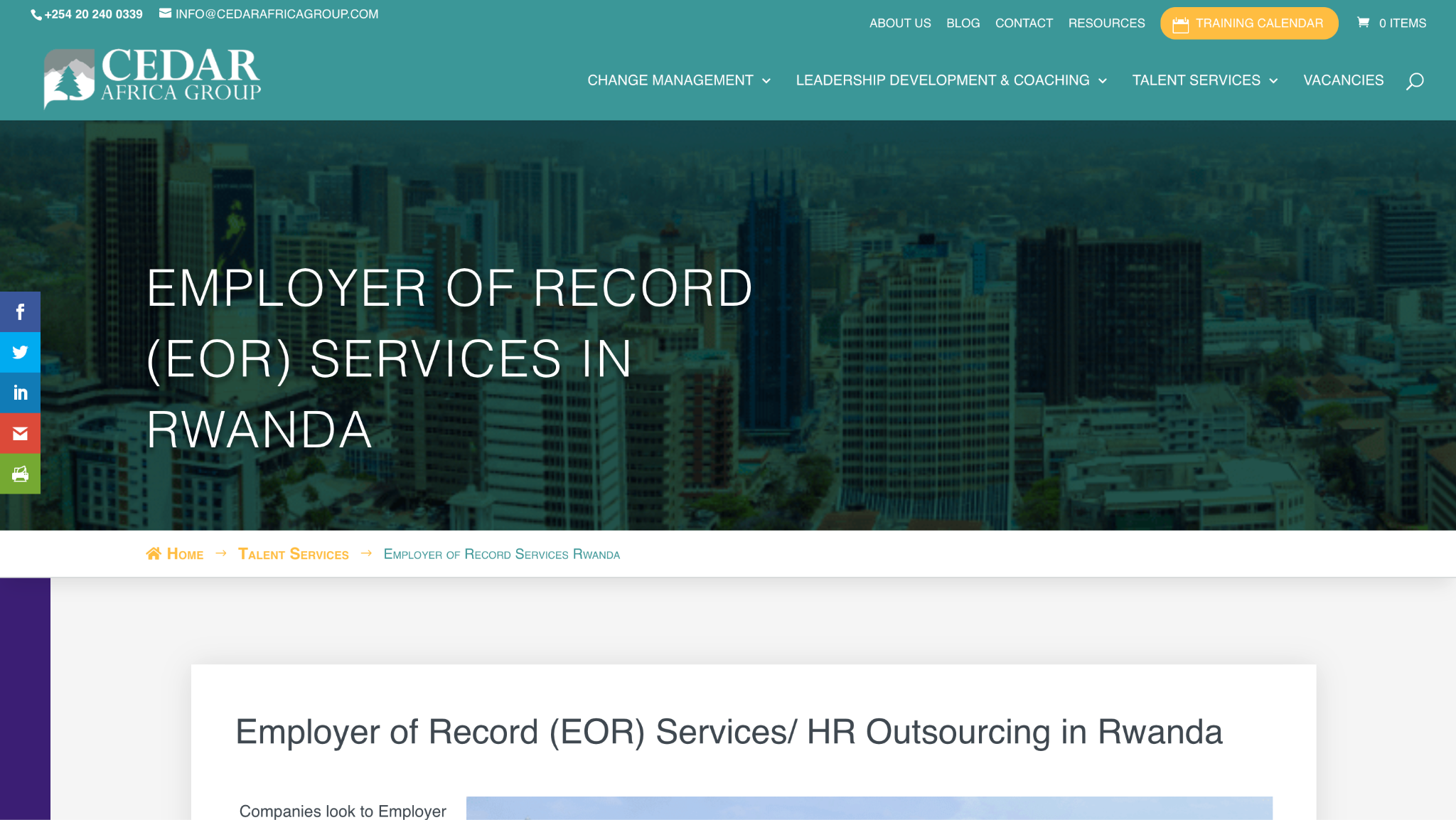
An East Africa specialist, Cedar Africa Group, runs a dedicated Rwanda practice that pairs compliant contracts and franc payroll with RSSB handling, then layers on recruitment and DGIE work-permit and visa support. Its EOR services in Rwanda are shaped for firms staffing local and expatriate roles side by side. Because the same team recruits and then employs, a hire can move from shortlist to payroll without changing hands. The recruitment arm also gives clients a read on local pay before they set an offer.
Key Specialty Area:
East Africa EOR with visa support
Service Cost:
Quote-based
Top Advantages:
- Dedicated East Africa desk
- Recruitment bundled with EOR
- Work-permit and visa handling
Scope of Services:
- Compliant Rwandan contracts
- RWF payroll and RSSB
- Expatriate permit support
Our Verdict
Strong for hiring that mixes local and expatriate staff
Huza HR
Company Description:
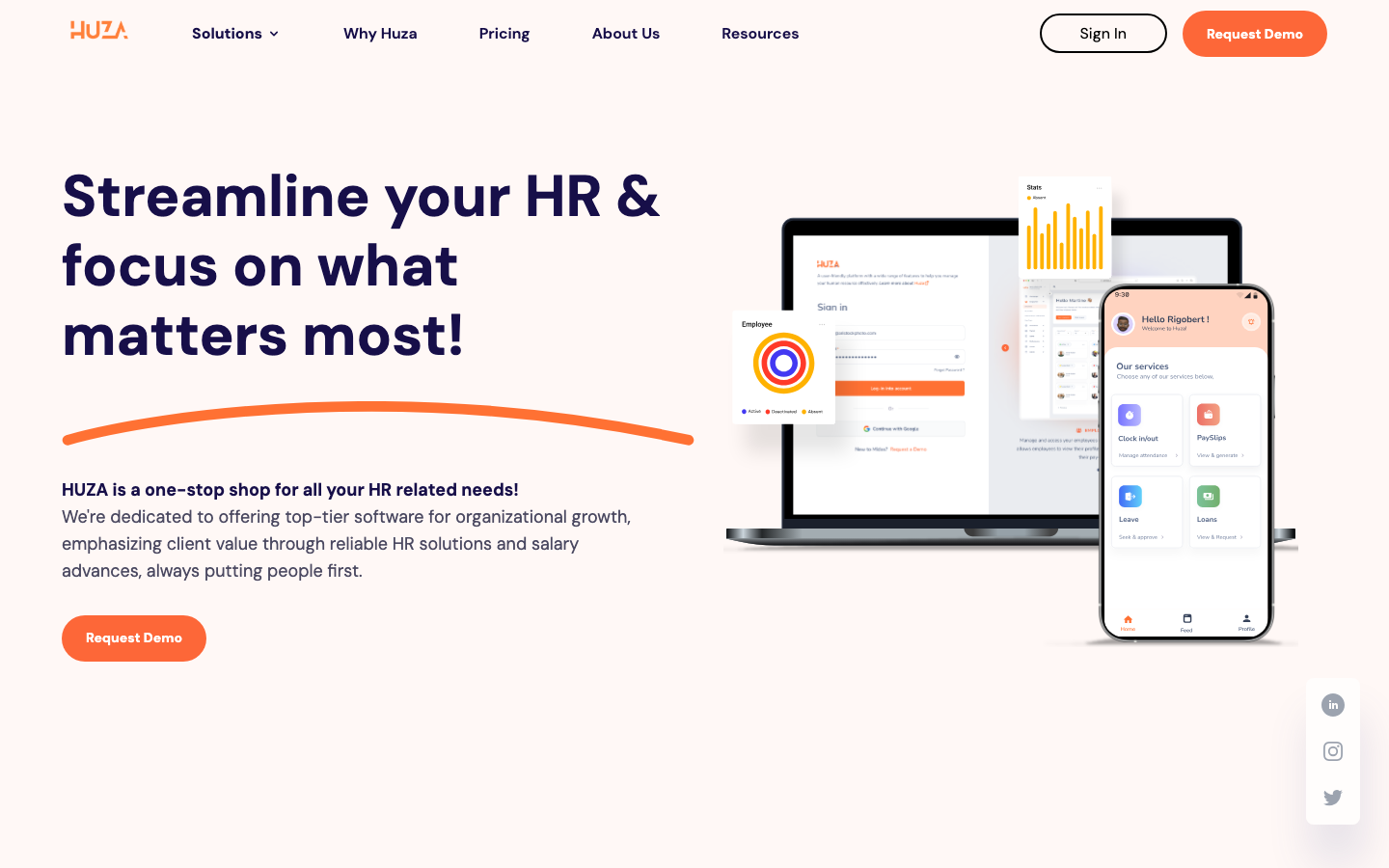
Huza HR, a Kigali HR and payroll house, works as a homegrown Employer of Record provider in Rwanda, covering payroll, HR services, and statutory compliance directly rather than through a partner. Its single-country focus translates into hands-on administration of RSSB and RRA. When a filing question comes up, the answer arrives from someone in Kigali rather than a distant ticket queue. That closeness matters most when a payroll or permit issue needs to be fixed before the next cycle.
Key Specialty Area:
Local Kigali EOR and payroll
Service Cost:
Quote-based
Top Advantages:
- Kigali-based single-market focus
- Direct RSSB and RRA filings
- Hands-on HR administration
Scope of Services:
- Local employment contracts
- Payroll, RSSB, PAYE
- Statutory-compliance support
Our Verdict
The pick for hands-on, in-country Kigali compliance
ITM Rwanda

Company Description:
The Kigali arm of the pan-African ITM group, ITM Rwanda delivers Employer of Record, payroll, and HR administration inside Rwanda while drawing on continent-wide processes. That blend gives multi-country employers a local face backed by group-scale systems. Payroll cycles and reporting stay consistent even as a client adds staff in neighboring ITM markets.
Key Specialty Area:
Local EOR backed by a pan-African group
Service Cost:
Quote-based
Top Advantages:
- Local Kigali presence
- Group-wide continental reach
- Standardized HR administration
Scope of Services:
- Rwandan employment contracts
- Payroll and RSSB
- HR administration and compliance
Our Verdict
Good where local presence meets pan-African scale
MaxisHR
Company Description:
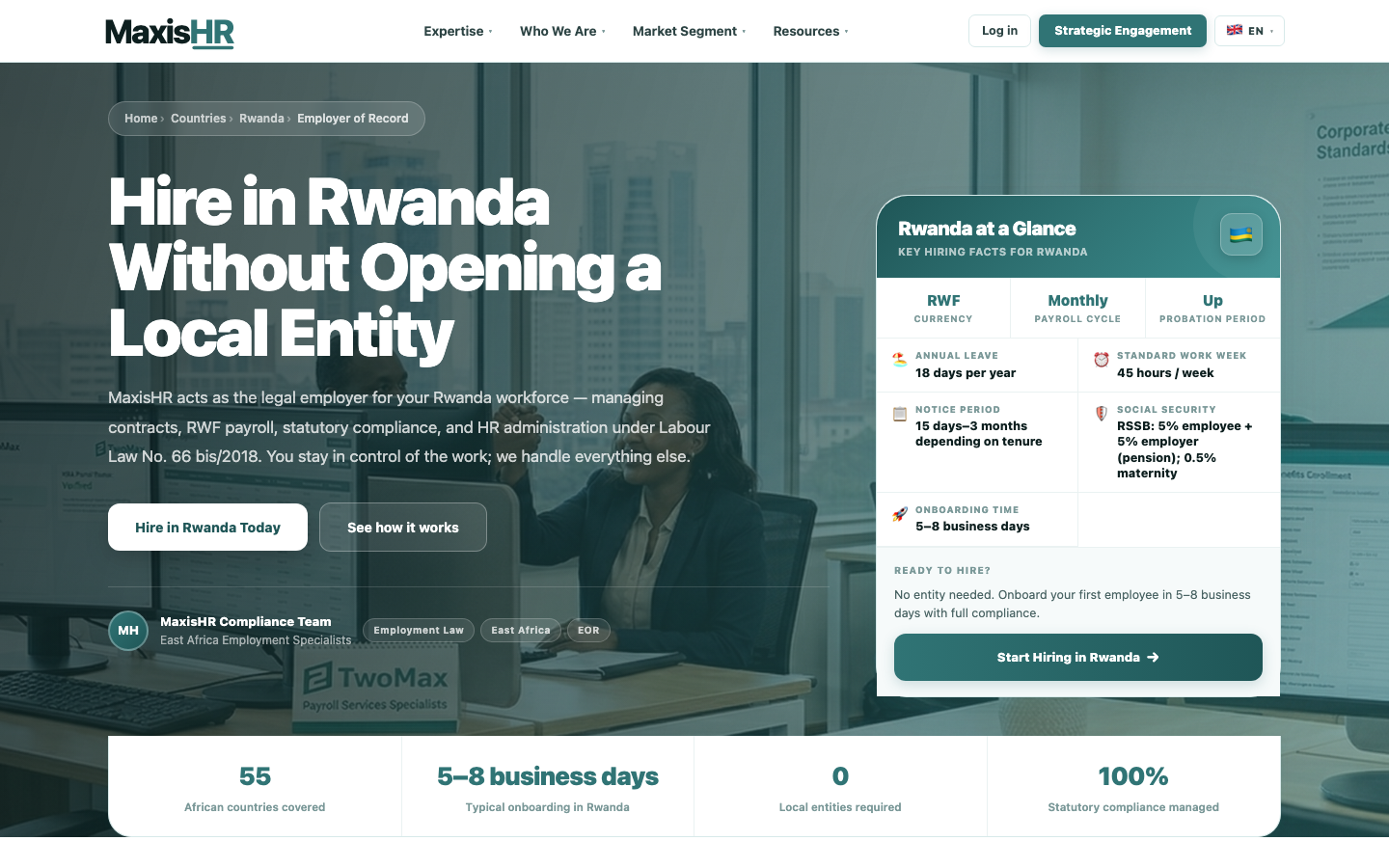
Built for African markets, MaxisHR operates an EOR in Rwanda under Labor Law No. 66 bis of 2018, handling franc payroll, RSSB deductions, leave, and offboarding, and advertises onboarding in roughly 5 to 8 business days. The quick turnaround appeals to teams that need people to be productive without delay. For project-driven employers racing to a start date, that short window can be the deciding factor between providers. Documentation still has to be complete, so the quoted speed assumes a clean file and a role that clears local checks.
Key Specialty Area:
Fast-onboarding EOR for African markets
Service Cost:
Quote-based
Top Advantages:
- Five-to-eight-day onboarding
- Leave and offboarding managed
- Built for African payroll rules
Scope of Services:
- Rwandan employment contracts
- RWF payroll and RSSB
- Leave and offboarding handling
Our Verdict
Best when speed of onboarding matters most
Talent Grid Africa
Company Description:
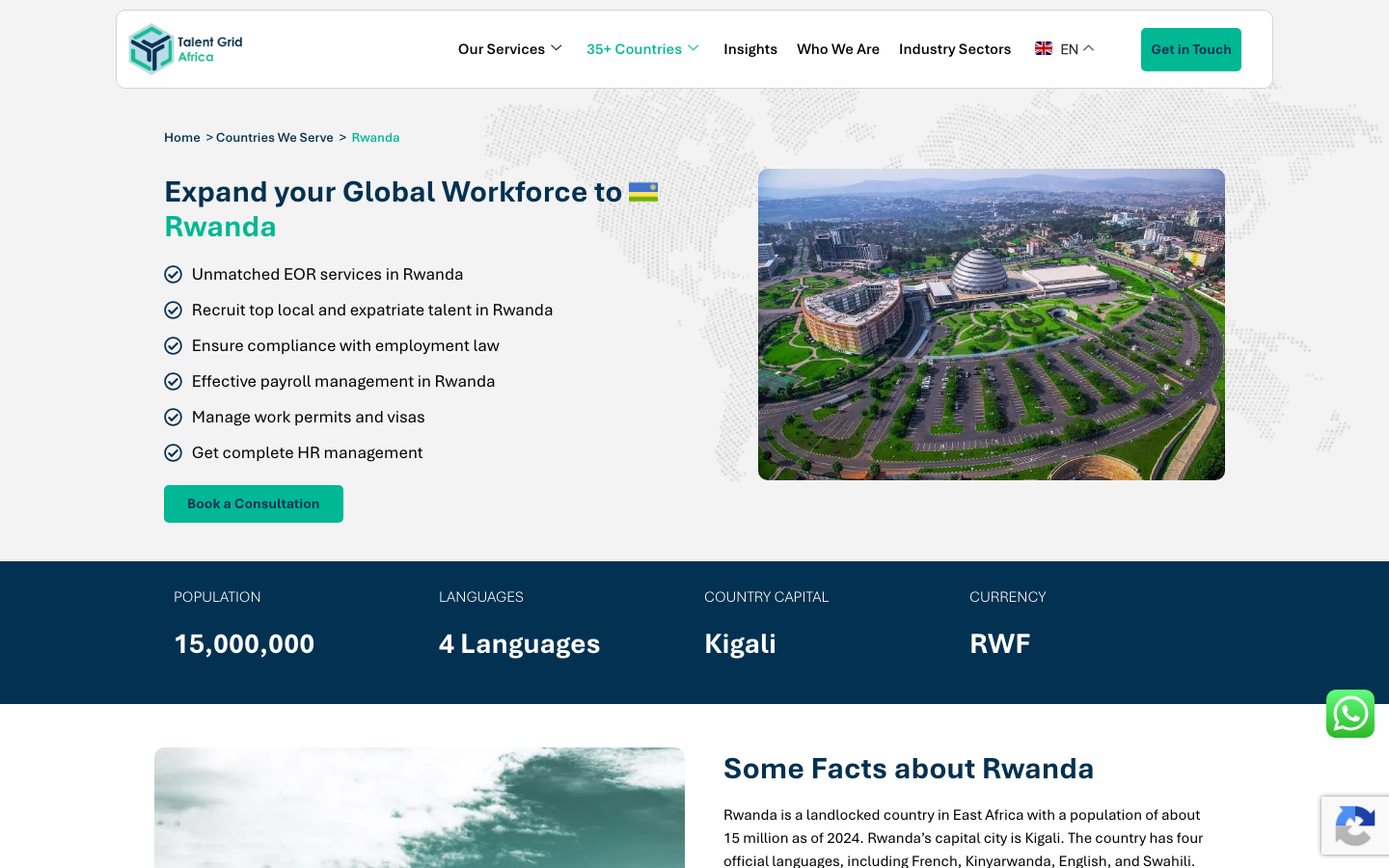
An East Africa recruiter and Employer of Record, Talent Grid Africa runs a dedicated Rwanda service that spans payroll, onboarding, and tax compliance to work permit support and executive search. Companies that want to source senior talent and employ them locally can do both through a single relationship. Bundling search with employment also reduces the handover risk that arises when a recruiter and an EOR sit at separate companies. Senior placements, where continuity counts, benefit most from that single thread.
Key Specialty Area:
Regional EOR plus executive hiring
Service Cost:
Quote-based
Top Advantages:
- Executive search included
- Onboarding and tax compliance
- Work-permit coordination
Scope of Services:
- Rwandan employment contracts
- Payroll and RSSB
- Recruitment and permits
Our Verdict
Useful for sourcing and employing senior talent together
Workforce Africa
Company Description:
With more than two decades in HR outsourcing, Workforce Africa runs an EOR in Rwanda covering payroll, benefits, compliance, contracts, onboarding, and work permits. A long operating history reassures buyers planning larger or longer-term hires rather than a single placement. Two decades of process show in how smoothly larger cohorts of workers move onto payroll. That depth is less critical for a single hire but pays off on a managed-workforce contract. Benefits administration and audits are handled in-house, which keeps larger cohorts tidy.
Key Specialty Area:
Established regional HR outsourcing and EOR
Service Cost:
Quote-based
Top Advantages:
- Twenty-plus-year track record
- Benefits and compliance covered
- Contracts and onboarding managed
Scope of Services:
- Rwandan employment contracts
- Payroll and benefits
- Work-permit handling
Our Verdict
Reassuring for larger or long-term Rwandan hires
Top 3 Global EOR Providers in Rwanda
Global EOR platforms follow with wider multi-country coverage and partner or entity networks that include Rwanda. We looked at network structure, local compliance support, payroll, permit assistance, onboarding, and pricing. As a benchmark, EOR pricing in Rwanda tends to fall between USD 199 and 699 per employee per month, depending on service depth and permit work.
Note that all listed providers are added below in alphabetical order.
Deel
Company Description:
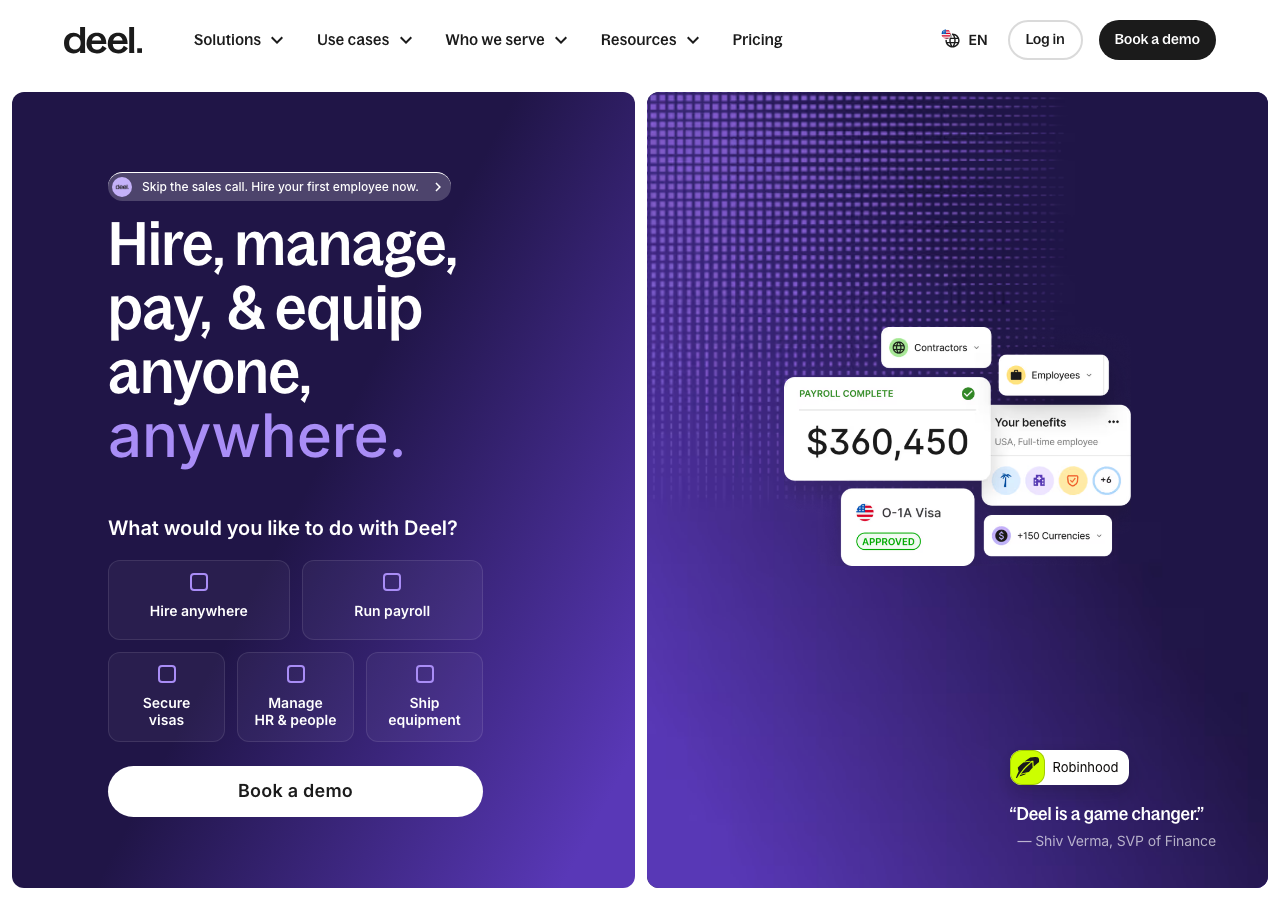
Deel is the self-serve giant of the category, present in more than 150 countries, and its Rwanda coverage automates contract generation, franc payroll, and RSSB and PAYE deductions. Because a starting rate is published, EOR pricing in Rwanda stays predictable from the very first hire. Everything from the signature to the first payslip runs through a single interface, so managers can approve documents without waiting on account handlers. The tradeoff is a lighter human touch, which some in-country buyers miss.
Key Specialty Area:
Self-serve global EOR platform
Service Cost:
From USD 599/month per employee
Top Advantages:
- Published, upfront pricing
- Automated contract generation
- 150-plus country footprint
Scope of Services:
- Rwandan employment contracts
- RWF payroll, RSSB, PAYE
- Self-serve hiring dashboard
Our Verdict
Suits companies already standardized on Deel elsewhere
*As pricing is subject to change, we are listing prices as they stand in July 2026
G-P (Globalization Partners)
Company Description:
G-P (Globalization Partners) brings an enterprise EOR spanning 180-plus countries to Rwanda, drafting compliant contracts and administering payroll, statutory benefits, and severance under Labor Law No. 66 bis of 2018. The platform is aimed at organizations that need to roll out identical employment terms across multiple jurisdictions. Audited processes and a deep in-house legal bench appeal to buyers who prize certainty over the lowest headline fee. Smaller Rwandan hires may find the enterprise wrapper heavier than they need.
Key Specialty Area:
Enterprise global EOR with a Rwanda practice
Service Cost:
Quote-based
Top Advantages:
- Mature 180-plus country platform
- Severance handled under 66 bis
- Consistency across jurisdictions
Scope of Services:
- Rwandan employment contracting
- Payroll and statutory benefits
- Severance administration
Our Verdict
A match for enterprises unifying employment across many markets
Rivermate

Company Description:
Rivermate offers a global EOR with Rwanda coverage that combines Labor Law compliance, an employment cost calculator, and human-led support, plus an optional recruitment add-on. Buyers who want to model the total cost before committing will get the most out of the calculator. For lean teams, EOR in Rwanda rarely gets simpler than a calculator paired with named support. The recruitment add-on is optional, so buyers pay only for the pieces they actually use.
Key Specialty Area:
Global EOR with built-in cost modeling
Service Cost:
From USD 319/month per employee
Top Advantages:
- Employment-cost calculator
- People-led rather than bot-led support
- Optional recruitment add-on
Scope of Services:
- Rwandan employment contracts
- Payroll, RSSB, PAYE
- Recruitment on request
Our Verdict
Handy for teams that want to model cost before committing
*As pricing is subject to change, we are listing prices as they stand in July 2026
Rwanda rarely sits alone in a regional hiring plan, so an Employer of Record Rwanda choice is usually weighed against its neighbors; see Kenya EOR, Nigeria EOR, and Tanzania EOR to compare the numbers and rules, and let the wider EOR Rwanda picture guide the final call.
What to Know About Rwanda EOR: FAQs
Which labor rules apply when a foreign company hires in Rwanda through an EOR?
Labor Law No. 66 bis of 2018 sets the terms, with Ministerial Order No. 01/MIFOTRA/23 governing hours. Contracts can be written in KinyaRwanda, French, or English, and the working week runs to 45 hours. Staff earn 18 days of annual leave and 12 weeks of maternity leave, and severance is in accordance with the law. Registration with the Rwanda Social Security Board is compulsory. Notably, the country enforces no national minimum wage, so pay is set by sector norms and negotiation. Employers therefore benchmark against comparable roles rather than a legal floor, and collective agreements can shape terms in some industries. Probation and notice periods are also defined in the code, so termination terms are rarely a surprise.
What does an EOR actually handle for payroll and social security in Rwanda?
The provider becomes the legal employer and pays staff in Rwandan francs. It signs them up with both the Rwanda Social Security Board and the Rwanda Revenue Authority, forwards the pension, medical, maternity, and occupational-hazards contributions, and deducts PAYE at source. Monthly statutory returns, compliant contracts, and payslips are all issued by the provider, leaving the client free to handle the employee’s day-to-day work. That division keeps performance management with the client while the provider owns the administrative burden and the filing risk.
Can a Rwanda EOR sort out work permits for foreign hires?
Yes. Well-established providers arrange work permits, special passes, and residence visas through the Directorate General of Immigration and Emigration, assembling the paperwork on the employer’s behalf. A firm with its own Rwandan entity typically manages this directly, whereas a global platform may lean on a local partner. Because timelines and document lists shift, it pays to pin down the exact scope of expatriate support before any contract is signed. Permit categories can also hinge on whether a role might be filled locally, so a precise job description helps the case. Renewals run on their own timeline, which is worth mapping before a placement begins.
How should a buyer compare EOR providers in Rwanda?
Start with whether the provider is physically in Rwanda or routes work through a partner. Weigh its track record on franc payroll, Social Security Board filings, and PAYE, plus its comfort drafting contracts in KinyaRwanda, French, or English. Severance handling under Labor Law 66 bis, transparent fees, flexible terms, and verifiable client references round out the picture, with references from similar sectors carrying extra weight. A short reference call frequently reveals more about a provider’s responsiveness than any polished sales deck. It also helps to ask how a provider manages an exit, since offboarding is where thinner operators tend to stumble.
How quick is onboarding in Rwanda, and what does it cost?
Local and regional providers often place a resident hire within 1 to 2 weeks, with expatriate cases taking longer while permits are cleared. Monthly fees typically range from USD 199 to 699 per employee, on top of salary, employer Social Security Board contributions, and PAYE processed through payroll. Confirm the current contribution split and PAYE bands before you budget, and remember that Rwanda sets no enforceable national minimum wage. Setting aside a small buffer for benefits and permit fees keeps the first budget honest and avoids surprises later. Most providers will share a sample cost breakdown on request, which makes comparison straightforward.

Yaryna is our lead writer with over 8 years of experience in crafting clear, compelling, and insightful content. Specializing in global employment and EOR solutions, she simplifies complex concepts to help businesses expand their remote teams with confidence. With a strong background working alongside diverse product and software teams, Yaryna brings a tech-savvy perspective to her writing, delivering both in-depth analysis and valuable insights.