Hiring good people has never been the hardest part. The real problem is making them to stay. Every year, companies spend heavily on recruiting only to watch new hires walk out within 18 months. What separates employers who hold onto top talent from those stuck in a revolving door usually comes down to one thing: a clear employee value proposition (EVP).
McKinsey research found that 40% of workers globally are weighing whether to quit in the next three to six months. Compensation alone was not enough to keep most of them. Flexibility, meaningful work, and a culture that does not drain people ranked just as high. A real EVP tackles all three.
Below you will find 10 employee value proposition examples pulled from different industries, a fill-in template, and the mistakes that sink most EVPs. These EVP employee value proposition examples are structured so you can adapt them, whether you are starting from zero or overhauling a version that no longer fits.
What Is an Employee Value Proposition?
In practice, an employee value proposition covers everything your company offers people beyond a paycheck. Career paths, daily culture, management style, flexibility, benefits, and the mission behind the work. Bundle those together, and that is your EVP.
A lot of people treat the EVP like career-page copy. It goes further than that. Clarifying what is employee value proposition in operational terms means looking at two things at once. For candidates who have never worked with you, the EVP is the first real signal of what everyday life at your company looks like. For employees already on the roster, it is the reason they stay rather than pick up a recruiter’s call. The employee value proposition meaning covers everything from how your job posts read to whether managers follow through on development promises.
Skip this step, or default to vague language like “great culture” and “competitive salary,” and talent decisions go purely transactional. The highest bidder gets the candidate. The second someone else bids more, your new hire is gone. A specific EVP built on honest claims creates the kind of stickiness that salary bumps alone cannot.
Key Employee Value Proposition Components
Any strong EVP rests on five components. Drop the ball on one, and competitors will notice before you do.
- Compensation and equity. Salary, bonuses, stock, and profit sharing. Still, the foundation, but on its own, money rarely keeps people past the next counteroffer.
- Benefits and well-being. Health coverage, retirement plans, mental health programs, parental leave, wellness budgets. These signals that the company sees employees as people, not output.
- Career development. Training budgets, clear promotion tracks, mentorship, and access to stretch projects. This is where ambitious employees look first after salary.
- Work environment and flexibility. Remote-friendly policies, flexible schedules, good tooling, reasonable autonomy. Post-2020, this component carries more weight than it used to.
- Purpose and culture. Mission clarity, values that show up in decisions (not just posters), belonging, diversity. People want to feel their work connects to something bigger.
Developing an employee value proposition begins with an honest audit of these five areas. Promising things you cannot back up erodes trust faster than having no formal EVP at all. The examples below will help you build employee value proposition statements grounded in reality.
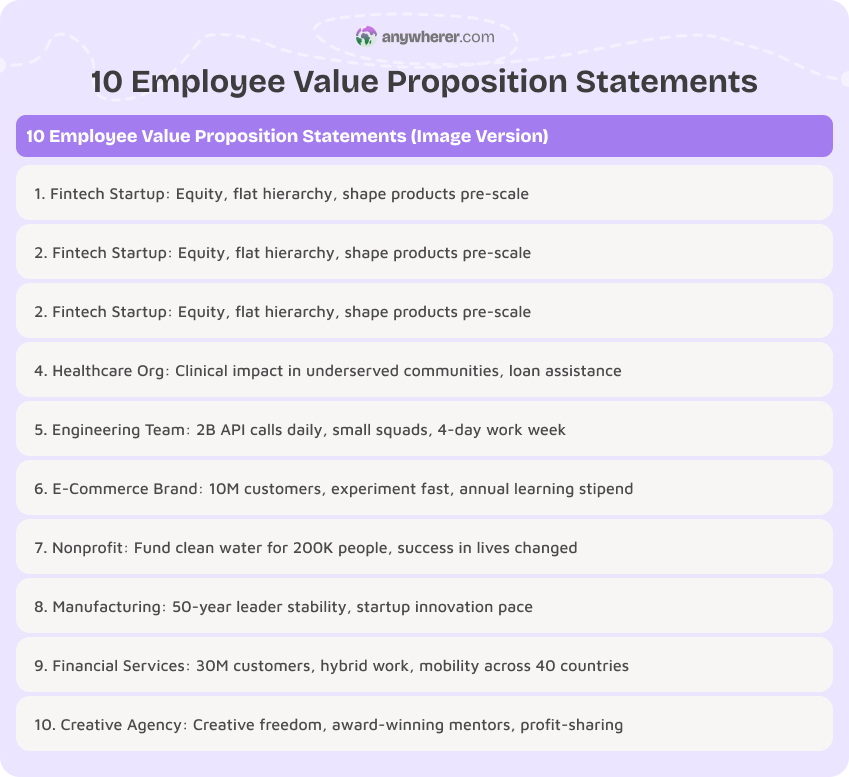
10 Best Employee Value Proposition Examples
Here are 10 examples of employee value proposition statements from different types of companies. Each example leans into a different strength. Some emphasize pay, others lead with mission, and a few bet on flexibility. Look for the patterns that match your own organization.
1. Remote-First SaaS Company
“Build products used by millions, from wherever you do your best work. We invest in async collaboration tools, home office budgets, and outcomes instead of hours logged.”
What makes it work:
- It leads with product impact, not just remote perks. Candidates want to know what they will build, not just where they will sit.
- The mention of async tools and home-office budgets suggests this company has thought through remote operations, not just allowed them.
- Measuring outcomes rather than hours signals genuine trust.
Where it fits: Technology companies with distributed teams competing for global engineering talent.
2. Scaling Fintech Startup
“Join a team rewriting how people manage money. Equity in a high-growth company, direct access to leadership, and the chance to shape products before they reach a million users.”
What makes it work:
- Equity at this stage is a real draw for candidates who are comfortable with risk and want upside
- Mentioning direct access to leadership tells experienced hires they will not get buried in layers of management
Where it fits: Early- to mid-stage startups hiring experienced people willing to trade stability for upside.
3. Global Consulting Firm
“Solve complex problems for Fortune 500 clients across industries. Structured mentorship, global mobility, and a career path designed around your ambitions.”
What makes it work:
- Fortune 500 client work carries prestige that candidates at this level actively seek out
- Structured mentorship and a defined career path remove guesswork about what comes next
- Global mobility is a strong pull for people who want international experience without freelancing
Where it fits: Professional services firms hiring from top MBA programs and experienced consultants.
4. Healthcare Organization
“Your clinical expertise directly improves patient outcomes in underserved communities. Competitive pay, student loan assistance, and scheduling flexibility.”
What makes it work:
- Opening with patient outcomes gives the statement a sense of mission that goes beyond the job description
- Student loan help is a practical incentive that medical grads actually factor into job decisions
- Scheduling flexibility speaks directly to burnout, which is the top reason healthcare workers leave
Where it fits: Hospitals, clinics, and telehealth platforms recruiting medical professionals.
5. Distributed Engineering Team
“Write code that processes 2 billion API calls daily. Work in small, autonomous squads with top-tier tooling, 4-day work weeks, and conference budgets to keep growing.”
What makes it work:
- Two billion API calls is the kind of scale number that makes infrastructure engineers stop scrolling
- Small, autonomous squads with solid tooling are exactly what senior developers screen for
- A 4-day work week is hard to ignore. It is specific, concrete, and still relatively rare
- Conference budgets show the company invests in keeping engineers current, not just productive
Where it fits: Platform and infrastructure companies hiring senior developers and SREs.
6. E-Commerce Brand
“Shape how 10 million customers discover and buy products they love. Data-driven decisions, rapid experimentation, and annual learning stipends for every team member.”
What makes it work:
- Ten million customers gives people a sense of scope that abstract growth metrics cannot provide
- Rapid experimentation tells candidates they will not spend months getting approvals before testing ideas
Where it fits: Direct-to-consumer brands and marketplaces hiring across marketing, product, and analytics.
7. Nonprofit Organization
“Your skills fund clean water access for 200,000 people annually. Meaningful work at a global scale, generous PTO, and a team that measures success in lives changed.”
What makes it work:
- Saying 200,000 people turns an abstract mission into something a candidate can picture
- Generous PTO acknowledges the salary trade-off and compensates in a way that matters to this audience
- Framing success in lives changed rather than revenue sets a completely different tone from corporate job posts
Where it fits: NGOs and social enterprises competing with private-sector salaries.
8. Manufacturing Company Going Digital
“Help a 50-year-old industry leader adopt automation, IoT, and predictive analytics. The stability of an established company with the innovation pace of a startup.”
What makes it work:
- Pairing stability with innovation is a strong contrast that appeals to two very different risk profiles at once
- Naming specific technologies like IoT and predictive analytics helps the right candidates self-select
Where it fits: Traditional manufacturers investing in digital transformation and Industry 4.0 initiatives.
9. Financial Services Enterprise
“Manage risk and build systems for a bank trusted by 30 million customers. Comprehensive benefits, hybrid work, and internal mobility across 40 countries.”
What makes it work:
- Thirty million customers is a credibility statement that does not need further explanation
- Hybrid work is table stakes now, but including it still matters because many banks are pushing for full return
- Internal mobility across 40 countries is a career variety promise that few competitors can match
Where it fits: Large banks, insurers, and asset managers hiring compliance, technology, and operations talent.
10. Creative Agency
“Create campaigns that define how global brands communicate. Creative freedom backed by production resources, mentorship from award-winning directors, and profit-sharing.”
What makes it work:
- For creative professionals, freedom over how work gets made is often more important than salary
- Award-winning directors tell candidates who their peers will be, and for this audience, that matters a lot
- Profit-sharing is unusual in agencies and makes the financial upside feel shared rather than concentrated at the top
Where it fits: Advertising, design, and media agencies hiring creative directors, strategists, and producers.
Employee Value Proposition Template
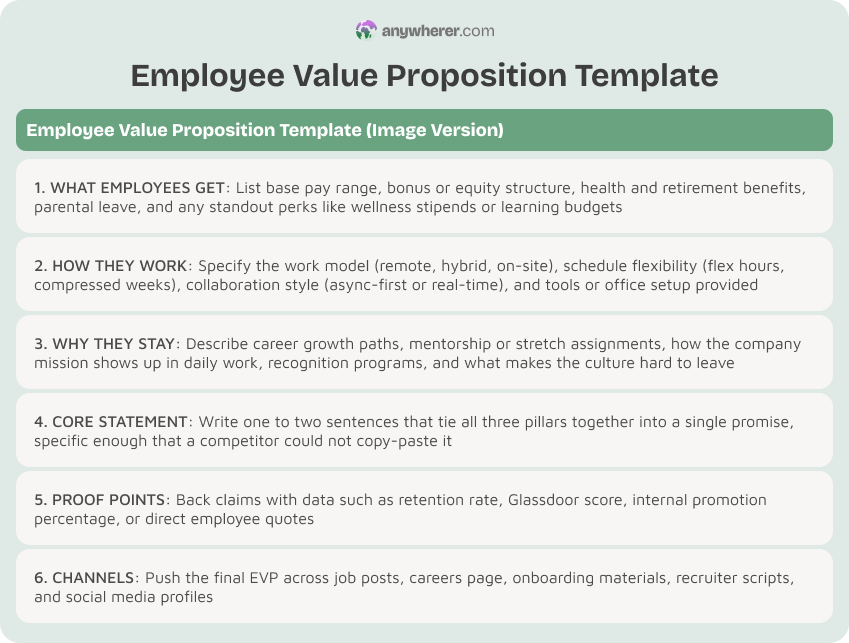
Use this sample employee value proposition template to organize your EVP around three pillars: what people receive, how they work, and why they stay. Fill in each row with specifics that reflect your company.
| Company / Team Name | [Your organization or business unit] |
| Target Talent Segment | [Engineers, marketers, executives, hourly staff, etc.] |
| Core EVP Statement | [One to two sentences that capture your unique employment offer in plain language] |
| WHAT EMPLOYEES GET | |
| Base Compensation | [Salary range, bonus structure, commission, equity or profit-sharing details] |
| Benefits & Wellbeing | [Health coverage, retirement match, parental leave, mental health support, wellness stipend] |
| HOW THEY WORK | |
| Work Model | [Remote, hybrid, on-site. Include schedule flexibility: flex hours, compressed weeks, async-first] |
| Tools & Environment | [Key tools, office setup, home-office budget, equipment provided] |
| WHY THEY STAY | |
| Career Development | [Training budget, promotion pathways, mentorship, stretch assignments, internal mobility] |
| Purpose & Culture | [Mission, values in action, DEI commitments, team rituals, how decisions are made] |
| Impact & Recognition | [How individual work connects to outcomes, recognition programs, and feedback loops] |
| PROOF & DISTRIBUTION | |
| Proof Points | [Glassdoor rating, retention rate, awards, employee quotes] |
| Channels | [Careers page, job posts, onboarding decks, social media, recruiter scripts] |
Common Mistakes When Building an EVP
Even teams that put real effort into developing an employee value proposition trip on the same handful of mistakes.
- Copying competitors. If your EVP could be swapped onto a competitor’s careers page without anyone noticing, it is not doing its job. Figure out what sets your workplace apart and lead with that.
- Overpromising. Startups love to claim unlimited growth and perfect balance. Neither is true, and candidates figure that out fast. People who join on overblown promises tend to leave sooner than those who never applied.
- Ignoring the people already there. Building an EVP entirely around what you want to attract, without asking current employees what they genuinely value, creates a gap between what is on the website and what happens on day one.
- Treating it as a one-time project. Teams change. Markets shift. What mattered to candidates two years ago may not matter now. Revisit your EVP annually at a minimum.
- Leaning too hard on salary. Pay matters, obviously. But study after study shows that flexibility, manager quality, and purpose keep people longer than raises do. If you need effective employee retention strategies that go past compensation, start by checking whether your EVP covers non-financial motivators.
Conclusion
Nobody pins an EVP to the break room wall and calls it done. It is a living reference that your hiring team, managers, and recruiters use every day. The 10 employee value proposition examples above span startups, enterprises, nonprofits, and agencies because what works in one context can fall flat in another.
Start with an honest look at your five core EVP components. Grab the employee value proposition template above and fill it in. Then share a draft with current employees before you publish anything externally. They will tell you what rings true. Update it whenever conditions change. Companies that pair a clear EVP with creative employee recognition ideas and real development paths tend to close the gap between getting people in the door and actually keeping them.
FAQs on Employee Value Proposition Examples
What is employee value proposition in simple terms?
It is the full package of pay, benefits, growth opportunities, culture, and work environment that a company gives employees in exchange for their time and skills. Think of it as your answer to “why should someone work here?”
How do you build employee value proposition from scratch?
Start by interviewing 10 to 15 employees across levels and departments. Ask them what keeps them around and what almost made them leave. Cross-reference with competitor job posts. Draft a core statement using only claims you can prove, test it with a small group, then roll it into job ads, the careers page, and onboarding.
What are the main employee value proposition components?
Five areas: compensation and equity, benefits and wellbeing, career development, work environment and flexibility, and purpose and culture. Most weak EVPs have at least one of these five neglected.
How long should an EVP statement be?
One to three sentences work best. Long enough to be specific, short enough to fit in a job posting headline or a social media graphic.
Can a small company have a strong EVP?
Absolutely. Smaller companies often beat large ones on flexibility, access to leadership, and speed of career progression. The trick is not to pretend to offer what big enterprises do, but to highlight what they cannot match.
How often should you update your EVP?
Once a year at a minimum. If you go through a big change, say a shift to remote, a round of layoffs, or a merger, do not wait for the annual review. Pull the EVP out and check whether it still matches reality.

Yaryna is our lead writer with over 8 years of experience in crafting clear, compelling, and insightful content. Specializing in global employment and EOR solutions, she simplifies complex concepts to help businesses expand their remote teams with confidence. With a strong background working alongside diverse product and software teams, Yaryna brings a tech-savvy perspective to her writing, delivering both in-depth analysis and valuable insights.