An employee development plan is a written agreement between a manager and a team member that spells out where the person is now, where they want to go, and what needs to happen to close the gap. Sounds simple. In practice, most companies either skip it entirely or create one during the annual review cycle and never look at it again. Gallup found that only about a third of US workers feel actively engaged at work. A chunk of that disengagement comes from people who don’t see a clear path forward in their role.
This article walks through nine employee development plan template examples, each designed for a different situation. Career growth, skill gaps, leadership readiness, onboarding, succession, performance recovery, internal mobility, retention, and DEI. Every template includes the reasoning behind it, a breakdown of components, an editable text version, and a shorter image-ready format you can hand directly to managers.
What Is an Employee Development Plan?
So what is a development plan for an employee in concrete terms? It’s a document, usually one to two pages, that captures the person’s current skills, the skills or competencies they need next, specific actions to get there, and a timeline. Some organizations keep it simple: a shared doc with bullet points. Others build it into their HRIS. The format doesn’t matter as much as whether anyone actually follows up on it.
A strong development plan for employee growth does three things. First, it connects the person’s goals with the company’s goals so everyone benefits. Second, it makes expectations visible. No guessing what “good performance” looks like. Third, it creates a rhythm of check-ins and adjustments. Plans that sit in a drawer for twelve months aren’t plans. They’re wish lists. According to LinkedIn’s Workplace Learning Report, 94% of employees say they’d stay at a company longer if it invested in their learning. That’s not a soft metric. That’s retention money sitting on the table.
Short-term goals typically cover the next 3 to 6 months: finish a certification, shadow a cross-functional team, take over a recurring client meeting. Long-term goals stretch one to three years out and usually involve a role change, a promotion path, or a lateral move into a new discipline. The employee development plan templates below cover both ends.
Employee Development Plan Template Examples
Below are nine employee development plan examples organized by purpose. Each one includes context on who it serves, the key components, a full text version you can copy and edit, and a condensed image version for presentations or manager handouts. Use them as a starting point and adjust for your industry, team size, and company goals.
Career Development Plan Template
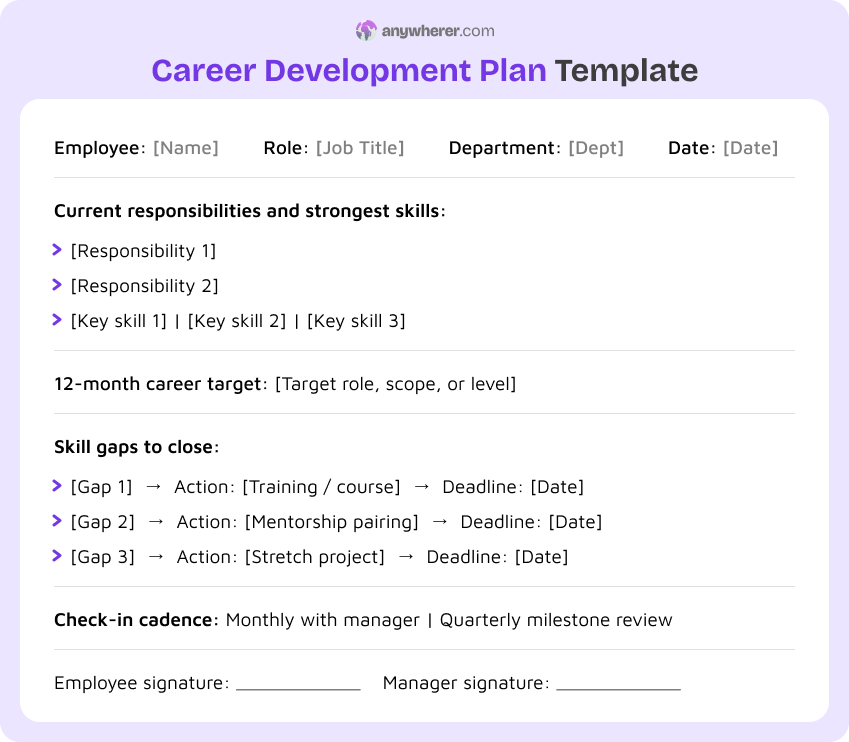
This is the plan most people picture when they hear “employee career development plan examples.” It maps where someone is today against where they want to be in one, two, or three years. Best suited for mid-level employees who’ve proven themselves in their current role and want to move up or sideways. The benefit for the organization is retention. People who see a future here don’t go looking for one somewhere else.
Components:
- Current role and key responsibilities
- Short-term career goals (3-6 months)
- Long-term career goals (1-3 years)
- Required skills, training, or certifications
- Timeline and milestone checkpoints
- Manager and employee sign-off
What it includes:
- Employee name: ___ | Role: ___ | Department: ___ | Date: ___
- Where are you now? Describe your current responsibilities and strongest skills.
- Where do you want to be in 12 months? Describe the role, scope, or skill level you’re targeting.
- What’s standing between here and there? List specific skill gaps or experience gaps.
- Actions:
- [Training course] by [date].
- [Mentorship pairing] starting [date].
- [Stretch project] assigned by [date].
- Check-in schedule:
- Monthly with manager.
- Quarterly review against milestones.
Skills Development Plan Template
When someone’s performance is fine but a specific technical or soft skill is holding them back, this template zeroes in on that gap. A junior data analyst who can’t present findings to non-technical stakeholders. A customer success manager who struggles with Salesforce reports. These are fixable problems with the right plan. The employee development plan goals examples below target exactly this kind of situation.
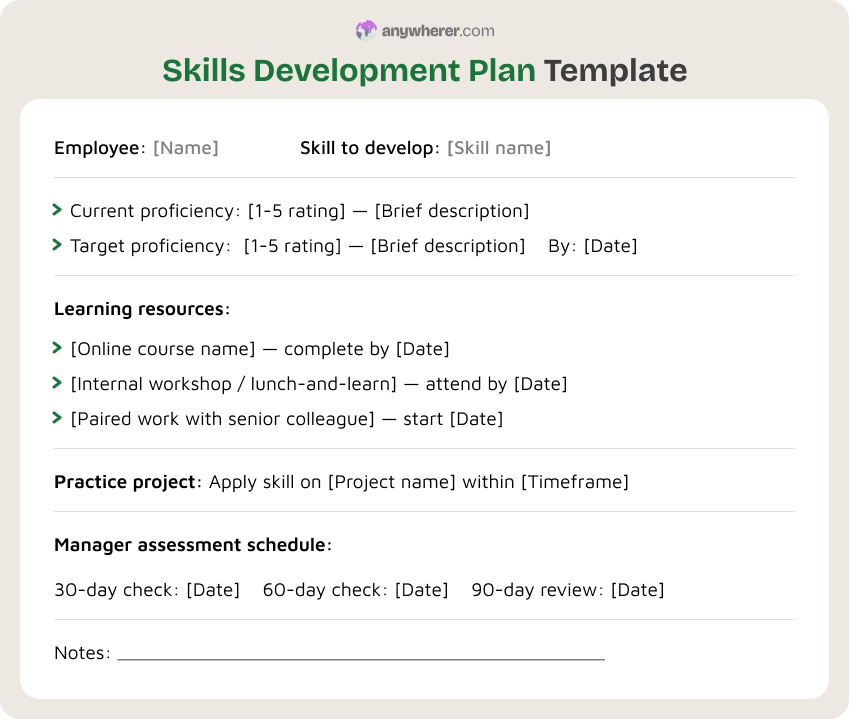
Components:
- Target skill and current proficiency level
- Desired proficiency level with measurable criteria
- Learning resources: courses, workshops, on-the-job practice
- Practice opportunities (real projects, not simulations)
- Assessment method and timeline
What it includes:
- Employee name: ___ | Skill to develop: ___
- How would you rate your current skill level? (1-5 scale with descriptions)
- Where do you need to be and by when?
- Resources: [Online course] + [internal workshop] + [paired work with senior colleague]
- Real-world application: Apply the skill on [specific project] within [timeframe].
- Manager assessment at 30, 60, and 90 days.
Leadership Development Plan Template
Not everyone who’s good at their job is ready to manage people. This plan bridges that gap for high-potential employees who’ve been identified for team lead or manager roles within the next 6 to 18 months. It also works for current managers who need to sharpen their approach. One example of employee development plan use here: a senior engineer who’s technically sharp but hasn’t run a project meeting or delivered a performance review before.
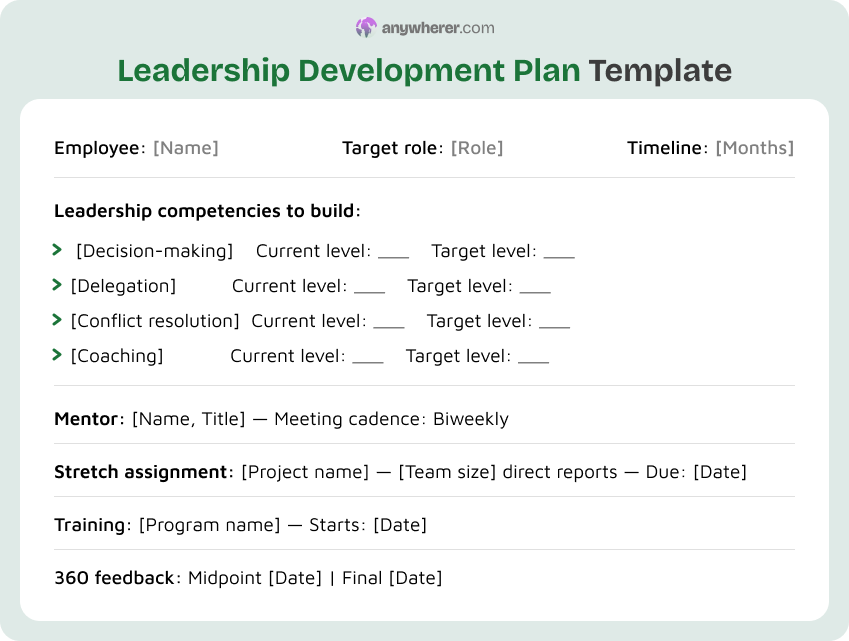
Components:
- Leadership competencies to build (decision-making, delegation, conflict resolution, coaching)
- Current leadership experience and gaps
- Mentorship or executive sponsor assignment
- Stretch assignments: lead a cross-functional project, run a team offsite, own a budget
- Formal training: management workshops, leadership cohort programs
- 360-degree feedback at midpoint and endpoint
What it includes:
- Employee name: ___ | Target leadership role: ___ | Timeline: ___
- Which leadership skills are strongest today? Which need work?
- Mentor assigned: [Name, title].
- Meeting cadence: biweekly.
- Stretch assignment:
- [Project name] by [date].
- Includes [team size] direct reports.
- Training: [Program name] starting [date].
- 360 feedback scheduled: midpoint [date], final [date].
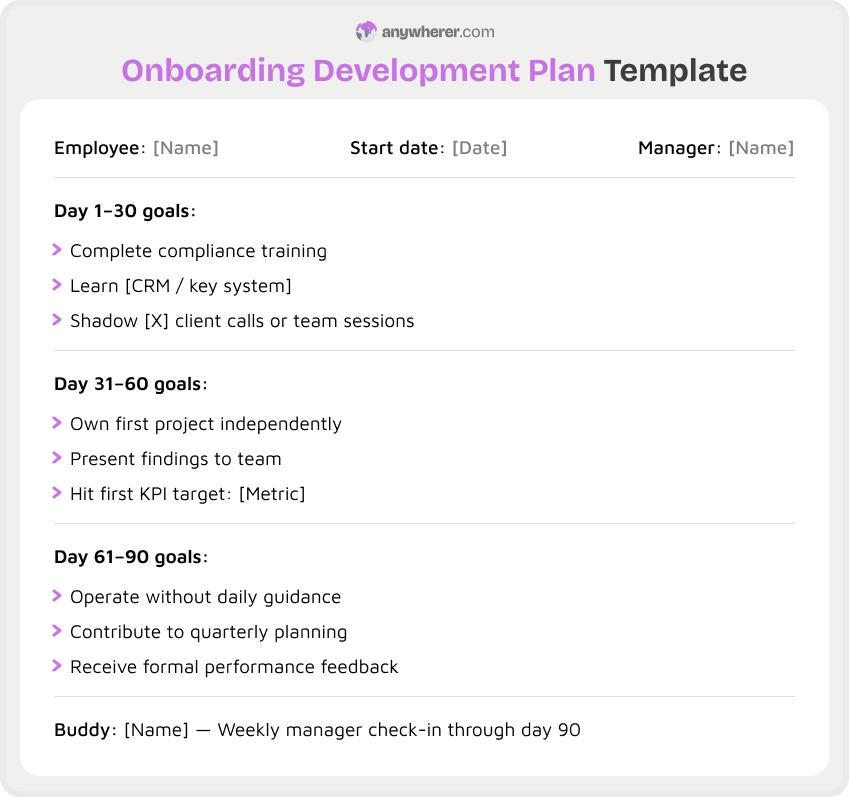
Onboarding and Training Development Plan Template
New hires don’t need a vague “learn the ropes” mandate. They need a structured path through their first 30, 60, and 90 days that ties directly to role expectations. This template for employee development plan during onboarding prevents the common mistake of overwhelming people in week one and then leaving them to figure things out alone in week four.
Components:
- 30-60-90 day goals, each with specific deliverables
- Required training: compliance, tools, product knowledge
- Buddy or mentor assignment
- Check-in schedule with manager
- Feedback collection points
What it includes:
- Employee name: ___ | Start date: ___ | Manager: ___
- Day 1-30 goals: [Complete compliance training] [Learn CRM system] [Shadow 3 client calls]
- Day 31-60 goals: [Own first project] [Present findings to team] [Hit first KPI target]
- Day 61-90 goals: [Operate independently] [Contribute to quarterly planning] [Receive formal performance feedback]
- Buddy: [Name]. Weekly check-in with manager through day 90.
Succession Planning Development Plan Template
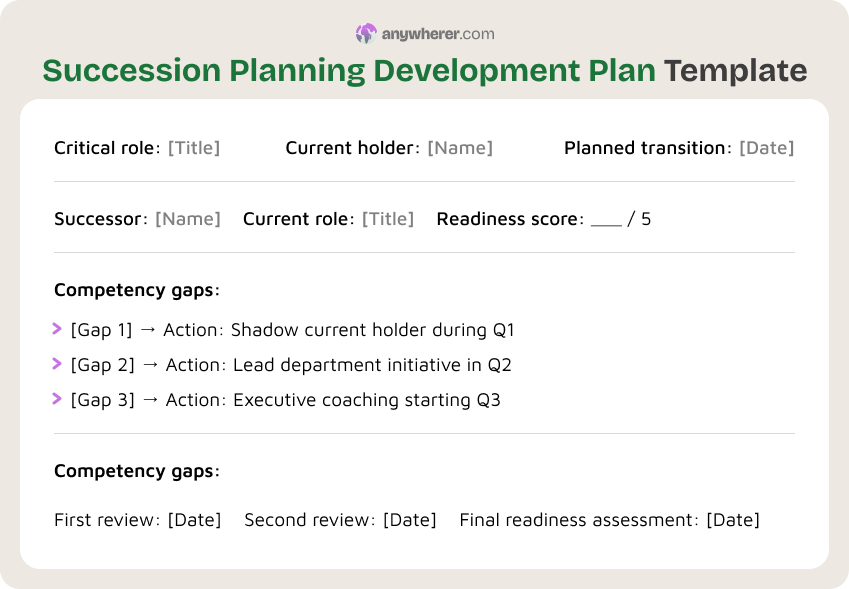
When a director or VP leaves and there’s no one ready to step in, the scramble costs the company months of productivity. This employee development strategic plan identifies high-potential people early and builds their readiness over 12 to 24 months. It’s not about picking favorites. It’s about reducing risk.
Components:
- Critical role being planned for
- Successor candidate(s) and current readiness level
- Competency gaps between current role and target role
- Development actions: rotations, shadowing, executive coaching
- Readiness review dates (every 6 months)
What it includes:
- Critical role: ___ | Current holder: ___ | Planned transition: ___
- Successor candidate: ___ | Current role: ___ | Readiness score: ___ / 5
- What does the successor need to learn? [List competencies]
- Actions: [Shadow current holder for Q1] [Lead department initiative in Q2] [Executive coaching starting Q3]
- Review dates: [Date 1], [Date 2]. Final readiness assessment: [Date].
Employee Performance Improvement Plan Template
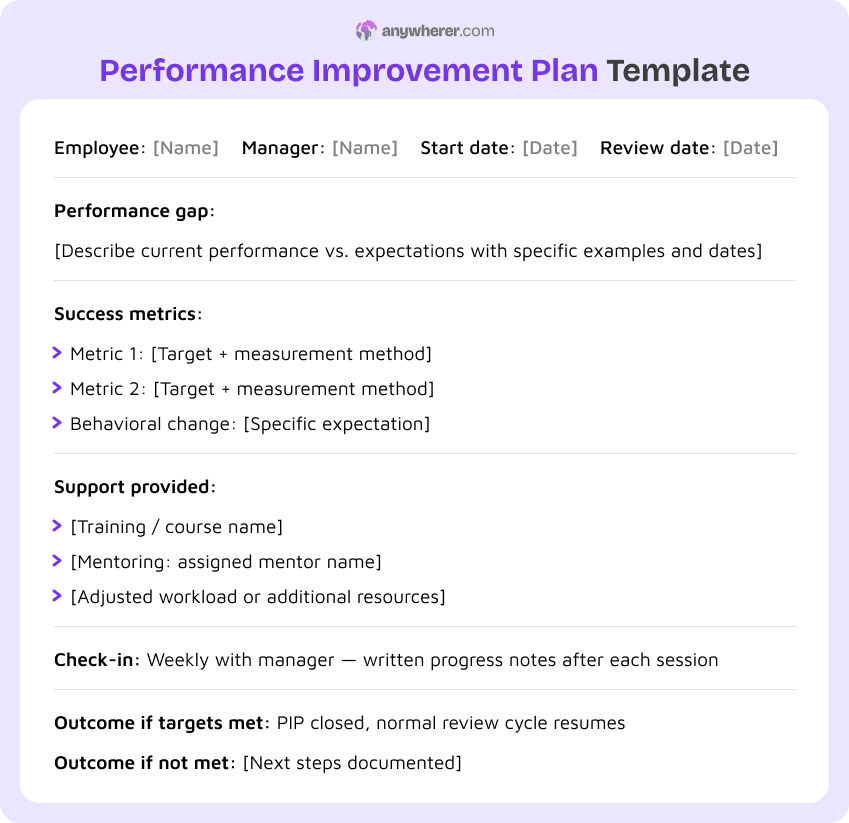
PIPs get a bad reputation because many companies use them as a paper trail before termination. A well-built PIP, though, should be an honest attempt to close a performance gap with clear metrics and support. This sample employee development plan variant works for employees who’ve been told their output or behavior needs to change and need a structured path to get there.
Components:
- Specific performance issues documented with dates and examples
- Expected performance standards, written in measurable terms
- Support provided: training, mentoring, reduced workload, tool access
- Weekly check-in schedule with manager
- Review date and possible outcomes (continuation, role change, or exit)
What it includes:
- Employee name: ___ | Manager: ___ | PIP start date: ___ | Review date: ___
- What’s the gap? Describe current performance vs. expectations with specific examples.
- What does success look like? [Metric 1: ___] [Metric 2: ___] [Behavioral change: ___]
- What support will the company provide? [Training] [Mentoring] [Adjusted workload]
- Check-in: Weekly with manager. Written progress notes after each session.
- Outcome if targets met: [PIP closed, normal review cycle resumes]. If not met: [Next steps documented].
Employee Career Growth and Mobility Plan Template
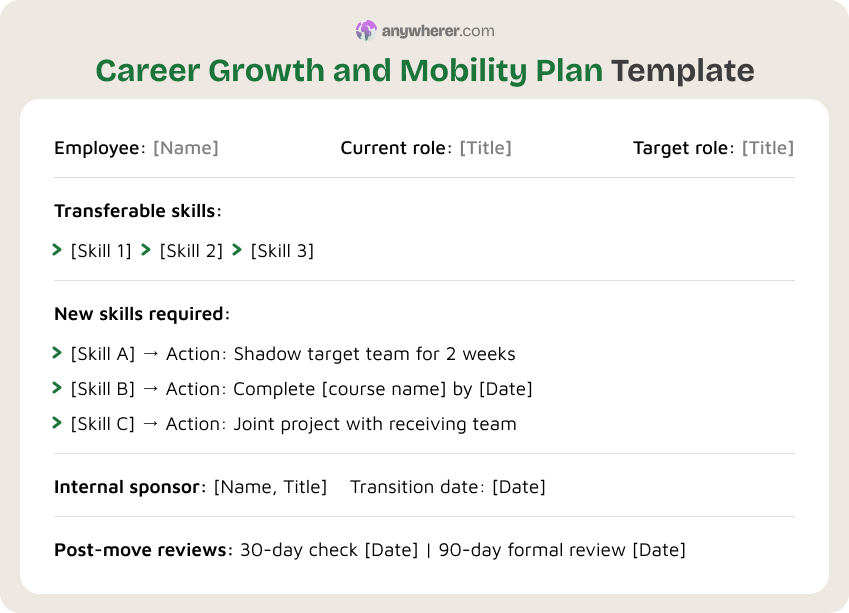
Lateral moves don’t always get enough attention. Sometimes the best employee development plan ideas involve moving someone from marketing analytics to product management or from client services to internal operations. This template maps out internal transfers and cross-functional moves. Pair it with performance review questions template data to identify who’s ready for a shift.
Components:
- Current role and transferable skills
- Target role or department and why it’s a good fit
- Skill gaps and ramp-up plan
- Internal sponsor or receiving manager
- Transition timeline and interim support
What it includes:
- Employee name: ___ | Current role: ___ | Target role: ___
- What skills transfer directly? What’s new?
- Ramp-up plan: [Shadow target team for 2 weeks] [Complete [course name]] [Joint project with receiving team]
- Internal sponsor: [Name, title]. Transition date: [Date].
- 30-day review after move. 90-day formal check against expectations.
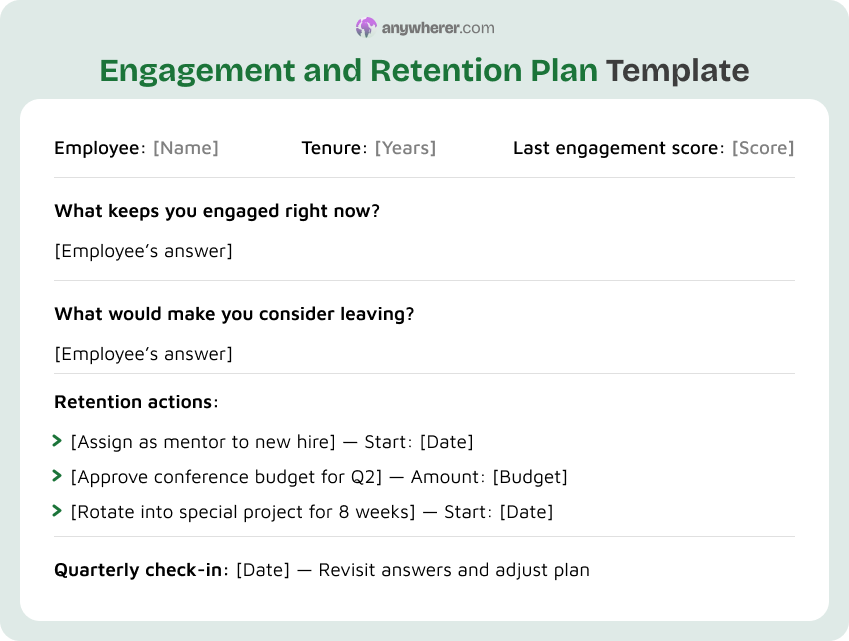
Employee Engagement and Retention Plan Template
This one addresses the people who aren’t underperforming and aren’t looking for a promotion but might leave anyway because they feel stale. An employee professional development plan focused on engagement is cheaper than backfill recruiting every time. This is a good example of how to create an employee development plan that’s preventive, not reactive.
Components:
- Current engagement drivers (survey data, one-on-one feedback)
- Risk factors identified (workload, monotony, lack of recognition)
- Actions: stretch projects, conference attendance, mentoring others, flexible schedule adjustments
- Quarterly pulse check with manager
What it includes:
- Employee name: ___ | Tenure: ___ | Last engagement score: ___
- What keeps you engaged in your work right now?
- What would make you consider leaving?
- Actions: [Assign as mentor to new hire] [Approve conference budget for Q2] [Rotate into special project for 8 weeks]
- Quarterly check-in to revisit answers and adjust plan.
Diversity, Equity, and Inclusion (DEI) Development Plan Template
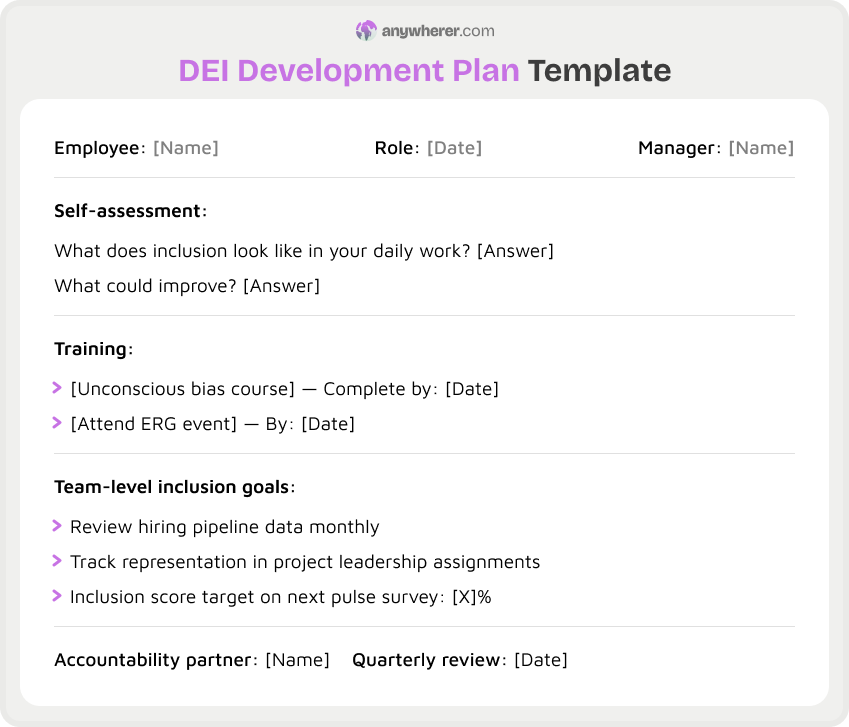
DEI initiatives fall flat when they stop at a workshop. This employee professional development plan template ties inclusion goals to individual behavior change and team-level metrics. It’s equally useful for managers building more inclusive teams and for individual contributors who want to grow their awareness. Combine this with individual development plan samples for a more detailed personal approach.
Components:
- Self-assessment of current DEI knowledge and behaviors
- Team-level inclusion goals tied to survey data
- Training: unconscious bias workshops, allyship programs, inclusive hiring practices
- Accountability partner or ERG involvement
- Quarterly review with specific metrics
What it includes:
- Employee name: ___ | Role: ___ | Manager: ___
- What does inclusion look like in your daily work? What could improve?
- Training: [Unconscious bias course by [date]] [Attend ERG event by [date]]
- Manager action: Review hiring pipeline data monthly. Track representation in project leadership assignments.
- Team metric: Inclusion score on next pulse survey. Target: [X]%.
- Quarterly review: [Date]. Compare against baseline.
Measuring Success in Employee Development Plans
A plan without measurement is just a conversation that happened once. Knowing how to make a development plan for an employee is the first step. Knowing whether it’s working is the step most teams skip.
- Regular check-ins. Managers should sit down with the employee at least once a month during the active plan period. Not a formal review. A 20-minute conversation about what’s moving, what’s stuck, and whether the original goals still make sense.
- Success metrics. Use numbers wherever possible. Completed a certification: yes or no. Took over a client account: which one, by what date. Improved presentation delivery: rated by three peers on a 1-5 scale. Vague goals produce vague results.
- Employee feedback. Ask the employee directly. What’s helping? What feels like busywork? Is the pace right? A short survey or an open conversation both work.
- Manager feedback. Manager observations over time matter more than a single performance review score. Is the person taking on harder work? Are they contributing more in meetings? Are their teammates noticing the difference?
Common Mistakes to Avoid in Employee Development Plans
Most development plans fail quietly. Nobody announces that the plan didn’t work. The document just stops getting opened. Here are the patterns that lead there.
- Setting vague or unrealistic goals. “Become a better communicator” isn’t a goal. “Deliver three client-facing presentations by June” is. Plans fall apart when there’s no way to tell whether someone actually made progress.
- Not involving the employee. The employee should co-author the plan. When a manager hands someone a list of things to improve with no conversation, compliance goes up and motivation goes down. People invest in plans they helped build.
- Lack of follow-up. A plan written in January and reviewed in December is a waste of time. Monthly check-ins are the minimum. Some plans need weekly touch points during the first 90 days.
- Focusing only on weaknesses. If every examples of employee development plan conversation focuses on what the person does poorly, they’ll disengage. Strong plans also build on what someone’s already good at and find ways to use those strengths.
- Refusing to adjust. Life changes. Company priorities shift. A goal that made sense in Q1 might not make sense in Q3. The plan should be a living document, not a contract.
FAQs on Employee Development Plan Templates
Why is an employee development plan important?
It gives people a reason to stay and a direction to grow. Companies that invest in growth plans see higher retention, better performance, and stronger internal pipelines for promotions. Without one, career conversations stay vague and employees start looking elsewhere.
What are the key components of an employee development plan?
At a minimum: current state assessment, specific goals with deadlines, required resources or training, a check-in schedule, and a way to measure results. Beyond that, the best employee development plan sample documents include the employee’s own input and connect personal goals to team or company objectives.
How can I track the progress of an employee development plan?
Monthly check-ins with the manager, written progress notes, and measurable milestones. If the goal was to complete a certification, either it’s done or it isn’t. If the goal was to improve client communication, use peer feedback scores or customer satisfaction data. Keep the tracking simple or nobody will do it.
How often should I review an employee development plan?
Monthly for active plans. Quarterly as an overall check on whether the plan still aligns with the person’s role and the company’s direction. Annual reviews are too infrequent. A lot happens in twelve months and the employee development plan example that made sense in January might need a rewrite by March.
How can I measure the success of an employee development plan?
Look at goal completion rates, skill assessment improvements, promotion or mobility outcomes, and retention data. Then ask the employee: do you feel like you’re growing here? Both the hard numbers and the person’s own take matter. If the metrics look fine but the person feels stuck, the plan needs work.

Yaryna is our lead writer with over 8 years of experience in crafting clear, compelling, and insightful content. Specializing in global employment and EOR solutions, she simplifies complex concepts to help businesses expand their remote teams with confidence. With a strong background working alongside diverse product and software teams, Yaryna brings a tech-savvy perspective to her writing, delivering both in-depth analysis and valuable insights.