A well-written job offer letter does more than confirm a hiring decision. It sets the tone for the entire employment relationship, gives the candidate clarity on compensation and expectations, and reduces the risk of disputes later. Yet many companies still send vague, overly legalistic letters that create confusion or, worse, push strong candidates toward competing offers.
According to SHRM, more than 70% of organizations are experiencing recruiting challenges, and the competition for strong candidates has only intensified. A clear, professional job offer letter example can be the difference between a candidate who signs on day one and one who keeps exploring other options. When candidates receive a structured offer that spells out compensation, start date, reporting line, and expectations, they feel respected and informed.
This guide provides a job offer letter template free to download and adapt to any role, along with nine ready-to-use sample job offer letter formats covering full-time, remote, contract, executive, and other common scenarios. Each template includes a full version and a condensed alternative, with job offer letter samples you can customize in minutes. Before the templates, we break down the nine essential sections every offer letter should contain so you can build your own from scratch if needed.
Essential Sections of a Job Offer Letter
Whether you use an offer letter template for job openings or draft letters from scratch, every offer should include these nine sections. Missing even one can lead to misunderstandings, delays in onboarding, or legal exposure.
Job Title and Reporting Line
State the exact job title, the department, and who the new hire will report to. If the role has a dotted-line relationship or a matrix reporting structure, mention that as well. Candidates often evaluate an offer partly by how the title compares with their current role, so precision matters.
What to include:
- Official title
- Department name
- Direct supervisor’s name and title
Common mistake: Using an internal job code or a vague working title that differs from what was discussed in interviews.
Start Date
Include the proposed first day of work. If the start date depends on background checks or visa approvals, note that the date is tentative and explain the conditions. A clear start date allows the candidate to give proper notice and plan logistics, especially for relocation or remote equipment setup.
What to include:
- Specific calendar date
- Any conditions that could shift it (e.g. background check, visa approval)
- Expected first-day schedule or orientation details
Common mistake: Writing “as soon as possible” instead of a concrete date, which signals disorganization.
Compensation and Payment Terms
Specify the base salary (annual, monthly, or hourly), pay frequency, and payment method. If the role includes variable pay such as bonuses, commissions, or equity, describe the structure clearly. According to SHRM research, unclear compensation language is one of the most common sources of early-tenure dissatisfaction.
What to include:
- Gross salary amount and currency
- Pay schedule (biweekly, monthly)
- Variable compensation with targets or vesting timelines
Common mistake: Listing only the annual figure without explaining whether it is gross or net, or omitting the pay schedule entirely.
Employment Type
Clarify whether the position is full-time, part-time, fixed-term, or contractor-based. This section protects both parties. In many jurisdictions the distinction between employee and contractor carries tax and benefits implications. Being explicit here avoids reclassification risks and ensures the candidate understands their status from the start.
What to include:
- Employment classification (full-time, part-time, contractor)
- Weekly expected hours
- Applicable labor law category if relevant
Common mistake: Using the term “full-time” without specifying the expected weekly hours.
Work Location and Remote Work Clause
Define where the employee is expected to work: office, hybrid, or fully remote. For distributed teams, include the registered work location for tax and compliance purposes. Remote clauses have become standard in global hiring and should specify any equipment, internet, or workspace reimbursement policies. A solid onboarding process checklist helps set expectations for remote hires from the very first day.
What to include:
- Primary work location
- Remote or hybrid eligibility
- Geographic restrictions tied to compliance
Common mistake: Labeling a role as “remote” without specifying the country or time-zone requirements for compliance purposes.
Benefits and Perks
Summarize the benefits package: health insurance, retirement contributions, paid time off, parental leave, learning stipends, and any other perks. You do not need to reproduce the full benefits handbook, but the candidate should understand the key offerings. Benefits often carry as much weight as salary in the candidate’s decision.
What to include:
- High-level list of benefits (health, PTO, retirement)
- Eligibility start date
- Note that full details will be provided in the employee handbook
Common mistake: Saying “competitive benefits” without listing anything specific, which reads as evasive.
Probation Period
If applicable, state the duration of the probationary period and what happens at its conclusion. Explain the review process, whether notice periods differ during probation, and what the candidate can expect in terms of feedback and evaluation milestones.
What to include:
- Duration (e.g. 90 days)
- Notice period during probation
- Criteria for successful completion
Common mistake: Mentioning a probation period without explaining the evaluation criteria or the implications of not passing.
Confidentiality and Company Policies
Reference any non-disclosure agreements, non-compete clauses, intellectual property assignments, or codes of conduct the employee will need to sign. Rather than embedding full legal text in the offer letter, link to or attach the relevant documents and note that signing them is a condition of employment.
What to include:
- List of required agreements (NDA, non-compete, IP assignment)
- Brief summary of each agreement
- Confirmation that copies will be provided separately
Common mistake: Burying a non-compete clause inside the offer letter without calling it out, which erodes trust.
Offer Expiration and Acceptance Instructions
Give the candidate a clear deadline by which to accept or decline the offer. Most companies allow five to ten business days, though senior roles may warrant more time. Include instructions on how to accept: signing and returning the letter, replying via email, or completing a digital acceptance workflow.
What to include:
- Expiration date
- Acceptance method (sign, email, digital signature)
- Contact person for questions
Common mistake: Omitting an expiration date entirely, which can leave the offer open indefinitely and complicate headcount planning.
9 Job Offer Letter Templates
Below are nine sample job offer letter template formats. Each includes a full version with all recommended sections and a condensed version for situations that call for brevity. Placeholders appear in brackets. Adapt the language to your company’s tone and have legal counsel review the final version before sending.
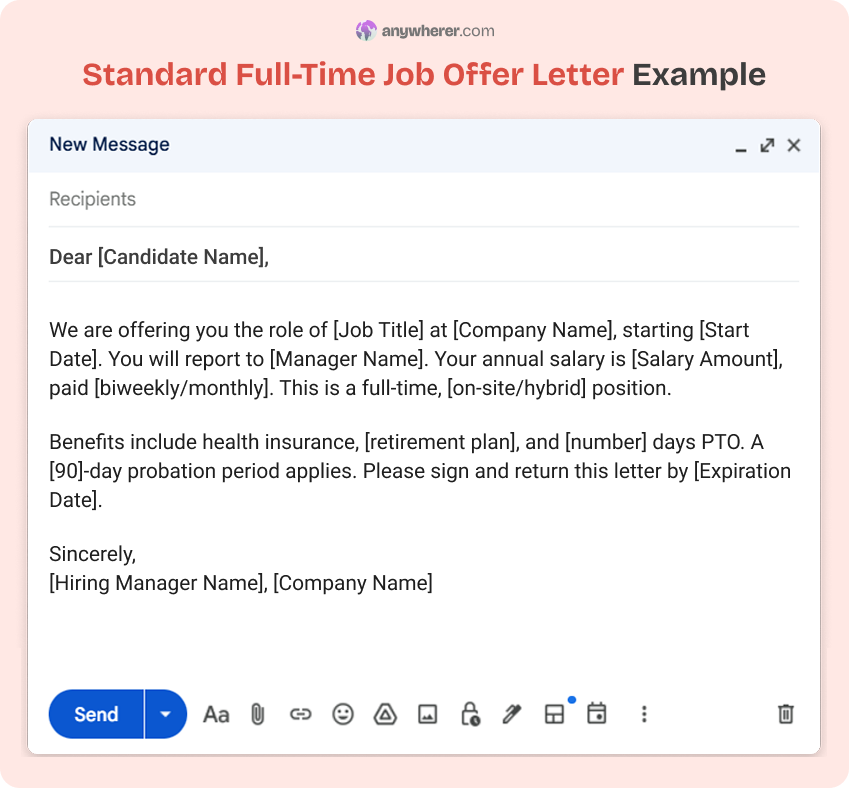
Standard Full-Time Job Offer Letter Example
This is the most common job offer letter template and works for permanent, full-time office or hybrid roles. It covers all nine essential sections in a straightforward format.
Dear [Candidate Name],
We are pleased to offer you the position of [Job Title] at [Company Name], reporting to [Manager Name], [Manager Title]. Your start date will be [Start Date].
Your annual gross salary will be [Salary Amount], paid [biweekly/monthly] via direct deposit. In addition, you will be eligible for [bonus/commission structure, if applicable] based on [performance metrics or targets].
This is a full-time position with an expected schedule of [40] hours per week. Your primary work location will be [Office Address / Hybrid: office X days per week].
You will be eligible for the following benefits starting on [Benefits Start Date]: health insurance, [retirement plan], [number] days of paid time off per year, and [any additional perks]. Full details will be provided in the employee handbook during onboarding.
Your employment will begin with a [90]-day probationary period, during which either party may end the relationship with [notice period] notice. A performance review will take place at the end of this period.
As a condition of employment, you will be required to sign a confidentiality agreement and acknowledge the company’s code of conduct. Copies of these documents are attached.
Please confirm your acceptance by signing and returning this letter by [Expiration Date]. If you have any questions, please contact [HR Contact Name] at [HR Email/Phone].
We are excited to welcome you to the team.
Sincerely,
[Hiring Manager Name]
[Hiring Manager Title]
[Company Name]
Remote Employee Job Offer Letter Sample
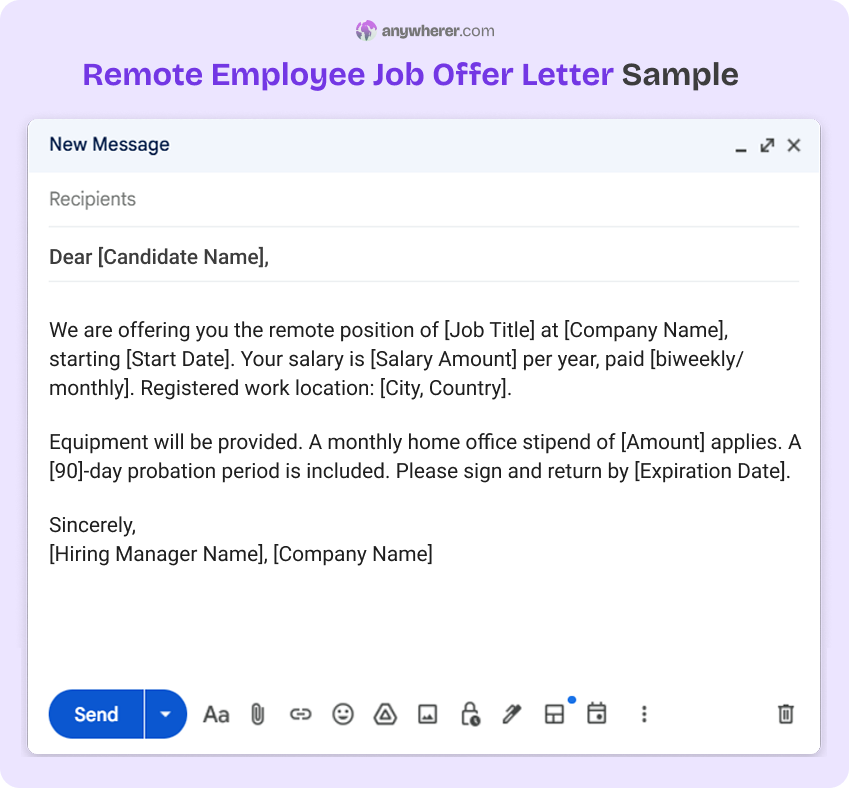
Use this example of offer letter when hiring someone who will work entirely from a remote location. It adds clauses for equipment, work-from-home reimbursements, and compliance jurisdiction. Pairing the letter with a detailed new employee onboarding plan ensures the remote hire has a smooth first few weeks.
Dear [Candidate Name],
We are pleased to offer you the position of [Job Title] at [Company Name]. You will report to [Manager Name], [Manager Title], and your start date will be [Start Date].
Your annual gross salary will be [Salary Amount], paid [biweekly/monthly]. [Include any variable pay details if applicable.]
This is a full-time, fully remote position. Your registered work location for tax and compliance purposes will be [City, State/Province, Country]. You are expected to maintain availability during [core hours, e.g. 10:00 AM to 3:00 PM EST] for team collaboration.
[Company Name] will provide a laptop and necessary peripherals. A monthly stipend of [Amount] will be provided to cover internet and home office expenses. You are responsible for maintaining a secure, distraction-free workspace that meets the company’s remote work policy standards.
Benefits include health insurance, [retirement plan], [number] days PTO, and [additional remote perks such as co-working space allowance]. Full details will follow during onboarding.
A [90]-day probationary period applies, during which either party may end the relationship with [notice period] notice. You will be evaluated against role-specific milestones at the end of this period.
You will be required to sign a confidentiality agreement and remote work policy acknowledgment prior to your start date.
Please accept this offer by signing and returning this letter by [Expiration Date]. For questions, contact [HR Contact] at [HR Email/Phone].
We look forward to having you on the team.
Sincerely,
[Hiring Manager Name]
[Hiring Manager Title]
[Company Name]
Fixed-Term Contract Job Offer Letter Template
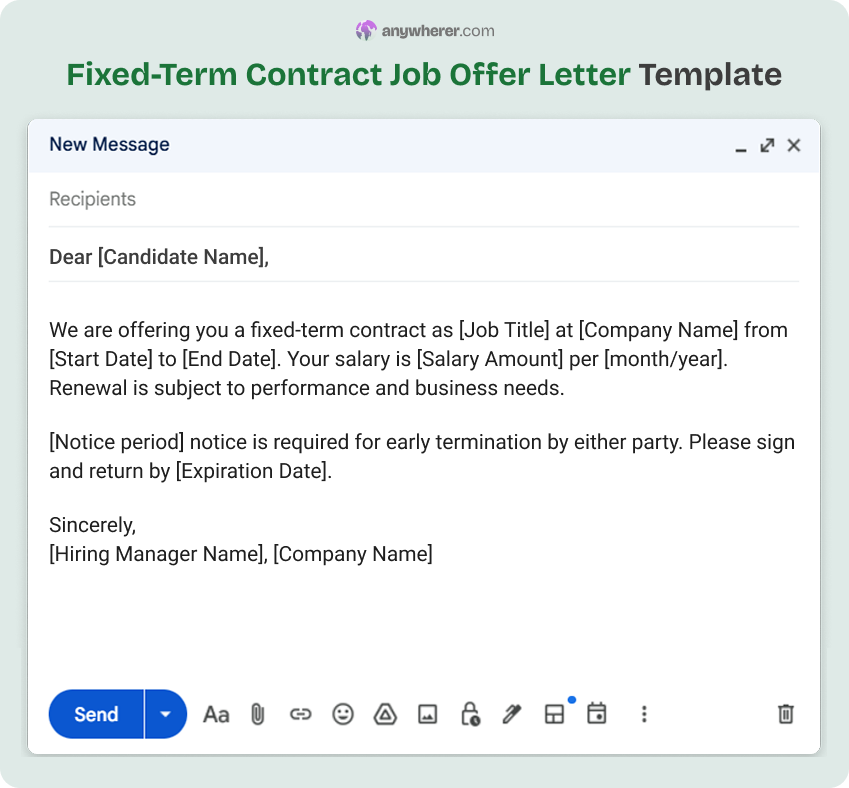
This job offer letter sample works for positions with a defined end date, such as project-based roles or seasonal positions. It highlights the contract duration and renewal conditions.
Dear [Candidate Name],
We are pleased to offer you a fixed-term position as [Job Title] at [Company Name], reporting to [Manager Name]. This contract begins on [Start Date] and ends on [End Date], with the possibility of renewal subject to business needs and performance.
Your gross salary for the contract period will be [Salary Amount] per [month/year], paid [biweekly/monthly]. [Include any project completion bonus if applicable.]
This is a [full-time/part-time] fixed-term role. Your primary work location will be [Office Address / Remote].
During the contract period, you will be eligible for [list applicable benefits, e.g. health insurance, PTO on a pro-rated basis]. Some benefits may differ from those offered to permanent employees, and details will be shared during onboarding.
Either party may terminate this contract before the end date with [notice period] written notice. Early termination terms are outlined in the attached employment agreement.
As a condition of this engagement, you will be required to sign a confidentiality agreement and any applicable policy acknowledgments.
Please confirm your acceptance by [Expiration Date] by signing and returning this letter. Contact [HR Contact] at [HR Email/Phone] with any questions.
Sincerely,
[Hiring Manager Name]
[Hiring Manager Title]
[Company Name]
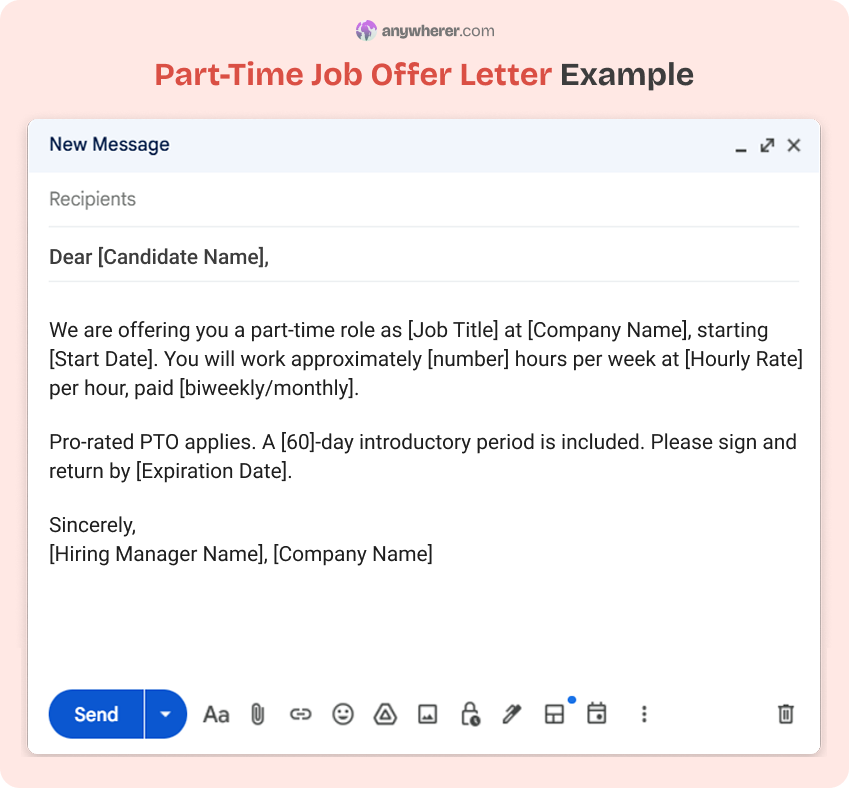
Part-Time Job Offer Letter Example
Part-time roles need the same level of clarity as full-time positions. This simple job offer letter sample emphasizes the weekly schedule and explains which benefits apply, since part-time employees often have different benefit eligibility.
Dear [Candidate Name],
We are pleased to offer you a part-time position as [Job Title] at [Company Name]. You will report to [Manager Name], and your start date will be [Start Date].
Your hourly rate will be [Hourly Rate], and you will be scheduled for approximately [number] hours per week. Your regular schedule will be [days and times, e.g. Monday through Wednesday, 9:00 AM to 2:00 PM]. Pay is processed [biweekly/monthly] via direct deposit.
This is a part-time, [on-site/hybrid/remote] position based at [Office Address or Remote Location].
As a part-time employee, you will be eligible for the following benefits: [list applicable benefits, e.g. pro-rated PTO, access to company training programs]. Health insurance and retirement plan eligibility depend on [hours threshold per applicable law or company policy].
A [60]-day introductory period applies, during which either party may end the arrangement with [notice period] notice.
You will be required to acknowledge the company’s code of conduct and applicable policies prior to your first day.
Please confirm your acceptance by signing and returning this letter by [Expiration Date]. Questions can be directed to [HR Contact] at [HR Email/Phone].
Sincerely,
[Hiring Manager Name]
[Hiring Manager Title]
[Company Name]
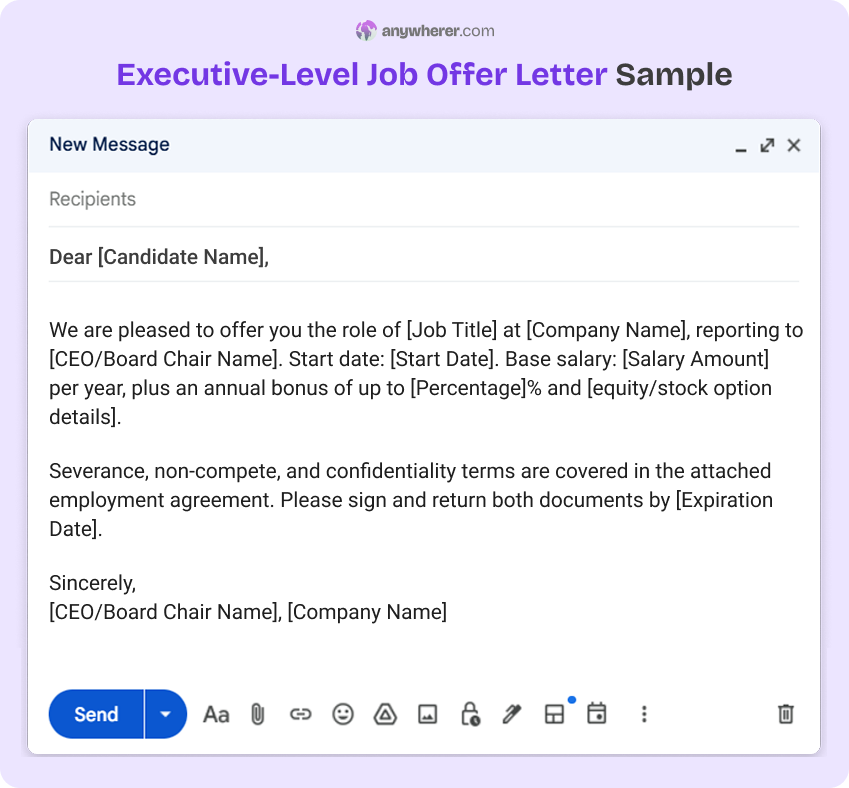
Executive-Level Job Offer Letter Sample
Executive job offer letter examples require more detail on equity, severance, and governance. This template covers the additional elements senior leaders typically expect while maintaining a professional, non-legalistic tone. A formal employment agreement usually accompanies this letter.
Dear [Candidate Name],
On behalf of the Board of Directors, we are pleased to offer you the position of [Job Title] at [Company Name]. You will report directly to [CEO/Board Chair Name] and serve as a member of the executive leadership team. Your anticipated start date is [Start Date].
Your annual base salary will be [Salary Amount], paid [biweekly/monthly]. In addition, you will be eligible for an annual performance bonus of up to [Percentage]% of your base salary, contingent upon achieving agreed-upon targets. You will also receive [equity/stock option grant details, vesting schedule, e.g. X shares vesting over 4 years with a 1-year cliff].
This is a full-time, [on-site/hybrid/remote] position. [Relocation assistance of up to [Amount] is available if applicable.]
Your executive benefits package includes [health insurance, executive health screening, retirement contribution, car allowance or travel budget, additional PTO]. Details are outlined in the attached summary.
In the event of termination without cause, you will be entitled to [severance terms, e.g. 6 months of base salary continuation and accelerated vesting of unvested equity]. Full severance terms are detailed in the accompanying employment agreement.
You will be expected to sign a confidentiality agreement, an intellectual property assignment agreement, and a non-compete covenant. These documents are attached for your review.
Please indicate your acceptance by signing and returning this letter and the employment agreement by [Expiration Date]. For questions, contact [HR/Legal Contact] at [Email/Phone].
We are confident you will make a significant contribution to [Company Name].
Sincerely,
[CEO/Board Chair Name]
[Title]
[Company Name]
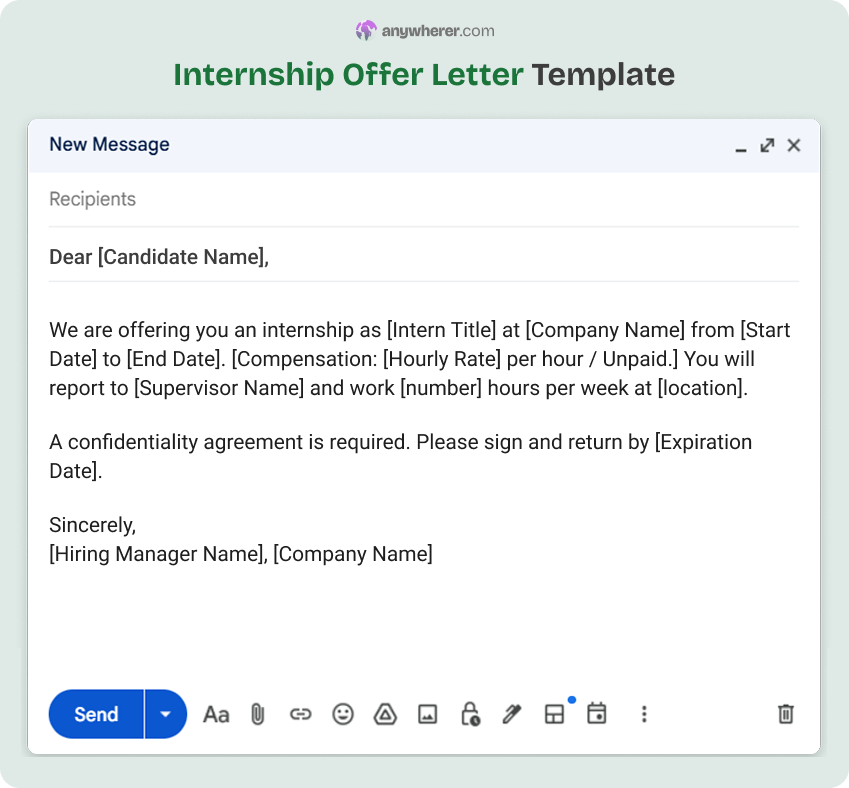
Internship Offer Letter Template
Internship offer letters should be concise but still cover the basics: duration, compensation (if paid), learning objectives, and supervisor. This employee job offer letter template adapts well for both paid and unpaid internships.
Dear [Candidate Name],
We are pleased to offer you an internship position as [Intern Title, e.g. Marketing Intern] at [Company Name]. You will report to [Supervisor Name], [Supervisor Title], and your internship will run from [Start Date] to [End Date].
[For paid internships:] Your hourly compensation will be [Hourly Rate], and you will be scheduled for approximately [number] hours per week. Payment is processed [biweekly/monthly].
[For unpaid internships:] This is an unpaid internship in compliance with [applicable labor law]. You will gain hands-on experience in [area].
Your work location will be [Office Address / Remote / Hybrid]. [If remote: equipment and workspace expectations follow the company’s remote work policy.]
During your internship you will focus on [brief description of projects or learning objectives]. A mid-point check-in and a final evaluation will be conducted by your supervisor.
As a condition of this internship, you will be required to sign a confidentiality agreement. Please note that this internship does not guarantee future employment, although outstanding interns may be considered for open positions.
Please confirm your acceptance by [Expiration Date]. Contact [HR Contact] at [HR Email/Phone] with any questions.
We look forward to working with you.
Sincerely,
[Hiring Manager Name]
[Hiring Manager Title]
[Company Name]
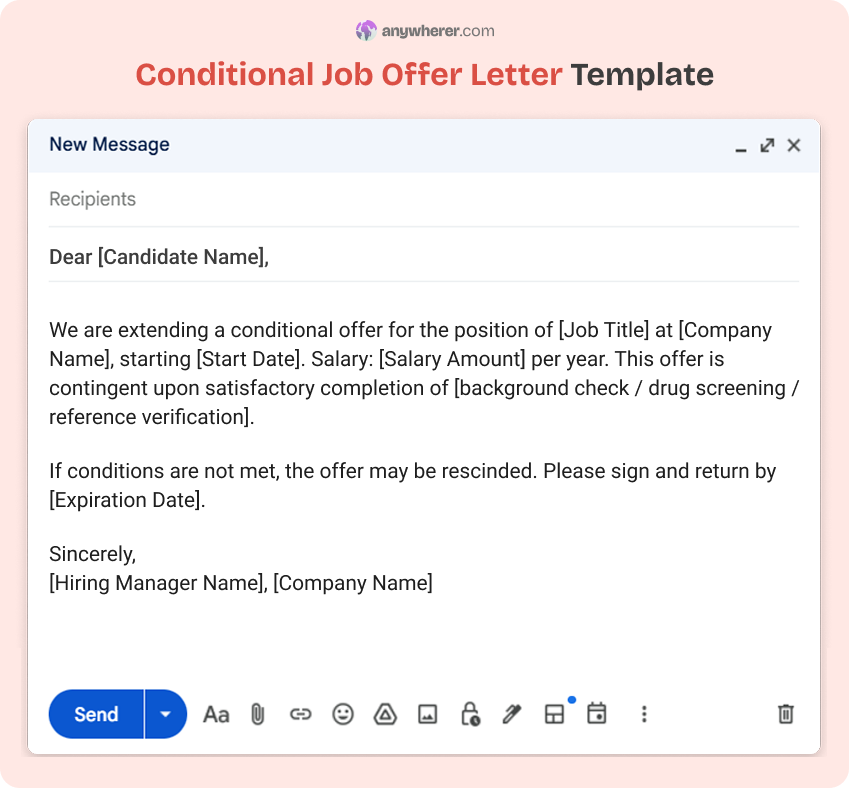
Conditional Job Offer Letter Template
A conditional offer letter is sent when hiring depends on the candidate meeting specific requirements such as passing a background check, drug screening, reference verification, or obtaining a work permit. This sample letter to offer a job makes the conditions explicit so both parties understand what needs to happen before employment can begin.
Dear [Candidate Name],
We are pleased to extend a conditional offer of employment for the position of [Job Title] at [Company Name]. You will report to [Manager Name], [Manager Title]. The proposed start date is [Start Date], subject to the successful completion of the conditions listed below.
This offer is contingent upon:
– Satisfactory completion of a background check
– [Drug screening / Reference verification / Work authorization / Professional license verification, as applicable]
– [Any other conditions]
Your annual salary will be [Salary Amount], paid [biweekly/monthly]. This is a [full-time/part-time], [on-site/remote/hybrid] position.
Benefits include [summary of key benefits]. A [90]-day probationary period applies once employment begins.
If any condition is not met, this offer may be rescinded. You will be notified promptly of the outcome of each verification step.
Please sign and return this letter by [Expiration Date] to acknowledge the conditional terms and initiate the verification process. Contact [HR Contact] at [HR Email/Phone] for questions.
Sincerely,
[Hiring Manager Name]
[Hiring Manager Title]
[Company Name]
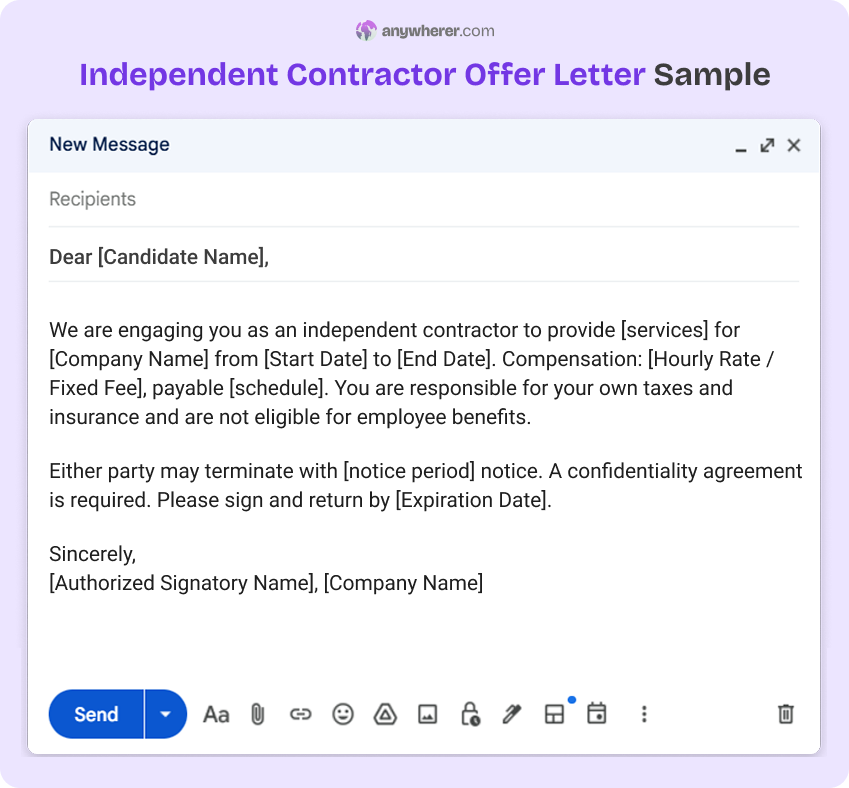
Independent Contractor Offer Letter Sample
Contractor engagements require careful wording to avoid misclassification. This offer letter examples for job engagements with independent contractors emphasizes the nature of the relationship, payment terms, and deliverables rather than hours or supervision.
Dear [Contractor Name],
We are pleased to engage you as an independent contractor to provide [description of services] for [Company Name]. This engagement will begin on [Start Date] and is expected to conclude on [End Date / upon completion of deliverables].
You will be compensated at a rate of [Hourly Rate / Fixed Project Fee], payable [upon invoice submission / biweekly / monthly / upon milestone completion]. Payment terms are net [30] days from receipt of a valid invoice.
As an independent contractor, you are responsible for your own taxes, insurance, and equipment. You are not eligible for employee benefits including health insurance, PTO, or retirement plans offered by [Company Name]. You retain the right to determine how and when the work is performed, provided deliverables meet agreed-upon standards and timelines.
The primary point of contact at [Company Name] will be [Contact Name], [Contact Title].
Either party may terminate this engagement with [notice period] written notice. Upon termination, you will be compensated for all work completed through the termination date.
You will be required to sign a confidentiality and intellectual property assignment agreement prior to beginning work.
Please confirm your acceptance by signing and returning this letter by [Expiration Date]. Contact [HR/Legal Contact] at [Email/Phone] with any questions.
Sincerely,
[Authorized Signatory Name]
[Title]
[Company Name]
Global / Cross-Border Job Offer Letter Template
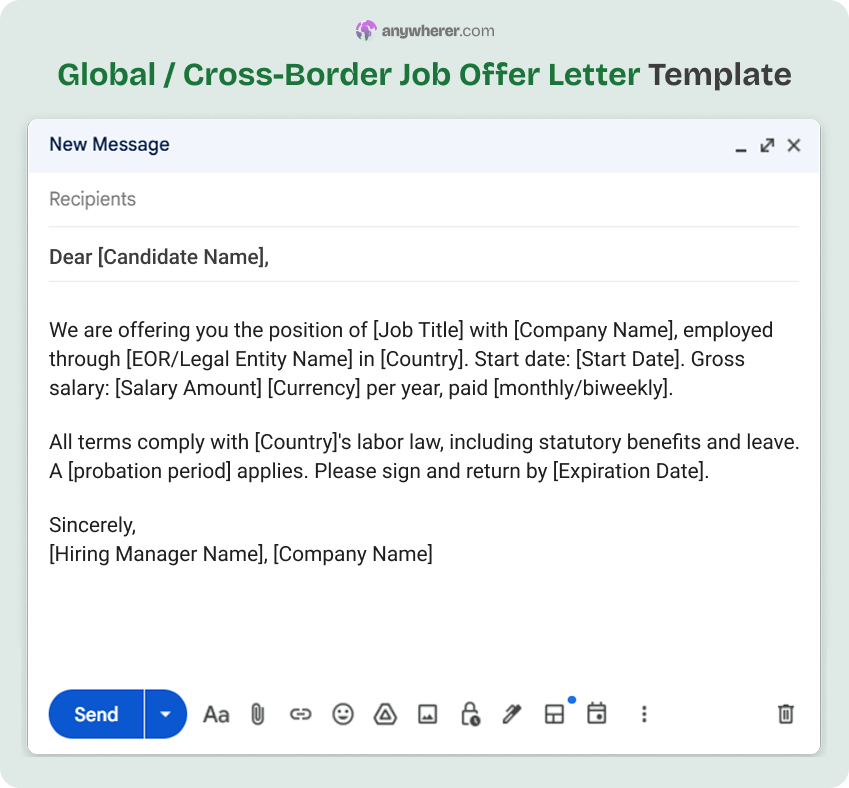
When hiring across borders, the offer letter needs to address jurisdiction, currency, tax obligations, and any employer-of-record (EOR) arrangements. This sample of a job offer letter is designed for companies hiring in a country where they do not have a legal entity. According to a Gallup report, more than half of employees are open to new opportunities, making speed and clarity in cross-border offers especially important.
Dear [Candidate Name],
We are pleased to offer you the position of [Job Title] with [Company Name]. Your employment will be administered through [EOR/Legal Entity Name] in [Country] in accordance with local labor laws.
You will report to [Manager Name], [Manager Title], and your start date will be [Start Date].
Your annual gross salary will be [Salary Amount] [Currency], paid [monthly/biweekly] in accordance with local payroll regulations. [If applicable: You will also be eligible for a performance bonus of up to [Percentage]% of base salary.]
This is a [full-time/part-time], [on-site/hybrid/remote] position. Your registered work location is [City, Country]. All employment terms comply with [Country]’s labor code, including statutory benefits, leave entitlements, and termination procedures.
Statutory benefits under [Country] law include [list key mandatory benefits, e.g. social security contributions, public health insurance, statutory annual leave of X days]. In addition, [Company Name] offers [supplementary benefits such as private health insurance, additional PTO, or learning stipends].
A [probation period as required by local law, e.g. 3 months] probationary period applies. During this period, either party may terminate the employment relationship with [local statutory notice period] notice.
You will be required to sign a confidentiality agreement and any applicable local employment documents. These will be provided by [EOR/Legal Entity Name] prior to your start date.
Please confirm your acceptance by signing and returning this letter by [Expiration Date]. For questions, contact [HR Contact] at [Email/Phone].
Sincerely,
[Hiring Manager Name]
[Hiring Manager Title]
[Company Name]
Customizing a Job Offer Letter
A simple job offer letter template gives you a starting point, but every role has unique details that require adaptation. Sending a generic letter signals a lack of care, while a personalized offer reinforces the candidate’s decision to join. Here are five ways to tailor any template to the specific hire.
- Reflect the role’s seniority. An internship letter needs a different tone and level of detail than an executive offer. Adjust the depth of compensation details, governance references, and formality accordingly.
- Match local legal requirements. Employment law varies by jurisdiction. In some countries, probation periods are regulated by statute, and benefits must include specific entitlements. Always verify local rules before finalizing the letter.
- Incorporate role-specific perks. If the position includes a signing bonus, relocation assistance, or a professional development budget, include those details in the letter rather than saving them for a separate document.
- Use your company’s voice. The offer letter is part of the candidate experience. If your company culture is informal, write in a warm and direct style. If it is more formal, maintain that tone throughout.
- Have legal and HR review every version. Templates save time, but they should not be sent without review. A quick check ensures compliance, accuracy, and consistency with your current policies.
Common Mistakes to Avoid in Job Offer Letters
Even experienced hiring teams make avoidable errors in offer letters. These mistakes can delay onboarding, damage the employer brand, or expose the company to legal risk.
- Vague compensation language. Stating a salary range instead of a fixed number, or failing to specify whether the figure is gross or net, forces the candidate to ask follow-up questions and slows acceptance.
- Missing or unrealistic deadlines. Giving the candidate 24 hours to decide on a major career move creates pressure and erodes trust. Conversely, no deadline at all leaves the offer open indefinitely.
- Inconsistent details. If the salary discussed in the final interview differs from the letter, or the job title has changed without explanation, the candidate’s confidence drops immediately.
- Overly legalistic language. A job offer letter is not an employment contract. Filling it with dense legal clauses makes it intimidating rather than welcoming. Reserve the legal detail for the separate employment agreement.
- Forgetting at-will or local-law disclaimers. In jurisdictions where at-will employment applies, omitting the disclaimer can inadvertently create an implied contract. In other countries, failing to reference statutory rights can render terms unenforceable.
- No clear acceptance instructions. The candidate should know exactly what to do: sign, scan, email, or use a digital signature platform. Ambiguity here leads to missed deadlines and unnecessary back-and-forth.
FAQs on Job Offer Letters
What is the difference between a job offer letter and an employment contract?
A job offer letter is a summary of the key terms of employment: title, salary, start date, and benefits. It signals the company’s intent to hire and invites the candidate to accept. An employment contract is a legally binding document that covers terms in greater depth, including termination clauses, intellectual property rights, dispute resolution, and governing law. In many jurisdictions, the offer letter becomes part of the employment record but is not intended to replace a full contract.
Is a job offer letter legally binding?
In most jurisdictions, a signed job offer letter creates a binding commitment on the specific terms it contains, particularly around compensation and start date. However, the enforceability depends on local labor law, the wording of the letter, and whether an at-will disclaimer is included. Legal counsel should review any offer letter template before use to ensure it reflects the intended level of commitment.
How long should a candidate have to respond to an offer letter?
Five to ten business days is the most common window for standard roles. Executive-level positions or offers that require relocation may warrant two to three weeks. Giving too little time pressures the candidate and risks losing them. Providing too much time can stall your hiring pipeline and leave other finalists waiting.
Can a job offer letter be rescinded after the candidate signs it?
Yes, in many at-will employment jurisdictions an employer can rescind an offer even after acceptance, though doing so carries reputational and sometimes legal risk. In countries with stronger employee protections, rescinding a signed offer may trigger liability for damages. If you need to rescind, communicate promptly and document the business reason.
Should a job offer letter include salary and benefits details?
Yes. Salary and benefits are among the most critical pieces of information for the candidate’s decision. At minimum, include the base salary, pay frequency, and a high-level summary of benefits. If variable compensation such as bonuses or equity is part of the package, outline the structure even if exact targets are finalized separately.
What should I do if the candidate wants to negotiate the offer?
Negotiation is normal and expected for most roles. Have a clear range approved before extending the offer so you can respond quickly. If the candidate negotiates salary, consider whether you can accommodate the request through other means such as additional PTO, a signing bonus, or a faster performance review cycle. Once terms are agreed, issue a revised offer letter that reflects the updated figures.
Do I need a different offer letter for international hires?
Yes. Cross-border offers must address the local labor code, statutory benefits, currency, tax obligations, and whether employment is managed through an employer of record. Using a domestic template for an international hire can create compliance gaps. The global/cross-border template in this guide provides a starting point, but always have a local legal expert review the final version. Research from SHRM shows that organizations increasingly rely on EOR arrangements to hire compliantly in markets where they lack a legal entity.
How formal should a job offer letter be?
The formality should match your company culture and the seniority of the role. A startup hiring a junior developer may use a warm, direct tone. A financial institution extending an executive offer will lean toward formal, precise language. Look at any example of a job offer letter in this guide and you will notice that clarity matters more than formality. Regardless of tone, every offer letter should be clear, complete, and free of ambiguity. Avoid using overly casual language that could be misinterpreted, and avoid legal jargon that the candidate cannot easily understand.

Yaryna is our lead writer with over 8 years of experience in crafting clear, compelling, and insightful content. Specializing in global employment and EOR solutions, she simplifies complex concepts to help businesses expand their remote teams with confidence. With a strong background working alongside diverse product and software teams, Yaryna brings a tech-savvy perspective to her writing, delivering both in-depth analysis and valuable insights.