Employee satisfaction in remote teams is harder to read than in a traditional office. Without shared physical spaces, managers lose the everyday signals that reveal how people truly feel about their work. By the time dissatisfaction becomes visible, the employee may already be looking elsewhere.
That is why regular surveys matter. Research from Gallup links satisfaction directly to retention and productivity. McKinsey research identifies the manager-employee relationship as the top factor in workplace satisfaction. For distributed teams, well-designed employee satisfaction survey questions are one of the few reliable ways to listen at scale and act before small frustrations become turnover.
This guide brings together more than 80 employee satisfaction survey questions examples designed for remote and hybrid teams. You will find survey questions to gauge employee satisfaction across six categories, plus open-ended questions for deeper insight and practical guidance on interpreting and acting on results. If you are also exploring performance review questions for remote managers or employee satisfaction survey software to automate the process, both pair well with this approach.
Employee Satisfaction Survey Questions by Category
The best employee satisfaction survey questions cover multiple dimensions of the employee experience. Satisfaction depends on pay, leadership, tools, culture, growth, and work-life balance, not just one of these in isolation. The questions for employee satisfaction survey below are grouped into six practical categories with ten questions each. Together, these sample employee satisfaction survey questions provide a comprehensive starting point for any remote or hybrid team.
Overall Remote Work Experience
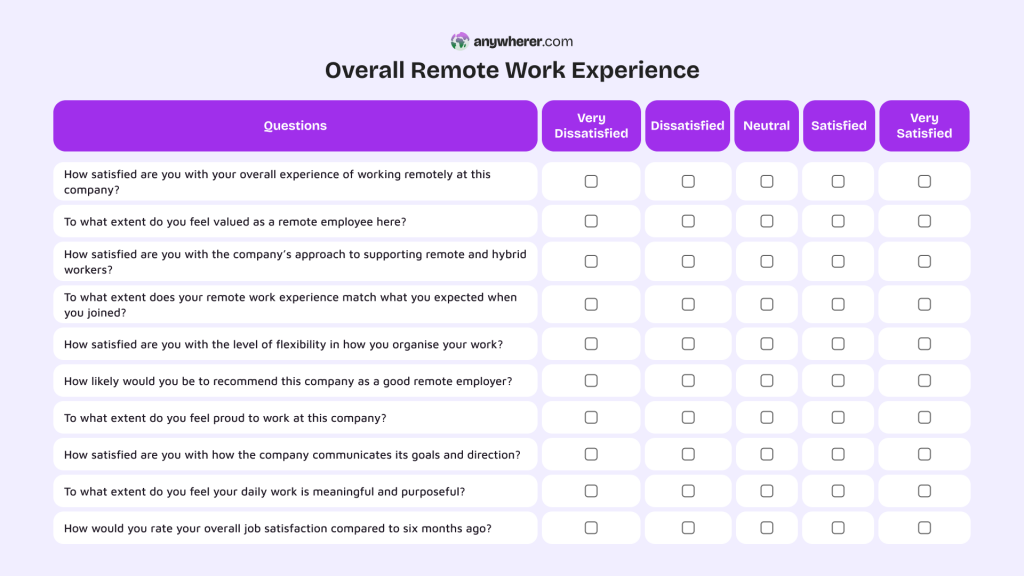
These questions capture how remote employees feel about their work experience as a whole. They serve as a general pulse check before exploring specific areas in more detail.
- How satisfied are you with your overall experience of working remotely at this company?
- To what extent do you feel valued as a remote employee here?
- How satisfied are you with the company’s approach to supporting remote and hybrid workers?
- To what extent does your remote work experience match what you expected when you joined?
- How satisfied are you with the level of flexibility in how you organise your work?
- How likely would you be to recommend this company as a good remote employer?
- To what extent do you feel proud to work at this company?
- How satisfied are you with how the company communicates its goals and direction?
- To what extent do you feel your daily work is meaningful and purposeful?
- How would you rate your overall job satisfaction compared to six months ago?
Suggested rating scale: 1 (Very Dissatisfied) to 5 (Very Satisfied). For questions phrased as “To what extent,” the same 1–5 scale applies, where 1 means “Not at all” and 5 means “Completely.” This scale can be reused across all categories below.
Communication and Collaboration
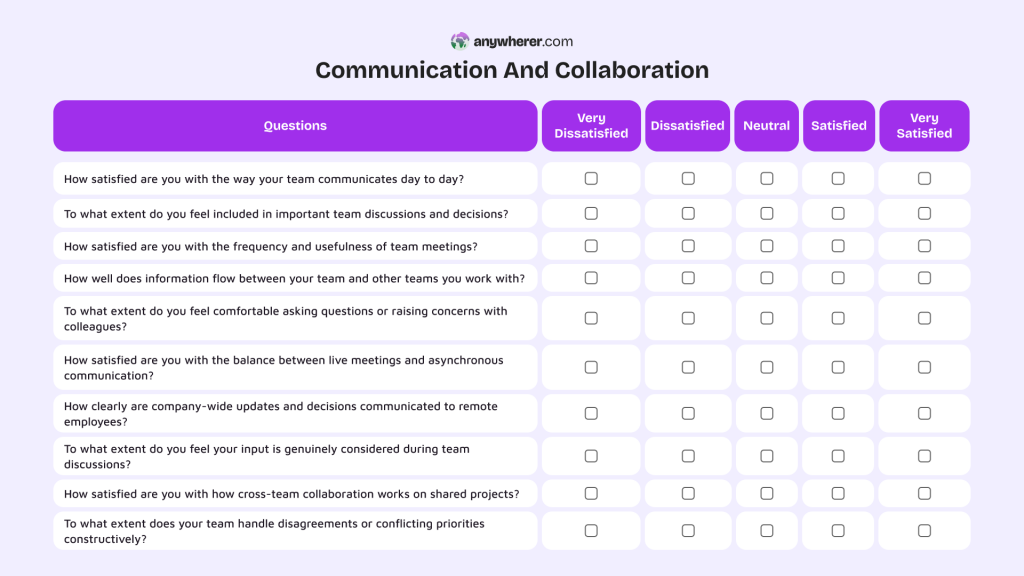
Remote work depends heavily on how well teams share information and work together across distance. These questions check whether communication is clear, inclusive, and effective.
- How satisfied are you with the way your team communicates day to day?
- To what extent do you feel included in important team discussions and decisions?
- How satisfied are you with the frequency and usefulness of team meetings?
- How well does information flow between your team and other teams you work with?
- To what extent do you feel comfortable asking questions or raising concerns with colleagues?
- How satisfied are you with the balance between live meetings and asynchronous communication?
- How clearly are company-wide updates and decisions communicated to remote employees?
- To what extent do you feel your input is genuinely considered during team discussions?
- How satisfied are you with how cross-team collaboration works on shared projects?
- To what extent does your team handle disagreements or conflicting priorities constructively?
Suggested rating scale: Same 1–5 scale as above.
Workload and Work-Life Balance
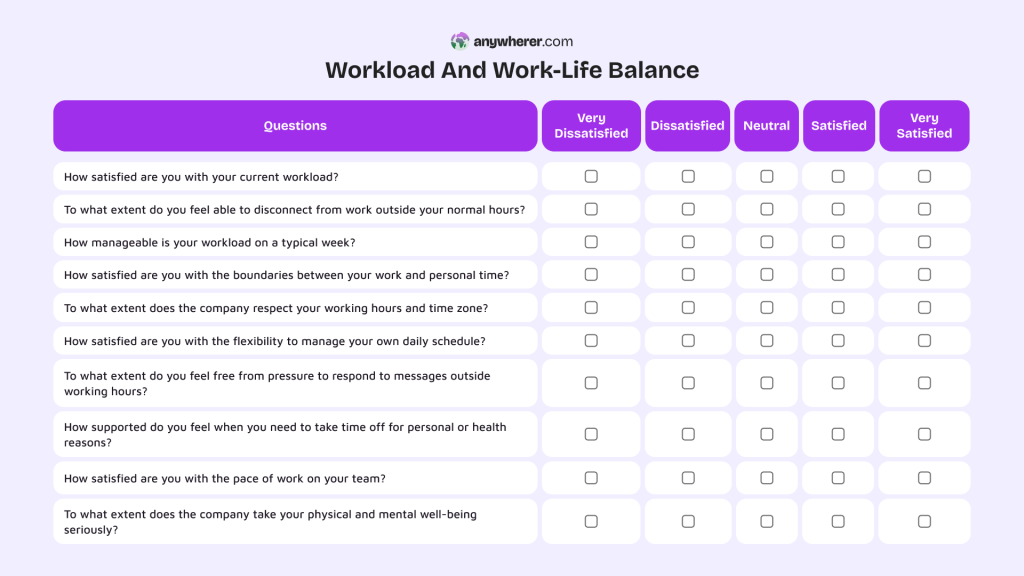
Remote employees can find it harder to separate work from the rest of their lives. These questions help identify whether workload and boundaries are sustainable.
- How satisfied are you with your current workload?
- To what extent do you feel able to disconnect from work outside your normal hours?
- How manageable is your workload on a typical week?
- How satisfied are you with the boundaries between your work and personal time?
- To what extent does the company respect your working hours and time zone?
- How satisfied are you with the flexibility to manage your own daily schedule?
- To what extent do you feel free from pressure to respond to messages outside working hours?
- How supported do you feel when you need to take time off for personal or health reasons?
- How satisfied are you with the pace of work on your team?
- To what extent does the company take your physical and mental well-being seriously?
Suggested rating scale: Same 1–5 scale. Some questions in this category (such as “How manageable is your workload”) may benefit from a tailored anchor, for example 1 (Not at all manageable) to 5 (Very manageable). Adjust as needed for your survey tool.
Manager Support and Feedback
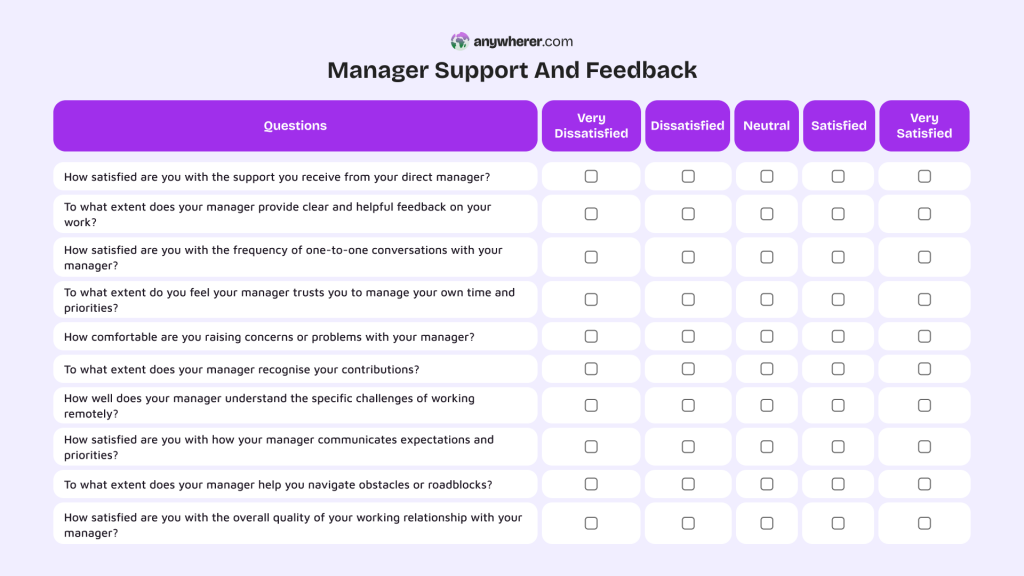
The manager relationship is one of the strongest drivers of satisfaction for remote employees. These questions explore whether people feel supported, heard, and fairly treated.
- How satisfied are you with the support you receive from your direct manager?
- To what extent does your manager provide clear and helpful feedback on your work?
- How satisfied are you with the frequency of one-to-one conversations with your manager?
- To what extent do you feel your manager trusts you to manage your own time and priorities?
- How comfortable are you raising concerns or problems with your manager?
- To what extent does your manager recognise your contributions?
- How well does your manager understand the specific challenges of working remotely?
- How satisfied are you with how your manager communicates expectations and priorities?
- To what extent does your manager help you navigate obstacles or roadblocks?
- How satisfied are you with the overall quality of your working relationship with your manager?
Suggested rating scale: Same 1–5 scale.
Tools, Technology and Processes
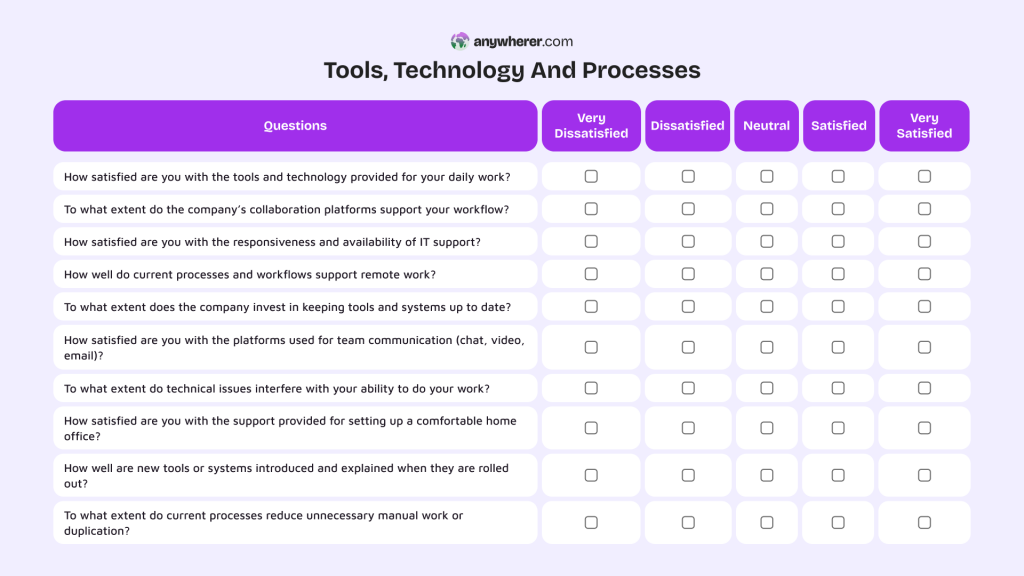
Remote employees depend entirely on their tools and digital environment to get work done. Satisfaction here has a direct effect on daily productivity and frustration levels.
- How satisfied are you with the tools and technology provided for your daily work?
- To what extent do the company’s collaboration platforms support your workflow?
- How satisfied are you with the responsiveness and availability of IT support?
- How well do current processes and workflows support remote work?
- To what extent does the company invest in keeping tools and systems up to date?
- How satisfied are you with the platforms used for team communication (chat, video, email)?
- To what extent do technical issues interfere with your ability to do your work?
- How satisfied are you with the support provided for setting up a comfortable home office?
- How well are new tools or systems introduced and explained when they are rolled out?
- To what extent do current processes reduce unnecessary manual work or duplication?
Suggested rating scale: Same 1–5 scale. Note that one question (“To what extent do technical issues interfere…”) is reverse-scored: a high score indicates a problem rather than satisfaction.
Growth and Career Development
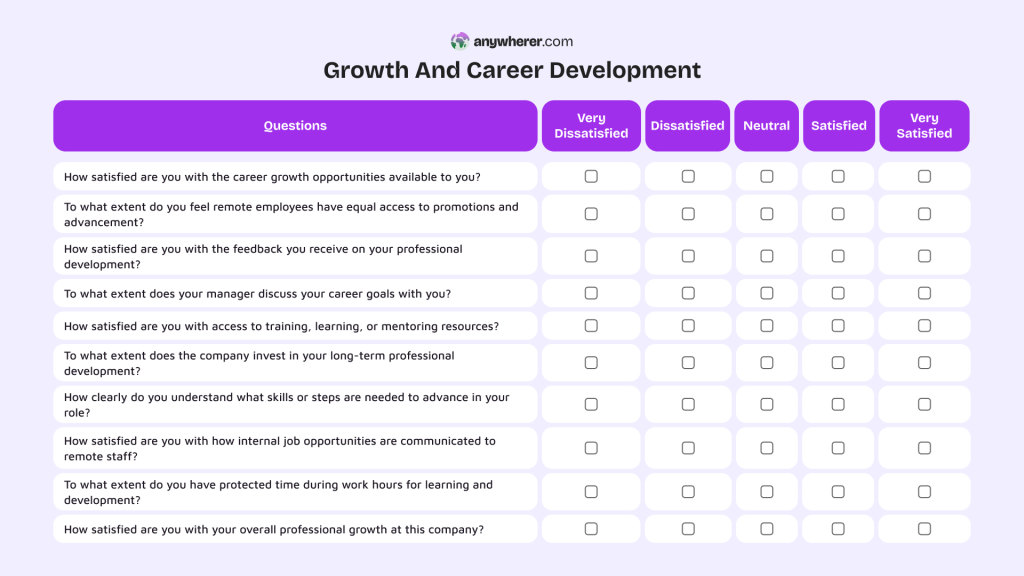
Remote employees sometimes worry that working away from the office limits their growth. These questions check whether people see a path forward and feel invested in.
- How satisfied are you with the career growth opportunities available to you?
- To what extent do you feel remote employees have equal access to promotions and advancement?
- How satisfied are you with the feedback you receive on your professional development?
- To what extent does your manager discuss your career goals with you?
- How satisfied are you with access to training, learning, or mentoring resources?
- To what extent does the company invest in your long-term professional development?
- How clearly do you understand what skills or steps are needed to advance in your role?
- How satisfied are you with how internal job opportunities are communicated to remote staff?
- To what extent do you have protected time during work hours for learning and development?
- How satisfied are you with your overall professional growth at this company?
Suggested rating scale: Same 1–5 scale.
Open-Ended Employee Satisfaction Survey Questions
Scale-based questions reveal patterns, but employee satisfaction survey open ended questions provide the context behind those numbers. In remote teams, where everyday cues are missing, written responses often surface issues that scores alone cannot capture.
The questions below cover what is working well, current challenges, communication and support gaps, career growth, and suggestions for improvement. You do not need to use all of them in a single survey. Selecting five to eight per cycle keeps the process focused without overwhelming respondents.
- What do you find most satisfying about working remotely at this company?
- What is the biggest challenge you face as a remote employee here?
- What would you change about how your team communicates?
- What helps you feel most engaged and motivated when working remotely?
- What could be improved about the way feedback is given on your team?
- How would you describe the company culture to someone considering joining as a remote employee?
- What is one thing leadership could do to better support remote workers?
- What tools or resources would make your daily work easier or more productive?
- What do you enjoy most about your current role?
- What frustrates you most about remote collaboration at this company?
- How has your work-life balance changed since working here, and what would improve it?
- What is one process or policy that feels outdated or unnecessary?
- What would help you feel more connected to your team and the broader company?
- In what ways could the company improve how it recognises employee contributions?
- What could your manager do differently to support you more effectively?
- What professional development opportunities would be most valuable to you right now?
- What is one thing the company does particularly well for remote employees?
- If you could change one thing about your workload or daily schedule, what would it be?
- How transparent do you feel company-wide decisions are, and what would improve that?
- What would make team meetings more useful or efficient for you?
- Do you feel remote employees have the same career opportunities as in-office staff? Why or why not?
- What was missing from your onboarding experience that would have helped you settle in faster?
- What could the company do to reduce unnecessary meetings or distractions?
- What does meaningful recognition look like to you, and do you experience it here?
- Is there anything else you would like leadership to know about your experience working remotely?
How to Interpret Remote Satisfaction Survey Results
Numbers alone do not tell the full story. A satisfaction score of 3.5 out of 5 means very different things depending on the context. What matters more than any single score is the pattern across responses and the direction of trends over time.
When reviewing results, focus on three things:
- Look for patterns across categories, not isolated scores. If workload and work-life balance both score low, the issue is likely systemic rather than isolated to one team or manager.
- Compare results across teams, locations, or tenure levels. Differences between groups often reveal structural issues that company-wide averages would hide.
- Pay close attention to neutral responses. A cluster of 3s on a 5-point scale rarely means everything is fine. More often, it signals passive dissatisfaction or a reluctance to commit to a clear answer.
Treat employee satisfaction survey questions and answers as a conversation, not a report card. The data tells you where to dig deeper, not what to conclude.
What to Do After You Collect the Feedback
Surveys lose their value the moment employees stop believing that feedback leads to change. As SHRM notes, effective survey programmes require a clear commitment to acting on results, not just collecting them. After gathering responses, the most important step is communication.
- Share a summary of high-level findings with the team. You do not need to present every data point, but people should see that their responses were read and understood.
- Acknowledge feedback openly, even when you cannot fix everything. Saying “we heard this, and here is why we cannot change it right now” is more honest than silence.
- Turn one or two insights into specific, visible actions. Small, concrete changes build more trust than broad promises.
This cycle of listening, sharing, and acting is what turns a survey from a checkbox into a real feedback loop.
Common Mistakes Managers Make with Satisfaction Surveys
Even well-intentioned survey programmes can go wrong. Here are some of the most common mistakes to watch for:
- Running surveys too often without follow-up. Frequent surveys without visible action train employees to stop taking them seriously.
- Asking questions but ignoring open-ended responses. Free-text answers often contain the most actionable insight, yet they are frequently skipped during analysis.
- Treating satisfaction scores as performance ratings. A team with low scores is not a failing team. It is a team telling you something needs attention.
- Not closing the feedback loop. If employees never hear what came out of the survey or what changed as a result, they assume nothing happened.
Each of these mistakes erodes trust. In remote teams, where trust is already harder to build, that erosion is difficult to reverse.
How Often to Run Remote Employee Satisfaction Surveys
There is no single right frequency, but most remote teams benefit from a layered approach:
- Pulse surveys (every 4–6 weeks): Short, focused, and useful for tracking shifts in specific areas.
- Quarterly surveys: Broader in scope, covering multiple satisfaction dimensions. These form the backbone of most survey programmes.
- Annual or bi-annual deep dives: Comprehensive reviews that assess the full employee experience, useful for benchmarking and strategic planning.
It also helps to run a targeted survey after major changes such as a reorganisation, a leadership transition, or a shift in remote work policy. These moments tend to affect remote employee satisfaction quickly, and a well-timed survey captures the impact while it is still fresh.
The most important rule: do not survey more often than you can act on results. Survey fatigue is real, and it is driven less by the number of surveys than by the absence of follow-through.
Final Words
Measuring remote employee satisfaction is not a one-time project. It is an ongoing practice that helps HR leaders, managers, and founders understand what keeps people and what quietly pushes them away.
The best questions for employee satisfaction survey are clear, specific, and focused on areas the organisation can realistically act on. Use the sample questions for employee satisfaction survey in this guide as a starting point. Adapt them to your team, rotate survey questions for employee satisfaction across cycles, and follow through on what you learn. The goal is not a perfect score. It is a feedback loop that keeps distributed teams connected, supported, and motivated for the long term.
FAQs on Remote Employee Satisfaction Surveys
How often should remote employee satisfaction surveys be conducted?
A quarterly satisfaction survey paired with shorter pulse checks every four to six weeks works well for most remote teams. The key is to match frequency to your ability to act on results. Surveying without follow-up erodes trust faster than not surveying at all. If your team is going through rapid change, increase the frequency temporarily and keep the surveys shorter.
Should remote satisfaction surveys be anonymous?
In most cases, yes. Anonymity encourages honest feedback, especially on sensitive topics like compensation, leadership, and team dynamics. Be transparent about how responses are aggregated and who has access to the data. In very small teams where anonymity is harder to guarantee, consider using third-party tools that enforce minimum group sizes for reporting.
How many questions should a remote satisfaction survey include?
A full quarterly survey works well with 25 to 40 questions. Pulse surveys should stay under 15. For remote teams already managing multiple tools and meetings, shorter surveys with a clear focus tend to produce higher-quality responses than longer, infrequent ones. Many teams also create an employee satisfaction survey questions pdf for offline workshops or manager planning sessions.
What’s the difference between employee satisfaction and engagement?
Satisfaction measures how content employees are with specific aspects of their job such as pay, tools, workload, and management. Engagement measures emotional commitment and motivation. An employee can be satisfied but disengaged, or highly engaged but dissatisfied with certain conditions. Measuring both gives a more complete view of the employee experience.
How do I encourage honest feedback from remote employees?
Start with guaranteed anonymity and clear communication about how responses will be used. Sharing previous survey results and the actions taken as a result goes a long way. When employees see that honest feedback leads to real change, they are more likely to respond openly in future cycles. Avoid making surveys feel like a formality.
What should I do if survey results are negative?
Resist the urge to explain away the data or treat it as a personal failure. Share key findings with the team openly, acknowledge what came through clearly, and commit to addressing one or two priority areas with specific actions. Negative results are a signal to improve, not a crisis. What damages trust is ignoring them.
How can I avoid survey fatigue in remote teams?
Keep surveys short and purposeful. Avoid running them more often than you can act on results. Vary the question set between cycles to avoid repetition, and always close the loop by sharing what you learned and what you plan to do. When people see their input leading to action, participation stays high.
Should survey questions be the same for all teams and roles?
A core set of questions that all teams answer allows you to compare results across the organisation. Adding a small number of role-specific or team-specific questions lets you capture context that matters for particular groups. The right balance depends on your organisation’s size and the diversity of roles and working conditions within it.

Yaryna is our lead writer with over 8 years of experience in crafting clear, compelling, and insightful content. Specializing in global employment and EOR solutions, she simplifies complex concepts to help businesses expand their remote teams with confidence. With a strong background working alongside diverse product and software teams, Yaryna brings a tech-savvy perspective to her writing, delivering both in-depth analysis and valuable insights.