Remote and hybrid work are no longer side experiments. For many teams, they are the standard way of operating. While this shift brings flexibility and autonomy, it also makes employee engagement harder to observe. There are no hallway conversations to overhear, fewer informal cues to read, and early signs of burnout or disengagement are easier to miss.
This is where well-designed survey questions on employee engagement become essential. For remote employees, surveys are often the most reliable way to understand how people actually feel about their work, their manager, and the organisation as a whole. Without them, leaders are often forced to rely on assumptions rather than insight.
The cost of low engagement is well documented. Research from Gallup consistently shows that disengaged employees are more likely to look for new roles, take more unplanned absences, and perform below their potential. In distributed teams, these issues tend to stay hidden longer, which makes them harder and more expensive to address once they surface.
This guide brings together more than 80 employee engagement questions for survey designed specifically for remote and distributed teams. You’ll find practical survey question examples, pulse questions, and the best employee engagement survey questions organised by theme, along with open-ended questions and guidance on how to interpret responses meaningfully.
We also touch on where dedicated tools can help. If you later want to automate surveys, analyse trends, and follow up at scale, you can also explore the best employee survey providers guide.
When and How to Run Engagement Surveys for Remote Teams
Before jumping into specific questions, it helps to be clear about format and rhythm. In remote teams, how and when you run surveys matters just as much as what you ask.
Common Survey Formats
Most distributed teams use a mix of survey types rather than relying on a single approach:
- Regular pulse surveys (every 2–4 weeks): Short and focused, usually 5–15 questions. These help track trends and spot changes early.
- Quarterly or bi-annual deep dives: Longer surveys that cover engagement, leadership, culture, and well-being in more depth.
- One-off thematic surveys: Used after major changes or to explore a specific topic such as workload, communication, or onboarding.
In practice, many remote teams combine lightweight pulse surveys with one or two deeper surveys each year.
Things to Consider for Remote Teams
Remote work adds a few constraints that affect survey design and timing:
- Time zones and async work: Keep surveys open long enough for everyone to respond. Avoid short deadlines that fall outside working hours for part of the team.
- Anonymity and psychological safety: In small or distributed teams, people may worry their responses are identifiable. Anonymous tools and clear communication about data use help build trust.
- Survey length and fatigue: Most people are comfortable with a survey that takes about 7–10 minutes. For remote teams already juggling tools and meetings, shorter is usually better.
Consistency and Follow-up
One of the most common mistakes is asking for feedback and then doing nothing with it. Remote employees notice quickly when survey results disappear into a void. Even small follow-ups or visible actions based on feedback help reinforce that their input matters.
Employee Engagement Survey Questions by Category
Engagement has many layers: motivation, communication, workload, career growth, and more. You’ll get the best insight when your employee engagement survey questions examples cover several of these areas instead of focusing on just one.
1. Overall Remote Engagement and Motivation
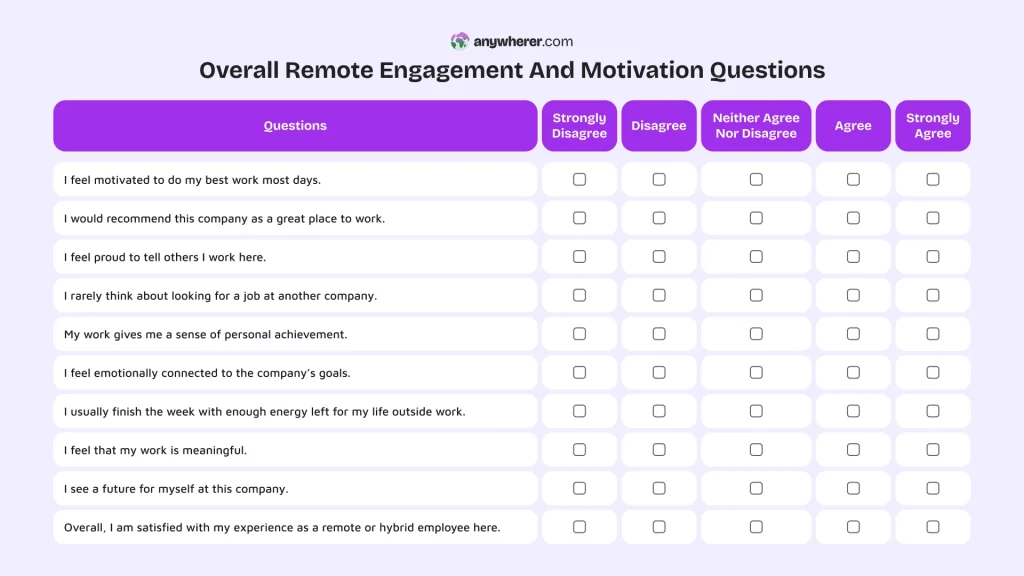
This group looks at how people feel about their work day to day. It checks energy levels, optimism, and the basic connection between the employee and their job. For remote teams, this is your early signal for burnout or quiet disengagement.
Questions:
- I feel motivated to do my best work most days.
- I would recommend this company as a great place to work.
- I feel proud to tell others I work here.
- I rarely think about looking for a job at another company.
- My work gives me a sense of personal achievement.
- I feel emotionally connected to the company’s goals.
- I usually finish the week with enough energy left for my life outside work.
- I feel that my work is meaningful.
- I see a future for myself at this company.
- Overall, I am satisfied with my experience as a remote or hybrid employee here.
Suggested response scale:
- Strongly disagree
- Disagree
- Neither agree nor disagree
- Agree
- Strongly agree
How to interpret responses to these questions: Look at averages over time rather than single scores. If motivation questions trend down across several surveys, that’s a warning sign. Also look at gaps between teams, managers, or locations. In remote work, one team may feel fine while another is quietly struggling but less visible.
Signals to watch for:
- Sharp drop in “I rarely think about looking for a job”
- Low or falling scores on “I see a future for myself here”
- Big difference between “proud to work here” and “motivated most days”
- High “neutral” scores across many questions, which may indicate quiet disconnection
2. Communication and Collaboration in Remote Teams
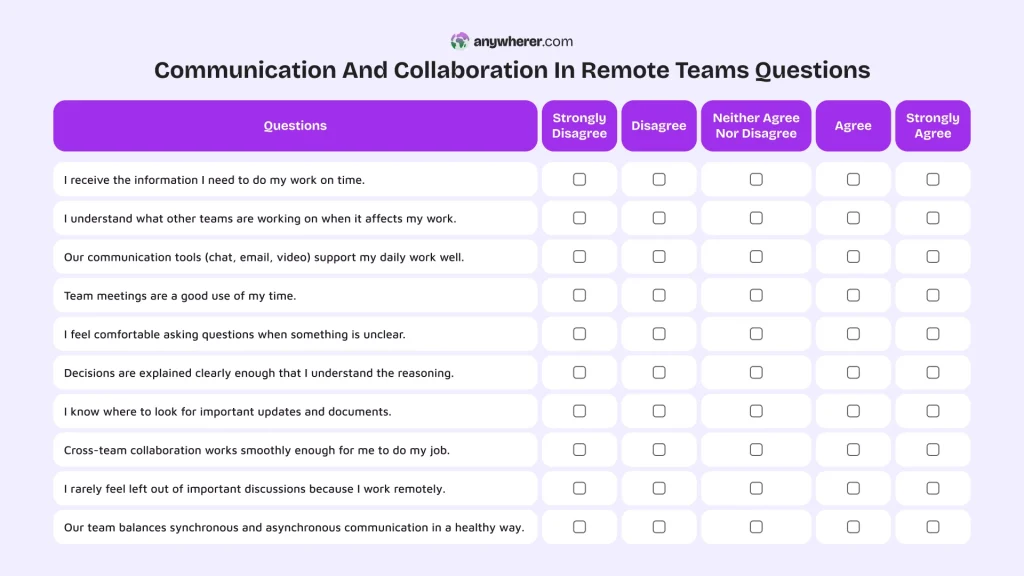
This area checks how well information flows, how people work together, and whether remote tools actually help or just create noise. It also touches on meeting quality and clarity of communication.
Questions:
- I receive the information I need to do my work on time.
- I understand what other teams are working on when it affects my work.
- Our communication tools (chat, email, video) support my daily work well.
- Team meetings are a good use of my time.
- I feel comfortable asking questions when something is unclear.
- Decisions are explained clearly enough that I understand the reasoning.
- I know where to look for important updates and documents.
- Cross-team collaboration works smoothly enough for me to do my job.
- I rarely feel left out of important discussions because I work remotely.
- Our team balances synchronous and asynchronous communication in a healthy way.
Suggested response scale:
- Strongly disagree
- Disagree
- Neither agree nor disagree
- Agree
- Strongly agree
How to interpret responses to these questions: If people rate meetings low but information flow high, you may be able to shift more work into async updates. If people feel lost about cross-team work or decisions, you may need better documentation or clearer owners. In remote contexts, even small communication gaps can grow into bigger trust issues over time.
Signals to watch for:
- Low scores on “I know where to look for important updates”
- Many people disagree that meetings are a good use of time
- High disagreement on “I rarely feel left out of important discussions”
- Comments in open text about confusion, repeated work, or missed dependencies
3. Manager Support and Feedback in a Remote Environment
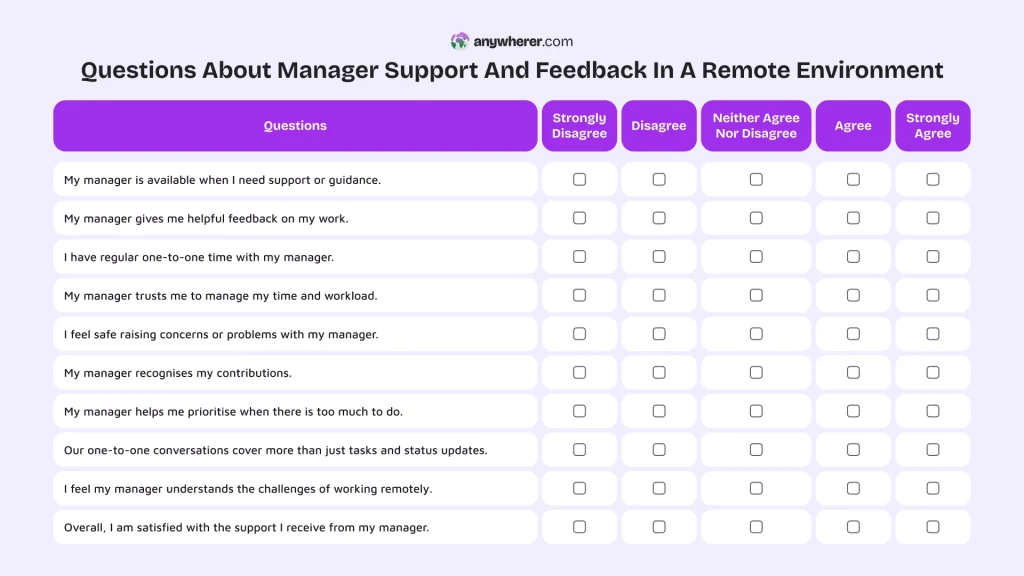
These questions explore the relationship between employee and manager in a remote context: support, availability, clarity, and feedback. Remote employees rely heavily on their manager to stay aligned and feel seen.
Questions:
- My manager is available when I need support or guidance.
- My manager gives me helpful feedback on my work.
- I have regular one-to-one time with my manager.
- My manager trusts me to manage my time and workload.
- I feel safe raising concerns or problems with my manager.
- My manager recognises my contributions.
- My manager helps me prioritise when there is too much to do.
- Our one-to-one conversations cover more than just tasks and status updates.
- I feel my manager understands the challenges of working remotely.
- Overall, I am satisfied with the support I receive from my manager.
Suggested response scale:
- Strongly disagree
- Disagree
- Neither agree nor disagree
- Agree
- Strongly agree
How to interpret responses to these questions: Compare manager support scores with overall engagement. If people feel disengaged but still rate their manager highly, the issues may sit at company or team level. If scores vary a lot between managers, that points to coaching or training needs.
Signals to watch for:
- Low agreement on “I feel safe raising concerns”
- Rare or missing one-to-ones reported by many people
- Managers seen as unavailable or only focused on tasks
- Remote challenges mentioned often in comments without clear support
4. Role Clarity and Expectations for Remote Employees
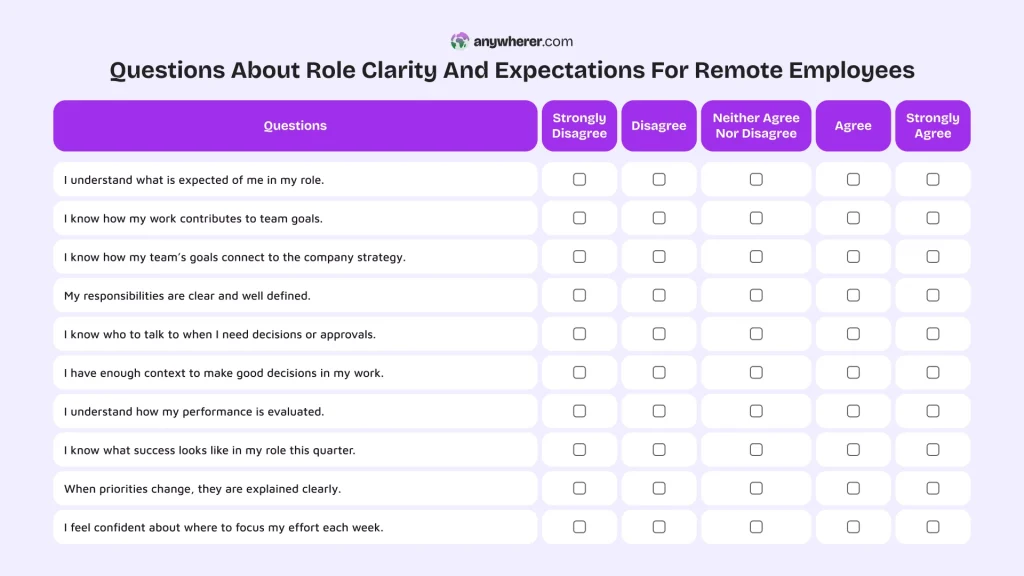
Remote employees need clear roles and expectations because they have fewer chances to “pick things up” informally. This set checks if people know what success looks like and how their work connects to bigger goals.
Questions:
- I understand what is expected of me in my role.
- I know how my work contributes to team goals.
- I know how my team’s goals connect to the company strategy.
- My responsibilities are clear and well defined.
- I know who to talk to when I need decisions or approvals.
- I have enough context to make good decisions in my work.
- I understand how my performance is evaluated.
- I know what success looks like in my role this quarter.
- When priorities change, they are explained clearly.
- I feel confident about where to focus my effort each week.
Suggested response scale:
- Strongly disagree
- Disagree
- Neither agree nor disagree
- Agree
- Strongly agree
How to interpret responses to these questions: Low clarity is a big risk in remote settings because people can drift without anyone noticing. If many employees feel unsure about expectations, you may need better goal setting, clearer documentation, or more frequent check-ins.
Signals to watch for:
- Low scores on “I understand what is expected of me”
- Confusion about how work links to company strategy
- Comments about changing priorities without explanation
- Team-level gaps where one function feels much less clear than others
5. Workload, Boundaries and Remote Well-Being
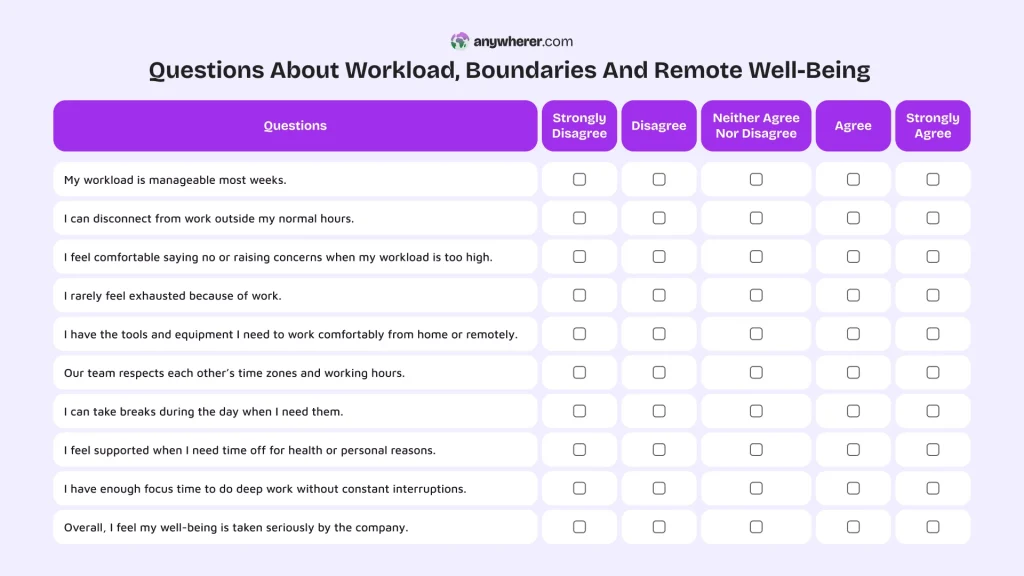
This section focuses on pace, stress, and boundaries between work and life. Remote setups can easily blur these lines and hide overwork until it becomes serious burnout.
Questions:
- My workload is manageable most weeks.
- I can disconnect from work outside my normal hours.
- I feel comfortable saying no or raising concerns when my workload is too high.
- I rarely feel exhausted because of work.
- I have the tools and equipment I need to work comfortably from home or remotely.
- Our team respects each other’s time zones and working hours.
- I can take breaks during the day when I need them.
- I feel supported when I need time off for health or personal reasons.
- I have enough focus time to do deep work without constant interruptions.
- Overall, I feel my well-being is taken seriously by the company.
Suggested response scale:
- Strongly disagree
- Disagree
- Neither agree nor disagree
- Agree
- Strongly agree
How to interpret responses to these questions: If people feel engaged but also report frequent exhaustion, you may have “engaged but burnt out” employees. Pay attention to time zone issues, message expectations, and project planning. In remote teams, this can show up as people answering messages late at night or on weekends.
Signals to watch for:
- Low scores on “I can disconnect from work”
- Many people disagree that their workload is manageable
- Comments about late messages, weekend work, or constant urgency
- High disagreement on feeling supported with time off
6. Recognition & Visibility in Distributed Teams
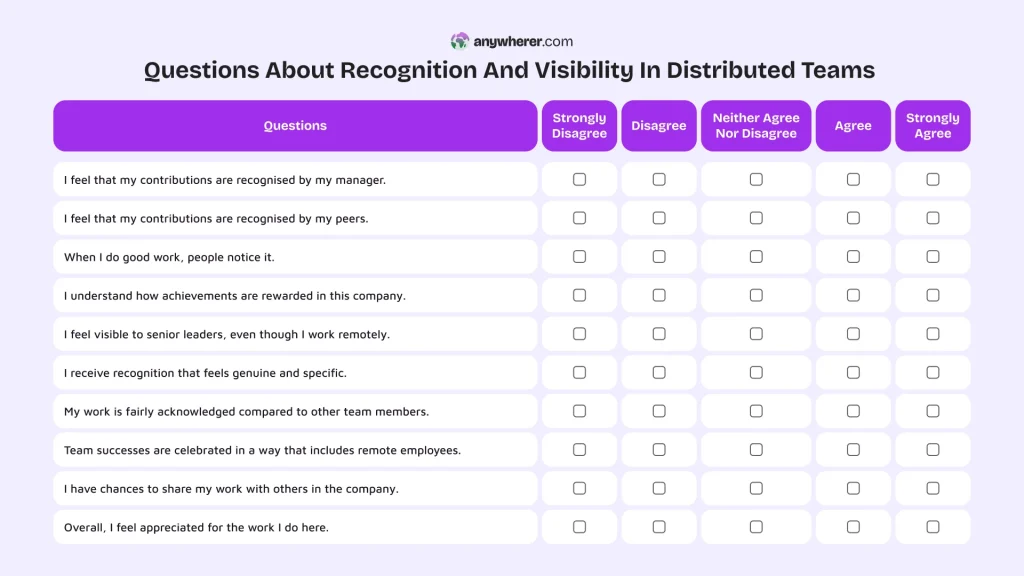
These questions focus on whether remote employees feel seen, appreciated, and visible. In distributed teams it is easy for “quiet” contributors to be overlooked, especially if they’re in another country or time zone.
Questions:
- I feel that my contributions are recognised by my manager.
- I feel that my contributions are recognised by my peers.
- When I do good work, people notice it.
- I understand how achievements are rewarded in this company.
- I feel visible to senior leaders, even though I work remotely.
- I receive recognition that feels genuine and specific.
- My work is fairly acknowledged compared to other team members.
- Team successes are celebrated in a way that includes remote employees.
- I have chances to share my work with others in the company.
- Overall, I feel appreciated for the work I do here.
Suggested response scale:
- Strongly disagree
- Disagree
- Neither agree nor disagree
- Agree
- Strongly agree
How to interpret responses to these questions: Compare recognition scores with overall engagement. Low recognition can explain drops in motivation. If people feel seen by peers but not by leaders, focus on visibility and communication from the top.
Signals to watch for:
- Many employees feel unseen by senior leaders
- Low agreement on fair acknowledgement compared to others
- Comments about being left out of celebrations or updates
- Repeated notes about “quiet work” or “behind the scenes” tasks not being recognised
7. Career Growth & Development for Remote Employees
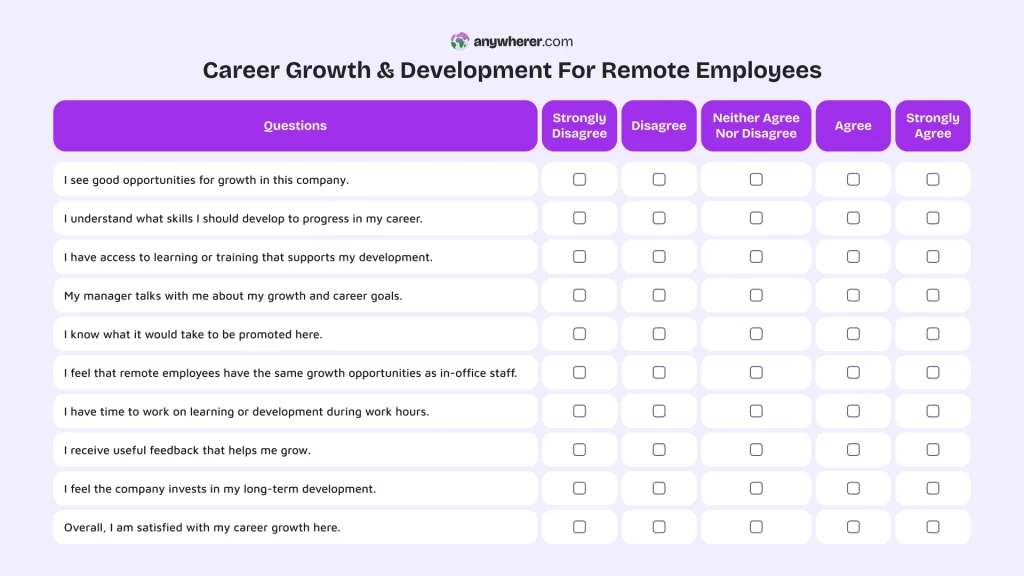
Remote employees often worry that being away from the office will slow their career. These questions examine access to growth, learning, and internal mobility.
Questions:
- I see good opportunities for growth in this company.
- I understand what skills I should develop to progress in my career.
- I have access to learning or training that supports my development.
- My manager talks with me about my growth and career goals.
- I know what it would take to be promoted here.
- I feel that remote employees have the same growth opportunities as in-office staff.
- I have time to work on learning or development during work hours.
- I receive useful feedback that helps me grow.
- I feel the company invests in my long-term development.
- Overall, I am satisfied with my career growth here.
Suggested response scale:
- Strongly disagree
- Disagree
- Neither agree nor disagree
- Agree
- Strongly agree
How to interpret responses to these questions: If engagement is high but growth scores are low, you may have happy but stuck employees who will later leave for better opportunities. Remote workers can feel especially blocked if promotions seem to favour in-person staff or certain locations.
Signals to watch for:
- Low scores on “remote employees have the same growth opportunities”
- Unclear promotion paths mentioned often in comments
- Little or no time for learning during work
- High neutrality across growth questions, which can indicate lack of information
Open-Ended Employee Engagement Survey Questions
Scaled questions are useful for trends, but open ended employee engagement survey questions help you understand the story behind the numbers. In remote teams, where context can be missing, these open answers are especially valuable.
Use a smaller set of open questions at the end of your survey or in a separate pulse. Below are ten options, each with a sample answer and red flags to watch for.
Note: You do not need to ask all of these in one go. Pick 2–4 at a time.
“What is one thing that makes your work easier as a remote employee here?”
Sample answer:
“Our shared documentation helps a lot. I can usually find answers without waiting for someone to come online. I also appreciate that my manager keeps meetings focused so I have time for deep work.”
Red flags to watch for:
- Employee struggles to name even one helpful thing
- Heavy focus on individual hacks, no mention of company support
- Comments like “nothing really makes it easier” or “I just cope”
“What is one thing that currently makes your work harder than it needs to be?”
Sample answer:
“We use several tools for communication and I am never sure which one to check first. Sometimes I miss updates because they only appear in one channel.”
Red flags to watch for:
- Mention of unclear priorities or constant changes
- Comments about time zones not being respected
- References to long days, late messages, or frequent urgent requests
“If you could change one thing about how our team communicates, what would it be and why?”
Sample answer:
“I would like more written updates instead of extra meetings. Written summaries would make it easier to follow along when I can’t join live.”
Red flags to watch for:
- Feelings of being left out of decisions
- Repeated mention of meetings that feel pointless
- Strong frustration with tools or lack of structure
“Do you feel your work is recognised fairly? Please explain your answer.”
Sample answer:
“I feel recognised within my immediate team, but people outside our group rarely see what we do. Sometimes I would like more chances to share our work in wider forums.”
Red flags to watch for:
- “My work happens behind the scenes and nobody notices”
- Perception that only loud or visible roles get credit
- Concerns about bias toward certain locations or time zones
“What is one thing your manager could start or stop doing to better support you as a remote employee?”
Sample answer:
“It would help if we had more regular one-to-one time. Right now it only happens when something is wrong, which makes those calls stressful.”
Red flags to watch for:
- Manager is rarely available or often cancels one-to-ones
- Feedback only appears when something goes wrong
- Employee feels judged rather than supported
“How do you feel about your workload over the last three months?”
Sample answer:
“It has been heavy at times but mostly manageable. The main issue is last-minute requests that appear late in my day and push me to work outside my normal hours.”
Red flags to watch for:
- Mentions of ongoing exhaustion, not just short peaks
- Signs of blurred boundaries between work and life
- Statements like “this pace is not sustainable”
“What could we do to make remote collaboration smoother across teams?”
Sample answer:
“Clearer owners for cross-team projects would help. Sometimes I am not sure who has the final say, so decisions take longer than needed.”
Red flags to watch for:
- Confusion over ownership and responsibilities
- Friction between teams over delays or missed handoffs
- Complaints about tools without anyone responsible for improving them
“Do you see a future for yourself at this company in the next two years? Why or why not?”
Sample answer:
“Yes, I do. I see growth in my role and I know the skills I need to move into a senior position. I also feel the company is investing in remote teams.”
Red flags to watch for:
- Any version of “I’m not sure” without a clear path
- People saying they enjoy the work but see no growth
- Comments hinting that remote employees are second-class
“What kind of learning or development support would be most useful for you right now?”
Sample answer:
“I would value more structured mentoring and time set aside for online courses related to my role. It would help if we had a clearer budget or policy for development.”
Red flags to watch for:
- Lack of awareness about existing learning options
- Feeling guilty or afraid to ask for development time
- Belief that development is only for in-office staff
“Is there anything else you would like leadership to know about your experience as a remote employee?”
Sample answer:
“Overall I’m happy here, but sometimes I feel decisions are announced suddenly without context. More visibility into how and why choices are made would help me feel more connected.”
Red flags to watch for:
- Strong statements of distrust or unfairness
- Repeated notes about “surprise” decisions
- Comments suggesting leaders don’t understand remote realities
Conclusion
Measuring employee engagement for remote employees is not about ticking a box. It’s a way to listen at scale, spot patterns early, and build a culture where people feel safe, supported, and proud of their work, even when they rarely meet in person.
A few simple principles:
- Use short, focused surveys more often instead of one long annual form
- Combine scaled questions for employee engagement survey with open text
- Share results openly and be honest about what you can and cannot change
- Pick one or two areas to improve at a time and follow through
Engagement in remote teams is never “done.” But with the right questions, and real follow-up, you can build a feedback loop that keeps people connected and helps them stay for the long term.
FAQs on Survey Questions to Measure Employee Engagement
How do you measure employee engagement in fully remote teams?
You measure engagement by combining data from different sources: employee engagement survey questions and answers, participation in projects, turnover patterns, and feedback from one-to-ones. Surveys give you structured input on motivation, communication, workload, and growth. In remote teams you rely more on these written signals because you have fewer in-person cues.
How often should remote employee engagement surveys be conducted?
Most remote teams use a mix of short pulse surveys every few weeks or months and one or two deeper surveys each year. The key is consistency. If you ask for feedback too rarely, you miss changes. If you ask too often without acting, people stop taking it seriously.
Should remote employee engagement surveys be anonymous?
In most cases, yes. Anonymity helps remote employees speak honestly, especially in small teams where people worry about being identified. You can still analyse by team, location, or function as long as you respect minimum group sizes and share how aggregated data will be used.
What is a good response rate for engagement surveys in remote teams?
Many companies aim for at least 70% response rate for core employee engagement pulse survey questions. Higher is even better. If response rates drop, that can be a signal of survey fatigue or lack of trust that anything will change. Shorter surveys and visible follow-up usually help.
How long should a remote employee engagement survey be?
Most remote employees are comfortable with surveys that take 7–10 minutes. That usually means 20–30 scaled questions plus a few open-ended ones. For very busy teams, start shorter and add depth with follow-up pulses or team discussions.
What’s the difference between pulse surveys and annual engagement surveys for remote teams?
Annual or bi-annual surveys give a broad view of engagement, culture, and leadership. Pulse surveys are short and more frequent, focused on a few topics at a time. For remote teams, pulse surveys are especially useful because they show trends and let you react early when something starts to slip.

Yaryna is our lead writer with over 8 years of experience in crafting clear, compelling, and insightful content. Specializing in global employment and EOR solutions, she simplifies complex concepts to help businesses expand their remote teams with confidence. With a strong background working alongside diverse product and software teams, Yaryna brings a tech-savvy perspective to her writing, delivering both in-depth analysis and valuable insights.