Here’s a scenario most people have been through. Someone gets a performance review, and the whole thing is basically just their manager’s opinion. One person’s take, filtered through whatever that manager happened to notice over the past year. Maybe it’s accurate. Maybe it’s missing half the picture. Usually it’s somewhere in between.
360-degree feedback tries to fix that. Instead of one perspective, you get input from several directions at once: the manager, yes, but also colleagues who work alongside the person, direct reports who see a completely different side of them, and sometimes people outside the team entirely. Put all of that together and you start to get something that actually resembles how someone really operates at work.
It’s not a new idea, but the evidence for it is solid. SHRM describes 360-degree coaching as one of the most effective leadership development tools available, specifically because it draws on unfiltered feedback from multiple sources. For anyone who’s watched a traditional review process fail to produce any real change, that’s a meaningful distinction.
What follows is a practical guide. You’ll find over 100 360 degree feedback examples organized by competency, a 360 degree feedback sample for both positive and developmental feedback in each category, and these 360 degree feedback samples are ready to use without much modification. There’s also a full question bank, notes for image content blocks, and answers to the questions that come up most often when teams run this process for the first time.
360 Degree Feedback Examples by Category
Rather than one long list, the examples here are sorted by competency. That makes it easier to find relevant language quickly, especially when you’re reviewing someone across multiple areas. Each section works as a standalone 360 degree feedback template, or you can combine all five into complete 360 degree feedback templates that cover different role types and levels. Use them as-is, adapt the wording to your context, or treat them as a 360-degree feedback template your team can build on over time.
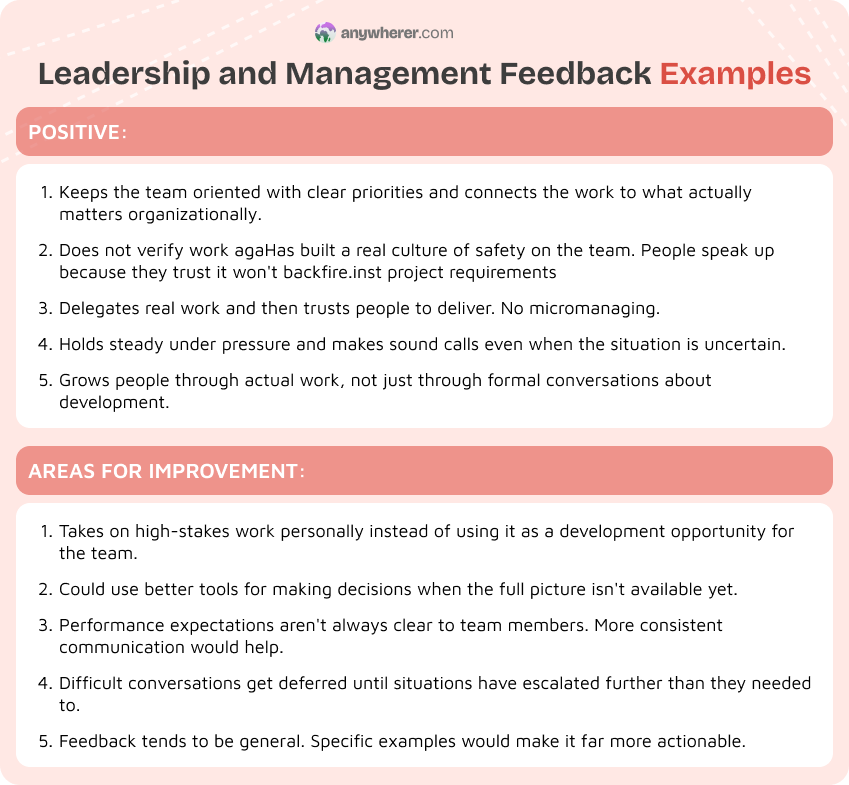
Leadership and Management Feedback Examples
Good leadership is one of those things that’s hard to define in the abstract but pretty obvious when you’re actually on the receiving end of it. Or not receiving it, as the case may be. This section covers direction-setting, decision-making under pressure, how someone develops their people, and whether they create an environment where good work is actually possible. Every example of 360 degree feedback here is written for direct use. These 360 degree feedback examples are especially relevant when reviewing managers or anyone in a senior individual contributor role.
Positive feedback samples:
- The team knows what the priorities are at any given point, and why. That clarity comes directly from how this person communicates direction.
- People on the team feel comfortable raising concerns, sharing rough ideas, and pushing back. That kind of psychological safety doesn’t happen by accident.
- Good at matching work to the right person and then actually stepping back. Doesn’t hover.
- When situations are messy or the stakes are high, stays grounded and makes decisions that hold up. The team takes its cues from that.
- Actively invests in the people on the team. Not just through formal development conversations but through real opportunities to stretch.
- When a decision gets made, explains the reasoning. That transparency matters a lot, especially when change is happening fast.
- Recognition isn’t rationed or saved for year-end. Gives it consistently, specifically, and when it actually counts.
- Accountability lands differently here than in most teams. It’s firm when it needs to be, but it doesn’t feel punitive.
- Reads situations well. Adjusts how they lead based on what the person or the moment actually calls for.
- Models the values the organization talks about rather than just repeating them. Integrity shows up in day-to-day behavior, not just in big moments.
Areas for improvement:
- When something high-stakes comes up, tends to take it on personally rather than distributing it. That’s a bottleneck for the team and a missed development opportunity.
- Decision-making slows in ambiguous situations. There’s a tendency to wait for clarity that may not arrive. Some frameworks for moving forward with incomplete information would help.
- A few team members aren’t sure what strong performance looks like for them specifically. More frequent, targeted check-ins would close that gap.
- Recognition tends to happen publicly. For people who’d rather be acknowledged privately, that doesn’t always work as well.
- Hard conversations get put off. And by the time they happen, a manageable issue has usually grown into something bigger.
- Doesn’t always take time to understand what each person on the team is working toward in their career. That makes it harder to give meaningful support.
- Feedback stays at a fairly high level. Adding specific examples to observations would make coaching significantly more useful.
- Defaults to building consensus even in situations where a clear, fast decision would actually serve the team better.
- Organizational noise and shifting priorities sometimes reach the team unfiltered. Better shielding would help people stay focused on what matters.
- Doesn’t always set visible limits on their own working hours, which can make it harder for the rest of the team to feel they can do the same.
Communication and Collaboration Feedback Samples
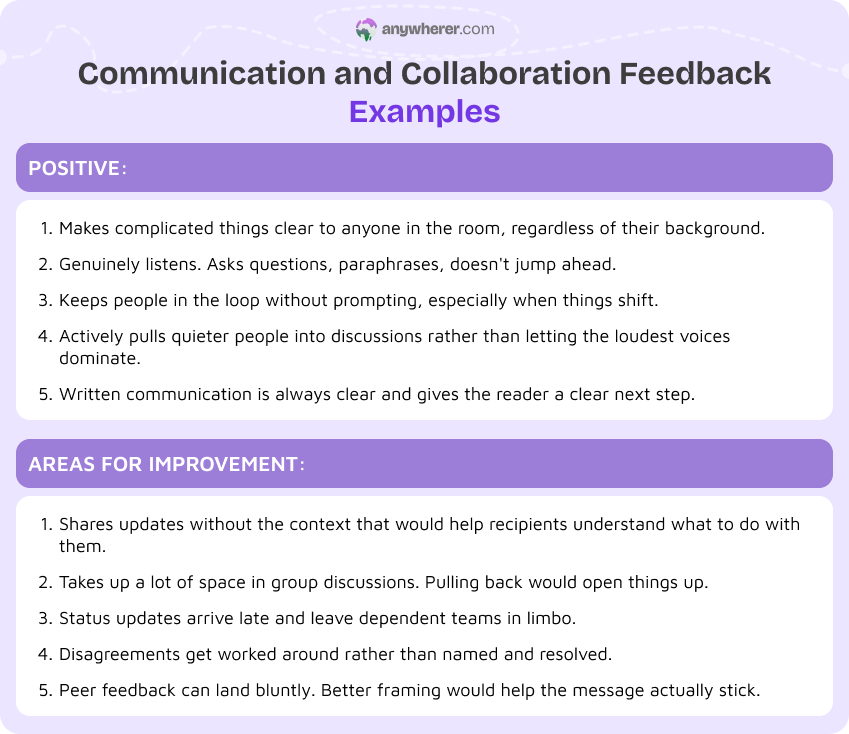
Communication comes up in almost every 360 degree feedback sample responses set, and it makes sense why. It’s underneath nearly everything else. This section is about how someone shares information, whether they actually listen, how they work across teams, and whether collaboration with them is genuinely productive or mostly a formality.
Positive feedback samples:
- Takes something complicated and explains it in a way that different people, with different backgrounds, can actually do something with.
- Listens in a way that’s noticeable. Asks questions. Reflects things back. Doesn’t interrupt or start formulating a response before the other person has finished.
- Stakeholders get updates without having to ask. Especially useful on projects that are changing direction or running behind.
- In group settings, pays attention to who’s not speaking and finds ways to bring them in, either in the room or in a follow-up.
- Comfortable translating between technical and non-technical audiences. Does it without talking down to either side.
- Written communication is clear, short enough to actually read, and always gives the reader something to do next.
- Approaches cross-functional work with genuine interest rather than treating it as a box to check.
- Shifts how they communicate depending on who they’re talking to, what channel makes sense, and what’s actually at stake in the conversation.
- Both gives and receives feedback in a way that feels like a real conversation. Not defensive, not performative.
- Follows through on what they say they’ll do in meetings. That kind of reliability is rarer than it sounds and it makes a difference.
Areas for improvement:
- Often shares information without enough context. People get the what but not the why, and that leaves them uncertain about what to do with it.
- In group discussions, can take up more of the space than is useful. Stepping back and actively inviting others in would improve the output.
- Written updates come late more often than they should. Teams that depend on them end up in a holding pattern.
- Tone in emotionally charged conversations could be better managed. The message lands harder than intended sometimes.
- Has a habit of working around disagreements rather than addressing them head-on. Surfacing things earlier usually leads to faster resolution.
- Meetings don’t always have a clear shape or intended outcome. Better structure would help conversations stay on track.
- Peer feedback can come across as blunt. The content is usually fair, but leading with the intent behind the comment would make it easier to receive.
- Most cross-functional relationships are transactional. A bit more investment in actual connection would make collaboration smoother over time.
- Information sometimes flows to a narrow group when broader sharing would have served the whole team better.
- In some conversations, the responses suggest the other person wasn’t quite fully heard. More active listening would help.
Problem-Solving and Innovation Feedback Samples
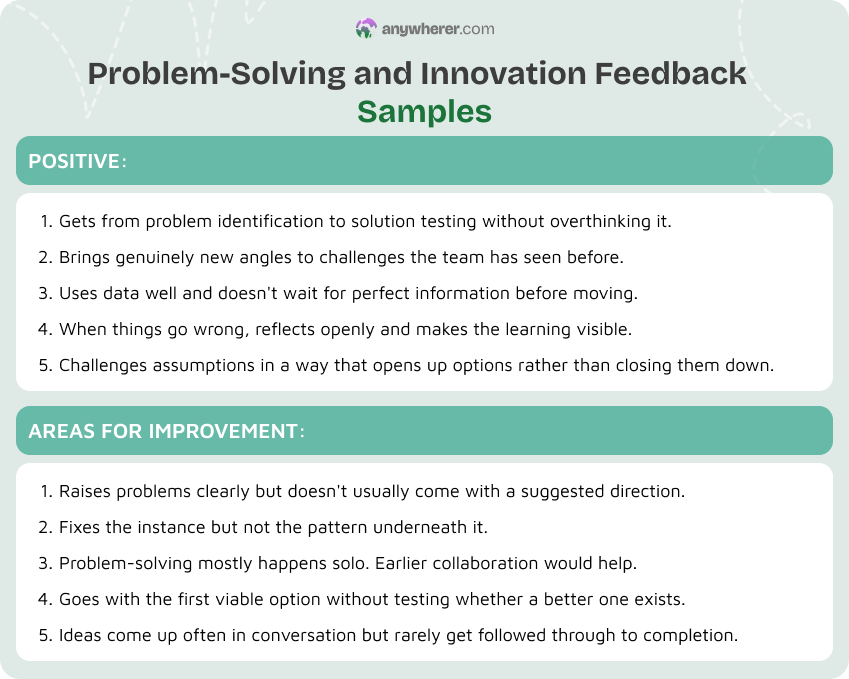
This category is less about whether someone solved the problem and more about how they went about it. A useful 360 degree feedback example here captures observable behavior: what did they actually do when something was wrong or unclear? Did they bring others in? Did they look at the root or just the surface?
Positive feedback samples:
- Moves from problem to solution quickly without getting stuck turning it over endlessly.
- When a familiar challenge comes up again, doesn’t reach for the same answer that was used last time. Asks whether there’s a better one.
- Uses data practically. Neither ignores it nor freezes waiting for a level of certainty that isn’t coming.
- Has a knack for framing problems in ways that open up the range of options rather than narrowing it before it’s had a chance to develop.
- Draws on people from different parts of the organization when working through something difficult. The solutions that come out of that tend to be better.
- When a project doesn’t go as planned, reflects openly on what went wrong and what would be different next time. That modeling matters.
- Spots issues at the process level, not just at the individual instance level. Fixes things more durably as a result.
- Keeps creativity grounded. Understands that an idea that can’t be executed in this context isn’t actually useful yet.
- Tests things deliberately. Knows what success would look like before starting and evaluates results honestly.
- Pushes back on assumptions in a way that doesn’t put people on the defensive. Opens things up rather than shutting them down.
Areas for improvement:
- Good at identifying what’s wrong. Less consistent at coming in with a proposed direction forward. Pairing the two would add more value.
- Solutions sometimes work locally but create problems downstream. A bit more scoping before implementation would reduce that.
- Risk appetite is on the conservative side, which can hold the team back from innovation that has real potential.
- Most problem-solving happens individually. Bringing others in earlier would usually surface better options and speed up buy-in.
- Ideas get floated fairly often but not always followed through. Closing the loop on proposals would build credibility over time.
- Recommendations would land better with more data behind them. Developing that habit is worth the effort.
- Tends to commit to the first solution that seems workable. Holding out for a couple of alternatives first sometimes leads somewhere better.
- Problems get addressed one instance at a time. Flagging the pattern underneath would drive more lasting improvement.
- Risk assessment tends to focus on the technical dimensions and underweights the human and process factors that often drive failure.
- Ideas sometimes get shared before they’re fully formed. That makes it harder for others to evaluate them fairly or get behind them.
Adaptability and Learning Feedback Examples
A lot of organizations say they value adaptability and then don’t actually measure it. These 360 degree feedback sample answers are designed to capture real behavior, not just attitude. How does someone actually respond when the plan changes, when a skill gap shows up, or when the environment they’re used to operating in shifts around them?
Positive feedback samples:
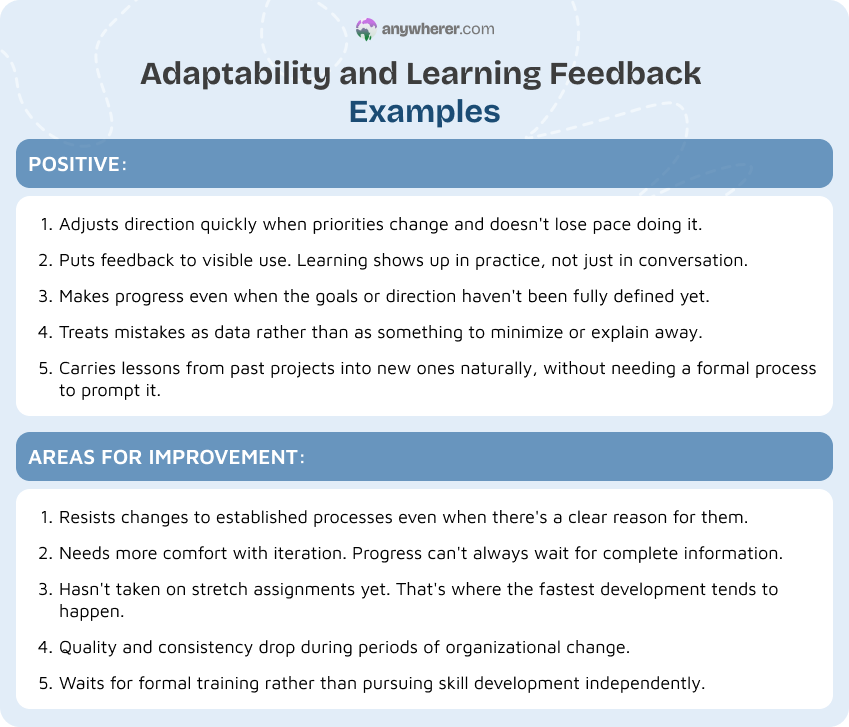
- When priorities change, adjusts quickly. Doesn’t need a long runway to recalibrate.
- Treats change as something to get curious about. That attitude tends to rub off on people nearby.
- Actively asks for feedback and does something visible with it. Learning isn’t performative here, it actually shows up in how they work.
- Picks up new technical skills or domain knowledge fast when the role demands it.
- Comfortable operating in ambiguous situations. Makes real progress even when the full picture hasn’t come together yet.
- Honest about mistakes and treats them as a starting point rather than something to move past as quickly as possible.
- Brings a genuine growth mindset to difficulty. Challenges are treated as something to work through, not evidence that something’s wrong.
- Stays current on what’s changing in their field without needing to be pushed. Proactive, not reactive.
- Consistent output even when processes, structures, or goals are in flux. Doesn’t need stability to do good work.
- Carries lessons from one project into the next without needing a formal retrospective to prompt it.
Areas for improvement:
- Pushes back on process changes even after the rationale has been explained. More openness to trying different approaches would help.
- Can get stuck waiting for certainty before moving. In fast-moving situations, that’s a problem. More comfort with iteration would make a real difference.
- Receives feedback well in the moment but implementation isn’t always visible afterward. Making that follow-through more explicit would help.
- Stays with familiar approaches even when the situation has clearly shifted. More proactive adaptation would be stronger than waiting until change is forced.
- New skill development often waits for a formal program. In environments that move quickly, self-directed learning would close gaps much faster.
- When role expectations feel unclear, the response is sometimes disengagement rather than actively seeking clarity.
- Output quality tends to dip during organizational transitions. More resilience to change would improve overall consistency.
- Doesn’t always build in time to reflect on what worked and what didn’t at the end of a cycle. That habit, if developed, would accelerate growth.
- Learning sometimes stays at the surface. Going deeper into development areas, even when it’s uncomfortable, produces more lasting results.
- Hasn’t yet put their hand up for stretch assignments that would push them into genuinely unfamiliar territory. That’s where the fastest development happens.
Work Ethic and Responsibility Feedback Examples
Capability matters, but reliability matters just as much. This category is about whether someone can actually be counted on. Do they follow through? Do they own what goes wrong? These examples fit well in a 360 degree feedback form template or as standalone notes within a broader review. They reflect the kind of behavior that either builds trust over time or quietly erodes it.
Positive feedback samples:
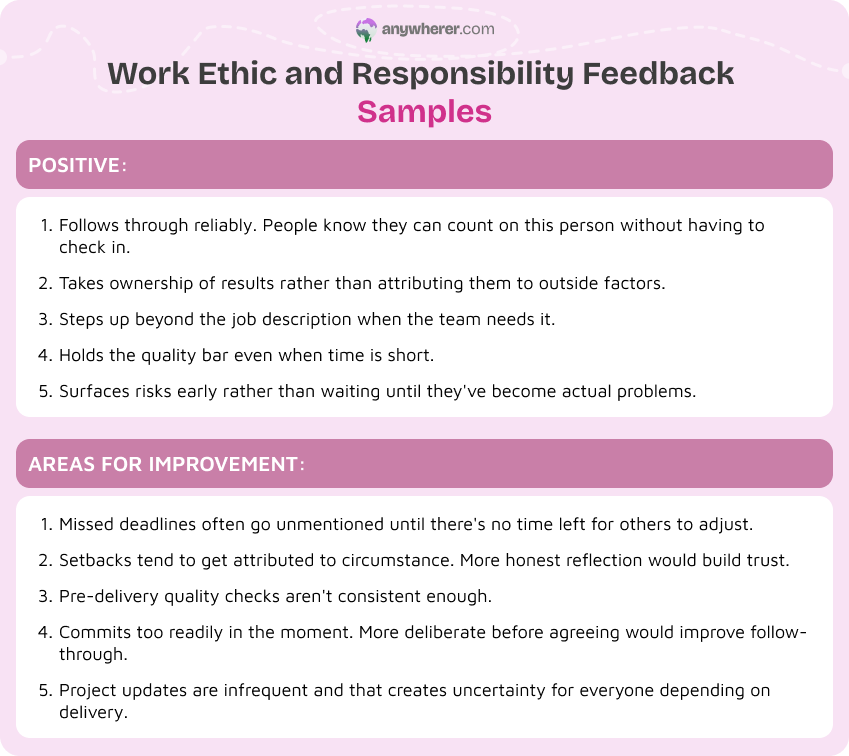
- When this person says they’ll do something, it gets done. That’s less common than it should be, and it makes a real difference to how the team functions.
- Doesn’t look for external explanations when things go wrong. Starts by looking at their own contribution.
- Pitches in beyond the defined scope when the work or the team needs it. Doesn’t wait to be asked, and doesn’t expect credit for it.
- Maintains quality standards even when time is tight. Urgency doesn’t become a reason to cut corners.
- Rarely drops something without flagging it first. When competing demands get unmanageable, says so before it becomes a problem.
- Honest about capacity limits. Raises concerns early rather than letting things slide and hoping no one notices.
- Reliable on small things too. That matters more than people give it credit for, because it signals that dependability isn’t situational.
- Brings real attention to quality. Work that goes through their hands tends to come out noticeably stronger.
- Produces consistently good output without needing close oversight. Self-directed and well-organized.
- Holds themselves to the same standards they’d expect of others on the team. That credibility doesn’t go unnoticed.
Areas for improvement:
- Missed deadlines sometimes go unmentioned until it’s too late for others to adjust. Earlier communication would give the team room to work with.
- When things go wrong, there’s a pattern of attributing it to external factors. More honest reflection on their own role would build trust over time.
- Quality slips under pressure more than it should. A more consistent habit of checking work before it goes out would help.
- Time isn’t always spent where it’ll have the most impact. More deliberate prioritization, especially when demands are competing, would help.
- Has a tendency to agree to things in the moment without fully thinking through whether follow-through is realistic. Being more deliberate before committing would strengthen trust.
Setting clearer personal benchmarks might help here. Looking at some employee performance goals examples could be a useful starting point for building a more structured way to track progress against expectations.
- Work sometimes drifts into areas that belong to other people without flagging it first. Better coordination would prevent friction.
- Project communication during active work is inconsistent. More regular updates would help stakeholders feel confident in delivery.
- Quality is applied unevenly. Some deliverables get serious attention while others come out below the expected standard.
- Established processes and documentation requirements don’t always get followed. More consistency here would help the team as a whole.
360 Degree Feedback Questions by Category
Bad questions produce useless answers. That’s really the whole problem with poorly run 360 processes. If the question is vague, the response will be vague, and no one grows from a vague response. The 360 degree feedback sample questions below are written to get specific, behavior-based input that actually has development value. They’re drawn from widely used 360 degree feedback questionnaire templates but rewritten to be clearer and more direct.
Each category covers multiple rater types: manager, peer, direct report, and self-assessment. The mix of rating-scale and open-ended questions is intentional. For more on writing effective review language in general, these performance review comments are worth a look.
Questions About Decision-Making and Accountability
These questions get at how someone makes calls when information is incomplete, how they stand behind those calls, and what happens when things don’t go as planned.
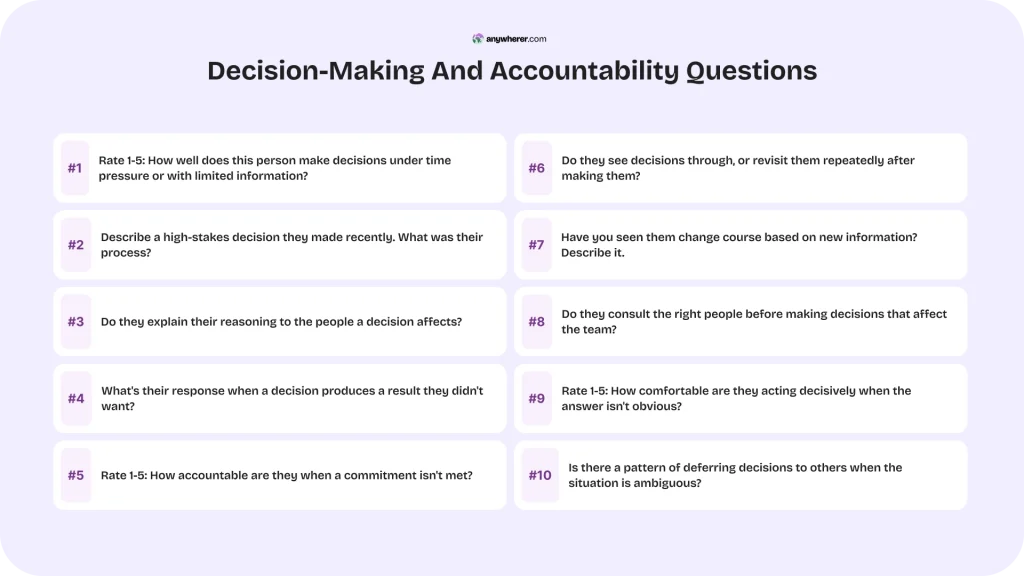
- Rate 1-5: How well does this person handle decisions when time is short or information is limited?
- Tell us about a specific situation where this person had to make a difficult call. How did they go about it?
- When this person makes a decision that affects others, how clearly do they explain their reasoning?
- What does this person do when a decision produces an outcome they didn’t expect or intend?
- How much does this person actually own their results rather than pointing to outside factors?
- Rate 1-5: Once a decision is made, how consistently does this person follow through on it?
- Has this person ever reversed course when new information came in? What did that look like?
- How do they balance speed and thoroughness when the stakes are real?
- Do they bring in the right people before making decisions that affect them?
- Rate 1-5: When a commitment doesn’t get met, how accountable is this person for it?
- Do they have a pattern of pushing decisions back to others rather than making the call themselves?
- How do they behave when a decision carries significant risk and there’s no clean answer?
360 Degree Feedback Questions About Emotional Intelligence and Interpersonal Skills
How someone manages their own reactions, picks up on what others are feeling, and handles interpersonal difficulty says a lot about how they’ll perform in almost any role. These questions are designed to surface that.
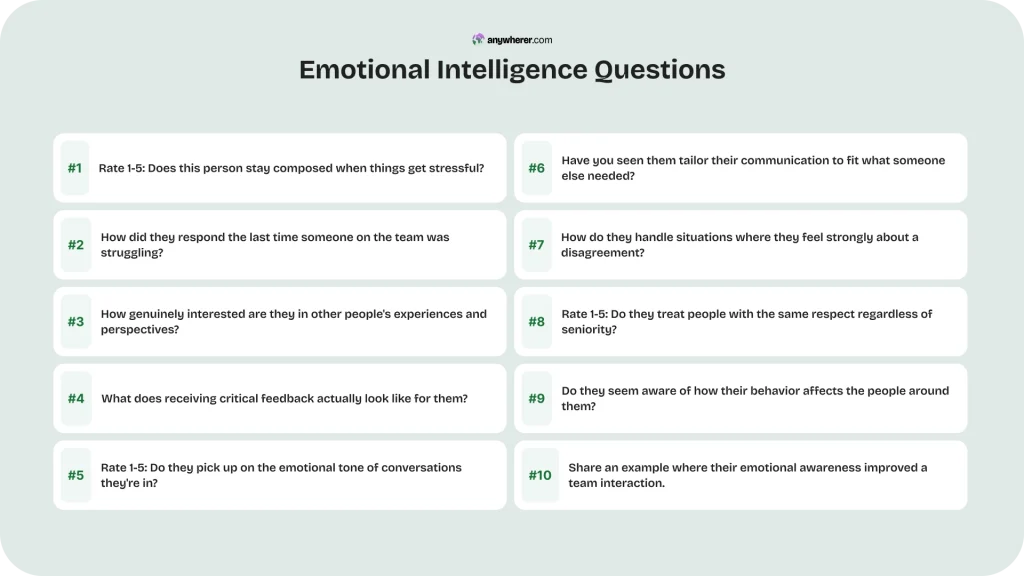
- Rate 1-5: When things get stressful or high-pressure, how well does this person manage their own response?
- Describe a situation where a colleague was struggling. How did this person respond to that?
- How genuine is this person’s interest in other people’s perspectives and experiences?
- When they receive critical feedback, what does that typically look like for them?
- Rate 1-5: How well do they read the emotional tone of a room or a conversation they’re in?
- Have you seen this person adjust how they communicate to fit what someone else needed? What happened?
- When they have strong feelings about a disagreement, how do they handle that?
- How well do they build actual trust and rapport with people across different teams or backgrounds?
- Rate 1-5: Do they treat people with consistent respect regardless of where they sit in the hierarchy?
- Can you give an example where this person’s emotional awareness made a real difference in how a team interaction went?
- Do they seem aware of how their behavior lands on the people around them?
- When a colleague is going through a hard time, how does this person show up?
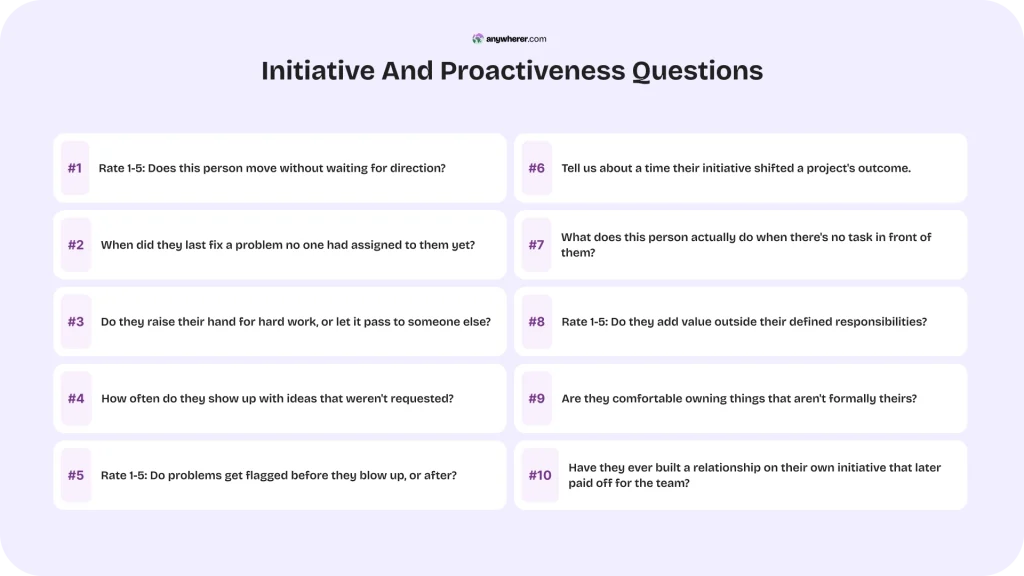
360-Degree Feedback Questions About Initiative and Proactiveness
Some people see something that needs doing and do it. Others wait to be told. These questions try to figure out which camp someone falls into, and whether that’s been consistent or situational.
- Without being asked, how often does this person actually go and fix something they spotted?
- Describe a specific time they caught a problem early and handled it before it became anyone else’s task.
- When uncomfortable or unfamiliar work comes up, do they put their hand up or quietly step back?
- How often do they walk in with an idea or a proposal nobody asked for?
- Rate 1-5: Do they mention risks and blockers early, or is the team usually caught off guard?
- Walk us through a situation where them taking initiative actually changed how something turned out.
- Is there evidence of them going beyond what their job description technically asks for?
- What does this person do in the gaps, when there’s no clear priority and no one has assigned them anything?
- Rate 1-5: Do they look for ways to be useful outside their own lane, or do they stay strictly within it?
- If no one gives them a playbook, do they write one themselves or wait for someone else to?
- Are they someone who takes on things that aren’t theirs to own, or do they stay narrowly focused on what’s assigned?
- Has there been a time they built a connection with someone proactively, without being asked to, that ended up helping the team?
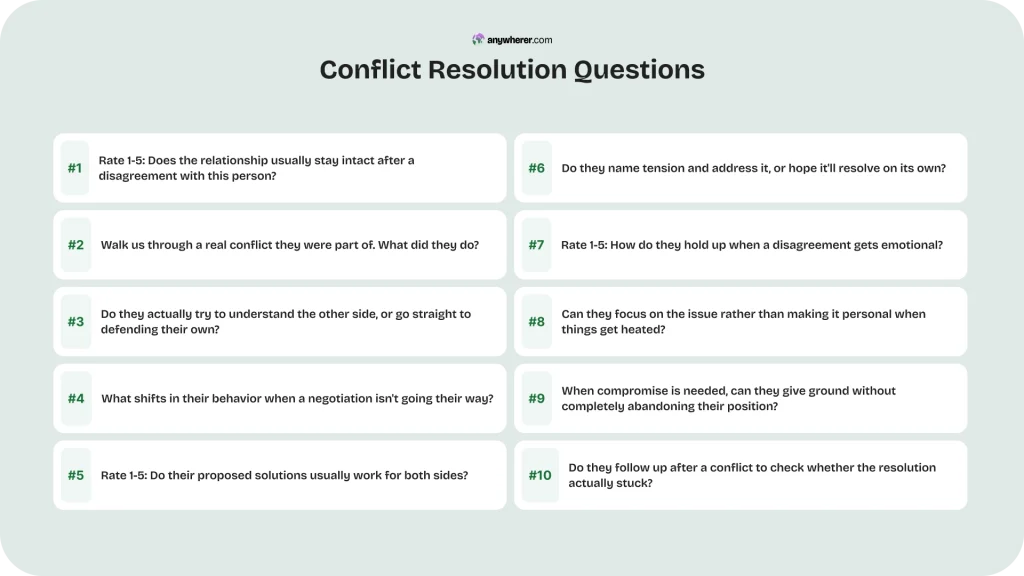
Questions About Conflict Resolution and Negotiation
Nobody likes conflict, but how someone handles it matters a lot, especially in roles where you’re constantly working across teams with competing priorities. These questions don’t try to catch someone out. They’re just trying to understand what actually happens when things get tense.
- Rate 1-5: When this person is in a disagreement, does the relationship usually survive it intact?
- Tell us about a conflict they were involved in. What did they actually do, step by step?
- Before pushing their own view, do they make a real effort to understand where the other person is coming from?
- When a negotiation starts going badly for them, what changes in how they behave?
- Rate 1-5: Do they tend to land on solutions that both sides can genuinely live with?
- Has there been a specific situation where the way they handled a conflict made the outcome better than it might have been? What happened?
- If something uncomfortable is sitting between them and a colleague, do they bring it up or let it sit?
- When disagreements start getting emotional, how does this person hold up?
- Rate 1-5: Can they stay focused on the actual issue rather than making it about the person?
- If they’re convinced they’re right but flexibility is needed, what do they do?
- After a conflict gets resolved, do they ever circle back to check whether it actually held?
- What happens to this person’s behavior if the other party becomes hostile or starts escalating?
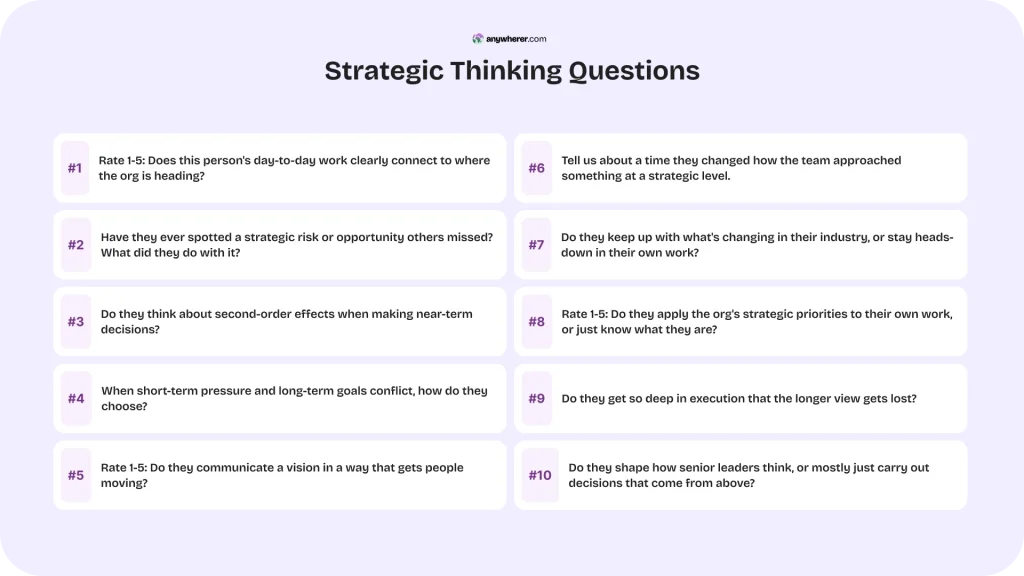
360 Degree Feedback Questions About Strategic Thinking and Vision
Not everyone needs to think strategically, but for managers and senior contributors, it matters quite a bit. These questions are a core part of any 360 degree feedback template for managers. They’re trying to find out whether someone is genuinely connected to what the organization is working toward, or just getting through their task list.
- Rate 1-5: Looking at this person’s day-to-day work, how clearly does it connect to where the organization is actually headed?
- Has there been a moment where they noticed something, a risk or an opportunity, that nobody else had picked up on yet? What happened?
- When they’re making a near-term call, how much thought goes into what that decision might close off or open up further down the road?
- Short-term pressure and longer-term goals don’t always point in the same direction. When that happens, what does this person typically do?
- Rate 1-5: Can they communicate a direction or vision in a way that actually lands with people and gets them moving?
- Give us an example of a time their strategic thinking shifted how the team or the organization approached something.
- Do they keep up with what’s changing in their field, or do they stay heads-down in their immediate work?
- Does this person think about second-order effects, what a current decision will make easier or harder six months from now?
- Rate 1-5: How well do they actually apply the organization’s strategic priorities to their own work rather than just knowing what they are?
- Is there a tendency to get so caught up in execution that the longer view gets lost?
- Do they try to shape how senior people are thinking, or do they mostly just carry out what comes down from above?
- When they’re weighing options, how do they think about short-term cost against longer-term benefit for the organization?
Frequently Asked Questions
Why is 360-degree feedback important?
A manager sees maybe 30% of what someone actually does at work. That’s being generous. They’re not in every meeting, they don’t see how this person behaves when a project hits a wall at 4pm on a Friday, and they definitely don’t see how the person is experienced by colleagues on other teams. That gap is significant, because some of the most important development opportunities live right there in the parts a single reviewer can’t see. The Center for Creative Leadership, which has spent over five decades studying exactly this, makes the case that 360 feedback produces a quality of self-awareness that no single-rater review can match. People see themselves more accurately when they hear from multiple directions at once, and that accuracy is what makes real development possible.
How should 360-degree feedback be structured?
The structure doesn’t need to be complicated, but it does need a few things to work properly. First, it needs a clear purpose. Feedback collected for development looks different from feedback used for an evaluation, and conflating the two causes problems. Second, it needs questions tied to specific, observable behaviors rather than vague traits. Third, it needs the right rater groups. Most organizations go with the direct manager, a peer group, and direct reports as their core three. A well-built 360 degree feedback template will cover all of that.
How often should 360-degree feedback be given?
Twice a year is the most common setup, usually tied to whatever performance cycle the organization already runs. Once a year is fairly standard too. But those are just the formal rounds. Lighter, informal check-ins can happen more often, especially around specific projects or development goals, without turning into a burden. The frequency that actually works is the one that keeps pace with how fast a person is changing in their role. If someone is in a high-growth situation, annual feedback is probably too infrequent to be useful.
What is the difference between 360-degree feedback and traditional performance reviews?
Traditional performance review comments come from one person, one angle, and typically focus on goal achievement and output. 360-degree feedback collects input from multiple directions and cares more about behavior, how someone works with others, and how they come across in different contexts. Neither one is a replacement for the other. A traditional review tells you what got delivered. A 360 tells you something about how. Both questions matter, and both are worth asking.
How do you handle negative feedback in 360-degree reviews?
The short version: vague feedback is useless, and specific feedback is hard to dismiss. ‘Needs to work on communication’ tells someone nothing. ‘Often sends updates only when prompted, which leaves the team unsure about where things stand’ gives someone an actual problem to solve. That’s the standard reviewers should be coached to. For the person on the receiving end, the most productive thing they can do is listen for patterns rather than reacting to individual comments. If three people mention the same thing independently, that’s worth taking seriously regardless of how much any single comment stings. The debrief is where a good facilitator can help by naming the themes without exposing individual contributors.
Can 360-degree feedback be anonymous?
For peers and direct reports, yes, and it’s usually the right call. Anonymity makes it possible for people to say what they actually think, particularly when giving feedback upward to a manager. Without it, a lot of honest input doesn’t get submitted at all. Manager responses are sometimes identified by default since the relationship is known anyway. The flip side of anonymity is that it occasionally produces low-quality responses, since there’s no accountability attached to vague or unconstructive comments. The way to counteract that isn’t to remove anonymity but to write better questions. One other thing worth handling well: participants should know what the confidentiality setup is before they submit, not find out afterward.

Yaryna is our lead writer with over 8 years of experience in crafting clear, compelling, and insightful content. Specializing in global employment and EOR solutions, she simplifies complex concepts to help businesses expand their remote teams with confidence. With a strong background working alongside diverse product and software teams, Yaryna brings a tech-savvy perspective to her writing, delivering both in-depth analysis and valuable insights.