Succession planning means deciding today who will fill a role tomorrow. The succession plan meaning boils down to one thing: a documented approach that maps critical positions to actual people who could step in. Every example of a succession plan usually follows that same logic, whether the company has five people or 5,000.
Most organizations recognize this need but stall on execution. A 2023 SHRM survey showed that only 21% of HR professionals reported having a formal succession plan in place. That number is surprising, but the pattern tracks. When a key person leaves without a ready replacement, projects stall and the remaining staff pick up work they never asked for. A solid succession plan template removes the blank-page problem. In this guide you will find eight succession plan templates, advice on how to write a succession plan, and real succession plan examples from companies you actually know.
Succession Plan Template Examples
Every succession plan template below uses the same layout: the problem it tackles, the core elements, challenges you will probably run into, best practices, and a table you can copy into a spreadsheet. Grab the succession plan sample closest to your situation and start filling it in. If you are wondering how to create a succession plan for employees at any level, these example succession plan frameworks give you a concrete starting point. A sample business succession plan does not need to be long. It needs to be honest and reviewed regularly.
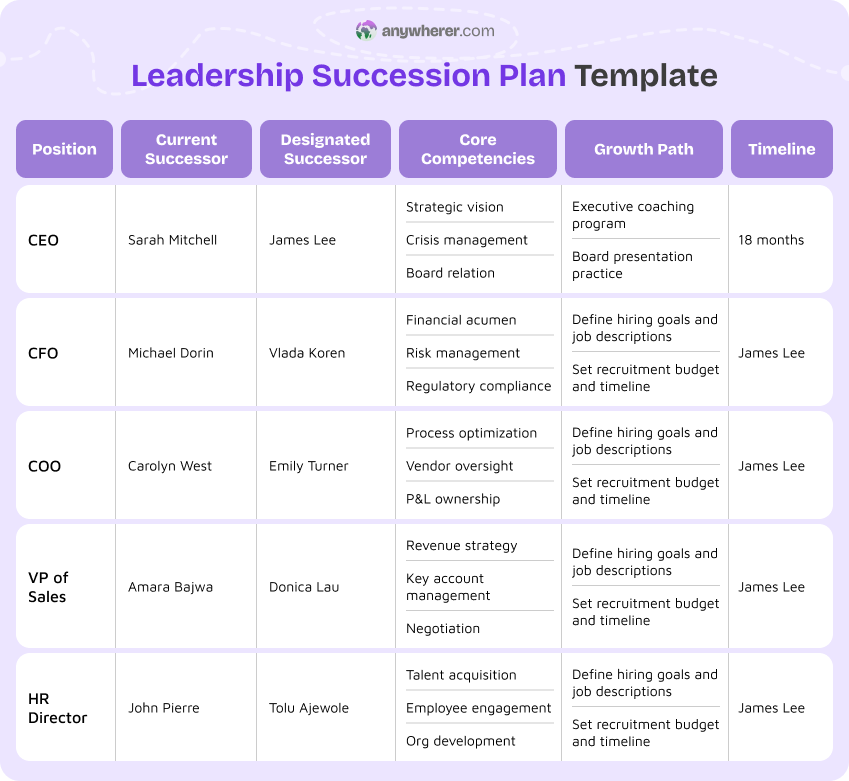
Leadership Succession Plan Template
What It Solves
Senior departures catch organizations off guard far more often than boards want to admit. I have watched companies scramble for months because nobody mapped who could step into a VP seat. A leadership succession plan fixes that gap before the vacancy shows up.
Core Elements
- Inventory of every leadership role with scope, decision rights, and reporting lines
- Readiness ratings for each candidate (ready now, ready in 12 months, developmental)
- Gap analysis comparing candidate competencies against role requirements
- Timeline for planned transitions with interim coverage arrangements
Challenges Overcome
Honest assessment is the hard part. Nobody wants to tell a VP that their favorite director is not ready. Running a calibration session where multiple leaders review the same candidates cuts that bias. Plans also go stale fast if nobody updates them after org changes.
Best Practices
- Tie readiness ratings to observable behaviors, not gut feeling
- Run a live tabletop exercise once a year to test the plan under a simulated departure
- Include external search as a fallback option for every critical seat
Employee Succession Plan Template
What It Solves
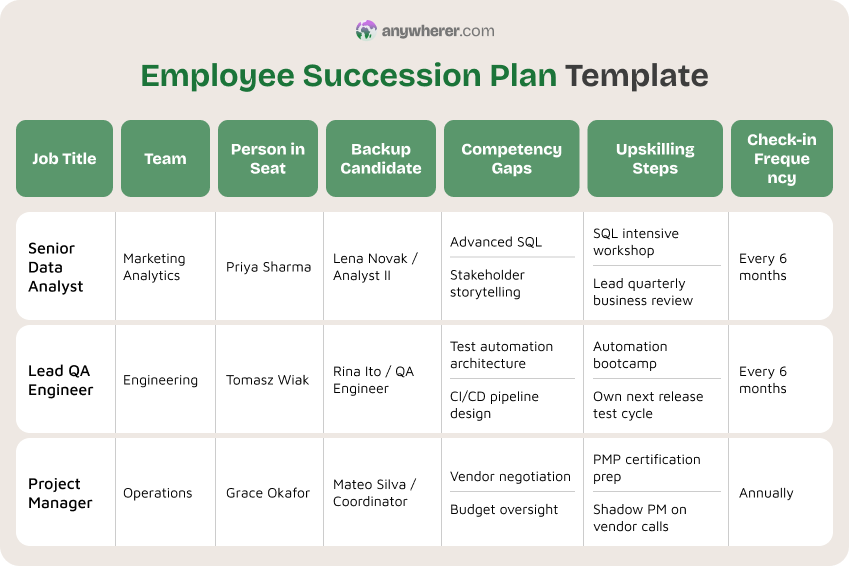
Not every succession risk lives in the corner office. An employee succession plan captures replacement paths for mid-level and specialist roles. Lose the wrong specialist and a whole project grinds to a halt.
Core Elements
- Role profiles for each position included in the plan
- List of potential successors ranked by readiness level
- Skills matrix mapping current capabilities against role demands
- Knowledge transfer checklist for critical processes
Challenges Overcome
Mid-level plans often stall because managers treat them as paperwork rather than living documents. Tie succession updates to existing talent review cycles so the work happens automatically.
Best Practices
- Keep at least two potential successors per role to avoid single-point-of-failure risk
- Include cross-functional stretch assignments in every development track
- Document tacit knowledge through shadowing weeks and recorded walk-throughs
Small Business Succession Plan Template
What It Solves
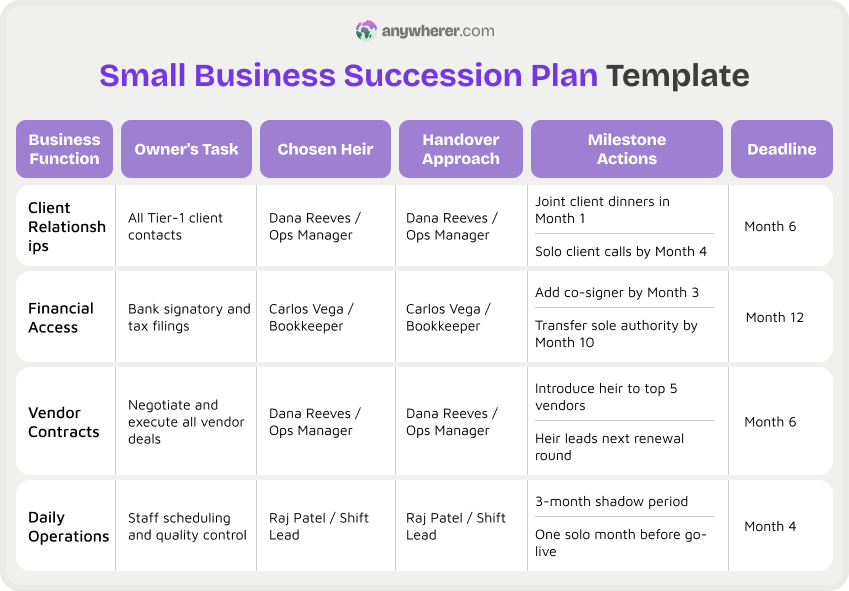
Owner-operators often are the business. Pull them out and everything from client relationships to bank access falls apart. A succession plan for small business owners tackles ownership transfer and day-to-day continuity at the same time. The small business succession plan example below covers the essentials without corporate overhead.
Core Elements
- Business valuation method and most recent estimate
- Ownership transfer structure (sale, gifting, trust, buy-sell agreement)
- Operational runbook covering tasks only the owner handles
- Client and vendor relationship transition plan
Challenges Overcome
Emotion is the biggest barrier. Many founders resist planning their exit because the business is personal. Framing the conversation around continuity rather than departure lowers that resistance.
Best Practices
- Start the plan at least three to five years before the intended transition date
- Get an independent business valuation, not a back-of-napkin number
- Test the successor by delegating full operational control for a trial period
Emergency Succession Plan Template
What It Solves
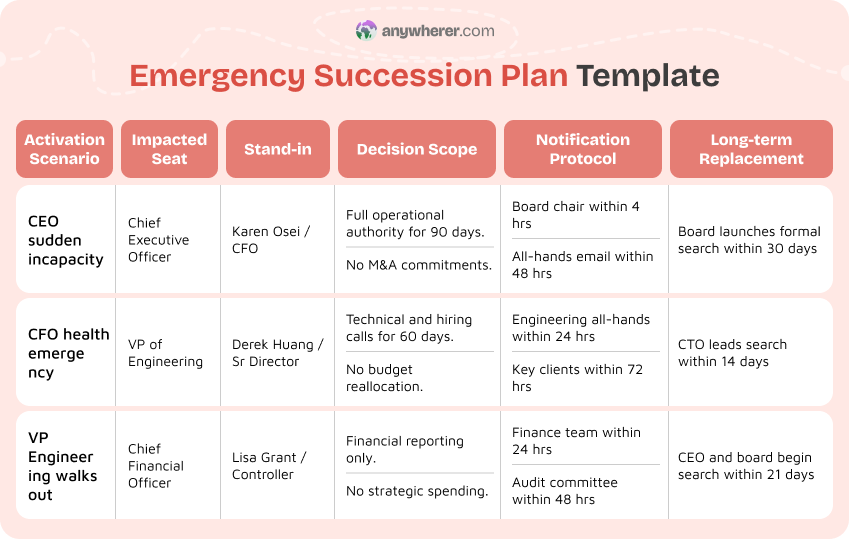
Planned retirements give you runway. A heart attack on a Tuesday morning does not. An emergency succession plan spells out who takes charge immediately and how decisions work during the first 30 to 90 days.
Core Elements
- Trigger criteria that activate the plan (death, incapacity, sudden resignation)
- Named interim leaders for every critical role, pre-approved by the board
- Communication protocol for staff, clients, vendors, and regulators
- Access instructions for key systems, accounts, and legal documents
Challenges Overcome
People avoid this plan because worst-case scenarios feel morbid. Frame it as a business insurance policy. A practical hurdle is system access: if only one person holds the passwords, the plan fails on day one.
Best Practices
- Store the plan in a location accessible to at least two people outside the leadership team
- Run a tabletop drill annually where the team simulates a sudden leader departure
- Review system access permissions quarterly to prevent lockouts
Talent Management Succession Plan Template
What It Solves
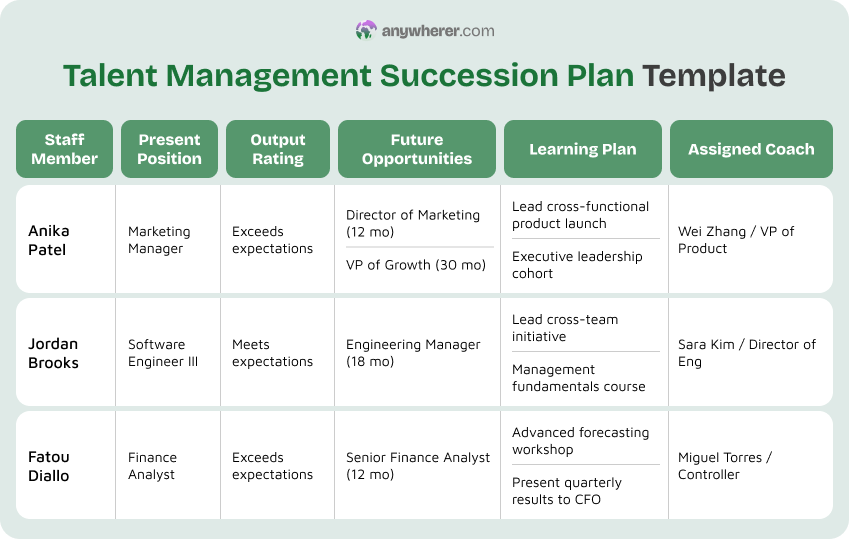
Most succession plans focus on specific seats. A talent management approach looks wider, connecting succession planning to performance reviews, career pathing, and learning programs so the bench never runs dry.
Core Elements
- 9-box grid or similar potential-performance matrix for all included employees
- High-potential identification criteria and calibration process
- Development pathways mapped to multiple future roles, not just one
- Metrics dashboard tracking pipeline health, diversity, and readiness movement
Challenges Overcome
Scale is the enemy. When you try to cover every employee at once, the process drowns in spreadsheets. Prioritize the top 15% to 20% of roles by business impact.
Best Practices
- Run calibration sessions across business units to normalize how managers rate potential
- Track movement on the 9-box grid year over year, not just static snapshots
- Tie succession metrics (bench strength, diversity) to leadership scorecards
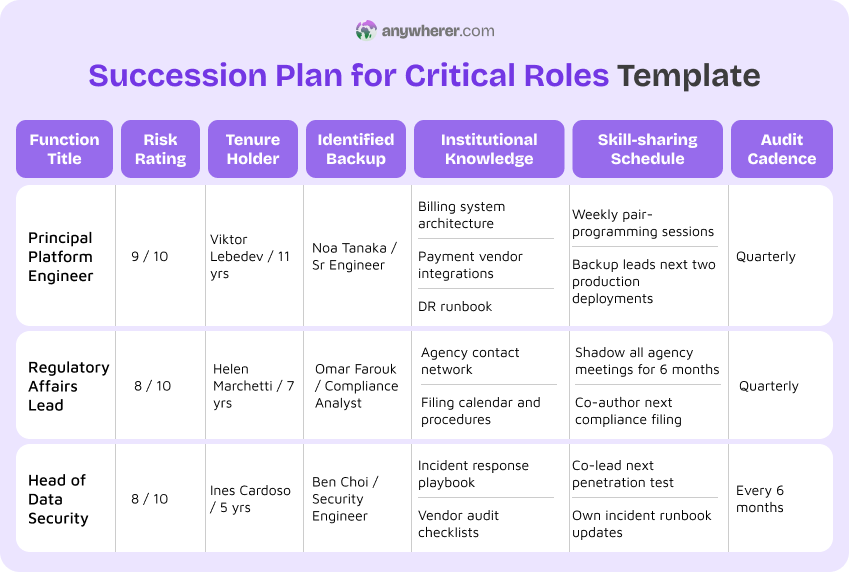
Succession Plan for Critical Roles Template
What It Solves
Some roles carry disproportionate risk. Think of the engineer who built the entire billing system or the regulatory lead who knows every agency contact by name. This template builds redundancy around those seats.
Core Elements
- Role criticality assessment scoring business impact, knowledge concentration, and market scarcity
- Named successors with readiness timelines
- Knowledge inventory documenting what the incumbent alone knows
- Cross-training schedule pairing the incumbent with at least one backup
Challenges Overcome
Incumbents in critical roles sometimes resist knowledge sharing because they see it as threatening their value. Position cross-training as risk management rather than replacement.
Best Practices
- Reassess criticality after every reorganization, acquisition, or technology change
- Assign a documentation sprint for each critical role: record processes, contacts, and decision logic
- Flag roles where the incumbent has no backup as a board-level risk item
Strategic Succession Plan Template
What It Solves
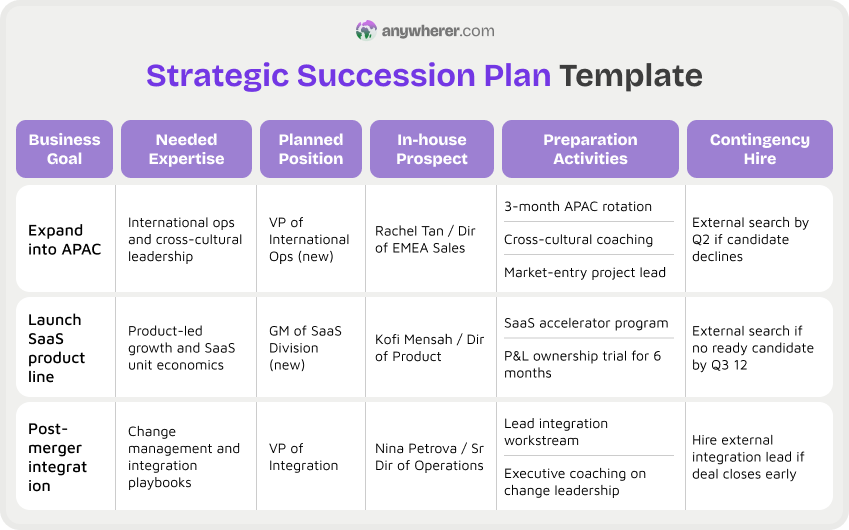
A strategic succession plan connects workforce continuity to your three-to-five-year business strategy. It asks the question most plans skip: will the leaders we develop today actually fit where the company is headed?
Core Elements
- Summary of the strategic plan’s key priorities and capability needs
- Future-state leadership competency model aligned with those priorities
- Gap closure roadmap with external hiring triggers if internal development won’t keep pace
- Scenario planning for major strategic pivots (acquisition, market exit, new geography)
Challenges Overcome
Strategy changes faster than development timelines. Build flexibility by defining broad capability themes rather than narrow job descriptions.
Best Practices
- Co-create the plan with the strategy team, not just HR
- Map each successor candidate to the specific strategic initiative they would support
- Build two scenarios (base case and pivot case) and test successor fitness against both
Cross-Department Succession Plan Template
What It Solves
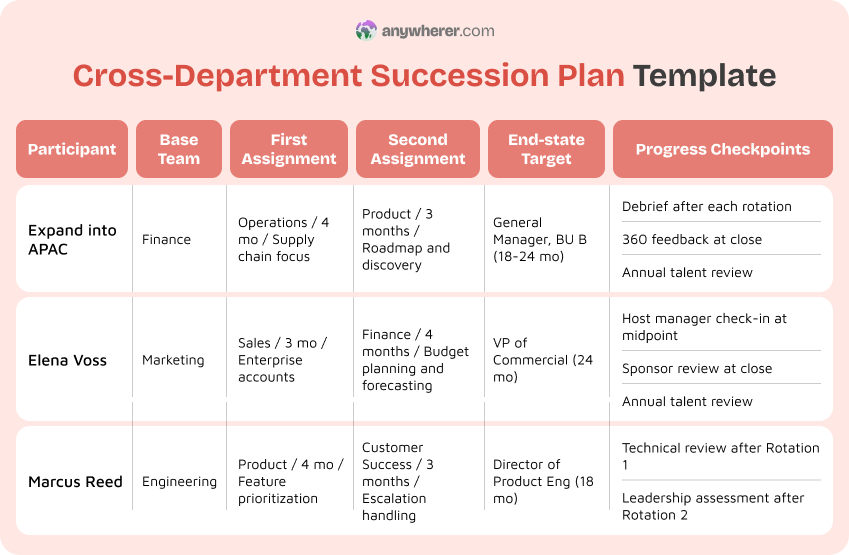
Siloed departments breed narrow leaders. A cross-department succession plan deliberately moves people through multiple functions, so they bring real breadth when they finally land in a general management seat.
Core Elements
- Cross-functional role map showing which departments feed into which leadership positions
- Rotation schedule with start dates, durations, and learning objectives
- Feedback loops from each rotation host (manager debrief, peer feedback, project outcomes)
- Coordination mechanism between department heads to manage headcount and timing
Challenges Overcome
Department heads resist releasing top performers into rotations. Counter this by treating rotation slots as a two-way street: every department that sends a person also receives one.
Best Practices
- Set rotation durations between three and six months, long enough to learn but short enough to keep momentum
- Assign a home-base sponsor who maintains career continuity while the employee rotates
- Align rotation timing with natural business cycles to minimize disruption
Common Pitfalls in Leadership Succession Planning
Even thoughtful leadership succession plans fall apart when organizations keep making the same errors. Downloading a sample succession plan is step one; dodging these five pitfalls is what separates a plan that works from one that sits in a drawer.
Waiting Until a Departure Is Announced
The most damaging mistake is treating succession planning as a reaction to a resignation letter. By then the departing leader is mentally checked out and the team is anxious. Build the plan when the seat is stable.
Relying on a Single Successor
Naming one heir apparent feels decisive but creates fragile risk. That person might leave, underperform, or decline. Keep at least two candidates per critical position.
Ignoring Cultural Fit
A successor with the right resume but the wrong working style can hurt the team more than an empty seat. Peer feedback and behavioral assessments belong in the readiness evaluation alongside performance metrics.
Treating the Plan as a Static Document
Succession plans saved in a shared drive and never opened again create false confidence. Tie plan reviews to existing calendar events so updates happen automatically.
Skipping Development Investment
Identifying a successor without funding their development is like drafting a player and never letting them practice. Allocate budget and manager time for stretch assignments and coaching.
Measuring the Success of a Succession Plan
A succession plan collecting dust in SharePoint feels productive but proves nothing. Unless you track real numbers, you have no way to know if the plan is working.
- Bench strength ratio: divide your ready-now candidates by the number of critical roles. Anything below 1.0 means uncovered seats.
- Time to fill internally: count the days between a vacancy and an internal promotion. If your internal fills routinely take longer than external hires, the pipeline is not producing ready people.
- Successor retention rate: check how many of your named successors are still around 12 and 24 months after being added to the plan. High turnover in this group points to poor engagement or unrealistic timelines.
- Readiness movement: compare readiness ratings year over year. If the same people sit in the same category for two straight cycles, whatever you are doing for development is not working.
- Diversity of the pipeline: measure representation of underrepresented groups at each readiness tier.
For context, McKinsey 2023 study found that companies in the top quartile for ethnic diversity on executive teams were 39% more likely to outperform on profitability.
Real-World Examples of Leadership Succession Success
Reading templates is useful. Watching how real companies handled succession is better. Each example of succession plan practice below shows a different approach to the same problem.
Apple: Tim Cook Succeeds Steve Jobs
Jobs started grooming Cook years before his health forced the issue. Cook ran the company during Jobs’ medical leaves in 2004 and 2009, which gave the board direct evidence of his judgment. Apple’s market cap has grown more than tenfold since 2011. That does not happen by accident.
Microsoft: Satya Nadella’s Cultural Reset
Ballmer left in 2014 and the board picked Nadella from a shortlist that included outside candidates. Nadella had 22 years at Microsoft and had already turned the cloud division into a growth engine. Revenue nearly quadrupled over the next decade. The takeaway: pick the person who fits where the company is going, not where it has been.
JPMorgan Chase: Jamie Dimon’s Long-Range Planning
Dimon has publicly managed his own succession for years, rotating candidates through major business lines and giving the board regular visibility into each person’s progress. That transparency keeps speculation low and retention high. For more on structuring development tracks like these, see our guide on employee development plan examples.
Sometimes development stalls and a successor simply is not performing. In those cases, a structured improvement process helps. Our pip plan template guide walks through timelines, escalation paths, and the documentation you actually need.
FAQs on Succession Planning
What is leadership succession planning?
It is the process of spotting and developing people who can step into senior roles when the current holder leaves. That means assessment, targeted development, and transition logistics all wrapped into one plan.
Why is leadership succession planning important for a business?
Unplanned leadership gaps stall decisions and unsettle clients. A plan keeps the pipeline warm so you are not scrambling when someone leaves. Companies with formal succession processes are more likely to outperform peers on revenue growth.
How do I identify potential successors within my organization?
Start with performance data and manager input. Then layer on tools like 9-box grids and behavioral interviews. Do not limit yourself to direct reports. Cross-functional high performers get overlooked constantly. Calibration sessions with multiple leaders reviewing the same candidates help reduce bias.
What are the key components of a leadership succession plan?
A solid plan includes a role profile, readiness assessments for each candidate, a gap analysis, development actions, an interim coverage arrangement, and a defined review cycle.
How long does it typically take to implement a leadership succession plan?
Building the initial plan takes four to eight weeks for most mid-size organizations. Developing candidates to ready-now status usually requires 12 to 24 months. Emergency interim plans should be ready from day one.
How do I ensure my leadership succession plan aligns with the company’s culture and values?
Bake behavioral competencies that reflect your actual values into the readiness criteria. Use 360-degree feedback and peer interviews, not just the manager’s opinion. Get current leaders involved in defining what good looks like so the criteria stick.
What challenges should I expect when implementing a leadership succession plan?
Resistance from leaders who feel threatened. Inflated readiness ratings. Political maneuvering among candidates. Those three come up in almost every organization I have seen. Structured calibration, clear governance, and a visible executive sponsor address most of it.
How often should I review and update my succession plan?
At least once a year during the talent planning cycle. But do not wait for the calendar. Update it any time something changes the roles or candidates: a promotion, a departure, a reorg, or a shift in strategy.

Yaryna is our lead writer with over 8 years of experience in crafting clear, compelling, and insightful content. Specializing in global employment and EOR solutions, she simplifies complex concepts to help businesses expand their remote teams with confidence. With a strong background working alongside diverse product and software teams, Yaryna brings a tech-savvy perspective to her writing, delivering both in-depth analysis and valuable insights.