Remote work has moved past the experimental phase. Most organizations adopted some form of it during 2020, and a significant share never went back to a fully on-site model. Buffer’s 2023 State of Remote Work surveyed 3,000 remote workers and found that 98% wanted to continue working remotely for the rest of their careers. That is not a passing preference, it reflects a permanent shift in how people expect to work. What’s often missing, though, is the documentation behind it.
A remote work policy template gives that documentation a repeatable structure. It answers the questions that seem obvious until they’re not: who decides core hours, what happens when someone relocates mid-quarter, who covers the cost of a second monitor, what the response-time expectation actually is. Without a written policy, each manager handles these differently, and inconsistency is where employee frustration starts.
This guide provides an eleven-section work from home policy ready to customize, three variations for different operating models, and a remote work policy checklist of common mistakes to avoid. McKinsey reported that 58% of the American workforce had at least one work-from-home day per week. That figure has only grown since. Whether the team is five people or five hundred, a written work from home policy removes guesswork and protects both sides.
Why Every Company Needs a Remote Work Policy
When remote arrangements depend on verbal agreements, the rules shift every time a new manager joins, a team restructures, or the company expands to a different region. One leader requires cameras on every call; the next one never brings it up. Neither is wrong, there is simply no reference document. Owl Labs reports that companies with documented remote work policies see higher employee satisfaction and up to 25% lower turnover. A written policy replaces assumptions with standards.
- Clarity on expectations. Work from home policy guidelines define schedules, response windows, and what a completed deliverable looks like. Ambiguity drops sharply once these are on paper.
- Consistency across roles. A new hire on day one and a senior director requesting flex time operate under the same set of rules. No informal exceptions.
- Built-in security. VPN requirements, device policies, and incident reporting procedures belong in every version of the document. Skipping them means relying on individual judgment for matters that need a standard.
- Legal protection. The moment an employee works from another state or country, tax and labor obligations shift. A policy clause covering this puts the organization’s compliance position on record.
- Measurable performance. Output-based KPIs keep the evaluation process the same for remote and on-site staff. When performance dips, a pip template provides a structured correction path rather than ad-hoc conversations.
Remote Work Policy Template
The employee remote work policy template below covers eleven sections, from the policy statement through the employee sign-off. Bracketed placeholders mark every field that needs company-specific data. Fill in the brackets, have employment counsel review the document, and distribute it to the team. The structure is designed to work for companies of any size; remove or expand sections as needed.
1. Policy Statement
[Company Name] supports remote work as a standard operating arrangement. This policy defines the obligations, expectations, and safeguards that apply to every employee authorized to work outside a company office. Its purpose is to ensure that flexibility does not compromise productivity, security, or accountability.
2. Coverage and Eligibility
This policy applies to [full-time employees / contractors / specified departments] with documented remote work approval. Eligibility is based on role suitability, performance history, and staffing requirements. [Manager / HR / Department Lead] grants final approval and records the arrangement in the employee’s personnel file.
3. Permitted Arrangements
[Company Name] recognizes three remote work formats:
- Fully remote – no office attendance at any point
- Hybrid – [X] in-office days per week, remaining days remote
- Ad-hoc remote – occasional work-from-home days approved on a case-by-case basis
The approved format is documented in the employee’s authorization letter. Changes require written agreement from [manager / HR].
4. Core Hours and Scheduling
Remote employees must be reachable during core hours: [e.g., 10:00 AM – 3:00 PM Eastern]. Outside that window, work hours may be arranged with manager approval. Schedule changes require [24 / 48] hours’ written notice to the team.
Breaks follow company policy: [e.g., one 60-minute lunch, two 15-minute rest periods]. Time tracking, where applicable, is managed through [tool name].
5. Communication Standards
Remote employees will:
- Remain reachable on [Slack / Teams / email] throughout core hours
- Respond to internal messages within [X] hours during the agreed working window
- Attend scheduled video calls, standups, and team meetings with camera on when required
- Keep a shared calendar current with availability, focus blocks, and time off
6. Equipment, Software, and Expenses
The company provides: [laptop, external display, headset, keyboard]. The employee is responsible for: [internet connection meeting a minimum of X Mbps, desk, chair]. A one-time home-office setup stipend of $[amount] is available upon approval. Ongoing reimbursement for [internet / coworking fees] is capped at $[amount] per month.
Company-owned hardware must be returned within [X] business days of the employee’s final working day. Loss or damage is reported to [IT / manager] immediately.
7. Information Security
This section is non-negotiable for any work from home policy for employees handling client or internal data. Remote staff must:
- Connect through the company VPN for all work-related access
- Use only company-approved devices for sensitive tasks
- Lock screens on every device when stepping away
- Report suspected security incidents to [Security Team / email] within [X] hours
Annual security awareness training is mandatory. Failure to complete it on time may result in suspended remote privileges.
8. Approved Work Locations
Remote work is permitted from: [home address on file / approved coworking spaces / domestic locations only]. Working from another country requires advance written approval from [HR / legal] and is capped at [X] calendar days per year. Location changes must be updated on file promptly.
9. Performance Standards
Evaluation is based on output rather than hours logged. Criteria include:
- On-time delivery of assigned projects and milestones
- Quality and completeness of work product
- Responsiveness and participation in team workflows
Performance gaps are addressed through the company’s standard review process.
Tip: For new remote hires, pairing this section with a 30-60-90 day plan template keeps the first quarter structured and expectations visible on both sides.
10. Policy Updates and Revocation
[Company Name] may revise or withdraw remote work privileges when business needs require it. Affected employees receive written notice at least [14 / 30] calendar days before the change takes effect. The policy itself is reviewed on a [quarterly / annual] basis by [HR / leadership team].
11. Employee Acknowledgment
By signing below, I confirm that I have read this Remote Work Policy in full and agree to comply with its provisions. I understand that violations may result in modified or revoked remote work arrangements.
Employee Name: ___________________________________
Employee Signature: ___________________________________
Date: ___________________________________
Manager Name: ___________________________________
Manager Signature: ___________________________________
Date: ___________________________________
Check out the remote work policy template in a convenient-to-use Google Doc format, ready for you to customize and implement in your organization.
Types of Remote Work Policy Templates
The eleven-section template covers the fundamentals, but the specific clauses shift depending on how the company actually runs. A fully distributed startup needs a different language than a mid-size firm with offices in three cities. Below are three condensed variations, each one a standalone remote work policy example with its own table. Use them as a remote work policy checklist: pick the closest match or combine clauses from multiple versions.
Fully Remote Work Policy Template
This remote working policy template applies to organizations without a physical office. There is no headquarters, no designated in-office days. Everyone operates from their own location full-time. When no building exists as a default, the policy must address time-zone overlap, hardware shipping logistics, stipend structures, and funded in-person gatherings for the collaboration that video calls cannot replace.
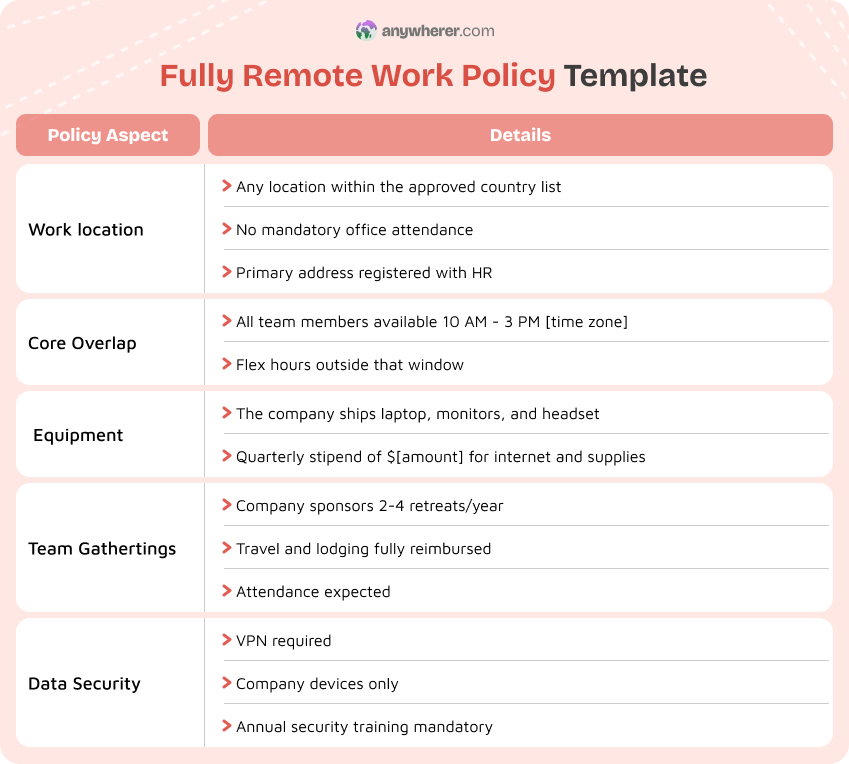
Clause sample: “Employees may work from any location within [approved countries]. All equipment is shipped to the registered home address and returned within [X] days of separation.”
Best suited for: remote-first startups, companies that permanently closed offices, and distributed teams across multiple time zones.
Hybrid Work Policy Template
A working from home policy template for hybrid teams needs to settle the split: which days are in-office, how desks are booked, and what the protocol is when a meeting has both on-site and remote participants. Without that clarity in writing, every week starts with the same scheduling debate, and productivity takes the hit.
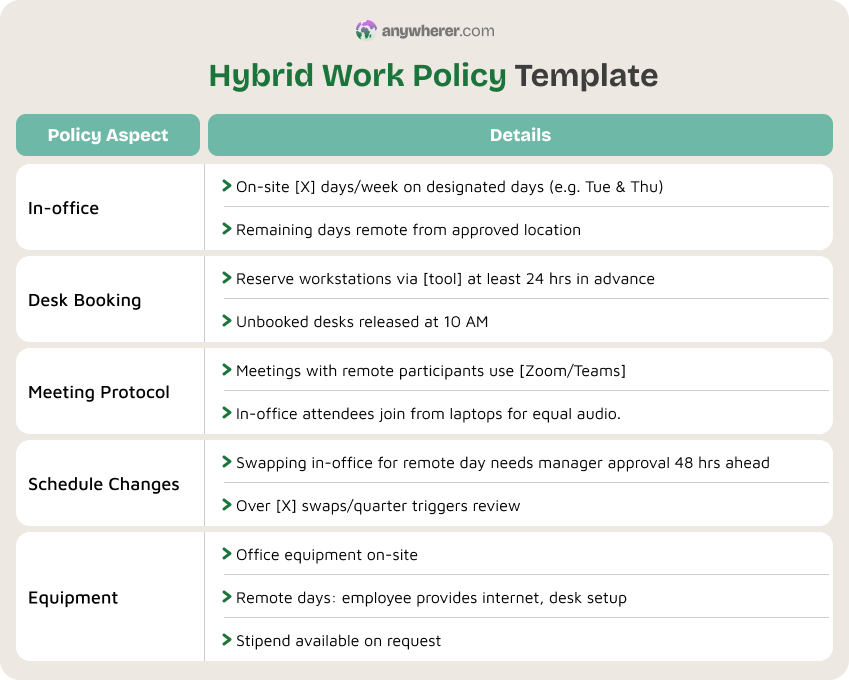
Clause sample: “Employees must be on-site at least [X] days per week. On remote days, full video availability during scheduled meetings is required, with the same response-time standards as on-site staff.”
Best suited for: mid-size and enterprise companies that maintain offices and want structured flexibility.
Flexible Remote Policy Template
This remote worker policy template is for organizations that still default to the office but permit a limited number of remote days per month. Consider it a remote worker policy sample for teams testing flexibility before committing to a hybrid model. Sample remote work policy language for this setup tends to be shorter because the baseline expectation remains on-site presence.
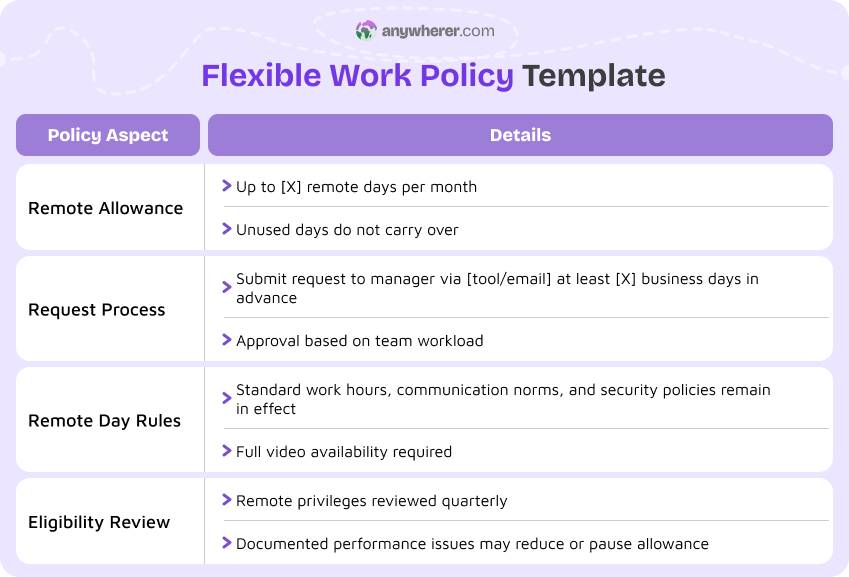
Clause sample: “Employees may request up to [X] remote days per month. Requests go to the direct manager at least [X] business days in advance. Unused days do not roll over.”
Best suited for: companies transitioning from fully on-site, teams offering remote days as a benefit, or organizations piloting flexibility before a broader rollout.
Common Remote Work Policy Mistakes
These five gaps show up repeatedly in otherwise solid remote work policies. Before sending a final draft to the team, run your work from home policy examples through this list. Even one of these omissions can undermine the entire document.
- No time zone. “Regular business hours” without a named time zone leads to scheduling conflicts within the first week. Specify the window.
- Missing response SLA. Without a written number, each manager invents a different standard. “Reply within two hours during core hours” is a policy. “Be responsive” is not.
- Security treated as optional. A single data breach costs more than the entire remote program. VPN rules, device standards, and incident procedures belong in every draft.
- No international clause. A sample work from home policy limited to domestic employees breaks the moment someone works from abroad. Include a jurisdiction approval step.
- Stale documents. A remote work policy sample left untouched for years protects nobody. Review at least annually.
FAQs
What should a remote work policy include?
A policy statement, eligibility criteria, permitted arrangements, core hours, communication standards, equipment and expenses, information security, approved locations, performance standards, a modification clause, and an employee acknowledgment. The template above covers all eleven.
Is a remote work policy legally required?
There is no single law that mandates one across all jurisdictions. However, labor codes in many regions require written terms on hours, safety, and data handling, and the number of such requirements has grown steadily since 2020. A formal work from home policy example on file serves as documented evidence of compliance efforts and reduces legal exposure if a dispute escalates.
How do you write a hybrid work policy?
Start with the master template and add clauses for mandatory in-office days, desk reservations, and hybrid meeting protocol. The hybrid section in this guide provides a ready-to-use starting point.
Can employees work remotely from another country?
Yes, but tax nexus, work permits, and data residency laws apply the moment they do. The policy should require pre-approval, list approved countries, and set a maximum number of days abroad per year.
What is included in a work from home policy template?
A thorough work from home policy example covers eligibility, hours, communication tools, equipment, security, and performance expectations. Stronger templates add fillable clauses, a legal compliance section, and expense reimbursement limits.
How often should remote policies be updated?
At least annually. Increase the frequency if the organization is expanding into new jurisdictions, going through a merger, growing faster than the current version accounts for, or integrating teams that previously operated under different guidelines. Set a calendar reminder so the review actually happens.

Yaryna is our lead writer with over 8 years of experience in crafting clear, compelling, and insightful content. Specializing in global employment and EOR solutions, she simplifies complex concepts to help businesses expand their remote teams with confidence. With a strong background working alongside diverse product and software teams, Yaryna brings a tech-savvy perspective to her writing, delivering both in-depth analysis and valuable insights.