Introduction
A recruitment plan is a simple, structured way to decide who you need to hire, when, why, and how. It connects business goals (like new product launches or market entry) to clear hiring actions, timelines, and budgets. Instead of “we’ll just post this role and see what happens,” a plan makes hiring part of your wider workforce strategy.
Growing teams feel this pressure the most. Skills shortages are real: recent European and global reports show that many employers struggle to fill roles, with around 60–80% in some markets saying they cannot find people with the right skills. At the same time, the cost of a bad hire can be high. Estimates from HR and labor sources often put the cost of a poor hire at around 30–40% of the person’s annual salary once you include hiring, onboarding, and early turnover. That is a big hit for scaling companies.
A recruitment plan is not the same as a job description or a simple hiring checklist. A job description describes one role. A checklist tracks small steps like “post job” and “schedule interview.” A plan sits above both: it shows how many people you need, which roles, in what order, from which sources, and on what budget. In other words, it acts like a simple recruitment strategy plan template for your team.
In this article, you’ll find a flexible recruitment plan template plus 12 examples for different growth scenarios, from fast-growth teams and startups to replacement hiring, high-volume roles, and budget-constrained setups. You can use them as starting points or mix elements into your own plan. You can also connect your hiring roadmap to related tools, such as an onboarding plan template for after the offer, and structured interviewing guides that include situational interview questions for key roles.
When and Why Teams Use Recruitment Plans
Recruitment plans matter most when hiring is tied to bigger changes, not just a one-off vacancy. Teams lean on a clear plan when they are scaling a function, opening a new office, entering a new market, or replacing key roles that carry a lot of risk if left open for long. They are also useful during annual budgeting cycles, when leadership needs to know how many people will be hired, in which roles, and at what approximate cost.
A structured plan helps both the business and the hiring side. For the business, it links headcount to real goals, so it is easier to see how new roles support revenue, product roadmaps, or service levels. It also makes salary and recruiting spend more predictable. For HR and talent teams, a recruitment plan brings clarity on priorities, timelines, and sourcing channels. Recruiters and hiring managers know which roles come first, which can wait, and what the expected timelines look like, instead of reacting to last-minute requests.
Because of this, recruitment planning directly supports better decision-making. It forces teams to think about “why this role, why now, and what happens if we don’t hire?” before posting a job. It also makes trade-offs more visible: for example, choosing between one senior hire or two junior hires, or shifting a role to a different location. Over time, data from past plans (what worked, what did not, how long things took) feeds into the next planning cycle, so hiring becomes less reactive and more strategic.
Recruitment Plan Templates & Examples
Each recruitment plan example below follows a similar structure but is tuned for a different scenario. You can treat them as recruitment plan templates you adapt inside your ATS, spreadsheet, or HR system.
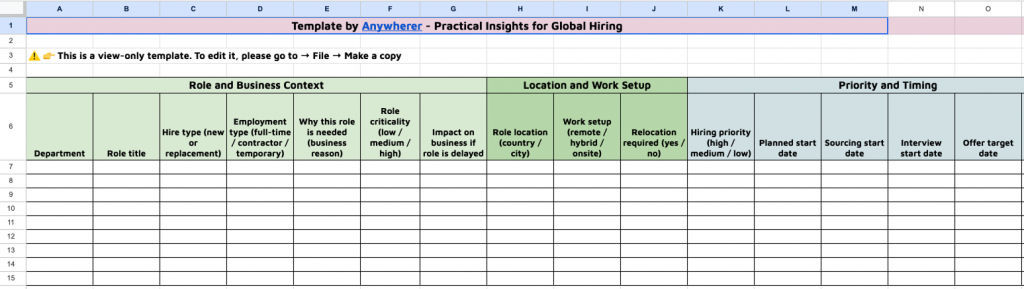
Want a practical version of this plan? We’ve created a simple recruitment plan spreadsheet you can copy and adapt for your team. It includes headcount planning, budget tracking, hiring timelines, and sourcing channels in one place.
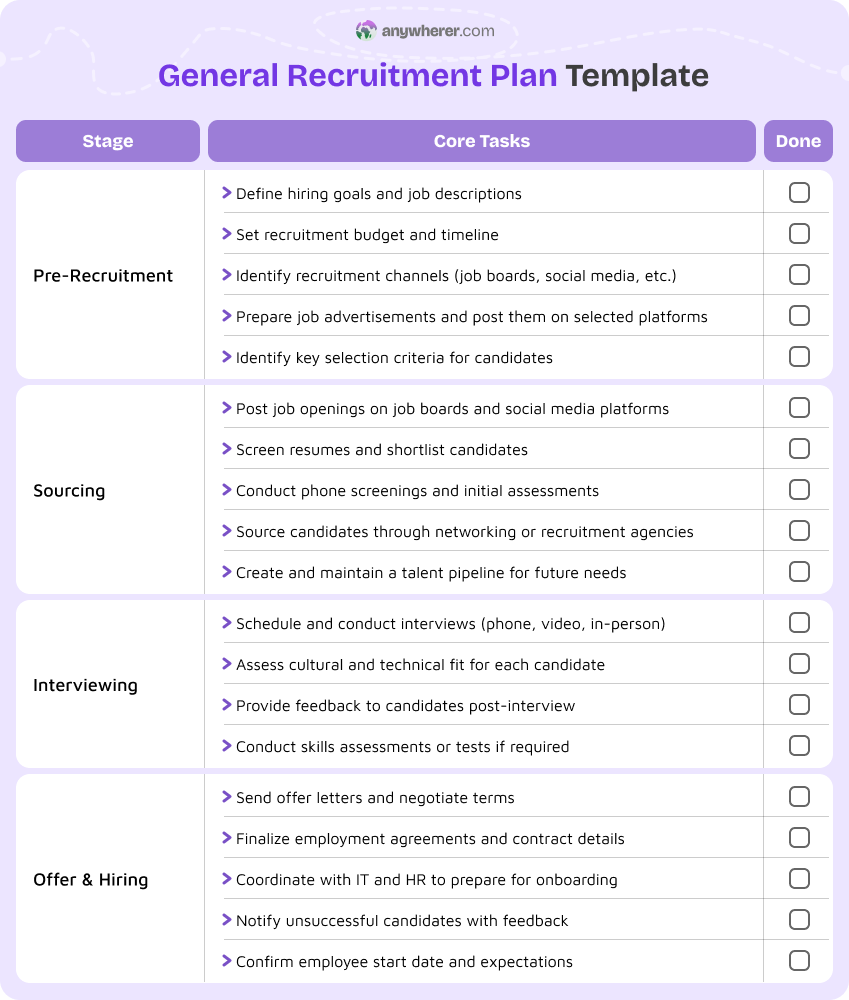
General Recruitment Plan Template
This general example of recruitment plan suits most small and mid-size companies that want a simple, reusable structure. It works best when you have a steady but not extreme hiring pace across several departments. It is most useful for annual or quarterly planning where you want to map out planned hires across functions, align with budgets, and give HR and managers a shared view, acting as a recruitment strategy plan template you can copy for each new cycle.
In most cases this type of plan covers a 3–12 month period, focuses on a mix of roles across departments with moderate volume and medium urgency, and is evaluated by the share of planned roles filled on time, average time-to-fill, cost-per-hire, and the quality and retention of new hires after 6–12 months.
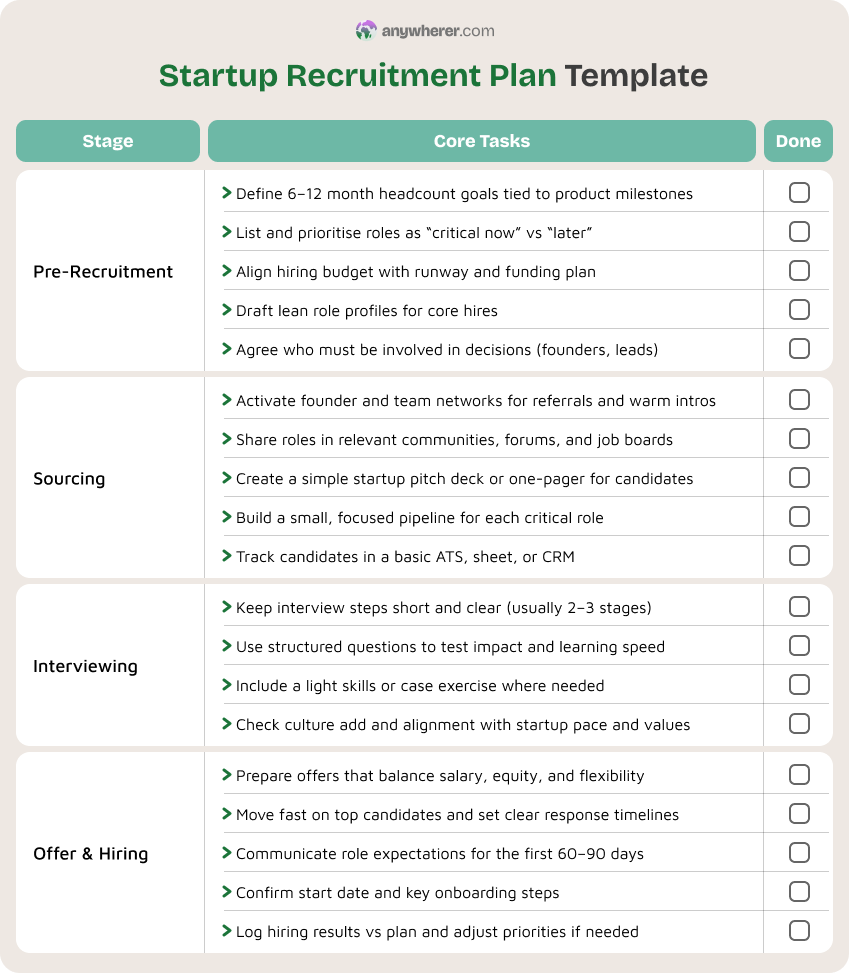
Startup Recruitment Plan Template
This recruitment plan for hiring example is for early-stage startups (seed to Series A) that need to grow from a small core team to their first stable org. It fits companies with limited HR infrastructure and founders still involved in most hires. It is most useful when you need to balance aggressive growth goals with limited budget and brand awareness, and it helps you decide which critical hires come first (for example, product, engineering, and first sales) and which can wait.
Usually this plan looks 6–12 months ahead, centres on a small number of high-impact roles with high urgency but strong selectiveness, and is judged by how quickly crucial roles are filled, how those hires affect product and revenue, and whether hiring costs stay in line with the startup’s runway.
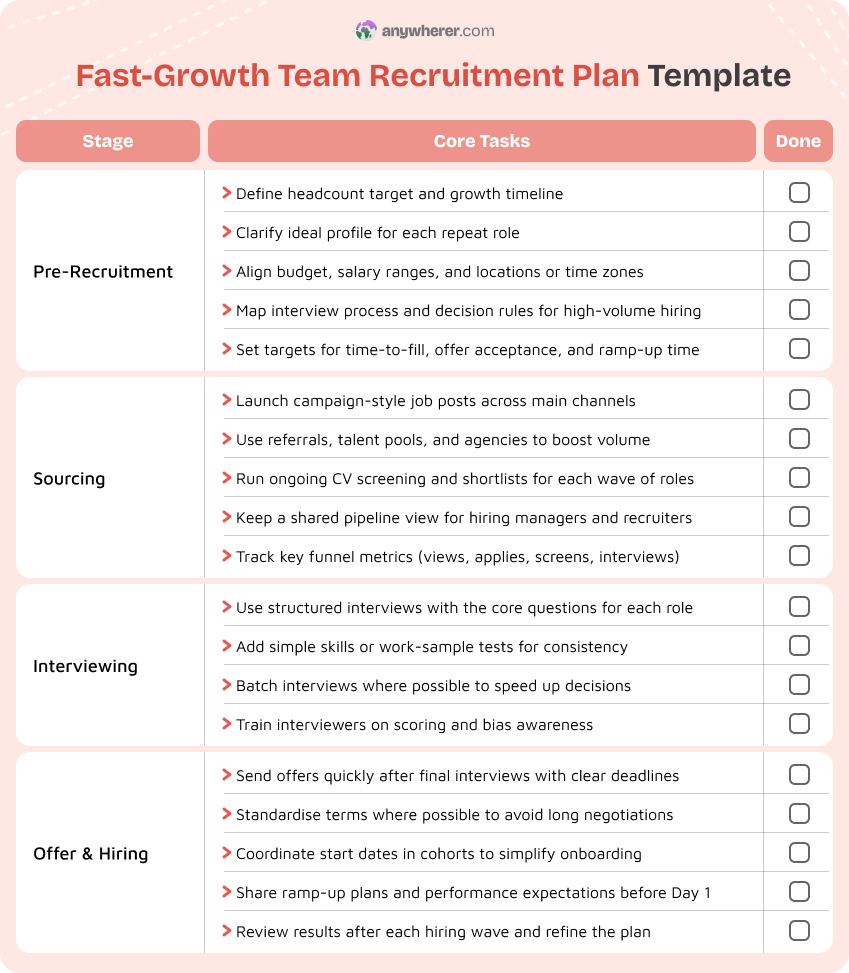
Fast-Growth Team Recruitment Plan Template
This recruitment campaign plan template is for scale-ups or business units that must double (or more) headcount quickly, often after funding or major customer wins. It fits teams with a clear growth target (for example, growing a sales team from 10 to 30, or an engineering group from 20 to 50) and a need for coordinated campaigns, not one-off requisitions.
Typically this kind of plan runs over 3–9 months, focuses on multiple similar roles such as SDRs, support agents, or engineers with strong urgency, and is evaluated by number of hires vs plan, time-to-fill for bulk roles, quality of hire, and whether performance stays stable during the ramp-up.
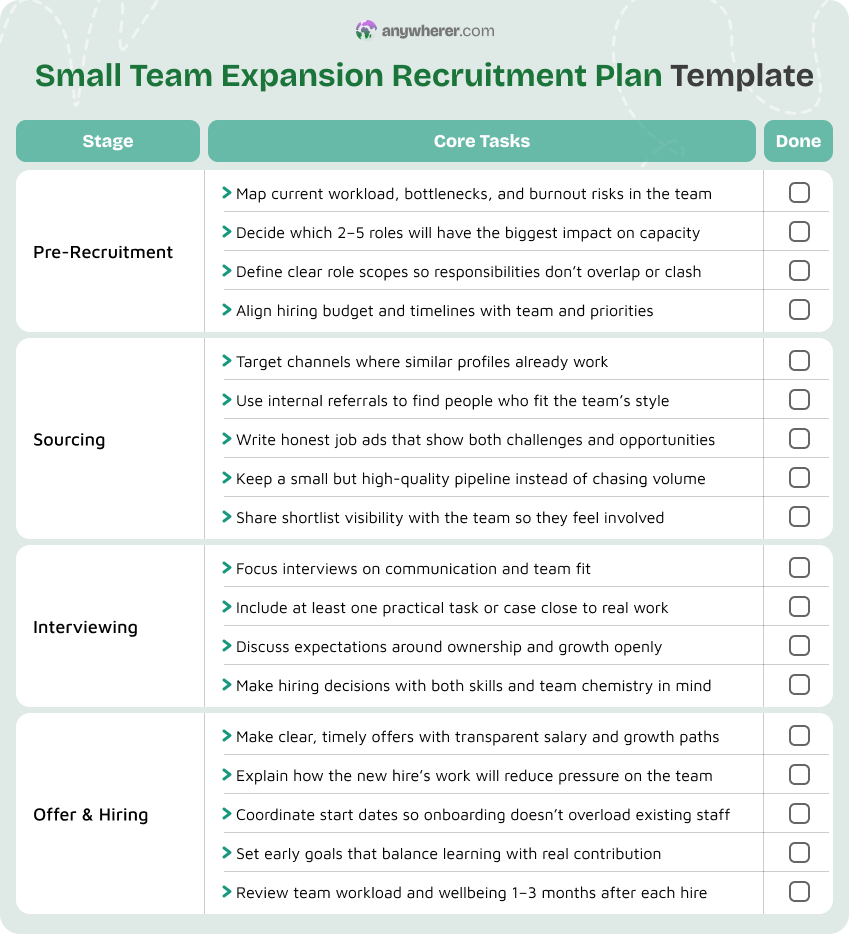
Small Team Expansion Recruitment Plan Template
This sample recruitment plan works for small teams adding a few key people (for example, going from 3 to 6 engineers, or 2 to 5 marketers). The focus is on impact and fit, not volume. It is most useful when a small team is at capacity and at risk of burnout or missed opportunities, but you still need to choose carefully due to budget or culture reasons.
In practice, this kind of plan usually covers 3–6 months, targets just a handful of roles with medium urgency but high influence on team dynamics, and is judged by smoother workload, better team performance, and strong retention in the first year.
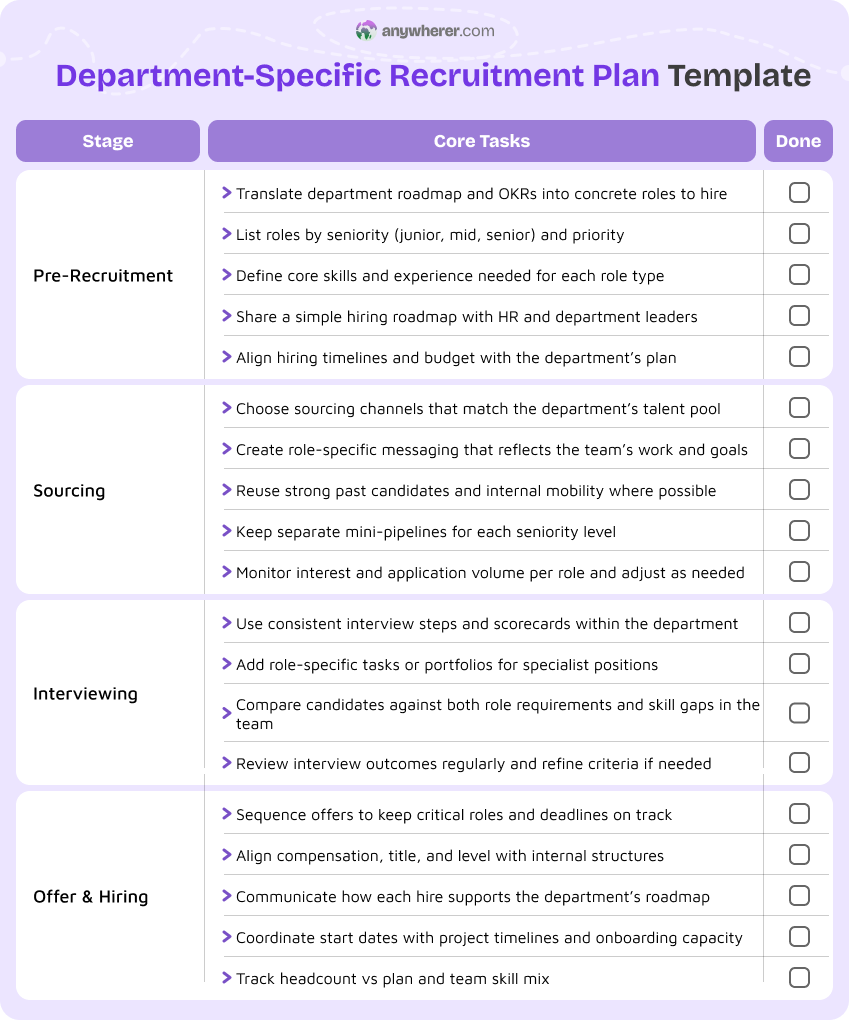
Department-Specific Recruitment Plan Template
This example recruitment plan is written for a single department (for example, marketing, engineering, customer success) that wants its own hiring roadmap tied to its strategy. It is most useful when a department has several role types and seniority levels to hire over a period (for example, junior, mid, and senior engineers; or content, performance, and product marketers) and wants to plan them in order of impact.
Most of these plans cover roughly 6–12 months, focus on a cluster of related roles with a mix of urgent and planned hires, and are evaluated by departmental headcount vs plan, the skill mix of the team, and delivery of that department’s OKRs.
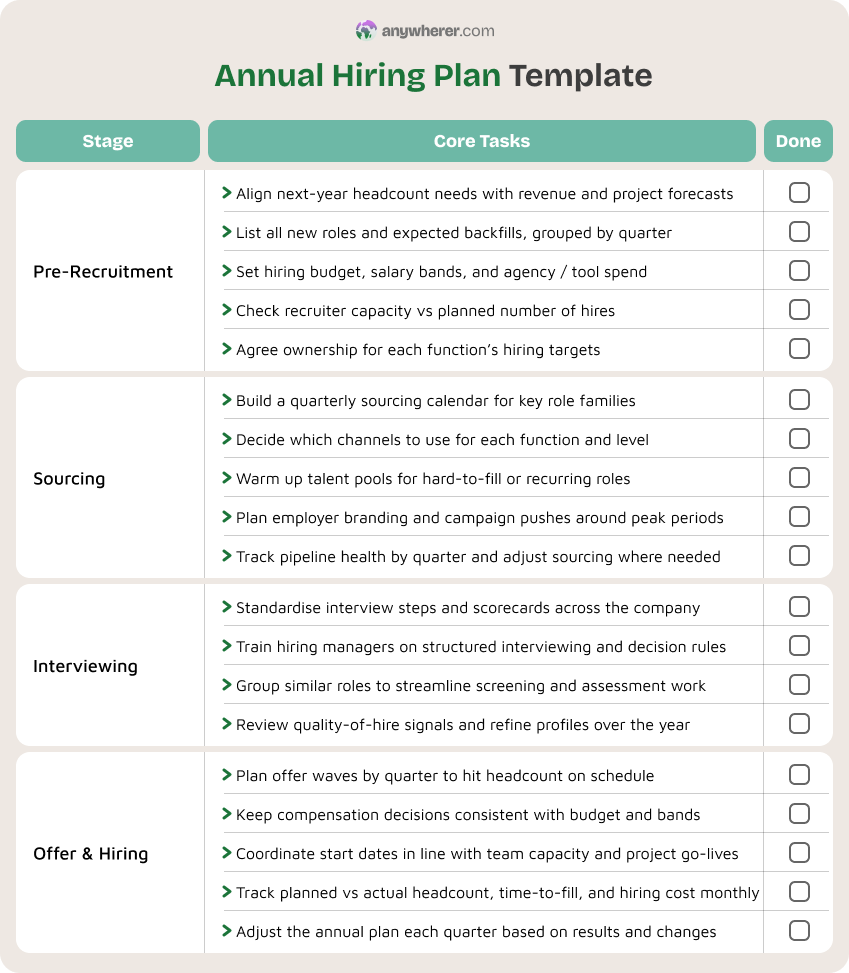
Annual Hiring Plan Template
This strategic recruitment plan template is used at company level for the full year. It connects financial planning, workforce planning, and recruiting, often as part of budget cycles. It is most useful for mid-size and larger organizations that need to align headcount to revenue targets and project plans, and ensure hiring capacity (recruiters, tools, agencies) can support the plan.
An annual plan typically spans 12 months, covers all planned roles by quarter including both new positions and backfills, and is evaluated by planned vs actual headcount, how well recruiting capacity matches demand, time-to-fill, and hiring costs vs budget.
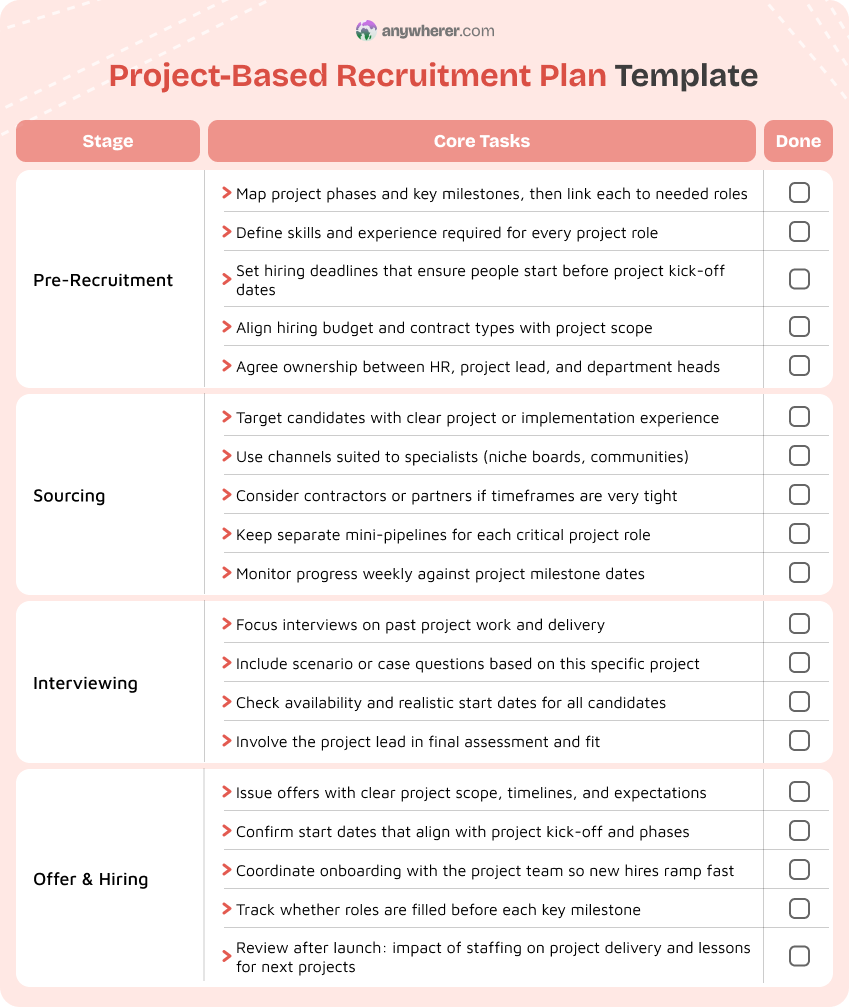
Project-Based Recruitment Plan Template
This recruitment action plan template is built around a specific project (for example, a new product, implementation, or market launch) with a clear start and end date. It fits companies that build cross-functional project teams and need the right mix of skills ready before or at project kick-off.
The timeframe usually matches project phases, often somewhere between 3 and 12 months, and the plan zeroes in on roles directly needed for the project such as specialists, project managers, and support staff. Success is normally evaluated by whether roles are filled before key milestones, whether there are minimal project delays due to staffing, and the overall quality of project outcomes.
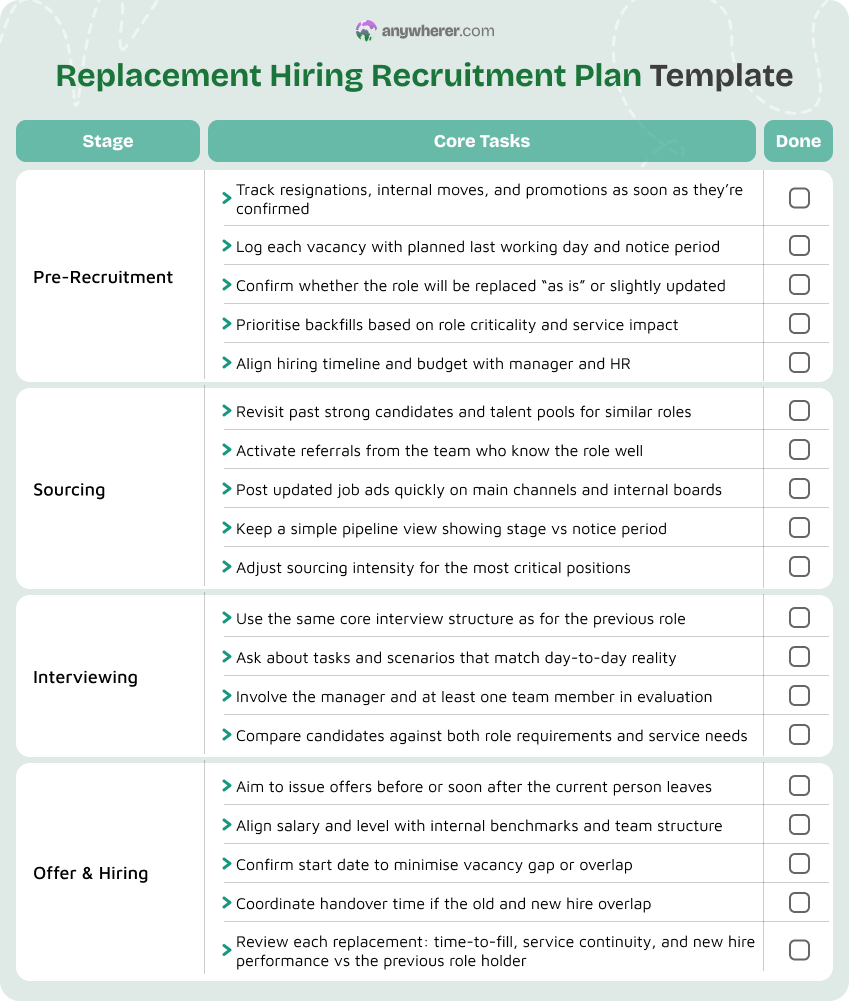
Replacement Hiring Recruitment Plan Template
This example of a recruitment plan covers backfills and replacements when people leave or move internally. It keeps replacement hiring predictable instead of ad-hoc. It is most useful for teams with steady turnover or internal mobility, where lost headcount must be replaced quickly to avoid gaps in service or delivery.
Each replacement plan usually runs on a rolling 1–3 month horizon per role, focuses on backfilling existing positions with urgency adjusted to how critical the role is, and is evaluated by time-to-fill vs notice periods, continuity of service, and the performance of replacements compared to previous role holders.
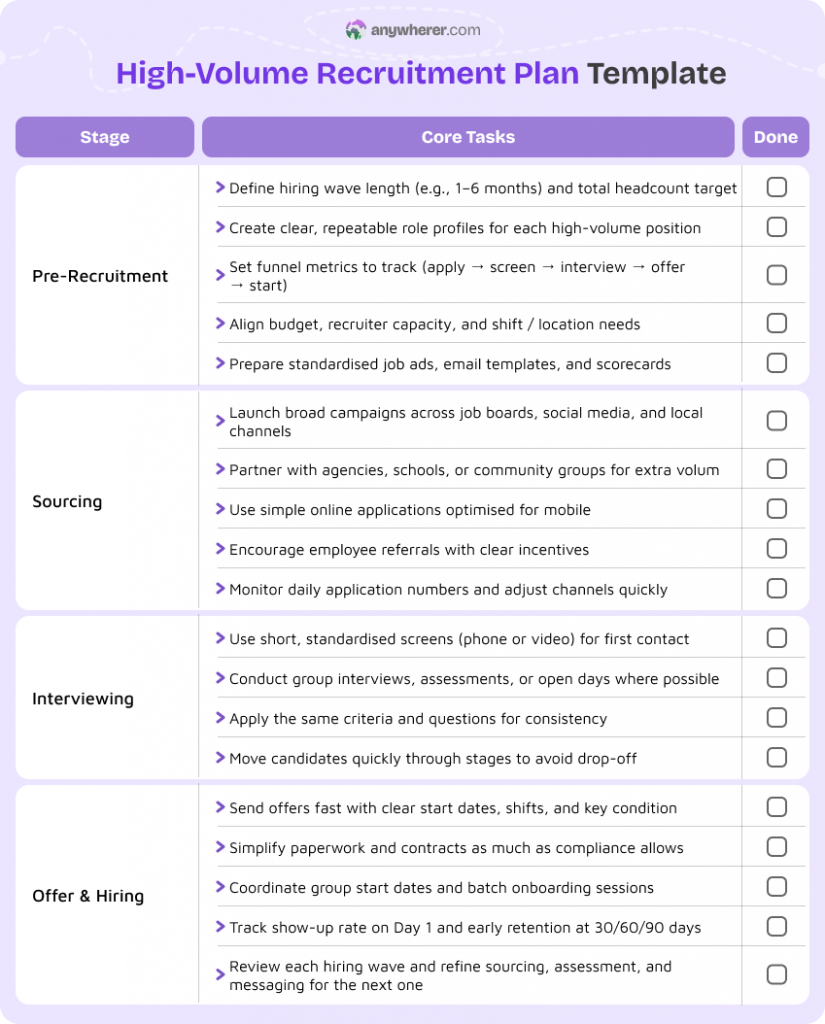
High-Volume Recruitment Plan Template
This plan type is a recruitment sourcing plan template for high-volume hiring (for example, call center agents, seasonal staff, warehouse workers, or junior support roles). It is most useful when you need dozens or hundreds of hires in a short time, often tied to peak seasons or large contracts, and it focuses on campaigns, funnels, and conversion rates.
These plans typically run for 1–6 months per hiring wave, centered on many similar roles with clear profiles and high urgency, and are evaluated by hires vs volume targets, overall time-to-fill, conversion at each funnel step (from application to start date), and early retention rates.
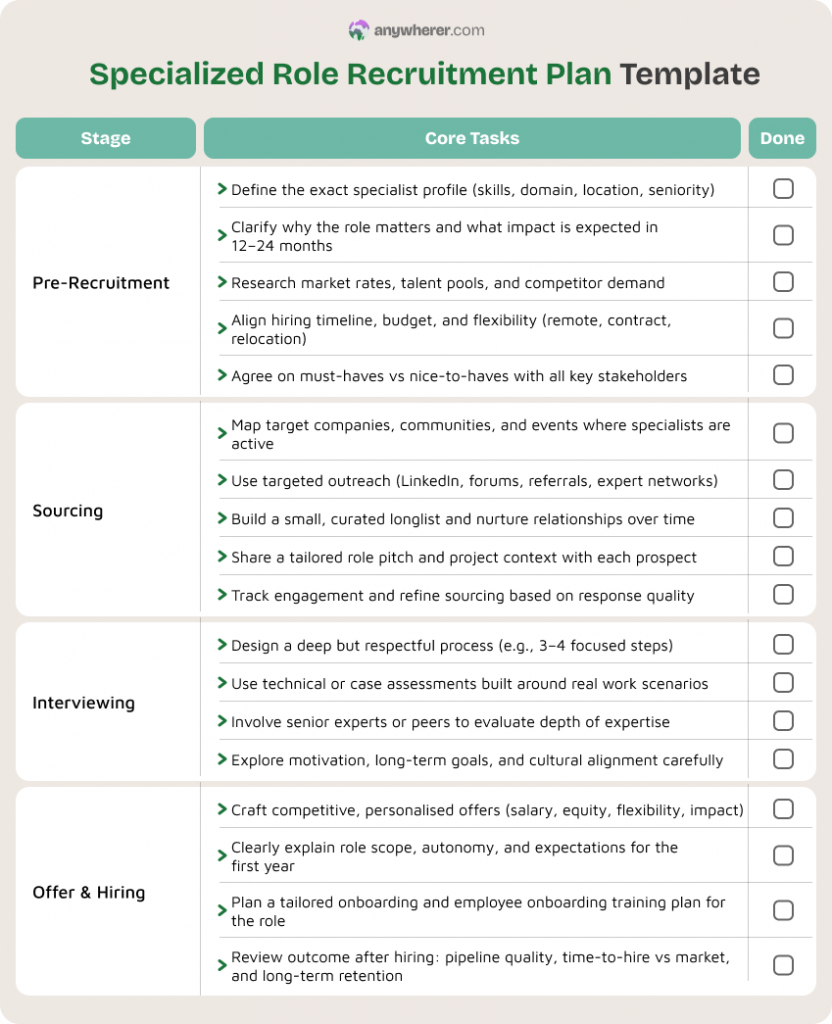
Specialized Role Recruitment Plan Template
This recruitment plan template focuses on scarce, specialist roles (for example, senior ML engineers, niche compliance experts, or country-specific legal roles). It is most useful when one or two hires are very hard to find and you need a careful, long-term sourcing and assessment plan rather than a simple job post.
The timeframe for these plans is often 3–9 months or longer, with a focus on a very small number of highly specialized roles and strong selectiveness. Success is usually evaluated by the quality of the pipeline, the number of truly qualified candidates engaged, time to hire compared to market norms, and long-term retention and impact of the new hire.
Budget-Constrained Recruitment Plan Template
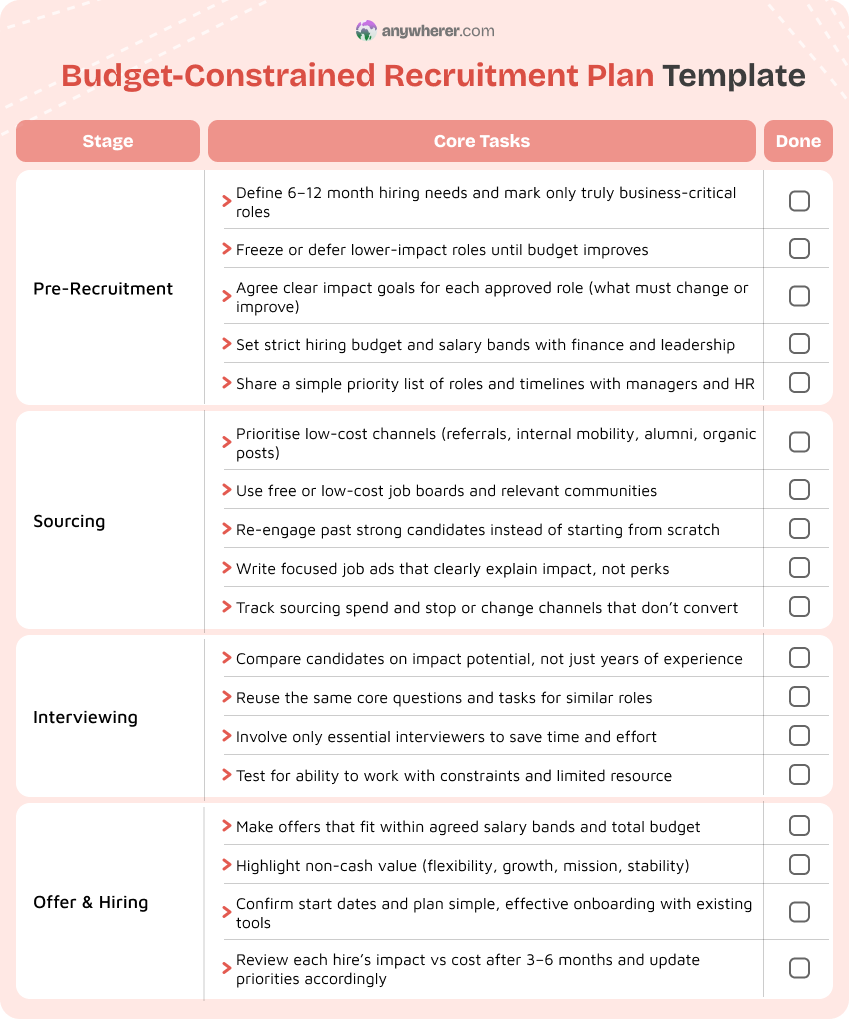
This recruitment plan template free style works when budgets are tight but you still need some hiring. It helps you prioritize roles and choose low-cost channels. It is most useful for bootstrapped businesses, teams in cost-saving mode, or non-profits that must justify every hire and focus on impact over headcount.
Normally this plan covers a 6–12 month period with frequent reviews, concentrates only on the most critical roles (often fewer than originally requested), and is evaluated by the impact of those hires relative to their cost, staying within budget, and maintaining key services or growth targets.
Flexible / Scalable Recruitment Plan Template
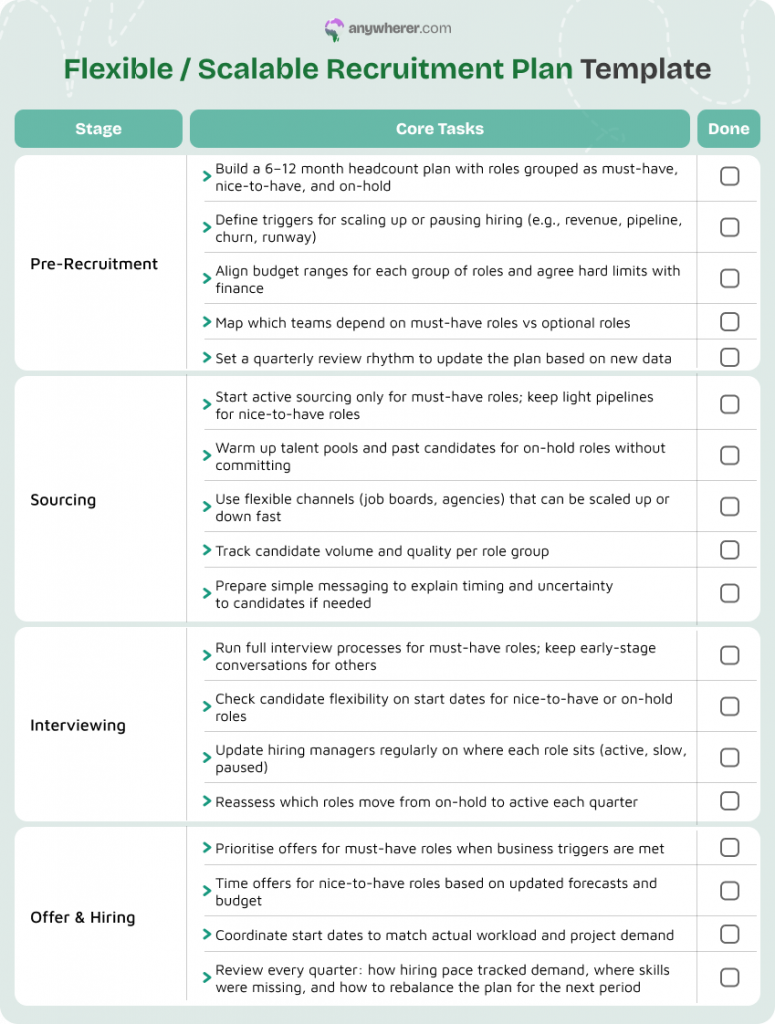
This flexible plan is an example of a recruitment plan that can scale up or down based on real-time business signals. It works like a “base plan plus options” model. It is most useful for companies in uncertain markets, where demand may grow or shrink quickly, and roles are grouped into “must-have,” “good-to-have,” and “on-hold” so you can move between tracks.
In most cases the time horizon is 6–12 months with quarterly reviews, with a hiring focus that mixes core roles and optional roles whose urgency can change. Success is evaluated by how well hiring speed tracks actual demand (speeding up or pausing when needed), whether costs stay under control, and whether critical skills are available when the business needs them.
Conclusion
Recruitment planning is not about adding more paperwork. It is about making hiring decisions that support sustainable team growth. A simple recruitment plan template helps you see what you need, when you need it, and how each hire connects to real goals.
For growing teams, this matters more every year. Skills shortages, changing markets, and rising hiring costs make reactive, last-minute recruitment risky and expensive. A clear plan gives you structure, helps you choose where to invest recruiter time, and keeps hiring aligned with headcount, budget, and product or revenue priorities.
FAQs on Recruitment Plan Templates
What is a recruitment plan template?
A recruitment plan template is a simple framework that shows which roles you need to hire, when, why, and how. It usually includes headcount targets, timelines, budgets, sourcing channels, and basic metrics. You can reuse the same template across teams and periods as a sample of recruitment plan that keeps decisions consistent.
How is a recruitment plan different from a hiring strategy?
A hiring strategy is the big picture: how you position your company, what channels you use, and how you assess candidates. A recruitment plan is more concrete. It is an example of a recruitment plan that turns strategy into actions, numbers, and dates.
Who should be involved in creating a recruitment plan?
At minimum, you need input from:
- The business or department leader (what roles and when)
- HR / Talent Acquisition (how to source, screen, and measure)
- Finance (budget and headcount limits)
For larger organizations, you may also involve workforce planning or operations. The best recruitment plan examples are created jointly, not by HR alone.
How often should recruitment plans be updated?
Most companies review their plans at least quarterly, and informally more often if something big changes (for example, new funding, market shifts, or hiring freezes). An annual hiring plan can set the baseline, with more detailed recruitment campaign plan templates or recruitment sourcing plan templates created for specific waves or teams.
Can recruitment plans be reused year over year?
Yes, but they should not be copied blindly. You can treat each as a recruitment plan template free to reuse structure and fields, but you should update assumptions, role priorities, and budgets every year. Over time, you build a library of recruitment action plan examples that make planning faster while still reflecting the current reality of your market and business.

Yaryna is our lead writer with over 8 years of experience in crafting clear, compelling, and insightful content. Specializing in global employment and EOR solutions, she simplifies complex concepts to help businesses expand their remote teams with confidence. With a strong background working alongside diverse product and software teams, Yaryna brings a tech-savvy perspective to her writing, delivering both in-depth analysis and valuable insights.