What Is a Panel Interview?
A panel interview brings multiple interviewers into a single conversation with one candidate. Instead of running separate rounds, the hiring team evaluates skills, judgment, and cultural alignment in one sitting. For companies building distributed or cross-functional teams, this format reduces scheduling overhead and delivers a more balanced assessment.
The value of a panel style interview depends entirely on preparation. When panelists arrive without assigned roles or standardized questions, the session becomes a free-form conversation where the loudest voice dominates and the candidate gets an inconsistent experience. SHRM confirms that structured interview approaches produce significantly better hiring outcomes when questions are planned in advance and evaluation criteria are defined before the candidate walks in.
Choosing the right interview panel questions, and knowing how to evaluate the answers, is what separates a productive panel from an expensive scheduling exercise.
Panel Interview vs One-on-One Interview
Both formats have a place in hiring, but they serve different purposes. Understanding where they differ helps you decide which questions to ask in a panel interview and when a one-on-one conversation is the better fit.
| Criteria | Panel Interview | One-on-One Interview |
| Number of interviewers | 3 to 5, typically from different functions | 1 interviewer per session |
| Assessment breadth | Multiple perspectives gathered simultaneously | Single perspective per round |
| Time to decision | Faster overall, fewer rounds needed | Slower, requires scheduling multiple sessions |
| Candidate pressure | Higher, multiple evaluators present | Lower, more conversational |
| Evaluation consistency | Higher when roles are pre-assigned | Varies across separate interviews |
| Relationship building | Limited, more formal setting | Stronger individual rapport |
| Bias reduction | Better, diverse perspectives offset individual bias | More prone to individual bias |
| Best suited for | Senior roles, cross-functional positions | Early screening, culture fit conversations |
Panel Interview Questions and Answers
The most effective panel interview questions to ask candidates are the ones that let each panelist evaluate a distinct competency. When every interviewer covers a different area, the panel collects a broader, more reliable signal than any single conversation could.
Collaboration and Cross-Functional Skills Questions
These questions reveal how candidates work across team boundaries, build alignment without authority, and navigate the friction that comes with cross-functional work.
Question #1: Describe a time you worked with a team outside your department to achieve a shared goal.
Sample answer: At my previous company, marketing and engineering had conflicting timelines for a product launch. I set up a shared tracker, aligned on milestones, and ran weekly syncs. We launched on time with full alignment.
Strong answer signals:
- References specific coordination methods
- Acknowledges tension without blame
- Focuses on outcomes
Red flags to watch:
- Takes sole credit
- Cannot name what other teams contributed
- Stays vague on process
Question #2: How do you handle disagreements about priorities when working across teams?
Sample answer: I start by understanding what each team is optimizing for. In most cases, conflicts come from misaligned metrics rather than bad intentions. I try to find shared objectives and escalate only when teams cannot agree independently.
Strong answer signals:
- Shows empathy for competing priorities
- Uses structured conflict resolution
- Remains outcome-focused
Red flags to watch:
- Defaults to escalation immediately
- Frames disagreements as win-lose
- Avoids direct conversations
Question #3: Tell us about a situation where you had to gain buy-in from stakeholders who did not report to you.
Sample answer: I needed compliance and product teams to agree on a revised data handling workflow. I mapped each stakeholder’s concerns in advance, presented the proposal in terms of their priorities, and gave them time to review. Both teams signed off within two weeks.
Strong answer signals:
- Prepares before pitching
- Adapts messaging to audience
- Shows patience in building consensus
Red flags to watch:
- Relies on authority
- Skips stakeholder concerns
- Expects immediate agreement
Question #4: Walk us through how you coordinated deliverables across multiple teams with competing deadlines.
Sample answer: I managed a platform migration with three teams on overlapping timelines. I created a dependency map, identified the critical path, and negotiated phased delivery with each lead. That allowed us to sequence work without blocking anyone.
Strong answer signals:
- Uses planning tools
- Understands dependencies
- Communicates proactively
Red flags to watch:
- Lets competing deadlines create chaos
- Does not track dependencies
- Avoids trade-off conversations
Question #5: Share an example of how you adapted your working style to collaborate with someone whose approach was very different from yours.
Sample answer: I worked with a lead who preferred async communication while I tend to resolve issues in real time. I shifted to writing detailed briefs before meetings and reserved live discussions for decision points. It improved our output quality.
Strong answer signals:
- Shows self-awareness
- Willingness to adapt
- Focuses on the relationship working, not just the task
Red flags to watch:
- Expects others to adapt without reciprocating
- Dismisses different styles
- Cannot give a specific example
Questions About Communication Under Pressure
Pressure exposes communication habits that rehearsed answers cannot hide. These typical panel interview questions test how candidates deliver information when the stakes are high and the audience is demanding.
Question #6: Tell us about a time you had to deliver difficult news to a team or client.
Sample answer: I informed a client that a key deliverable would be delayed by three weeks due to a vendor issue. I prepared a revised timeline, explained the root cause, and outlined mitigation steps before the call. The client stayed with us.
Strong answer signals:
- Prepares before delivering bad news
- Takes ownership
- Offers solutions alongside problems
Red flags to watch:
- Avoids responsibility
- Delivers bad news without a plan
- Blames others
Question #7: Describe a situation where miscommunication caused a problem and how you resolved it.
Sample answer: A handoff between design and development led to a feature built to an outdated spec. I brought both teams together, traced the breakdown, and introduced a sign-off step before development begins. We rebuilt the feature in one sprint.
Strong answer signals:
- Traces root cause
- Implements preventive measures
- Stays solution-focused
Red flags to watch:
- Blames others for the miscommunication
- Does not learn from it
- Avoids describing the resolution
Question #8: How have you handled a high-stakes presentation where things did not go as planned?
Sample answer: During a board presentation, our demo environment went down. I switched to a static walkthrough I had prepared as backup, acknowledged the issue openly, and redirected the conversation to the data. The board approved the proposal.
Strong answer signals:
- Has contingency plans
- Stays composed
- Adapts in real time
Red flags to watch:
- Freezes under pressure
- Does not prepare backups
- Becomes defensive
Question #9: Give an example of explaining a complex concept to a non-technical audience under time pressure.
Sample answer: I had ten minutes to brief the executive team on why a system migration was critical. I framed it in terms of customer impact and cost risk and used three slides. They approved the budget in the same meeting.
Strong answer signals:
- Adjusts language to audience
- Prioritizes clarity over completeness
- Reads the room
Red flags to watch:
- Overloads with jargon
- Cannot simplify
- Loses the audience
Question #10: Walk us through a scenario where you managed conflicting messages from different stakeholders.
Sample answer: Product and sales were giving engineering opposing requirements. I organized a joint session where both teams presented their reasoning, then facilitated prioritization based on customer data. We agreed on a single scope and moved forward without rework.
Strong answer signals:
- Creates space for alignment
- Uses data to resolve disputes
- Does not pick sides without justification
Red flags to watch:
- Follows the loudest voice
- Avoids surfacing the conflict
- Does not document decisions
Questions About Leadership and Decision-Making
Leadership questions in a panel setting reveal whether a candidate drives decisions through clarity and accountability or defaults to consensus and avoidance. Good panel interview questions in this area push beyond rehearsed answers.
Question #11: Describe a decision you made with incomplete information and how it turned out.
Sample answer: We had to choose between two vendor platforms with limited performance data on one. I gathered what was available, consulted peers who had used similar tools, and chose the option with better integration support. We onboarded in half the expected time.
Strong answer signals:
- Comfortable with ambiguity
- Gathers available data
- Makes reasoned trade-offs
Red flags to watch:
- Waits indefinitely for perfect information
- Cannot explain reasoning
- Avoids accountability for the outcome
Question #12: Tell us about a time you had to reverse a decision you had already committed to.
Sample answer: I championed a new workflow tool, but adoption was low and the team was losing time switching between systems. After three months, I acknowledged it was not working, led the rollback, and documented what we learned.
Strong answer signals:
- Admits mistakes openly
- Prioritizes outcomes over ego
- Learns from reversals
Red flags to watch:
- Doubles down despite evidence
- Blames the team for poor adoption
- Avoids revisiting decisions
Question #13: How have you handled a situation where your team disagreed with a direction you set?
Sample answer: When I proposed restructuring our sprint process, several team members pushed back. I invited them to present concerns in a retro, adjusted two changes based on their input, and rolled out the rest as a trial. Buy-in improved significantly.
Strong answer signals:
- Welcomes dissent
- Adjusts without abandoning the core goal
- Uses structured feedback channels
Red flags to watch:
- Overrides dissent without listening
- Takes disagreement personally
- Avoids difficult conversations
Question #14: Give an example of how you prioritized competing initiatives with limited resources.
Sample answer: Three projects competed for the same development team. I built a scoring framework based on customer impact, revenue potential, and effort, then presented the ranking to leadership. We deferred one project and completed the top two on time.
Strong answer signals:
- Uses a framework for decisions
- Communicates rationale clearly
- Accepts trade-offs
Red flags to watch:
- Tries to do everything at once
- Cannot articulate why one initiative was chosen over another
- Avoids saying no
Question #15: Share a time when you had to lead through ambiguity without clear organizational direction.
Sample answer: During a restructuring, my team had no confirmed reporting line for six weeks. I kept our roadmap moving, held daily standups, and communicated what I knew honestly. When the new structure was announced, we were the only team that had not lost velocity.
Strong answer signals:
- Provides stability during uncertainty
- Communicates honestly
- Maintains focus on deliverables
Red flags to watch:
- Waits for direction instead of acting
- Creates panic
- Withdraws from the team
Problem-Solving Panel Interview Questions
Problem-solving questions help the panel assess analytical depth and resourcefulness. The strongest candidates describe not just what they did but why their approach worked when others had failed.
Question #16: Describe a problem you solved that others had previously failed to resolve.
Sample answer: Customer churn had been rising for two quarters and prior interventions targeted pricing. I analyzed support ticket data and found onboarding complexity was the actual driver. Redesigning the first-week experience dropped churn by 18%.
Strong answer signals:
- Explains what was missed in earlier attempts
- Shows clear, structured problem-solving
- Quantifies results and clarifies their role
Red flags to watch:
- Cannot explain what made their approach different
- Provides vague outcomes
- Takes credit for team work
Question #17: Tell us about a time you identified a root cause that was not immediately obvious.
Sample answer: Our deployment failure rate spiked and the initial assumption was code quality. After reviewing logs and talking to the team, I traced the issue to environment configuration drift between staging and production. Fixing the config pipeline resolved it within a week.
Strong answer signals:
- Investigates systematically
- Does not accept first assumptions
- Involves the right people
Red flags to watch:
- Jumps to conclusions
- Relies on instinct over data
- Cannot describe the investigation process
Question #18: How have you approached a situation where the standard solution did not work?
Sample answer: Our vendor vetting process was too slow for a time-sensitive partnership. I proposed parallel evaluation with compressed review cycles and conditional approval, which got sign-off from legal within a week instead of the usual six.
Strong answer signals:
- Adapts processes to context
- Balances speed and risk
- Proposes alternatives with clear trade-offs
Red flags to watch:
- Follows process rigidly without questioning
- Waits for someone else to propose alternatives
- Cannot articulate the risk
Question #19: Walk us through a process improvement you initiated and implemented.
Sample answer: Our monthly reporting cycle consumed three days of analyst time. I automated the data pull and built a self-populating template, cutting the cycle to four hours. The team used the reclaimed time for deeper analysis.
Strong answer signals:
- Identifies inefficiencies independently
- Implements solutions
- Quantifies impact
Red flags to watch:
- Proposes changes without implementing them
- Cannot measure results
- Does not consider downstream effects
Question #20: Give an example of how you used data to support a solution that was initially unpopular.
Sample answer: I recommended deferring a feature the sales team had been requesting for months. I presented usage data from comparable features, projected development costs, and showed the opportunity cost against higher-impact work. Leadership agreed.
Strong answer signals:
- Backs arguments with evidence
- Communicates respectfully despite pushback
- Stays focused on business outcomes
Red flags to watch:
- Uses data selectively to support a predetermined conclusion
- Dismisses opposing views
- Cannot handle pushback
Other Questions to Ask In a Panel Interview
Behavioral Interview Questions
Behavioral questions for a panel interview assess how candidates have handled real situations in the past. They work best when each panelist listens for a different competency. If your process includes a dedicated behavioral round, pair these with top behavioral interview questions designed for deeper follow-up.
- Tell us about a time you went above and beyond what was expected in your role.
- Describe a situation where you had to adapt quickly to an unexpected change at work.
- Share an example of receiving critical feedback and how you responded to it.
- Walk us through a project that did not meet its original goals and what you learned.
- How have you handled a situation where you had to meet a tight deadline with limited support?
Situational Interview Questions
Situational questions present hypothetical scenarios and assess how candidates think on their feet. In a panel format, they reveal decision-making patterns that are hard to rehearse. These pair well with situational questions for interviews when you want to build a full scenario-based assessment.
- If you joined this team and found morale was low, what would be your approach in the first month?
- How would you handle discovering that a teammate was not meeting their responsibilities on a shared project?
- What would you do if two team members came to you with opposing views on how to approach a task?
- If you were given a project with unclear goals and a fixed deadline, how would you proceed?
- How would you manage a client who changed requirements after development was already underway?
Leadership Panel Interview Questions
These questions help panelists assess whether a candidate leads through influence, structure, or authority. They are particularly relevant for roles where the person will manage others or drive initiatives across teams. When selecting questions to ask in panel interview settings for leadership roles, focus on evidence of decision-making under real constraints.
- How do you build trust with a new team when stepping into a leadership role?
- Describe your approach to delegating tasks when your team is stretched thin.
- What does accountability look like in how you lead day to day?
- How do you develop less experienced team members while managing your own workload?
- What is your process for deciding whether a team initiative should continue or be stopped?
Technical and Functional Questions
Technical questions in a panel setting allow the subject-matter expert on the panel to assess depth while other panelists observe how the candidate communicates complex ideas. Tailor these to the specific role and adjust for seniority.
- Walk us through how you stay current with developments in your field.
- Describe a technical challenge you faced and the tools or frameworks you used to solve it.
- How do you evaluate new tools or platforms before recommending them to your team?
- Give an example of translating a business requirement into a technical solution.
- What is your approach to balancing speed and quality in technical delivery?
Culture Fit Panel Interview Questions
Culture fit questions help the panel evaluate whether a candidate will thrive in the team’s working environment. They work best when panelists represent different functions, since alignment with one team does not guarantee alignment across the organization.
- What kind of work environment brings out your best performance?
- How do you handle situations where team values conflict with project pressure?
- Describe what healthy team dynamics look like to you.
- How do you approach building relationships with colleagues whose work styles differ from yours?
- What role does feedback play in your daily work?
Conflict Management Questions
Conflict management questions reveal how candidates navigate tension without damaging relationships. In a panel, these questions often produce the most revealing answers because the pressure of multiple observers mirrors real workplace dynamics.
- Tell us about a workplace conflict you helped resolve between two other people.
- Describe a time when you disagreed with a manager’s decision and how you handled it.
- How do you de-escalate tension during a team meeting?
- Share an example of navigating a conflict where there was no clear right answer.
- What is your approach when you realize you were wrong during a disagreement?
Adaptability and Change Management Questions
These questions test how candidates respond to shifting conditions, whether that involves organizational change, evolving priorities, or new ways of working. Panelists should listen for resilience, flexibility, and a learning orientation.
- Describe a time when a significant change at work affected your role and how you responded.
- How do you maintain productivity when priorities shift frequently?
- Give an example of learning a new skill or process quickly to meet a business need.
- How have you helped a team navigate a period of uncertainty or transition?
- What strategies do you use to stay effective when the scope of your work changes mid-project?
Strategic Thinking Questions
Strategic thinking questions evaluate whether a candidate can connect daily work to broader business goals. They are especially useful for mid-level and senior roles where independent judgment has real organizational impact.
- How do you decide which projects or tasks will create the most value for your team?
- Describe a time you identified a long-term risk that others had overlooked.
- How do you balance short-term results with long-term objectives?
- Give an example of how you used market or industry trends to influence a business decision.
- What is your process for evaluating whether a current strategy is still working?
Common Panel Interview Mistakes
Even well-intentioned panels can undermine their own effectiveness. These are the mistakes that most frequently reduce the quality of panel interviews.
- Asking overlapping questions. When panelists do not coordinate in advance, candidates answer the same prompt multiple times while critical competencies go untested.
- Letting one panelist dominate the conversation. Panels work when each interviewer has equal space. If one voice takes over, the format offers no advantage over a standard one-on-one.
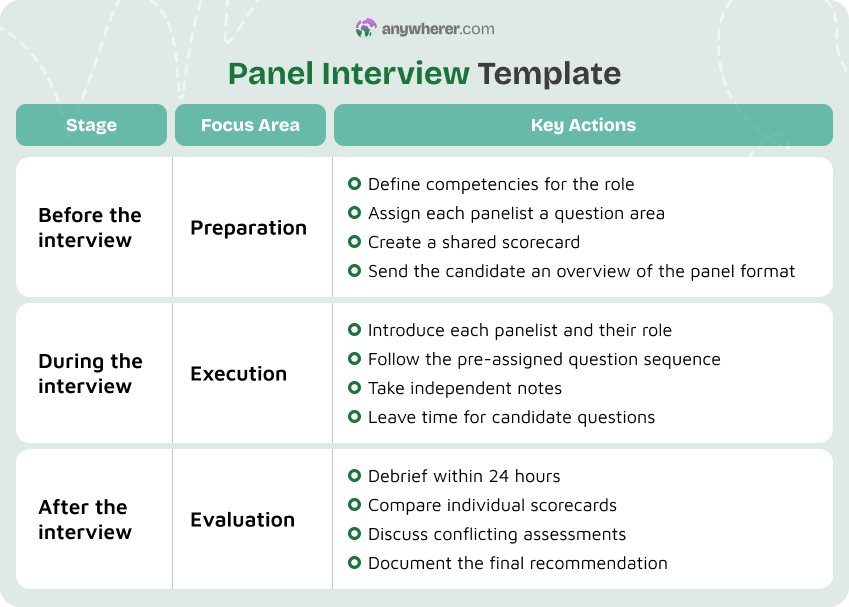
- Skipping the post-interview debrief. Without a structured debrief immediately after the session, individual impressions blur and groupthink takes over when the team reconvenes later.
- Using generic questions without role alignment. Common panel interview questions pulled from a template without adjusting for the specific role miss the competencies that actually predict success.
- Not briefing the candidate on the format. Candidates who walk into a panel without knowing how many people will be present or how the session is structured perform below their actual ability.
Panel Interview Template
Knowing how to conduct a panel interview starts with a repeatable structure. The template below breaks the process into three stages with specific actions that keep the panel organized and the evaluation consistent. Many teams compile their panel interview questions and answers pdf to share across the hiring team before each session.
Final Words
A well-run panel interview compresses evaluation time, reduces individual bias, and gives the candidate a clearer picture of the team they would be joining. The format works equally well for in-person and virtual panel interview setups, as long as the structure is in place before the conversation starts. HBR research confirms that structured approaches are among the most effective tools for reducing hiring bias and improving prediction accuracy.
The questions in this article are designed to be adapted, not copied. Choose the ones that match your role requirements, assign them to the right panelists, and build a scorecard that reflects what matters for the position. Questions to ask during a panel interview should always be tied to the competencies that predict success in the role, not to a generic checklist.
FAQs on Panel Interview Questions
What is a panel interview?
A panel interview is a hiring format where multiple interviewers assess a single candidate in one session. Typically, each panelist represents a different function or perspective, such as the hiring manager, a peer, and someone from a cross-functional team. The purpose is to evaluate the candidate from multiple angles simultaneously rather than spreading assessment across separate one-on-one rounds.
How many people should be on an interview panel?
Three to five is the standard range. Fewer than three limits the diversity of perspective. More than five tends to overwhelm the candidate and makes scheduling difficult. The ideal panel includes the hiring manager, a technical or functional lead, and at least one person from a team the candidate would collaborate with regularly.
How long should a panel interview last?
Most panel interviews run between 45 and 60 minutes. That gives each panelist enough time to cover their assigned area, allows the candidate to ask questions, and avoids the fatigue that comes from extended sessions. Panels that run over an hour typically have too many overlapping questions or too many panelists.
What are good panel interview questions to ask candidates?
The most effective questions for a panel interview are competency-based and distributed across panelists so no two interviewers cover the same area. Focus on collaboration, problem-solving, communication under pressure, and role-specific skills. Avoid open-ended prompts that invite rehearsed answers instead of authentic responses.
How do you conduct a panel interview effectively?
Assign each panelist a specific competency area and set of questions before the interview. Use a shared scorecard so everyone evaluates against the same criteria. Start the session by introducing the panel and explaining the format. Debrief within 24 hours while impressions are fresh. The questions to ask during panel interview sessions should be pre-assigned, not improvised.
Are panel interviews harder for candidates?
Panel interviews can feel more intense due to the number of evaluators present, but they are not inherently harder. Candidates often prefer them because the entire assessment happens in a single session rather than multiple rounds. Clear communication about the format in advance helps reduce unnecessary pressure. Candidates who prepare questions to ask an interview panel often perform better because they engage each panelist directly.
Can panel interviews be conducted virtually?
Yes. A virtual panel interview follows the same structure as an in-person one. The key adjustments are technical: use a reliable video platform, ensure each panelist has their camera on, and establish a speaking order to avoid talking over one another. The same preparation, question assignment, and scoring practices apply regardless of format.
How do you reduce bias in a panel interview?
Structured formats are the strongest tool for reducing bias. Assign predetermined questions, use a consistent scoring rubric, and have panelists submit their evaluations independently before discussing as a group. Diverse panel composition also helps, as varied perspectives offset individual blind spots and lead to more balanced hiring decisions.

Yaryna is our lead writer with over 8 years of experience in crafting clear, compelling, and insightful content. Specializing in global employment and EOR solutions, she simplifies complex concepts to help businesses expand their remote teams with confidence. With a strong background working alongside diverse product and software teams, Yaryna brings a tech-savvy perspective to her writing, delivering both in-depth analysis and valuable insights.