Most companies have an orientation process, but not all of them run it well. Ask any HR director who’s honest about their numbers and they’ll admit the same thing: the gap between what’s planned and what actually happens on day one is wide. Gallup surveyed thousands of workers and found that only 12% strongly agree their company handles onboarding well. That leaves 88% somewhere between “it was fine” and “nobody told me where the printer was.”
This guide provides a new employee orientation checklist in four stages: what happens before the start date, the first day itself, the full first week, and ongoing support through 90 days. Each stage has a description, a task list, and content formatted for slides or handouts. Five-person office or 2,000-employee operation across three time zones, this new hire orientation checklist adapts to fit.
Why Employee Orientation Matters
Orientation is the first real test of whether a company follows through on what it promised during interviews. Think about it from the new hire’s perspective: they walk in with expectations built over weeks of recruiting, multiple rounds of conversations. What happens in those first 72 hours either confirms everything or contradicts it.
The numbers back this up. SHRM reports that structured onboarding makes people 58% more likely to still be with the company at the three-year mark. And when someone leaves early? The replacement bill runs six to nine months of that person’s salary. Recruiting fees, interviewing time, training from scratch. It adds up faster than most managers realize.
Here’s what a functioning employee orientation checklist delivers in real terms:
- Faster ramp-up. People stop guessing. They know their tasks, their tools, and who to call when something breaks. One example: a sales rep with Salesforce access and a call schedule by Tuesday is building a pipeline while someone without those resources is still hunting for a login.
- Higher engagement. When day one feels thought-through, people lean in. When it’s disorganized, they pull back. Simple cause and effect.
- Lower turnover. One solid week of orientation costs a fraction of what you’ll spend replacing the person who resigns in month two because nobody showed them how things work here.
- Consistency. With a checklist for new hires, every department runs the same process. Marketing doesn’t wing it while engineering has a 20-page binder.
- Compliance from the start. Tax forms, NDAs, data security agreements, safety acknowledgments. All signed before anyone opens a client file. This isn’t optional for regulated industries, and it shouldn’t be optional anywhere else.
Companies that skip orientation or treat it as a formality send a clear message. The new hire reads it. Their teammates read it too. And the impression doesn’t fade once the first week ends.
New Employee Orientation Checklist Templates
Below is the complete orientation checklist for new employees, broken into four stages. Each one includes a description, a bullet-point task list, and image-ready content you can drop into presentations or print for managers.
Use this new hire orientation checklist template as written or adjust it for your particular industry and team size. If your company already follows an onboarding process checklist for remote hires, combine it with this orientation template for new employees so nothing slips through. Orientation covers the first two weeks. Onboarding stretches the full quarter.
Pre-Orientation Preparation Checklist Template
Most of the awkwardness people remember from their first day at a job usually comes down to preparation that never happened. The IT ticket that slipped through. The badge nobody ordered. The desk that still had the previous person’s coffee mug sitting on it. Pre-orientation exists to prevent all of this.
A sample new employee orientation with a solid pre-start phase eliminates the “we’re still getting things set up” conversation entirely. The bar isn’t high: laptop ready, email working, desk clean (or equipment shipped on time for remote hires), and at least one person who knows the new hire’s name and title.
Complete these tasks before day one:
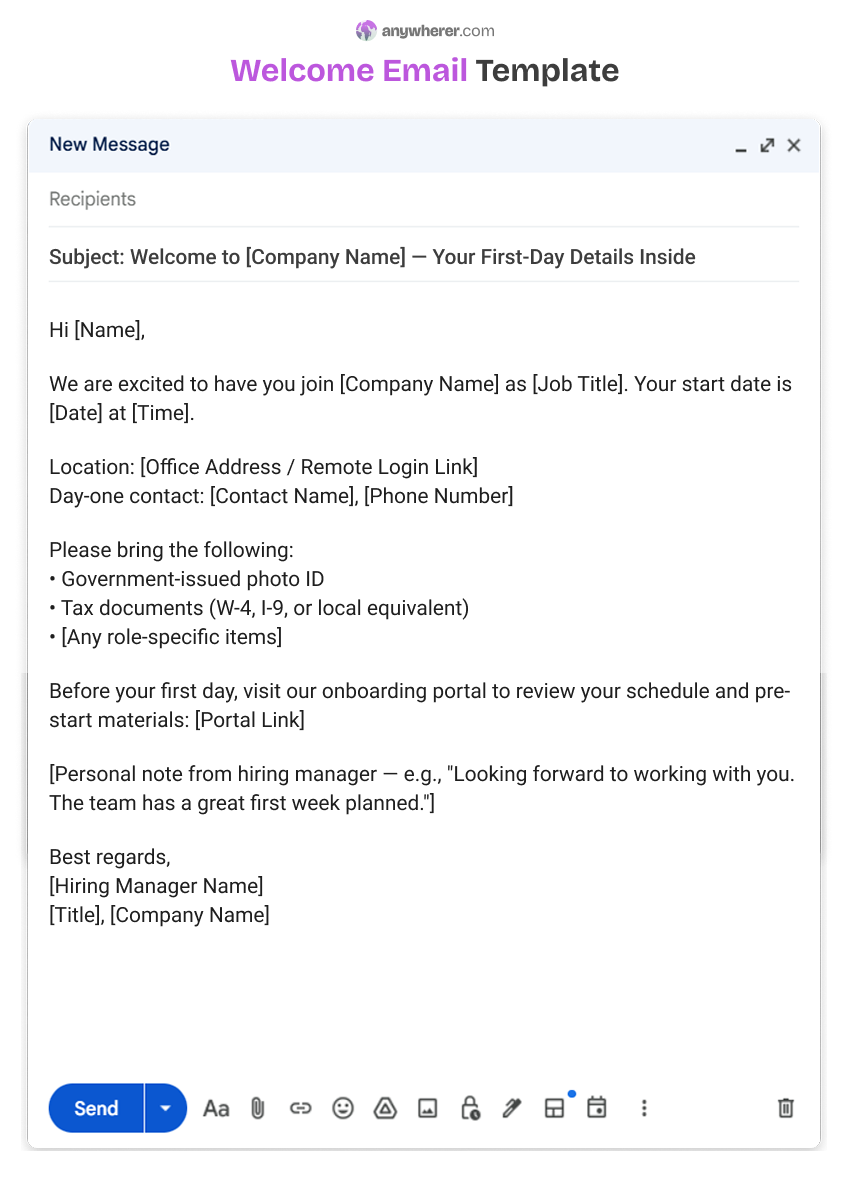
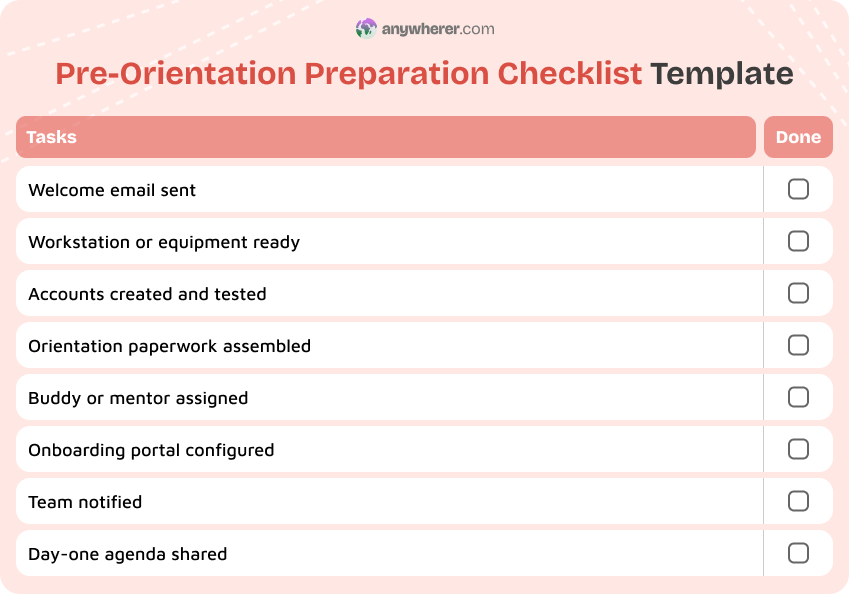
- Send a welcome email with the start date, time, location or remote login link, parking details, dress code, and the name of whoever will greet them.
- Prepare the workstation. Laptop, monitor, keyboard, headset. For remote hires, ship equipment so it lands at least two business days before the start date. Late shipping means a wasted first day.
- Create and test every account: email, HR platform, Slack or Teams, project management tool, VPN. Test each one. A password that doesn’t work at 9 AM Monday tells the new hire exactly how prepared the company is.
- Assemble orientation paperwork. Employment contract, tax forms, direct deposit form, NDA, benefits enrollment packet, and the employee handbook acknowledgment page.
- Assign a buddy or mentor. Tell them the new hire’s name, role, and start date. Ask them to send a quick welcome message ahead of time.
- Set up the onboarding portal or shared folder with training materials, org chart, internal acronym glossary, and the first-week schedule.
- Notify the team. One message with the name, title, and start date. People should know who’s joining before the person walks in.
- Share the new employee orientation agenda in advance. No surprises on day one.
First Day Checklist Template
Day one should center on people, not paperwork. Yes, there are forms to sign and systems to set up. But here’s the reality: if the strongest memory from someone’s first day is filling out an insurance enrollment form, something went sideways. The person should leave at 5 PM knowing the names on their team, the tools they’ll use daily, and what the rest of the week looks like.
A good new hire orientation agenda template builds the schedule with room to breathe. Back-to-back sessions exhaust people and kill retention. Leave gaps. Here’s the sequence:
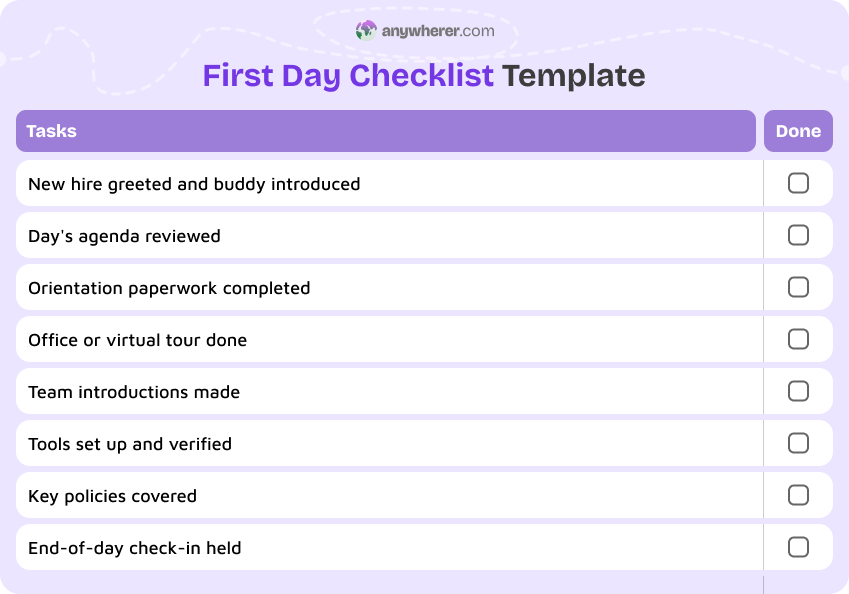
- Meet the new hire at the door. Reception, video lobby, parking lot entrance. Doesn’t matter where. What matters is that someone is there. Sitting alone wondering if anyone remembered you’re starting today is a poor first impression for any employer.
- Walk them through the day’s plan. Hour by hour works well. People relax once they see what’s ahead.
- Complete orientation paperwork: tax forms, emergency contacts, benefits enrollment, and any signatures left from the pre-start phase.
- Do the office tour (or virtual walkthrough). Kitchen, restrooms, meeting rooms, emergency exits, print stations. For remote teams: shared drives, project boards, and where to find help when stuck.
- Introduce the new hire to their direct team. Names, roles, who handles what. Keep it short. Deeper conversations happen naturally over the next few days.
- Open tools together: email, chat, calendar, role-specific software. Click through each one. Confirm everything works before moving on to the next item.
- Cover the policies that matter most right now: code of conduct, attendance expectations, communication norms, and data security. Save the rest for later in the week.
- End with a 10-minute check-in. The manager or buddy asks how things went, catches anything that slipped, and previews day two.
First Week Checklist Template
Once day one is behind you, training begins in earnest. This is the week when the new hire learns the team’s rhythm: how meetings run, who makes decisions, what “doing well” actually looks like here. Pair this staff orientation checklist with an onboarding plan for new hires so each day ties back to 30-60-90 day targets.
Check-ins during week one aren’t a courtesy. They’re operational. Questions show up that the person didn’t think of on Monday. Small misunderstandings grow when nobody catches them. Here’s the employee orientation template for this phase:
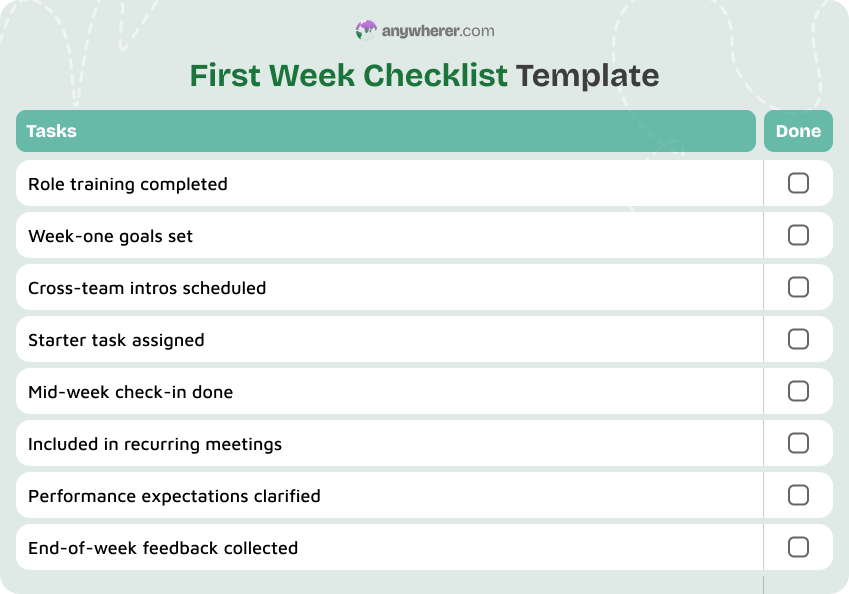
- Deliver role-specific training: product knowledge, internal tools, workflows, and relevant documentation. Skip the generic company overview and go straight to what the role requires.
- Set concrete first-week goals. “Shadow two client calls” is measurable. “Get familiar with the product” is not. Be specific or the goals serve no purpose.
- Schedule cross-functional introductions. Department heads, partner teams, anyone the new hire will interact with regularly. This builds context that training decks can’t.
- Hand off a small, real task. Something that produces actual output. A quick win in the first week does more for confidence than any amount of encouragement.
- Run a mid-week check-in with the manager. Review progress, handle open questions, and shift priorities if something isn’t working.
- Pull the new hire into team rituals: standups, retrospectives, group lunch, whatever defines how this team operates. Culture is absorbed through participation, not through a handbook.
- Clarify performance expectations. What does “meeting expectations” look like at the 30-day mark? If the target isn’t visible, people can’t aim at it.
- Close the week with a feedback conversation. What worked? What was confusing? What do they need more of going forward?
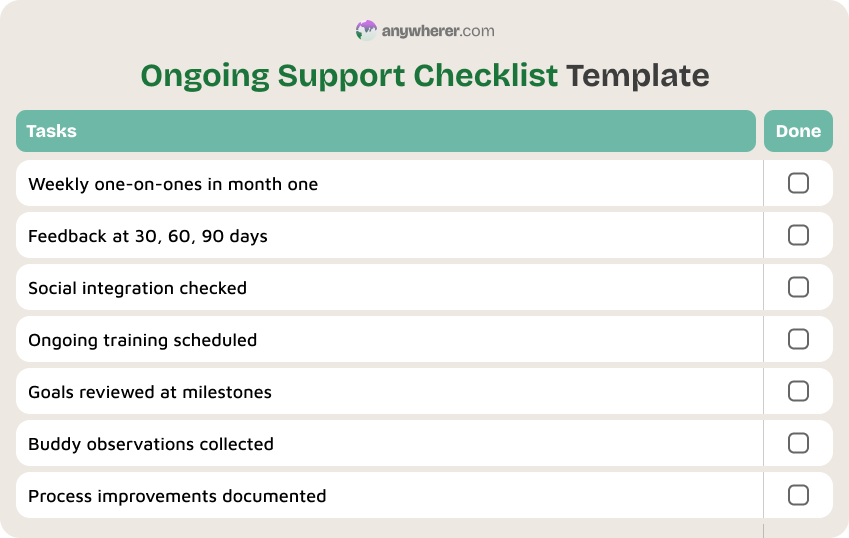
Ongoing Support Checklist Template
Orientation doesn’t end on Friday. The first week builds the foundation, yes. But the real test shows up in month two and month three, once the initial energy fades and ordinary routine takes over.
BambooHR found that employees who go through effective onboarding feel up to 18 times more committed to their employer. Eighteen times. That kind of commitment doesn’t materialize in five days. It builds through consistent check-ins, honest feedback, and a manager who actually reads whatever the new hire shares.
This phase also gives you the data to sharpen your orientation plan template for the next hire. If three people in a row flag the same problem, that’s a process issue. Not a people issue.
- Weekly one-on-ones with the manager through month one. Move to biweekly after that through day 90.
- Structured feedback at 30, 60, and 90 days. A short survey or conversation guide works. Keep the format consistent across hires so patterns become visible quickly.
- Check social integration. Does the person have someone to eat lunch with? Someone to ask the questions that feel too minor for a formal meeting? Isolation in month one is one of the strongest predictors of early departure.
- Continue training. Advanced product sessions, cross-department deep dives, access to learning platforms. Growth shouldn’t stop after the first five days.
- Revisit goals at day 30 and day 60. What sounded right in week one sometimes needs adjusting once the person sees the real workload.
- Talk to the buddy or mentor. They see things the manager doesn’t see from across the room.
- Document what went well and what didn’t. Update the checklist before the next person starts.
Best Practices for an Effective Orientation
Checklists keep you organized but they don’t guarantee the experience lands well. These practices bridge that gap between having a plan and executing it in a way people actually remember.
- Personalize by role. A backend engineer and a regional account manager don’t need the same first week. Tailor your new hire orientation template by role and department so the training connects to the actual job instead of reading like a corporate brochure.
- Make it interactive. Nobody retains a 60-slide deck at 10 AM on their first day. Team lunches, live Q&A with a department lead, a short collaborative task on day two: those leave a mark. The new hire should be participating more than listening during the first 48 hours.
- Use software, don’t lean on it. Onboarding platforms handle reminders, doc tracking, and scheduling. Useful. But the platform can’t replace a manager who stops by someone’s desk and asks how the first week is going. Automate the paperwork. Keep the human part human.
- Prepare something personal. A handwritten welcome note, a desk plant, a small kit with pens and sticky notes. Cheap gestures that say “we thought about you before you arrived.” People notice this kind of thing more than most companies expect.
- Pace the content. Studies show people retain roughly 10% of what they hear in a marathon session. Space things out across the full week. A new employee orientation template free of time pressure beats a morning sprint through 14 topics every single time.
Common Mistakes to Avoid in a Checklist for New Hires
Most orientation failures aren’t complicated. They’re just invisible to the person who designed the process three years ago and hasn’t revisited it since. Run your current new employee orientation checklist template against this list before the next start date and see what holds up.
- No prep before day one. Laptop not ready, accounts missing, nobody told the front desk. This is why the pre-orientation stage exists. Use it.
- Too much at once. Every policy, every tool demo, every form, packed into one morning. That’s not training. A good new hire orientation agenda template spreads content across days, not hours.
- Vanishing after day one. The manager shows up for day one, then goes dark for two weeks. The new hire fills the gap with guesses, and guesses are usually wrong. Weekly check-ins through 90 days are part of managing.
- One program for all roles. A finance analyst and a product designer need different tools, different contacts, different first assignments. One generic program wastes everyone’s time.
- No feedback loop. Never asking what worked and what fell flat means the same problems repeat with every hire. Three questions at the end of week one. Five minutes. That’s all it takes to surface issues that would otherwise stay buried.
Conclusion
Good orientation isn’t complicated and it doesn’t need expensive tools. Prepare before day one. Focus that first day on people, not policies. Fill week one with real training, not death-by-PowerPoint. Then keep showing up for the next three months. That pattern works at 15 employees and it works at 15,000.
The free new employee orientation checklist templates above cover every stage from pre-start prep to 90-day follow-up. Load them into your HR system, print them for managers, or drop them in a shared drive. The format doesn’t matter. What matters is that somebody owns the process and follows through. Every new hire. Every time.
FAQs on New Employee Orientation Checklist Templates
What is the purpose of a new employee orientation?
It tells the new hire who they’ll work with, what the expectations are, how the company operates, and where to go when they’re stuck. A clear new employee orientation agenda covers compliance, tool access, team introductions, and role-specific details so the person isn’t spending their first month piecing it together on their own.
How long should the orientation process last?
Day one handles introductions, paperwork, and tool setup. The rest of the week adds role-specific training and early goals. But the full orientation, with scheduled check-ins and feedback, should stretch to at least 90 days. Trying to squeeze everything into a single morning is a recipe for confusion and turnover.
What should be covered during the first day of orientation?
Team introductions, a facility or virtual tour, core policies, tool setup, and orientation paperwork like tax forms and benefits enrollment. Watch the pace. Nobody should leave day one feeling like they tried to absorb a semester of information in eight hours.
How can I make the orientation process more engaging?
Swap lecture-style presentations for actual conversations. Peer introductions, team lunches, collaborative exercises, live Q&A sessions with leadership. Give the new hire a buddy for questions that feel too small to bring to a manager. Engagement comes from connection, not from reading policy documents off a screen.
What are some common mistakes to avoid during orientation?
Skipping preparation before day one, dumping everything into one session, running the same generic program for every role, and ignoring follow-up after week one. All of these are fixable with an orientation checklist template and a manager who treats this work as part of the job, not extra credit.
How can I ensure the new employee feels welcomed?
Start before they arrive. Send a welcome email, prepare the workspace, tell the team. On day one, be at the door when they show up. Introduce the buddy. Don’t leave them alone with a stack of forms and a link to the employee handbook. The whole point is to make them feel expected, not like a surprise.
Need a new employee orientation template you can customize by department? The checklists above work as a new hire orientation checklist that scales from a five-person startup to a global enterprise. Download, adjust, roll out.

Yaryna is our lead writer with over 8 years of experience in crafting clear, compelling, and insightful content. Specializing in global employment and EOR solutions, she simplifies complex concepts to help businesses expand their remote teams with confidence. With a strong background working alongside diverse product and software teams, Yaryna brings a tech-savvy perspective to her writing, delivering both in-depth analysis and valuable insights.