An individual development plan (IDP) is a structured document that outlines an employee’s goals, the skills they need to develop, and the specific steps they will take to get there. Unlike a performance review, which looks backward, an IDP looks forward. It maps out where an employee wants to go and how they plan to grow.
The problem with most advice on personal development plans for employees is that it stays abstract. Telling someone to ‘set SMART goals’ or ‘identify a mentor’ is not wrong, but it does not answer the practical question: what does an idp look like in the real world? That is why concrete idp examples are more useful than theory. When you see a finished plan, complete with goals, actions, and timelines, it becomes much easier to create your own.
According to SHRM, 76% of employees say they are more likely to stay with a company that offers continuous training and development opportunities. And a recent Deloitte survey found that learning and development is among the top three reasons younger employees choose an employer. Structured individual development plan examples give managers a practical starting point for making this investment real.
Below you will find 9 individual development plan examples, each targeting a different employee scenario. Think of them as examples of personal development plans you can adapt directly. Every example includes a detailed text version plus a condensed image-ready template that works for presentations, one-pagers, or team dashboards. Whether you need a personal development plan sample for onboarding or a leadership growth template, there is a starting point here.
9 Individual Development Plan Examples
The following personal development plan examples cover a range of situations, from general growth plans to targeted templates for new hires, managers, remote workers, and more. These idp examples for employees include a scenario description, a full text template, and a condensed visual version. Use them as idp ideas and starting points, not rigid prescriptions. Adapt the goals, actions, and timelines to fit the employee’s actual role, level, and circumstances.
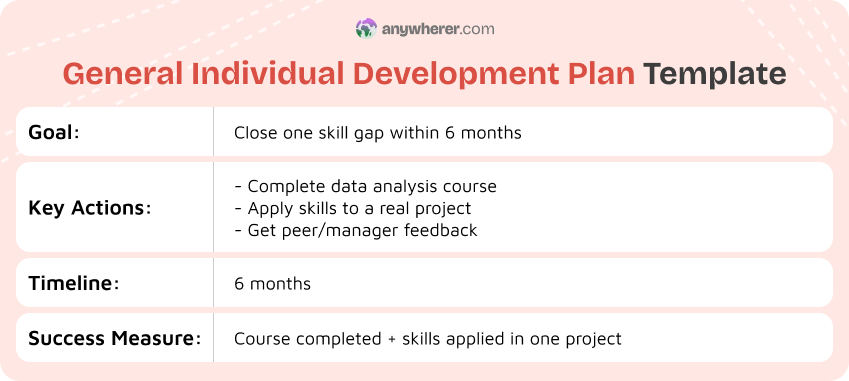
General Individual Development Plan Example
This plan suits any employee looking to grow within their current role. It provides a broad framework for identifying strengths, setting goals, and tracking progress over a defined period.
Development Goal: Strengthen core competencies and close one identified skill gap within the next two quarters.
Current Focus Area / Gap: The employee performs well in day-to-day tasks but has not yet taken on stretch assignments. Their manager has noted a gap in data analysis skills that limits their contribution to cross-functional projects.
Actions to Take:
- Complete an introductory data analysis course within the first 6 weeks
- Apply newly learned skills to at least one real project by the end of Month 3
- Request feedback from a peer or manager after each milestone
- Document lessons learned and share a brief summary with the team
Resources or Support Needed: Online learning platform access, 2 hours per week of dedicated learning time, manager check-ins every two weeks.
Timeline: 6 months.
Success Indicators: Completion of the course, successful application of data skills in one project, and positive feedback from the project lead.
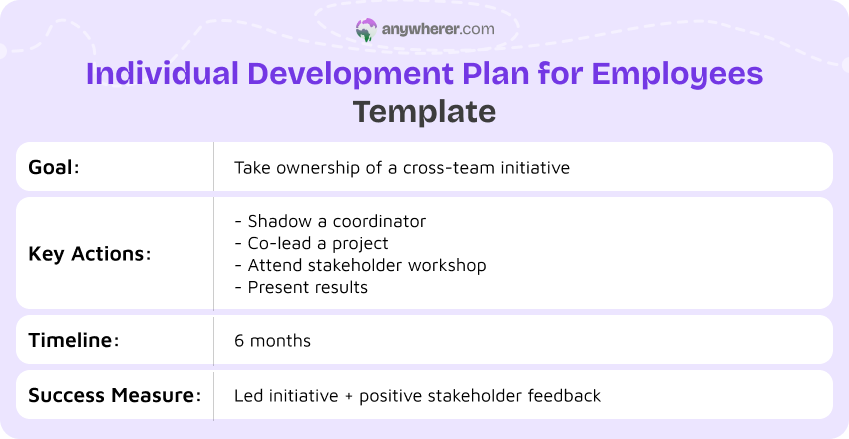
Individual Development Plan for Employees Example
This individual development plan for employees focuses on a mid-level professional who wants to deepen their expertise and take on more responsibility. The plan helps them move beyond routine tasks and develop broader capabilities.
Development Goal: Build advanced project coordination skills and take ownership of one cross-team initiative within six months.
Current Focus Area / Gap: The employee consistently meets expectations but tends to stay within their comfort zone. They have expressed interest in growing into a project coordination role but lack experience managing timelines and stakeholders across teams.
Actions to Take:
- Shadow a project coordinator for two weeks to observe workflow and stakeholder communication
- Co-lead one cross-team project under supervision during Months 2 through 4
- Attend a workshop on stakeholder management and communication
- Present project outcomes to the department by Month 6
Resources or Support Needed: Access to internal project management tools, mentorship from a senior coordinator, and one half-day per month for structured learning.
Timeline: 6 months.
Success Indicators: Successfully co-led one initiative, positive feedback from stakeholders, and demonstrated ability to manage timelines independently.
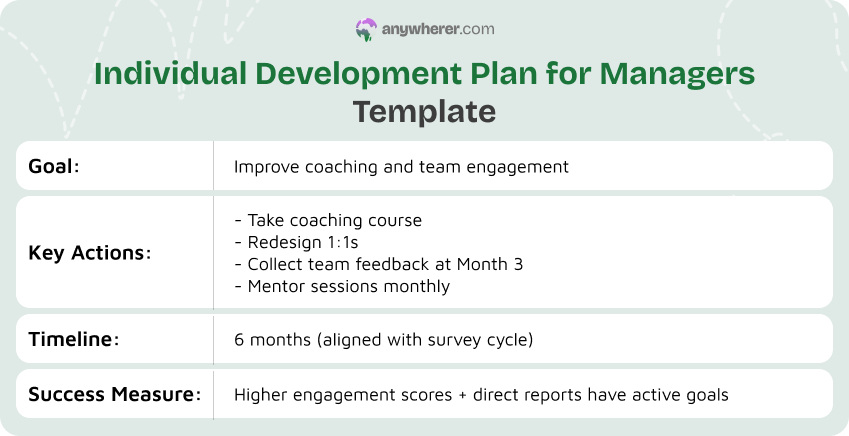
Individual Development Plan for Managers Example
This plan targets a team manager who needs to strengthen people leadership and decision-making skills. It focuses on building trust, giving better feedback, and improving how the manager supports their direct reports.
Development Goal: Improve feedback quality and team engagement scores by developing coaching and communication skills.
Current Focus Area / Gap: The manager is technically skilled but has received feedback that their direct reports do not feel supported during one-on-ones. Team engagement survey scores declined in the last cycle, particularly around the ‘my manager cares about my development’ question.
Actions to Take:
- Complete a coaching fundamentals course within the first month
- Restructure one-on-one meetings to include a dedicated development discussion
- Collect anonymous feedback from direct reports at the 3-month mark
- Work with an internal mentor (senior manager) to refine coaching techniques
- Review and adjust approach based on mid-cycle feedback
Resources or Support Needed: Coaching course enrollment, anonymous survey tool, monthly sessions with a senior manager mentor.
Timeline: 6 months, aligned with the next engagement survey cycle.
Success Indicators: Improved engagement scores in the ‘manager support’ category, direct reports report feeling more supported, and at least two direct reports have active development goals.
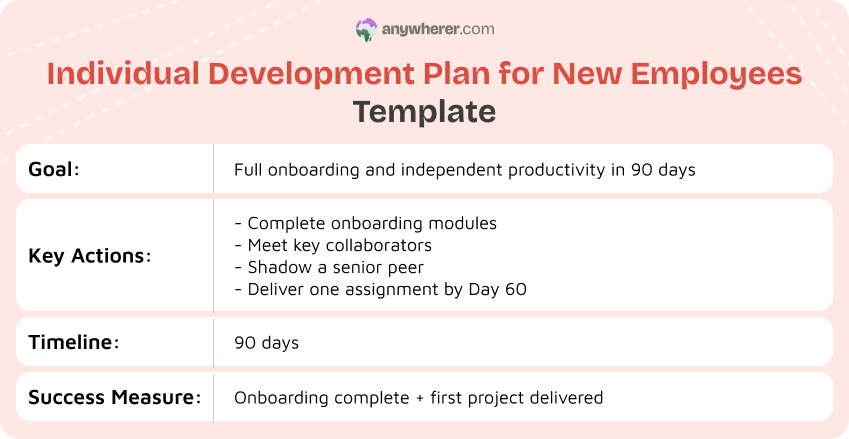
Individual Development Plan for New Employees Template
This plan supports a new hire during their first 90 days. It focuses on onboarding essentials, building internal relationships, and reaching baseline productivity in the role.
Development Goal: Become fully onboarded and independently productive in core responsibilities within 90 days.
Current Focus Area / Gap: The new employee is joining a distributed team and needs to quickly learn internal tools, understand workflows, and build relationships without the benefit of a shared office.
Actions to Take:
- Complete all required onboarding modules within the first two weeks
- Schedule introductory calls with key collaborators across departments during Weeks 2 through 4
- Shadow a senior team member for at least three working sessions
- Complete one small independent task by Day 30 and one full project cycle by Day 60
- Attend a weekly check-in with the manager to discuss progress and ask questions
Resources or Support Needed: Access to onboarding portal, buddy/mentor assignment, scheduled manager check-ins, internal documentation and knowledge base.
Timeline: 90 days.
Success Indicators: Completion of onboarding, positive feedback from buddy and manager, and successful delivery of at least one independent assignment.
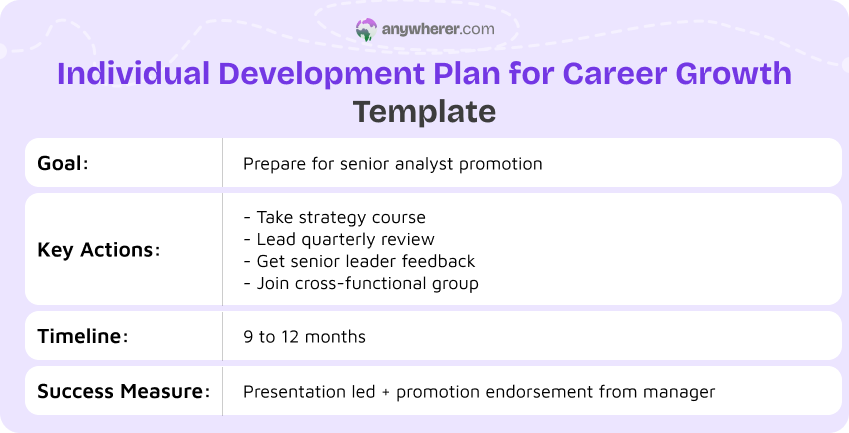
Individual Development Plan for Career Growth Template
This plan is for an employee preparing to move into a higher-level role within the next year. It focuses on developing the competencies required for the target position while maintaining strong performance in the current one.
Development Goal: Prepare for promotion to a senior analyst position by developing strategic thinking and presentation skills.
Current Focus Area / Gap: The employee has strong technical abilities but needs to demonstrate strategic thinking and executive-level communication before being considered for promotion. These are the two key gaps identified during the last performance review.
Actions to Take:
- Enroll in a strategic thinking or business acumen course within the first month
- Volunteer to lead the next quarterly business review presentation
- Seek feedback from at least two senior leaders after the presentation
- Participate in a cross-functional working group to gain broader organizational exposure
- Draft a personal career roadmap with short-term and long-term milestones
Resources or Support Needed: Learning budget for external course, manager sponsorship for the presentation opportunity, access to senior leaders for mentorship.
Timeline: 9 to 12 months.
Success Indicators: Completed the course, led at least one executive-level presentation with positive feedback, and received endorsement from the manager for promotion readiness.
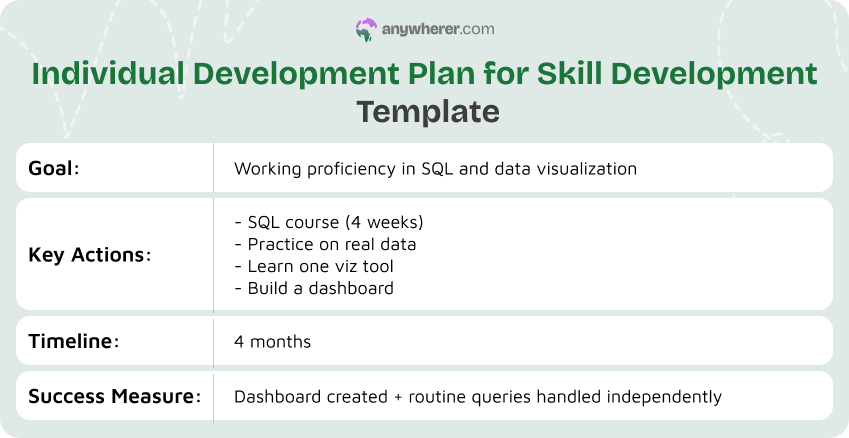
Individual Development Plan for Skill Development Sample
This plan is designed for an employee who needs to build a specific technical or functional skill to remain effective in their role. It could apply to anyone from a marketing specialist learning analytics to a finance associate learning new software.
Development Goal: Achieve working proficiency in SQL and data visualization tools within four months.
Current Focus Area / Gap: The employee’s role increasingly involves pulling reports and interpreting data, but they currently rely on others for queries and visualizations. This dependency slows down their workflow and limits their ability to contribute to data-driven discussions.
Actions to Take:
- Complete an online SQL fundamentals course within the first 4 weeks
- Practice writing queries on real internal datasets during Weeks 5 through 8
- Learn the basics of one visualization tool (e.g., Looker, Tableau, or Power BI) by Month 3
- Build one dashboard or report using real data and present it to the team
- Schedule bi-weekly check-ins with a data-proficient colleague for feedback
Resources or Support Needed: Online course subscription, access to non-sensitive internal datasets for practice, bi-weekly peer mentoring sessions.
Timeline: 4 months.
Success Indicators: Completed the SQL course, independently created at least one report or dashboard, and reduced dependency on others for routine data requests.
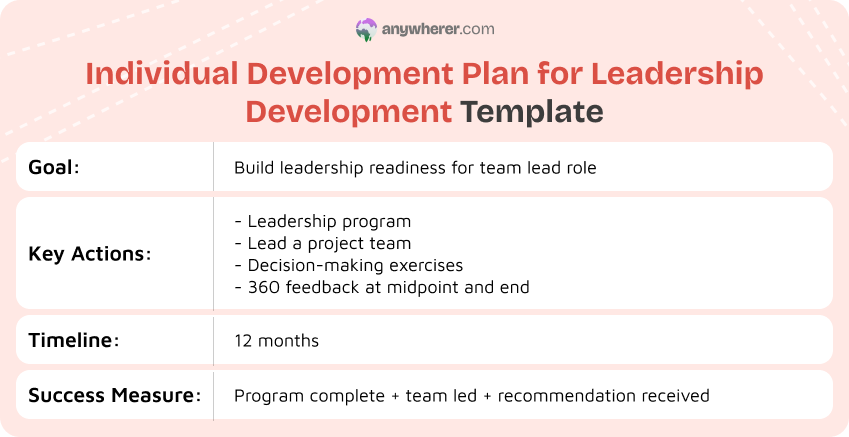
Individual Development Plan for Leadership Development Example
This plan supports a high-potential employee being groomed for a future leadership position. It covers strategic skills, team influence, and decision-making under pressure.
Development Goal: Develop leadership readiness by building skills in decision-making, delegation, and team influence.
Current Focus Area / Gap: The employee has been identified as high-potential and is expected to move into a team lead role within the next year. However, they have limited experience making decisions with incomplete information and tend to take on too much work instead of delegating.
Actions to Take:
- Complete a leadership development program (internal or external) within the first quarter
- Lead a small project team for at least one initiative to practice delegation
- Participate in scenario-based decision-making exercises with a mentor
- Read two recommended books on leadership and discuss takeaways with the mentor
- Request 360-degree feedback at the halfway point and again at the end
Resources or Support Needed: Leadership program enrollment, mentor pairing with a current director, 360-degree feedback tool access.
Timeline: 12 months.
Success Indicators: Completed leadership program, successfully led one project team, received improved 360-degree feedback scores, and earned a formal recommendation for the team lead role.
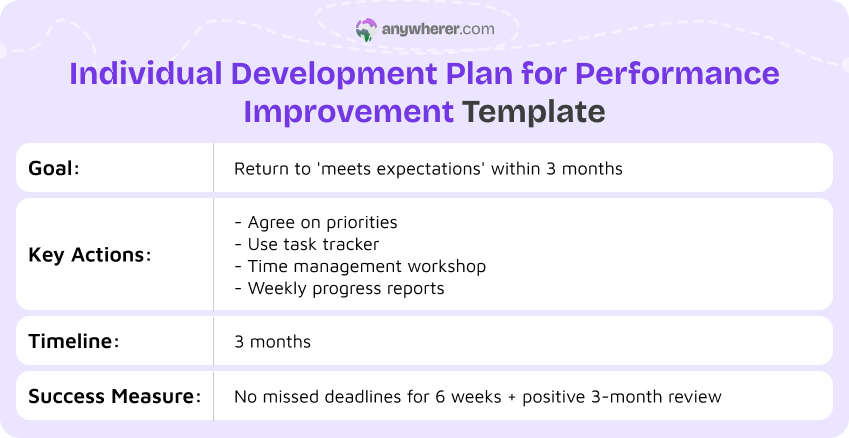
Individual Development Plan for Performance Improvement Template
This plan is for an employee whose recent performance has fallen below expectations. It provides structure, support, and clear milestones to help them get back on track.
Development Goal: Bring performance back to the ‘meets expectations’ level within three months by addressing time management and task completion issues.
Current Focus Area / Gap: The employee has missed several deadlines over the past quarter and has struggled to prioritize tasks effectively. This has affected team deliverables and required others to step in. The plan is intended as supportive, not punitive.
Actions to Take:
- Meet with the manager to review current workload and agree on realistic priorities
- Use a task management tool (e.g., Asana, Trello) to track all assignments with deadlines
- Complete a time management workshop within the first two weeks
- Submit a weekly progress update to the manager every Friday
- Have a formal check-in at the 6-week mark to assess improvement
Resources or Support Needed: Task management tool access, time management workshop enrollment, weekly manager check-ins, and clear written expectations for each deliverable.
Timeline: 3 months.
Success Indicators: No missed deadlines for 6 consecutive weeks, improved weekly progress reports, and positive feedback from the manager at the 3-month review.
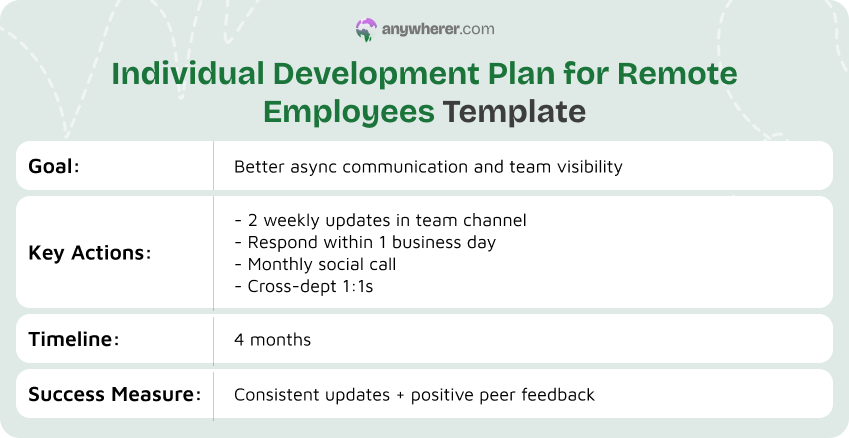
Individual Development Plan for Remote Employees Example
This plan addresses the unique challenges of working remotely, including communication across time zones, visibility, and self-management. It helps remote employees stay connected, productive, and aligned with team goals.
Development Goal: Improve async communication skills and increase visibility within the team over the next four months.
Current Focus Area / Gap: The remote employee performs well on individual tasks but is often ‘invisible’ during collaborative work. They tend to communicate infrequently in shared channels, miss context in async threads, and rarely share updates proactively. This limits their influence and makes it harder for the team to coordinate.
Actions to Take:
- Post at least two substantive updates per week in the team’s shared channel
- Respond to async messages within one business day, including when the answer is ‘I will follow up’
- Attend at least one optional team call or social event per month
- Schedule a monthly 1:1 with a colleague from another department to expand internal network
- Complete a short course on effective written communication for distributed teams
Resources or Support Needed: Team communication guidelines, async communication course, manager support for scheduling cross-department 1:1s.
Timeline: 4 months.
Success Indicators: Consistent weekly updates in shared channels, improved response times noted by teammates, and positive feedback in the next peer review cycle.
Common Mistakes in Individual Development Plans
Even well-intentioned development plans can fall short if they repeat common pitfalls. Here are four mistakes that undermine individual development plans, and what to do instead.
Goals that are too vague
A goal like ‘improve communication skills’ gives the employee nothing to act on. Effective development goals should be specific enough to measure. Instead of ‘get better at presenting,’ try ‘lead one team presentation per quarter and collect feedback from attendees.’ Vague goals lead to vague results, and eventually the plan gets abandoned.
Plans with no follow-up
An IDP that gets created and never revisited is worse than having no plan at all. It signals that development is not a real priority. Managers and employees should schedule regular check-ins, ideally monthly, to review progress, adjust timelines, and address roadblocks. Without follow-up, even the best-written plan collects dust.
Overloading the plan with too many goals
Trying to develop five skills at once is a recipe for burnout and shallow progress. A strong IDP focuses on one to two development goals per cycle. If an employee has multiple areas to work on, prioritize them and tackle the most impactful ones first. Depth beats breadth when it comes to real skill growth.
Treating IDPs as performance correction only
Some organizations only introduce development plans when an employee is underperforming. This creates a negative association: the moment someone receives an IDP, they assume they are in trouble. Individual development plans should be used proactively for all employees, not just those on a performance improvement plan template. When framed as a growth tool rather than a corrective measure, IDPs become something employees look forward to, not dread.
Conclusions
A strong individual development plan does not need to be complicated. It needs a clear goal, realistic actions, a timeline, and a way to measure progress. The individual development plan (IDP) examples above show what that looks like across different roles, levels, and situations.
The difference between an IDP that works and one that does not usually comes down to two things: specificity and follow-up. Plans with vague goals and no review schedule rarely lead anywhere. Plans with concrete steps and regular check-ins tend to produce real results.
Research from Gallup shows that employees whose managers help them grow and develop through their strengths are more than twice as likely to be engaged. An individual development plan sample is a practical first step toward that kind of support. Adapt these ideas for individual development plan templates to fit your team, schedule follow-ups, and treat development as an ongoing conversation rather than a one-time exercise.
FAQs on Individual Development Plan
Who should create the individual development plan: the employee or the manager?
Both should be involved. The employee drives the plan because they understand their own career goals and interests best. The manager contributes by providing feedback, aligning the personal development plan for employees with team needs, and helping remove obstacles. The most effective IDPs are collaborative efforts where both sides take ownership.
How often should an individual development plan be reviewed or updated?
At minimum, every quarter. Some teams review them monthly, especially during the first few months of a new plan. The key is consistency. A plan that only gets reviewed once a year quickly becomes outdated and irrelevant.
How detailed should an individual development plan be?
Detailed enough to act on, but not so complex that it becomes overwhelming. A strong IDP includes a clear goal, specific actions, a realistic timeline, and measurable success indicators. If a plan takes more than 15 minutes to review, it is probably too long.
How many goals should be included in one individual development plan?
One to two goals per cycle is ideal. Spreading effort across too many goals leads to shallow progress. Focusing on fewer goals allows the employee to go deeper and produce meaningful results.
Are individual development plans mandatory for employees?
There is no legal requirement. Whether IDPs are mandatory depends on the organization’s culture and policies. However, companies that encourage voluntary IDPs with real support tend to see stronger engagement and retention than those that mandate them without follow-through.
Can individual development plans be used for remote employees?
Absolutely. Remote employees often benefit even more from structured development plans because they miss the informal learning opportunities that come with working in an office. An IDP gives remote team members a clear framework for growth, visibility into their own progress, and regular touchpoints with their manager.

Yaryna is our lead writer with over 8 years of experience in crafting clear, compelling, and insightful content. Specializing in global employment and EOR solutions, she simplifies complex concepts to help businesses expand their remote teams with confidence. With a strong background working alongside diverse product and software teams, Yaryna brings a tech-savvy perspective to her writing, delivering both in-depth analysis and valuable insights.