Performance reviews get a bad rap. Most of the time, it’s deserved. Not because feedback is inherently bad, or because managers don’t care. It’s because there’s no shared structure. Every manager runs their review a bit differently. One person’s ‘meets expectations’ is another’s ‘needs improvement,’ and nobody’s comparing notes. The employee walks out with a vague sense of how they did but nothing concrete to work from.
A well-built employee performance evaluation form fixes that by giving everyone the same starting point. Gallup research found employees whose managers actively help them set goals are 3.6 times more likely to be engaged at work. And Deloitte’s analysis of performance management shows organizations that move toward structured, frequent feedback pull ahead of peers on productivity. The form is just a tool. But it’s the tool that makes a repeatable conversation possible.
Below are 12 employee evaluation form examples covering the full employee lifecycle. Every entry includes a ready-to-use text template plus a short image caption. Not all 12 will apply to every team. Use what fits.
Employee Evaluation Form Template Examples
These cover everything from a new hire’s first 30 days through to annual performance reviews. Some are manager-led. Some sit with the employee. A few work best when both people fill one out separately before the meeting.
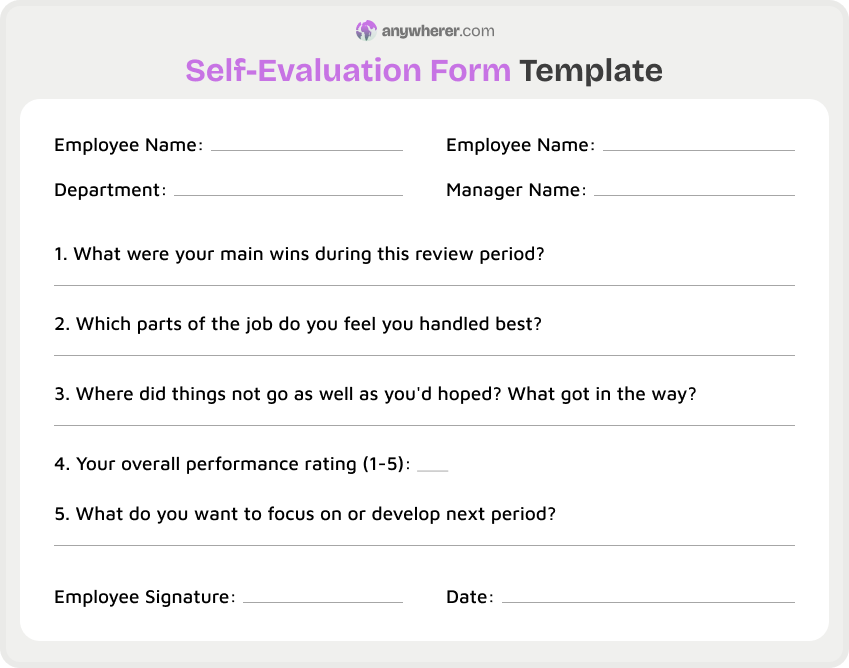
Self-Evaluation Form Template
Most employees go into reviews not knowing what’s coming. The manager has prepared. They haven’t. That imbalance shows up in the conversation.
An employee self evaluation form template fixes that by giving employees a structure to work from before they walk in. When both sides have put something on paper ahead of time, the review turns into an actual exchange rather than a one-way assessment.
There’s a practical upside for managers too. Employees know things about their own work that don’t naturally travel up the chain. The self-evaluation surfaces that before it gets left out.
Manager Evaluation Form Template
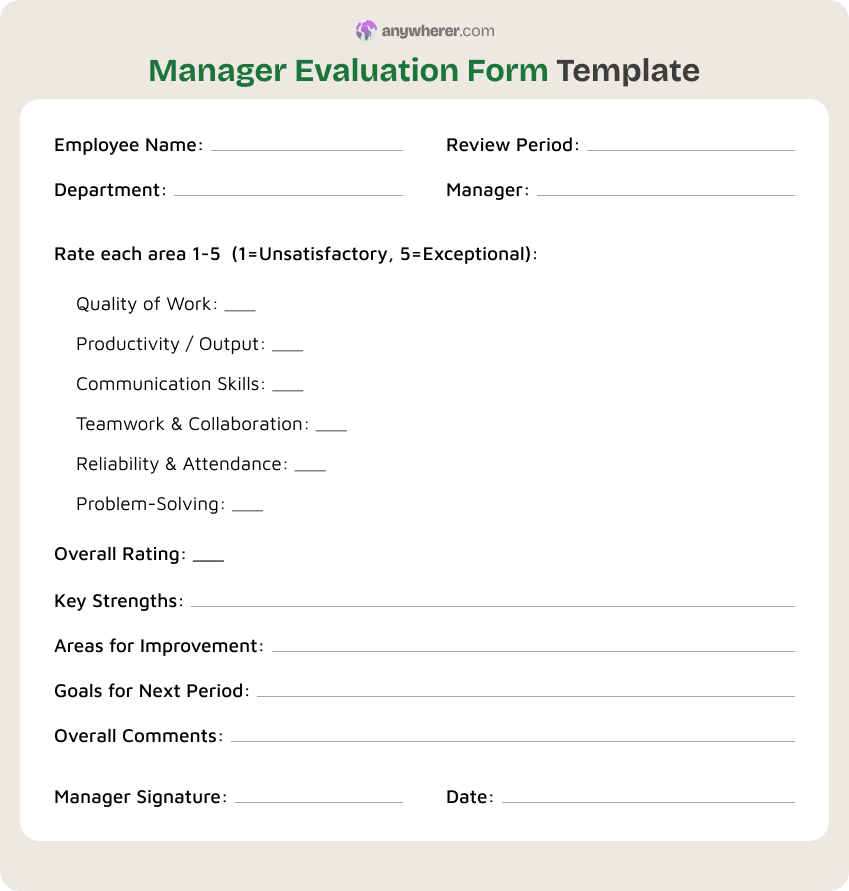
Ask two managers across different departments to evaluate the same hypothetical employee and you’ll probably get two very different numbers. Same performance, different frame of reference.
That inconsistency causes real problems when pay reviews and promotions come around. A thorough employee performance evaluation form template standardizes the criteria so everyone is being measured against the same standard, not just their manager’s personal definition of ‘good.’
360-Degree Feedback Form Template
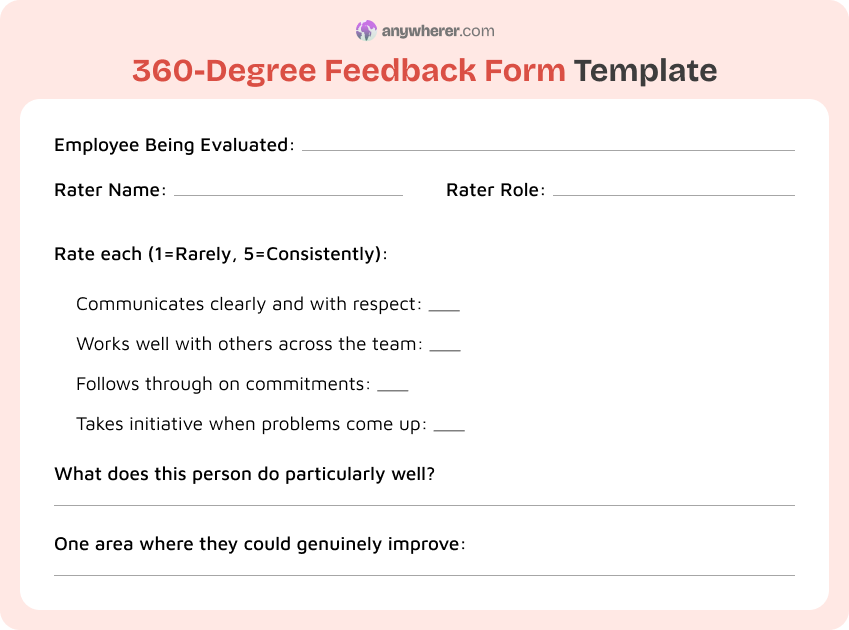
A manager sees one slice of how someone operates. Colleagues see the rest. How someone handles pressure in a cross-functional meeting, how they treat people with less authority, how they show up when the manager isn’t in the room: most of that stays invisible in a standard review.
This evaluation form sample for employee 360 reviews changes that. SHRM data points to 10 to 15 percent improvements in leadership effectiveness when it’s implemented well. The ‘implemented well’ part matters. Collecting feedback and filing it away is worse than not collecting it at all.
Four to eight raters per person. Anonymize where you can.
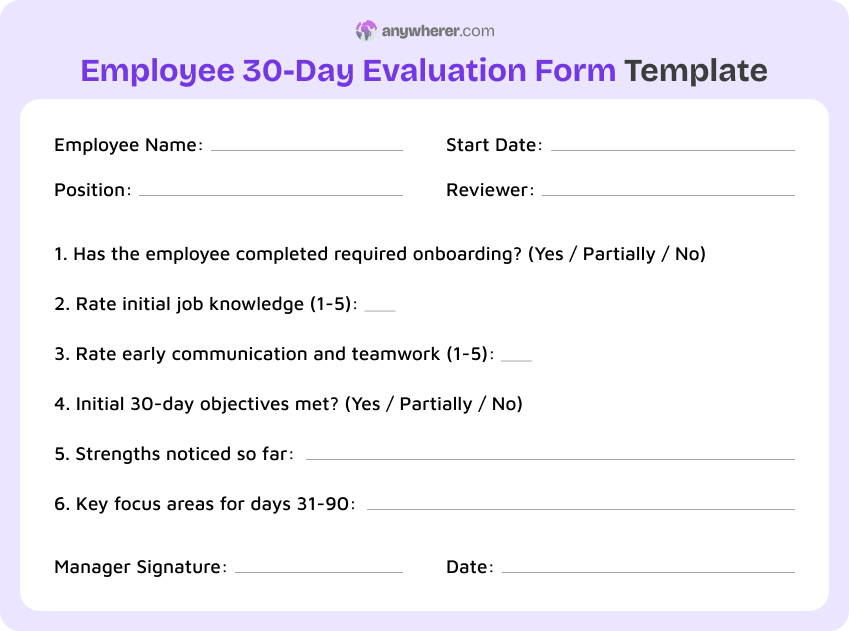
Employee 30-Day Evaluation Form Template
Here’s what usually happens in the first month without a check-in form: the manager assumes things are fine because the new hire seems to be settling in. The new hire doesn’t raise anything because they don’t want to come across as difficult. Problems that could have been fixed in week three are still there at month six.
An employee 30 day evaluation form isn’t a performance review. It’s a structured reason to have the conversation that both sides are quietly waiting for.
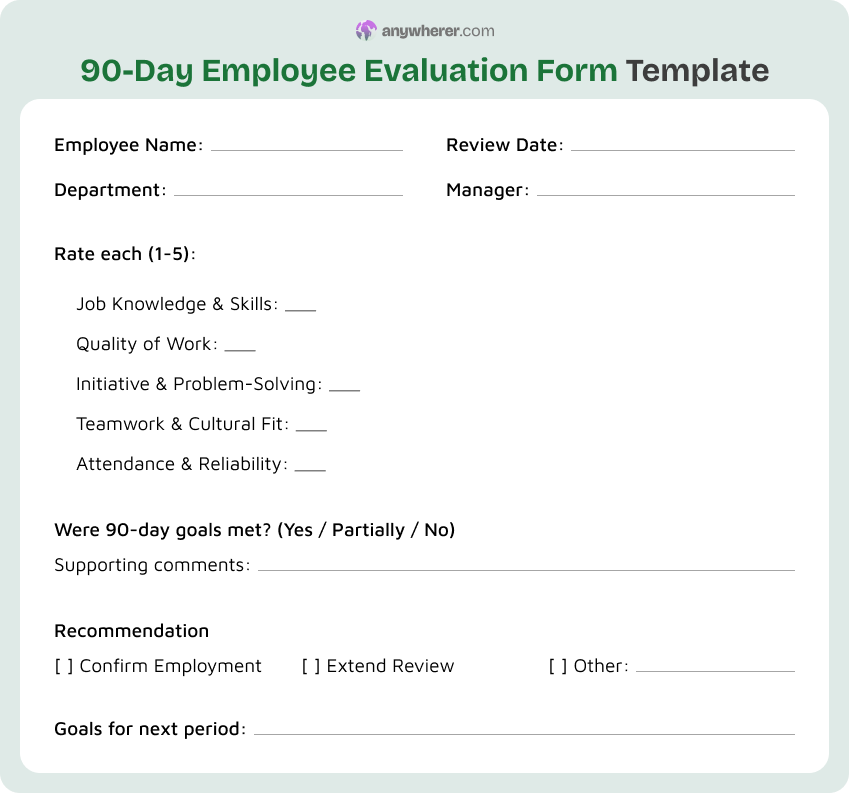
90-Day Employee Evaluation Form
Three months in, the grace period is over. There’s enough observed behavior to form a real opinion. And in most organizations, this is also when the formal probationary period ends, which means this review carries weight.
A 90 day employee evaluation form should make one thing clear: no surprises. The employee needs to know exactly where they stand before any employment confirmation happens. If the news isn’t good, it shouldn’t be news.
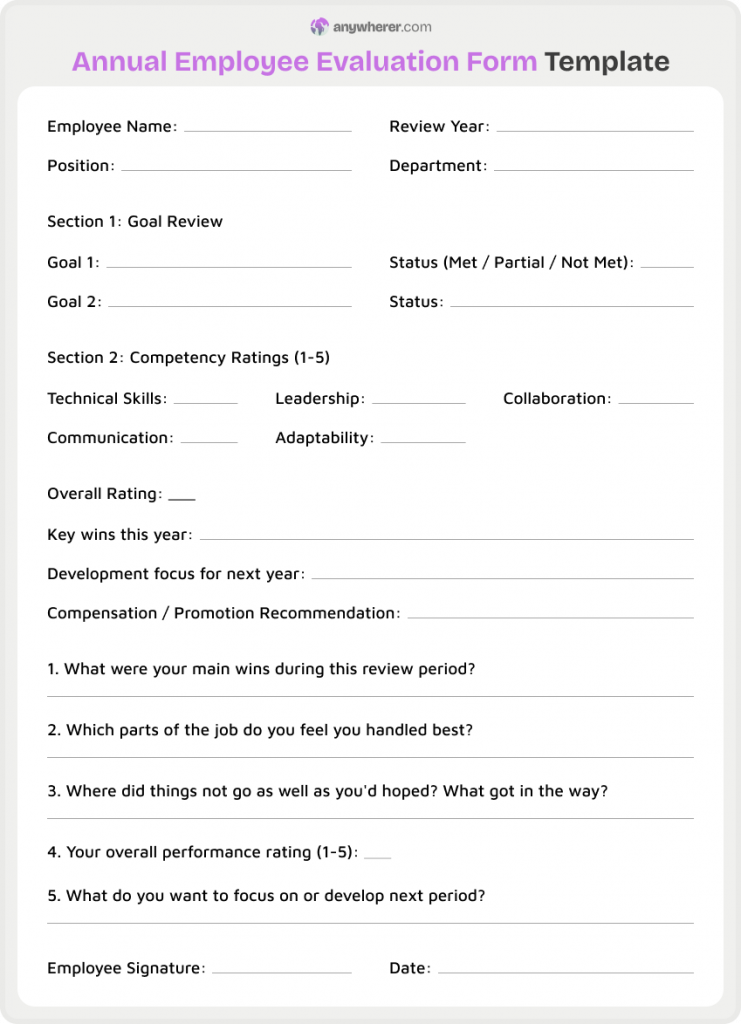
Annual Employee Evaluation Form Template
Annual reviews have a bad reputation, and they’ve mostly earned it. Stressful to give, stressful to receive, and often disconnected from the other 51 weeks of the year. The annual employee evaluation form is also the one most directly tied to compensation: it frequently doubles as an employee raise evaluation form, which is partly why the stakes feel high. Using the right questions for performance review makes a real difference here.
The template below keeps it tight: two goal reviews, five competency ratings, and explicit space for what happens next. That last section is where most annual forms fall flat. Good at documenting the past. Weak on committing to the future.
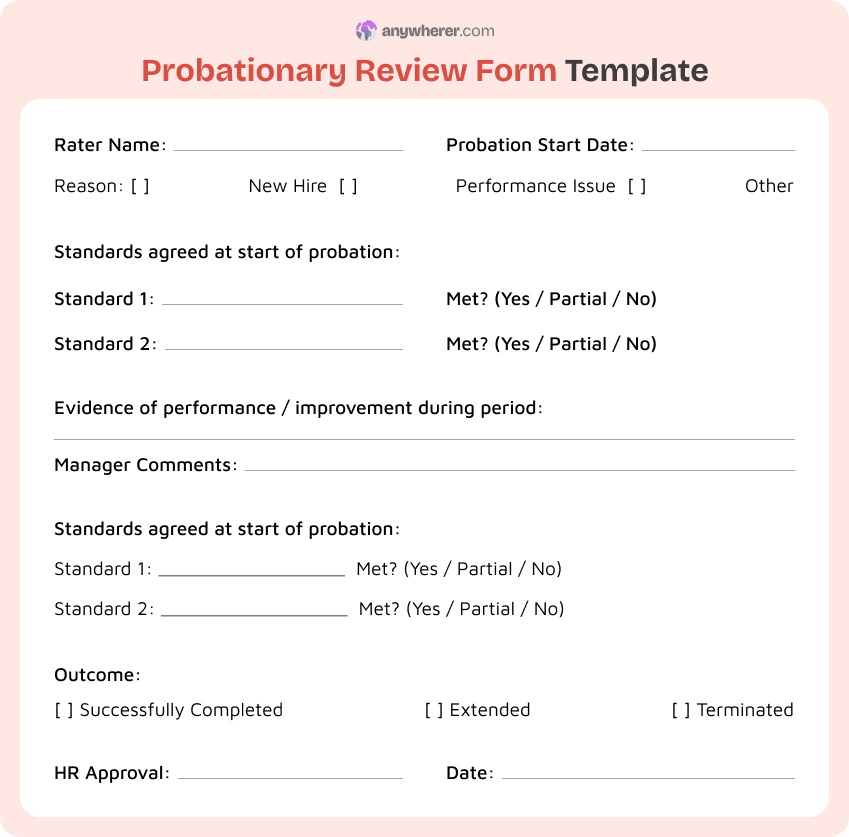
Probationary Review Form Template
Two situations call for this. A new hire reaching the end of their initial period. Or an employee coming out of a formal performance warning. Either way, the form needs to be more precise than a standard evaluation.
Unlike a simple sample employee evaluation form used for routine check-ins, this one is built around specific standards that were written down and agreed on at the start of probation. That precision matters: if the outcome is termination, you need documentation that holds up. ‘Didn’t seem like the right fit’ doesn’t. ‘Failed to meet response-time standard on 14 of 20 measured occasions’ does.
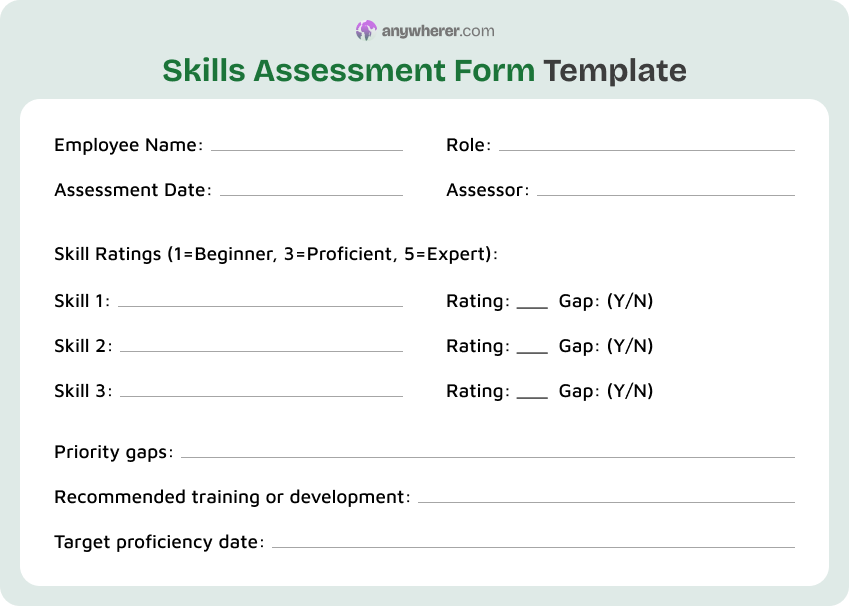
Skills Assessment Form Template
Most evaluation forms are measuring some mix of performance, attitude, and behavior. An employee training evaluation form has a narrower brief: it maps what someone can and can’t do technically. That makes it less personal and more actionable than a standard review.
Rating someone’s Excel proficiency at 2 out of 5 is just a fact. That’s useful. It tells you exactly what training is needed and gives you a baseline to measure against in six months. If you’re looking for a free employee performance evaluation form to get started with skills mapping, this format is easy to adapt without any specialist tools. It also drives succession planning: you can see who has the gap and how long closing it is likely to take.
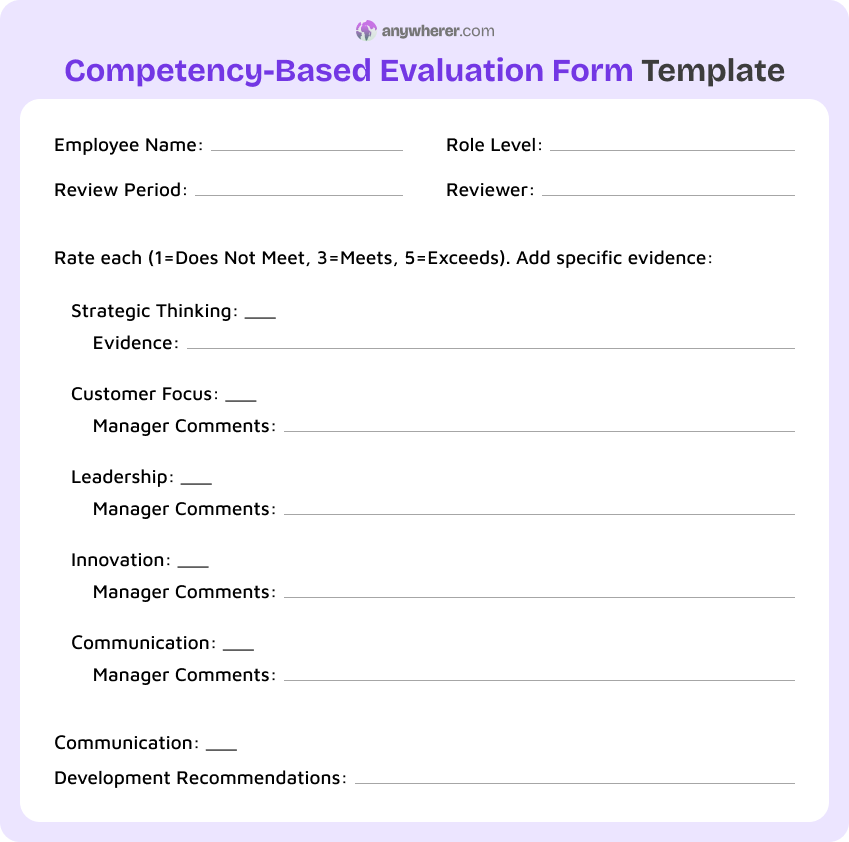
Competency-Based Evaluation Form Template
A ratings-only competency form produces numbers that managers argue about indefinitely. A 4 for strategic thinking from one manager is a 3 from another. Without evidence, there’s no way to compare them and no way to defend either one.
Adding a behavioral evidence field changes everything. A good performance evaluation form template for competency-based reviews doesn’t just ask for a rating; it requires a specific observed example. ‘I gave them a 4 for strategic thinking because they restructured the Q3 forecasting process under timeline pressure and flagged three risks that weren’t on anyone’s radar’ is defensible. ‘I gave them a 4 because they’re generally quite strategic’ isn’t.
More work to complete. Significantly more useful in development conversations afterward.
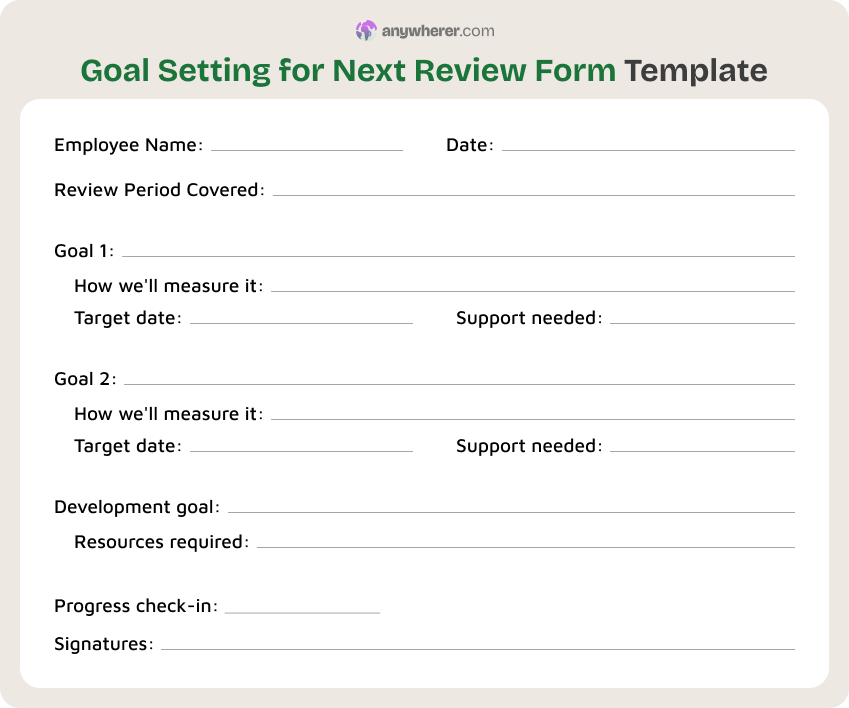
Goal Setting for Next Review Form Template
A manager says ‘let’s work on your communication this year.’ The employee nods. Both walk out with completely different ideas of what that means. Nobody writes anything down. Six months later, nothing has changed. The same conversation happens again at the next review.
Written goals break that loop. An employee career growth evaluation form focused on goal-setting doesn’t need to be elaborate. Two performance goals and one development goal, each with a clear measure and a date, is enough. Both people sign it. That last part matters more than it sounds: a signed commitment changes how seriously both sides treat it over the following months.
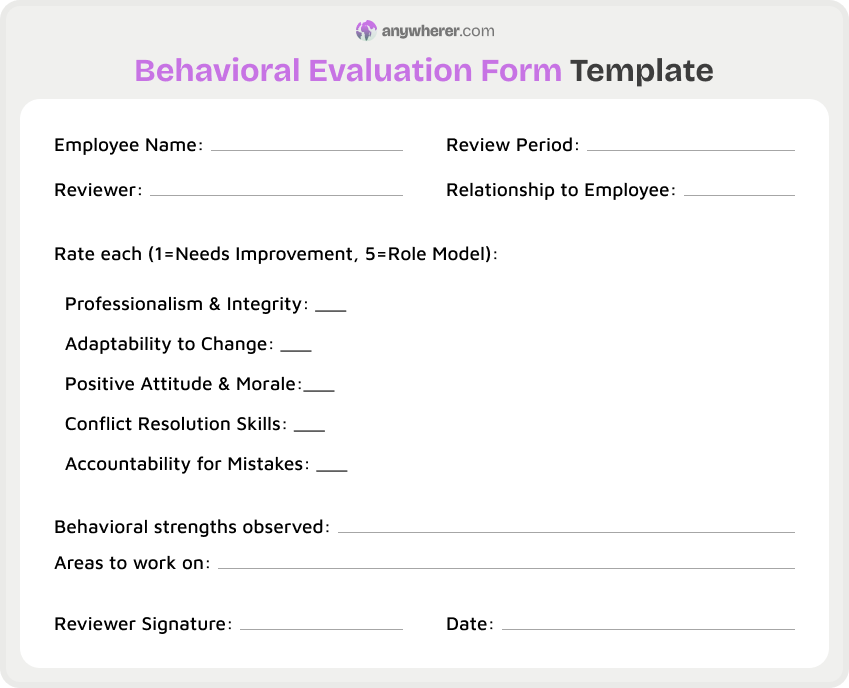
Behavioral Evaluation Form Template
Output metrics tell you what someone produced. They say almost nothing about how. For a lot of roles – client-facing, team leadership, support functions the how is actually more important.
A basic employee evaluation form or a simple employee evaluation form typically skips this dimension entirely. When a role demands strong interpersonal performance, a dedicated behavioral form is worth adding alongside the standard output-based assessment. It also gives structure to the conversations managers tend to avoid: telling someone their behavior in meetings is affecting team dynamics requires a framework, not just a difficult conversation.
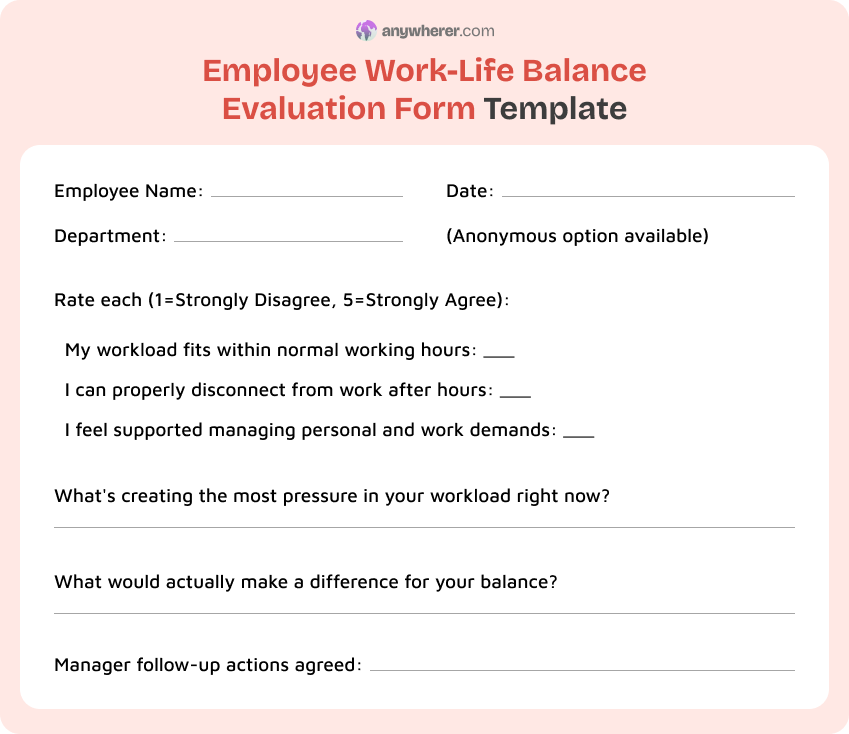
Employee Work-Life Balance Evaluation Form Template
Burnout builds quietly. By the time it shows up as disengagement or sick leave patterns, the person is usually months past the point where a conversation could have helped. An employee work-life balance evaluation form is one of the few tools that catches those signals early enough to act on them. It pairs naturally with any questions for employee satisfaction survey process but goes deeper specifically on workload and sustainability.
This is one of the formats that works well as a free employee evaluation form, since it requires no specialist software and can be filled out in any format. Some teams share it as an employee evaluation form free of scoring pressure entirely, running it as an open conversation rather than a rated exercise. Run it anonymously if trust in the team is still being built. And actually do something with the answers. Asking and then doing nothing is worse than not asking.
Common Mistakes to Avoid When Using Employee Evaluation Forms
Looking at employee evaluation form examples from different organizations, the templates themselves are rarely the problem. What goes wrong is in execution.
Vague feedback
‘Needs to improve communication’ is not feedback. It’s a category. Feedback that actually helps someone looks like: ‘In the client update on the 14th, the key risks weren’t raised until the client asked directly. Next quarter, the goal is to surface those in the first ten minutes.’ Specific situation, specific behavior, specific change. Anything less is noise.
Scoring from memory
Recency bias is probably the most common rating error. A strong month before the review inflates scores that should reflect the full year. The fix is low-effort and most managers don’t do it: keep a short running note throughout the year. Even a line a month. When the review comes around, you’re scoring on evidence, not whatever happened to stick.
No written goals at the end
A review with no next steps is a report card. It captures the past and does nothing for the future. Even two written goals with a date and a named measure is enough. Without it, the conversation evaporates as soon as the meeting ends.
Annual reviews doing all the heavy lifting
According to LinkedIn’s workplace research, nearly 60 percent of employees want feedback on a daily or weekly basis. Annual reviews can’t carry that. Even short quarterly check-ins using a simple employee evaluation form shift the culture from ‘performance management as event’ to something that actually resembles ongoing management.
Conclusion
Twelve templates is a lot. The practical approach is to pick two or three that fix whatever is currently weakest in your process.
Inconsistent annual reviews? Start with the competency-based form and the goal-setting template. Retention is the concern? The work-life balance and 360-degree forms tend to surface what exit interviews catch too late. Building from scratch and need a quick employee evaluation form sample to adapt? The manager evaluation form and 30-day check-in are the foundation everything else builds on.
None of these need software or a long implementation. A clear structure, consistent criteria, and a manager who actually prepares for the conversation: that combination outperforms most elaborate performance management systems.
FAQs
How often should employee evaluations be conducted?
Most organizations anchor to annual reviews with quarterly check-ins. In faster environments, monthly or milestone-based reviews make more sense. The frequency matters less than whether reviews actually happen consistently. An annual review that reliably takes place beats quarterly check-ins that get rescheduled indefinitely.
What are the key components of an employee evaluation form?
At minimum: employee details, review period, performance criteria with ratings, qualitative comments, and goals for next period. A more thorough version adds a self-assessment section, role-specific competency ratings, and signature fields. If you’re starting out, a free employee evaluation form template with these basics is enough to build from. The competency section is where most basic forms fall short: generic criteria that don’t reflect the actual role produce data that’s hard to use.
What type of rating scale should be used in an employee evaluation form?
A 5-point scale gives enough range to differentiate without becoming hard to interpret. A 3-point scale works for faster, simpler forms. Either way, write out what each level means before anyone starts scoring. Without written definitions, the same number means something different to every manager who applies it.
How do employee evaluations impact employee development?
When they’re done well, they produce a documented picture of where someone is now and what needs to happen next. The key word is documented. Verbal feedback in a meeting gets misremembered or forgotten. Written feedback the employee keeps a copy of is something they can actually work from.
How do you ensure fairness in employee evaluations?
Standardized criteria across comparable roles. Ratings backed by behavioral evidence, not impressions. And calibration sessions where managers compare scores before anything goes on record. That last step catches inconsistency before it causes problems.
How can you avoid bias in the evaluation process?
Name the biases specifically in training, not just define them. Show managers what recency bias, halo effect, and affinity bias actually look like in a real evaluation. Require behavioral evidence for ratings. Hold calibration meetings before scores are finalized.
What should you do if an employee disagrees with their evaluation?
Well-built forms include a formal comments or rebuttal section. For serious disagreements, HR should facilitate a follow-up. The goal isn’t to automatically change the score every time someone objects: it’s to make sure their perspective is part of the official record, because that matters regardless of the outcome.
How do you link employee evaluations to performance improvement plans?
When the evaluation flags below-threshold performance, the PIP should reference the exact criteria from the evaluation, set specific measurable targets, define a timeline, and document what support the organization is providing. Vague PIPs fail. They also don’t hold up if the situation escalates.

Yaryna is our lead writer with over 8 years of experience in crafting clear, compelling, and insightful content. Specializing in global employment and EOR solutions, she simplifies complex concepts to help businesses expand their remote teams with confidence. With a strong background working alongside diverse product and software teams, Yaryna brings a tech-savvy perspective to her writing, delivering both in-depth analysis and valuable insights.