What Is the Best Employer of Record for Staffing Agencies in 2026?
Choosing an employer of record for staffing agencies is a different exercise from choosing one for a company hiring its own staff. An agency deal has three parties instead of two. You place the worker and keep the client. The provider signs the employment contract and handles payroll, taxes, and insurance. The client directs the work and pays your invoice on its own terms. Your margin sits between the bill rate you charge and the pay rate the worker receives, and the provider sits inside that spread. Nothing about that arrangement resembles a company employing its own hire.
The volume behind this is substantial and mostly invisible. The American Staffing Association reports that America’s staffing companies employed nearly 2.2 million temporary and contract workers in an average week during 2024. Roughly 27,000 firms share that volume. Two pressures follow into 2026. Worker classification is scrutinized harder than it was. Agencies are also asked more often to place workers in states and countries where they have no entity. Neither problem is solved by finding a cheaper platform.
So the selection logic here is intentionally narrow. A provider earned a place only by naming staffing firms, recruitment agencies, or talent suppliers as a buyer on its own site. That removed most of the familiar global platforms, which accept agency customers without building for them. For scale, ASA put US staffing sales at $27.6 billion in the first quarter of 2026. Agencies placing workers in Europe also operate under Directive 2008/104/EC on temporary agency work. It requires that basic working and employment conditions for agency workers match what they would receive if hired directly. Nothing here is legal, tax, or employment-law advice. Below, I’ve reviewed 11 providers in A-Z order.

INSIGHT: Why can’t a staffing agency just use a normal EOR?

Because an agency places hourly workers on timesheets and gets paid after it has already paid them. Most global platforms are built for salaried monthly employees and prefunded payroll.
- Roughly 57% of the 27,000 US staffing and recruiting firms operate in the temporary and contract sector, which is half of the market this page serves (American Staffing Association, read 29 August 2026).
- A single quarter of US staffing sales ran to $27.6 billion in early 2026, and every dollar of it passed through somebody’s payroll (ASA, published 25 June 2026).
- Only 4 of the 11 providers here publish a payroll funding position. The other seven leave the most consequential commercial term unstated.
- The cash gap in one line: you pay the worker on your cycle and bill the client on the client’s terms, and somebody finances the difference.
Employer of Record for Staffing Agencies Compared
An agency reader should be able to shortlist from this table alone. Read the last column first. Payroll funding decides how many placements you can carry at once, and only 3 of the 11 publish a position on it.
| Provider | Family | Coverage | Services | Worker types | Payroll funding |
|---|---|---|---|---|---|
| BOSS | Domestic back office | 50 states | EOR and full back office | Salaried and hourly | Provider funds |
| CXC Global | International agency EOR | 100+ countries | EOR, AOR and managed programs | Salaried and hourly | Not published |
| FoxHire | Domestic back office | All 50 states | EOR and back office | Salaried and hourly | Not published |
| Innovative Employee Solutions | Hybrid payrolling and program | 50 states and 150+ countries | EOR, AOR and back office | Salaried and hourly | Provider funds |
| Magnit | Hybrid payrolling and program | 130+ countries | EOR within a managed program | Salaried and hourly | Not published |
| Multiplier | International agency EOR | 150+ countries | EOR and COR through a referral partnership | Salaried | Not published |
| myBasePay | Domestic back office | US and nearshore, 186 countries claimed | EOR, AOR and payroll funding | Salaried and hourly | Provider funds |
| People2.0 | International agency EOR | 130+ countries | EOR, AOR and full back office | Salaried and hourly | Not published |
| TCWGlobal | Hybrid payrolling and program | US and international programs | EOR and back office | Salaried and hourly | Not published |
| Teamed | International agency EOR | 187+ countries | EOR, contractor management and entities | Salaried | Not published |
| Workwell Global | International agency EOR | 150+ countries | EOR and contractor management | Not published | Not published |
Every entry above was read off the provider’s own site in September 2026.
Why an Agency Needs a Different Kind of EOR
Start with the shape of the deal. An ordinary arrangement has two parties: the company and the provider that employs on its behalf. An agency arrangement has three. The worker is employed by the provider, managed day to day by your client, and owned commercially by you. That third party is not a detail. That’s why every term in the contract reads differently from a standard employer-of-record agreement.
Contractually, the third party raises questions a normal deal never has to ask. Who issues the invoice to the end client, and whose name appears on it? May the provider contract with that client directly, now or after your assignment ends? What exactly does the non-solicit cover, and for how long? Your client list is the asset your business is built on, and you are about to introduce a vendor to it. In a normal deal, that risk doesn’t exist because there is no client to introduce.
Financially, the third party creates a gap. You pay the worker on your cycle, often weekly. Your client pays you on its cycle, often 45 or 60 days later. Somebody finances the difference, and providers answer that three ways. Some fund payroll themselves and carry the gap. Some require you to prefund, meaning you send the money before payday. Some invoice the end client directly and settle with you afterward. Your answer sets the ceiling on how many placements you can run at once.
That is also why the familiar names are absent from this page. The large global platforms are built for a company employing its own hire on a monthly salary. Most support neither hourly rates, nor timesheets, nor weekly payroll, nor funding. They are good products for a different buyer, and you can compare them properly in our guide to the best EOR companies. They are simply not what an agency is shopping for.
Six Things to Test Before You Sign
Six questions separate a provider built for agencies from one that merely accepts them. Ask all six before the commercial conversation, because four are answered by architecture rather than negotiation.
Payroll funding and prefunding. This is the fault line. BOSS puts the choice in its plan names, offering a funded option and a self-funded one. Innovative Employee Solutions lists payroll funding inside its back office, and myBasePay sells it as a named product. The other seven publish no position, which means you are prefunding until somebody tells you otherwise in writing.
Hourly and daily rate employment. Most global contracts assume a monthly salary, which is useless for a project worker on variable hours. Teamed publishes salaried employment only, and Workwell Global does not publish a worker-type position on its agency pages at all. The domestic specialists all handle hourly W-2 work because that is the only kind of work they were built for.
Timesheets and pay cadence. Ask whether the provider ingests timesheets and runs weekly or fortnightly payroll rather than monthly only. FoxHire markets guaranteed weekly income to recruiters and covers timekeeping. Workwell Global publishes timesheet management inside its contractor product. A monthly-only platform will quietly convert every hourly placement into an administrative problem.
AOR alongside EOR. An agent of record engages workers who stay self-employed rather than becoming employees. If a classification review moves a worker from one category to the other, a provider offering only one forces a second vendor mid-placement. CXC Global, Innovative Employee Solutions, myBasePay, and People2.0 publish both under one relationship.
FX and margin transparency. Your margin is the spread between bill rate and pay rate, so an undisclosed currency conversion margin comes straight out of it. Ask for the FX rate as a percentage rather than as a promise. Teamed is the only provider here publishing a position, stating zero FX absorbed in any currency pairing alongside a flat monthly fee.
Invoicing and branding. Establish whether you invoice the client or the provider does, and whose name the client sees. People2.0 and Innovative Employee Solutions both publish invoicing inside the back office, which is convenient and also means your client receives paper from someone else. That is a different purchase from RPO companies, which sell recruiting capacity rather than employment infrastructure.
EOR Services for Highly Regulated Industries
Searches for EOR services for highly regulated industries suggest a separate product category exists. It does not. Finance, legal, and healthcare are placement verticals rather than employment models, and the mechanism is identical in all three. What changes is the screening, licensing, insurance, and data handling wrapped around the placement. The question is how much of that wrapper the provider carries.
- Financial services and fintech. Agencies asking what the best eor for finance staffing agencies are usually asking about the wrapper rather than the employment. Expect enhanced background and credit screening, regulated-role certification, and reference chains. Add conflict and outside-business-interest declarations, plus data handling rules imposed by the end client rather than by statute. CXC Global is the only provider here publishing banking, finance, and insurance as named verticals. Teamed lists financial services and fintech among the industries it serves. Nobody else publishes a position, and the entity-versus-provider question gets asked more often in this vertical because regulated clients scrutinize who actually employs their contractors.
- Legal. Agencies searching for the best eor for legal staffing agencies should know the honest answer first. No provider on this list is a legal-sector specialist, and Teamed naming legal services among its industries is a customer list rather than a capability. What actually matters is conflict checking before a placement, plus bar admission and practice certificate status. Then professional indemnity cover and who holds it, and confidentiality obligations that follow the worker. Ask which of those the provider will perform and which stay with you, and get the answer as a written split rather than a reassurance.
- Healthcare and life sciences. This is the one vertical where a provider here has a specific, verifiable capability. FoxHire documents verification straight against state boards, with suspensions and expirations tracked, federal exclusion checks run, and immunization records held. TCWGlobal publishes primary source verification of licenses and certifications through its healthcare brand. People2.0 documents a healthcare staffing division placing nurses. Malpractice cover is the gap: none of the three publishes who carries it.
One thing is common to all three verticals. The end client sets the bar, not the provider, and you remain responsible for meeting it, whoever signs the employment contract. Nothing in this section is legal or regulatory advice.
Choosing an Agency EOR by Situation
Agencies land here from four different starting points, and no single shortlist serves all of them. A domestic desk placing W-2 contractors and a firm supplying into an enterprise managed program are buying different products from different families. Every provider is placed in exactly one group, chosen for where it actually fits rather than where it could arguably appear.
For US Domestic Contract Placement
BOSS, FoxHire, and myBasePay all cover 50 states, W-2 employment, weekly payroll, workers’ compensation, and state registration. None of them sells you an international product you will never open. For an agency placing only at home, that focus is an advantage, not a limitation. FoxHire has run this since 1992 and adds credential monitoring for clinical placements. BOSS and myBasePay both publish payroll funding, which for a growing domestic desk usually matters more than anything else on the page.
For a First International Placement
One contractor, one new country, and no entity is where Teamed and Workwell Global fit. Workwell publishes an agency-facing product covering 150+ countries, with employer of record and independent contractor engagement under one relationship. That matters because you often don’t know the worker’s correct status until the review is done. Teamed covers 187+ countries and publishes a flat price. Agencies hiring their own staff abroad want our guide to EOR services for international hiring instead, since that is a different purchase.
For Placing at Program Scale
CXC Global and Magnit both operate at the program layer, and it is worth being clear about which side of it you are on. These platforms are usually bought by the enterprise running a vendor-neutral contingent program, not by the agency supplying into it. As a supplier, you register with the program and work inside its rules. CXC Global is the more accessible of the two for an agency buying employment directly. It sells EOR and AOR as standalone services across 100+ countries rather than only inside a managed program.
For Outsourcing the Whole Back Office
Innovative Employee Solutions, People2.0, and TCWGlobal all take on timesheets, invoicing, collections, and reporting alongside employment. What you give up is control and visibility. Your client receives paper from a company that is not yours, and collections conversations happen without you in the room. People2.0 runs the widest version of this across 130+ countries. Agencies weighing whether to outsource further should note that this is narrower than what BPO companies sell, and deliberately so.
How Agency EOR Pricing Works
Agency pricing does not look like corporate pricing, and the difference is structural rather than cosmetic. A corporate buyer pays a flat monthly fee per employee. An agency usually pays a percentage of the pay rate or a markup on the bill rate. The provider’s exposure scales with the wage bill and the placement count rather than with headcount. Three models turn up. A percentage of gross pay, a fixed amount per worker per pay period, and a flat monthly fee borrowed from the corporate market.
Four things move the number underneath whichever model you get. Employer taxes and workers’ compensation in the placement jurisdiction. Then whether the provider carries payroll funding, your volume, and FX where client and worker sit in different currencies. Two providers out of 11 puts a number on its website. Nine rows therefore read Custom pricing, and nothing in the table was lifted from a comparison article.
| Provider | Pricing model | Published price | Payroll funding | Volume discount published |
|---|---|---|---|---|
| BOSS | Quote only, plan based | Custom pricing | Provider funds | Not published |
| CXC Global | Quote only | Custom pricing | Not published | Not published |
| FoxHire | Quote only | Custom pricing | Not published | Not published |
| Innovative Employee Solutions | Quote only | Custom pricing | Provider funds | Not published |
| Magnit | Quote only, program based | Custom pricing | Not published | Not published |
| Multiplier | Published per employee monthly, tiered | $459 per employee per month (Core), billed annually | Not published | Not published |
| myBasePay | Quote only | Custom pricing | Provider funds | Not published |
| People2.0 | Quote only | Custom pricing | Not published | Not published |
| TCWGlobal | Quote only | Custom pricing | Not published | Not published |
| Teamed | Flat monthly per employee | $599 per employee per month, or £479 | Not published | Not published |
| Workwell Global | Quote only | Custom pricing | Not published | Not published |
As pricing is subject to change, prices are listed as of September 2026.
How to Choose an EOR for Your Agency
I would start with where you place rather than with a provider list. An agency placing only in the United States is better served by a domestic specialist handling 50 states, weekly payroll, and workers’ compensation. A global platform carries markets it will never touch. Then read the non-solicit before the price list. Your client list is the asset; the provider will have contact with it, and that clause is where the answer lives.
Get the payroll funding position in writing, including what happens when a client pays 30 days late rather than on time. Confirm the worker types and pay cadence the provider actually supports. Placing hourly workers on a monthly salaried platform does not work, and no amount of goodwill fixes it. Ask whether an agent-of-record agreement is available under the same paperwork, so a classification change doesn’t send you shopping mid-assignment.
Ask for the FX margin as a percentage and model it against your spread on a real placement rather than a hypothetical one. Ask what conversion costs when a contract placement goes permanent. That is where your best margin lives, and where a loosely drafted agreement quietly takes it. Then ask for two agency references at your size placing into your markets, and call them. Ask those references what broke in the first quarter, because that is the only question whose answer you cannot get from a sales call.
Top 11 Employer of Record Providers for Staffing Agencies in 2026
I checked each provider’s agency-facing pages, the services it actually sells, and the worker types it documents. The payroll funding position came from the same pages, and I pulled every rating fresh on the day of writing. A silent provider is reported as silent, never topped up from a directory entry.
I’m listing all providers in alphabetical order to keep this comparison neutral.
The mix runs across three families. Domestic back-office specialists built only for US contract placement, and international providers selling employer of record for staffing agencies across borders. Then hybrid payrolling and program providers serving agencies and enterprises from one platform. Which family you need depends on where you place, not which brand you recognize.
BOSS
Quick Overview
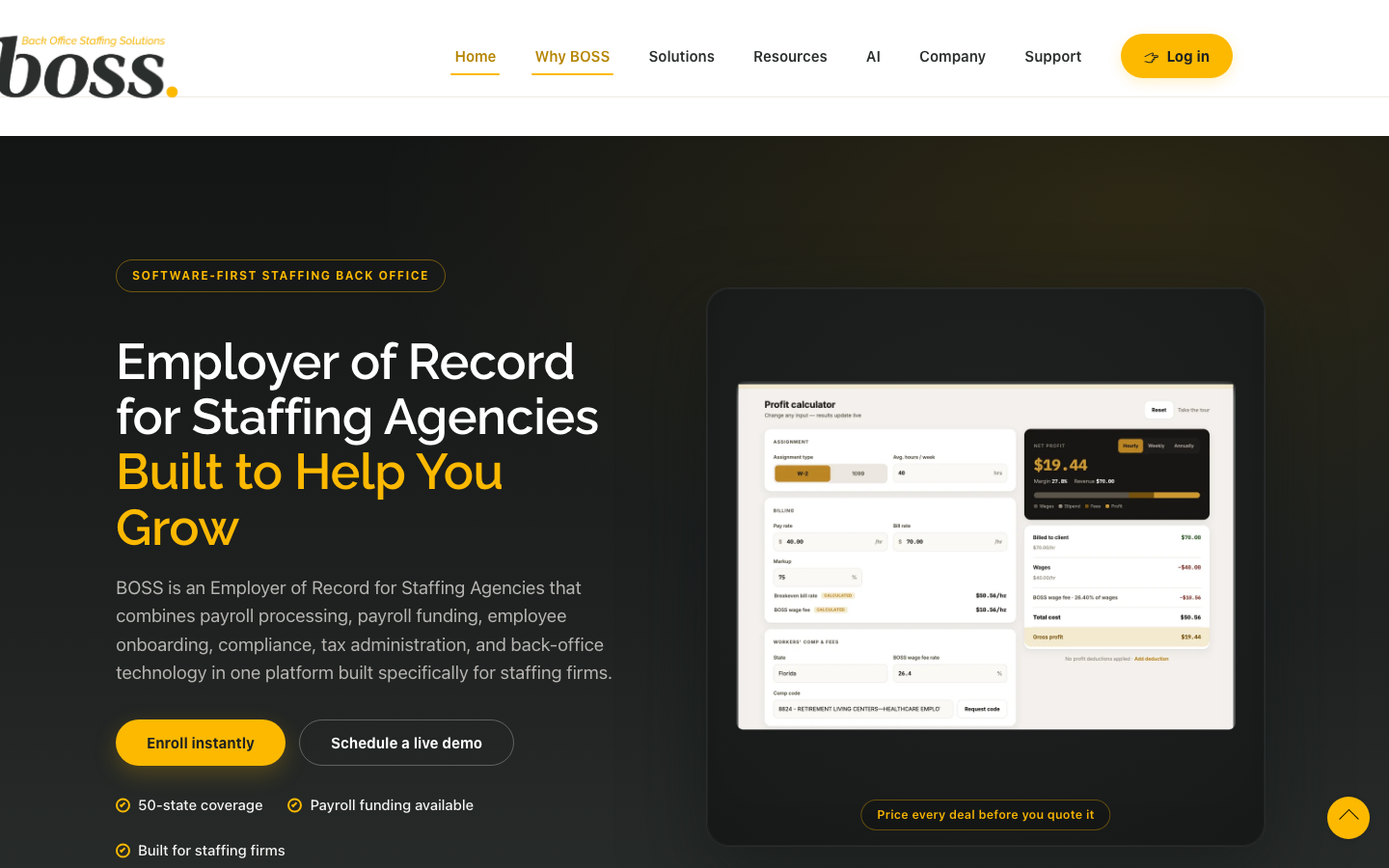
BOSS is a domestic back-office specialist, US only, offering employer of record alongside a full back office rather than an agent of record line. It does not recruit or compete with agencies for placements. Payroll, funding, onboarding, tax administration, and the back-office technology behind them all sit in one platform written for staffing firms. The vendor states it offers 50-state coverage and publishes funded and self-funded plans.
Agency Strengths
- Payroll funding published as a plan choice rather than negotiated case by case
- Built only for staffing firms, so hourly W-2 placement is the default rather than an exception
- Profit distributions paid out as soon as you invoice, which shortens the cash cycle further
- A profit calculator that prices a placement before you quote it to the client
Trade-offs
- Nothing outside the United States, whatever the volume or the client
- No agent of record line, so self-employed placements need a second vendor
- No public rating at all, so there is no independent read on service quality
BOSS Review
Weighing this one against the global names misses the point. For an agency placing W-2 contractors and waiting 45 days to get paid, funded payroll and a purpose-built back office beat country coverage. It is the wrong choice the moment a client asks you to place someone in Ireland, because that capability simply is not there.
Our Verdict
Funded Domestic Back Office
CXC Global

Quick Overview
CXC Global is an international agency provider covering 100+ countries, offering employer of record and agent of record together. It is explicitly vendor-neutral, which means it does not recruit and does not compete with you for placements. It has run contingent workforce services since the early 1990s and publishes banking, finance, and insurance among its named verticals. The vendor states 34 years of operation.
Agency Strengths
- Vendor neutrality stated on its own site, which removes the client-poaching question
- EOR and AOR available as standalone services rather than only inside a managed program
- Published industry verticals including banking, finance, and insurance for regulated placement
Trade-offs
- No published payroll funding position, so assume you prefund until told otherwise
- The managed program heritage means the sales motion is oriented to larger buyers
- Two public reviews behind a 5.0, which is not a sample worth interpreting
CXC Global Review
I keep coming back to the neutrality point with CXC Global, because it is the one thing an agency cannot verify after signing. Having it stated publicly is worth more than a warm assurance in a call. It suits a firm placing across several countries that wants one relationship. A two-person domestic desk will find it oversized.
Our Verdict
Vendor Neutral Program Partner
FoxHire
Quick Overview
FoxHire is a domestic back-office specialist covering all 50 states. It offers an employer of record with an automated back office rather than a separate agent of record product. It does not compete with agencies for placements. Operating since 1992, it has become the W-2 employer for placements made by recruiters and staffing firms. The vendor markets guaranteed weekly income to recruiters without the burden of payroll, tax, onboarding, or timekeeping.
Agency Strengths
- License and credential monitoring through direct state board access for clinical placement
- Timekeeping and weekly pay handled inside the platform rather than bolted on
- Thirty-plus years employing contract placements, which is unusual depth in this market
Trade-offs
- The moment a placement crosses a border, you need a second provider
- No published payroll funding position and no separate agent of record line
- Only 26 public reviews behind a 4.9, sparse for a firm trading since 1992
FoxHire Review
I would put FoxHire at the top of a domestic shortlist for any agency placing into regulated work. The credential monitoring is a real operational commitment rather than a marketing line, and very little else on this page comes close. The limit is geography. Cross a border, and the shortlist changes entirely.
Our Verdict
Fifty State Contract Employment
Innovative Employee Solutions
Quick Overview
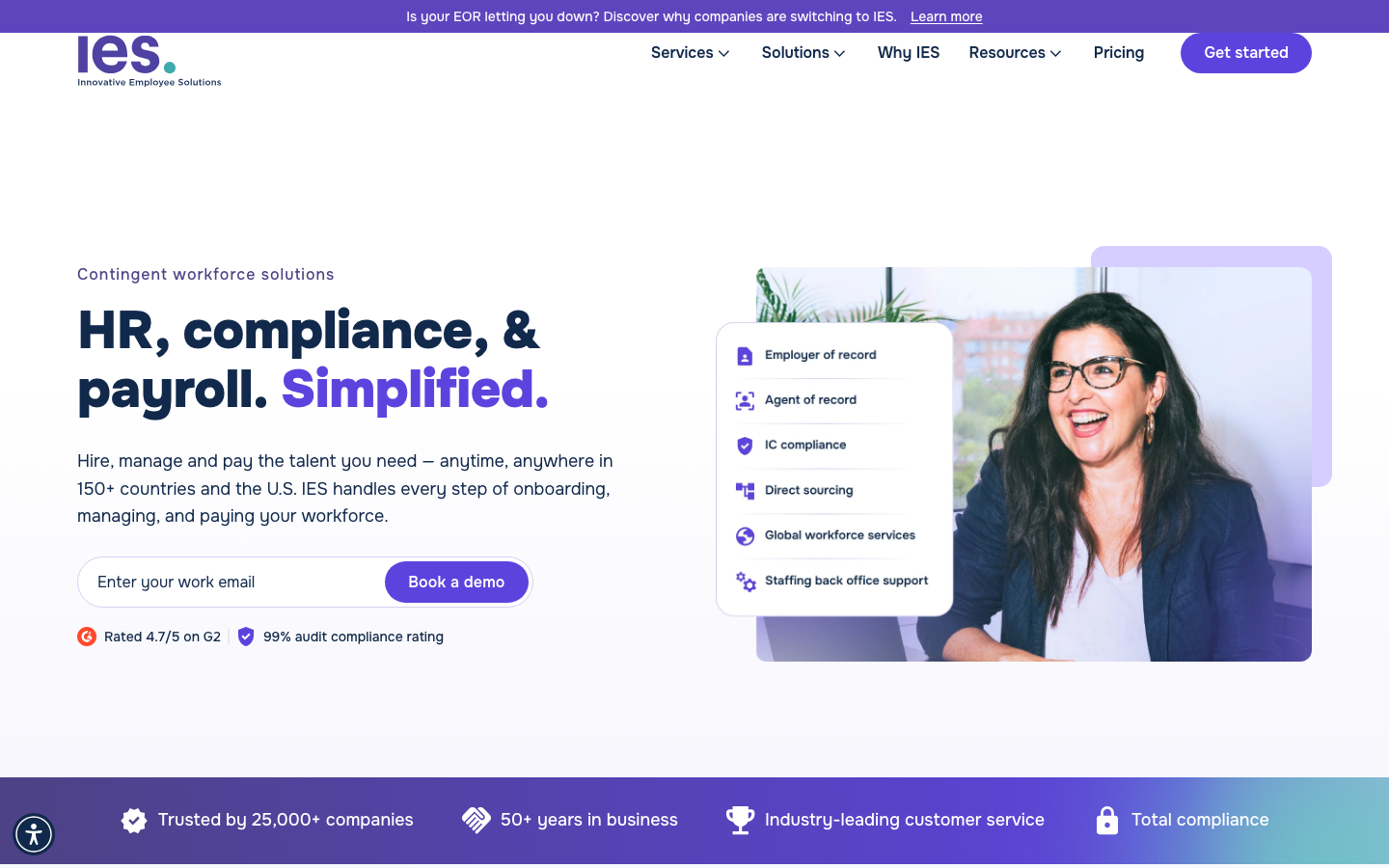
Innovative Employee Solutions is a hybrid payrolling and program provider covering all 50 states and 150+ countries. It offers employer of record and agent of record services, along with a full back office. It does not recruit against its agency clients. It serves everyone from a solo recruiter adding a first contract placement to multi-office staffing organizations. The vendor states 50+ years in business and 25,000+ companies served.
Agency Strengths
- Both payroll funding and profit payments written into the back office scope
- EOR and AOR under one relationship, so a classification change does not need a second vendor
- Invoicing to the end client handled alongside employment for agencies outsourcing the whole function
Trade-offs
- International coverage is not split into direct versus partner-delivered markets
- The sector-agnostic positioning leaves regulated placement capability unstated
- A 4.7 rating from 23 public reviews, which is a small sample for a firm this old
Innovative Employee Solutions Review
I read this one as the safe middle of the list. Fifty years of contract employment and both EOR and AOR under one agreement covers most of what an agency needs without forcing a choice early. It suits a firm growing from domestic into its first few international placements. A firm needing published funding terms before signing should press harder on that point.
Our Verdict
Funded Hybrid Payrolling Partner
Magnit

Quick Overview
Magnit is a hybrid payrolling and program platform covering 130+ countries. It sells employer of record inside a vendor-neutral managed program rather than as a standalone agency product. It does not recruit against suppliers. Its buyer is the enterprise running the contingent program, not the agency supplying into it. The vendor states 35+ years of industry experience.
Agency Strengths
- EOR workers sit in the same dashboard as the rest of an enterprise contingent program
- Vendor-neutral managed services with three decades of program history behind them
- Coverage across 130+ countries for suppliers working inside global programs
Trade-offs
- The buyer is the program owner, so an agency registers with it rather than buys from it
- No published payroll funding position for a supplier carrying the cash gap
- A single public review behind a 4.5, which settles nothing in either direction
Magnit Review
My take on Magnit is that agencies meet it rather than choose it. If your enterprise client runs its contingent program here, you will work inside it. Whether you like the platform is largely academic. As a provider you buy employment from directly, it is a poor fit unless you are already operating at program scale.
Our Verdict
Enterprise Program Side Platform
Multiplier

Quick Overview
Multiplier runs a referral-based recruitment agency partnership rather than a staffing back office. Agencies source and place the candidate; Multiplier then becomes the Employer of Record directly for the client company, handling onboarding, payroll, benefits, and compliance across 150+ countries, while the agency earns recognition or recurring revenue on the placement. It does not employ the agency’s own workforce or fund the agency’s payroll cycle. A published case study credits the model with generating over $1M in new revenue for one global recruitment firm (Korn Ferry) through localized payroll, benefits, and tax administration for its APAC clients.
Agency Strengths
- A named, documented recruitment-agency partnership with a public case study showing real revenue outcomes
- EOR for full-time placements and a separate COR product for contractor placements
- 150+ owned entities, so the employing party is Multiplier’s own local infrastructure rather than a further partner layer
- Contracts generated in about 5 minutes and candidates onboarded within 48 hours
Trade-offs
- Multiplier employs the end client’s hire, not the agency’s own workforce; agencies do not gain payroll funding or working-capital relief from this model
- No published position on hourly pay, weekly payroll, or timesheet ingestion, the requirements this list’s temp-staffing entries are built around
- Best suited to permanent, salaried international placements and contractor conversions, not hourly W-2 or per diem staffing
Multiplier Review
I’d place Multiplier in a different lane than most of this list. It’s a genuine, documented recruitment-agency partnership with a real revenue case study behind it, but the shape is a referral relationship into direct client employment, not a staffing back office that funds an agency’s own temp payroll. For an executive search or professional placement firm expanding into international hires, that’s exactly the right tool. For a travel nursing or hourly staffing desk needing weekly pay and a funded payroll gap, it isn’t, and nothing on Multiplier’s site claims otherwise.
Our Verdict
Referral Partnership, Not Staffing Back Office
myBasePay

Quick Overview
myBasePay is a domestic back-office specialist with nearshore and international reach. It offers employer of record and agent of record together, with payroll funding as a named product. It does not compete with agencies for placements. It is positioned squarely at staffing firms and the enterprise procurement teams that buy from them. The vendor states it manages 6,000+ workers and claims coverage across 186 countries.
Agency Strengths
- Payroll funding sold as a named product rather than mentioned in passing
- EOR and AOR both available, so classification changes stay with one vendor
- Benefits access used deliberately as a retention lever for contract talent
- Adding workers in new states without the agency setting up an entity
Trade-offs
- Founded in 2020, so the operating history behind the coverage claim is short
- The 186-country figure sits oddly against a US and nearshore emphasis
- No public rating at all, and no profile to check independent feedback against
myBasePay Review
Weighing this one, the funding-plus-benefits combination is genuinely differentiated for a mid-size domestic agency competing for contract talent. Benefits win redeployments, and funding wins growth. The caution is age, not capability. Ask for references from agencies your size before you take the international coverage claim at face value.
Our Verdict
Benefits Led Agency Infrastructure
People2.0
Quick Overview
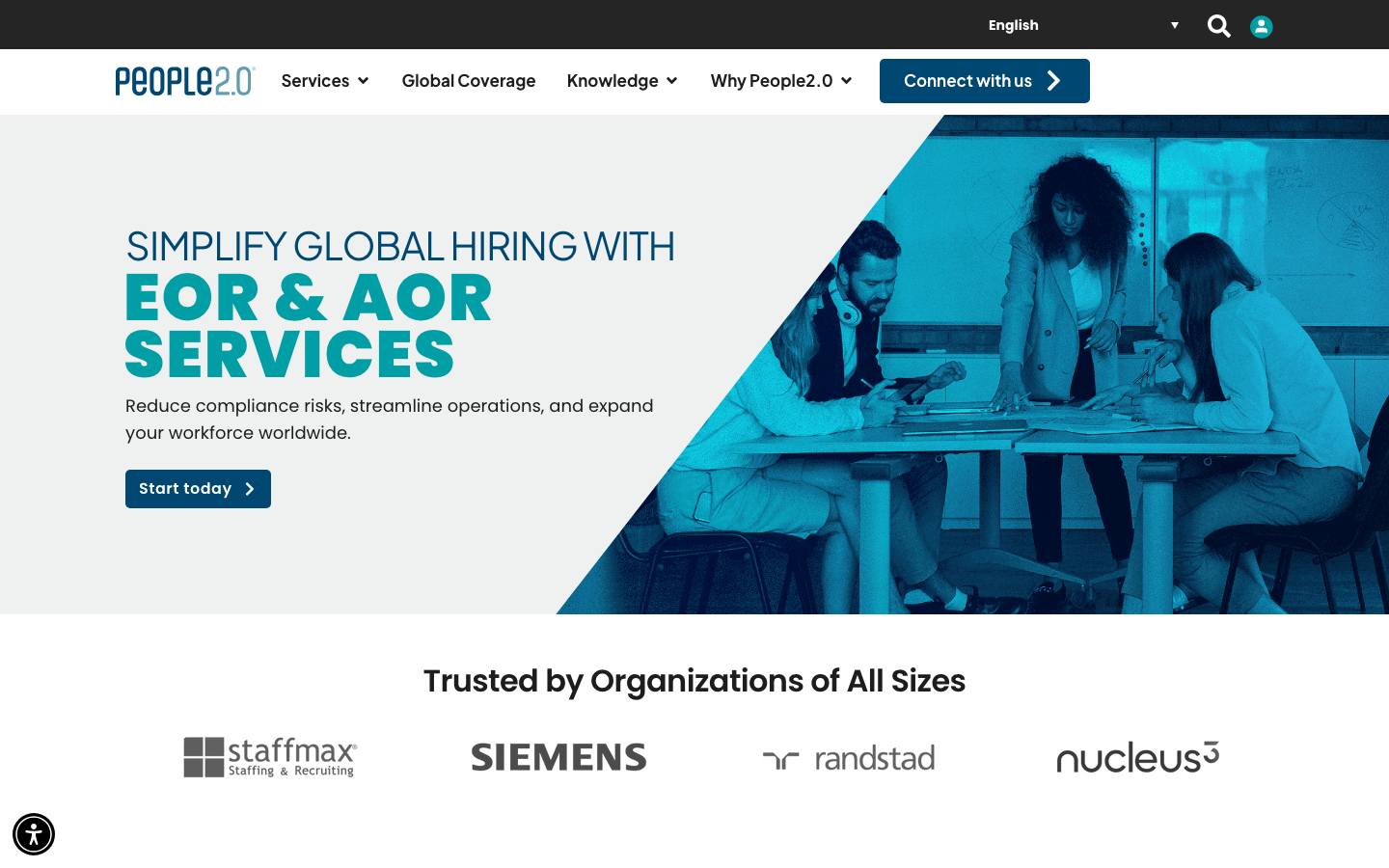
People2.0 is an international agency provider covering 130+ countries. One relationship covers employment, contractor engagement, invoicing, and tax filing, from onboarding to final payment. It sells only to talent suppliers rather than competing with them. It is the largest dedicated provider of its kind. The vendor positions itself explicitly around talent suppliers rather than end employers.
Agency Strengths
- Full back office including invoicing and collections, not employment alone
- EOR and AOR under one classification process across 130+ countries
- Built exclusively for talent suppliers, so the commercial model assumes your margin sits in the middle
Trade-offs
- No published payroll funding position, which matters most at scale
- Owned versus partner-delivered markets are not broken out publicly
- One public review supporting a 4.0, far too little to judge on
People2.0 Review
I would put People2.0 in front of any agency that has outgrown running its own back office. Handling invoicing and collections alongside employment removes an entire function, and the supplier-only positioning means the incentives line up. The trade-off is visibility: your client hears about money from someone else, and some agencies will not accept that.
Our Verdict
Full Back Office Scale
TCWGlobal
Quick Overview
TCWGlobal is a hybrid payrolling and program provider covering the US and international programs. It offers employer of record and back office rather than a published agent of record line. It is the one provider here that also recruits, running healthcare staffing under its own brand, so it competes with agencies for some placements. The vendor reports 750+ clients and 15,000+ workers worldwide.
Agency Strengths
- High-touch service model oriented to large domestic and international programs
- Primary source verification of licenses and certifications for clinical placement
- Back office bought together with payrolling and employment rather than separately
Trade-offs
- It also staffs, which makes it a competitor as well as a supplier for some desks
- No published payroll funding position and no published agent of record line
- One public review behind a 4.5, and an international footprint that is never broken down
TCWGlobal Review
I read this one as a capable provider carrying a conflict you have to price. The service model and the credentialing depth are real, and for a large program that matters. But handing your client relationship to a company that also recruits is a decision, not a detail. It deserves a careful non-solicit and an honest conversation up front.
Our Verdict
High Touch Program Payrolling
Teamed

Quick Overview
Teamed is an international provider covering 187+ countries, offering employer of record with contractor management and entity setup, and it does not recruit. It is the only provider on this page publishing a rate. The vendor states a flat $599 per employee per month, or £479, with zero FX absorbed in any currency pairing. It also publishes no setup or exit fees. It also publishes 187+ countries and 80+ currencies.
Agency Strengths
- A published flat price, which no other provider on this list offers
- Zero FX margin stated openly, which protects the spread on cross-currency placements
- No setup or exit fees, so a single trial placement carries no committed cost
Trade-offs
- It publishes no agency-facing service, positioning itself for companies hiring directly
- Salaried employment only, with no published hourly or daily rate model
- A 4.5 rating from 75 public reviews, and self-published rankings against providers on this list that are marketing rather than evidence
Teamed Review
My take on Teamed is that the pricing transparency is genuinely useful and the positioning is not. Zero FX and a published rate let an agency model a placement before quoting. But nothing on the site addresses the three-party problem, and salaried-only employment rules out most contract desks. Use it for a salaried international placement and look elsewhere for hourly work.
Our Verdict
Published-Price Global EOR
*As pricing is subject to change, we are listing prices as they stand in September 2026
Workwell Global

Quick Overview
Workwell Global is an international agency provider covering 150+ countries, offering employer of record alongside independent contractor engagement. It supports recruitment firms rather than competing with them for placements. Its agency pages are among the most explicit on this list about the buyer. The vendor states it has spent over two decades helping businesses hire across 150+ countries. It also publishes a case study of a UK agency placing 600+ contractors into the US.
Agency Strengths
- A dedicated staffing and recruitment firm’s product rather than a general page with agencies mentioned
- Employment and independent contractor engagement available under one relationship
- Timesheet management and electronic worker verification published inside the contractor product
- Immigration and visa support where work authorization blocks a placement
Trade-offs
- No published worker type position, so hourly and daily rate support needs confirming
- No published payroll funding position and no published pricing
- No public rating, and the group runs more than one live site under the Workwell name
Workwell Global Review
I keep coming back to how clearly Workwell Global addresses the agency buyer, which is rarer on this page than it should be. For a UK or European firm placing its first contractors abroad, it is a natural first call. The gap is documentation. Several things an agency most needs to know aren’t written down, so put them in the contract instead.
Our Verdict
Recruitment Built Global Reach
INSIGHT: Who pays your contractors while you wait for your client to pay you?
Providers answer this three different ways, and the answer sets the ceiling on how many placements an agency can carry at once.
- 4 of the 11 publish a payroll funding position on their own site: BOSS, Innovative Employee Solutions, Multiplier, and myBasePay. The other seven publish nothing, which in practice means the agency prefunds.
- US staffing sales ran to $27.6 billion in the first quarter of 2026, and nearly 2.2 million temporary and contract employees worked in an average week in 2024 (American Staffing Association).
- BOSS is the only provider here publishing funded and self-funded plans as a choice, letting an agency decide who carries the gap rather than negotiating it.
- The arithmetic never changes: you pay weekly, your client pays on its own terms, and the difference is financed by somebody.
Sources:
as of September 2026
FAQs About EOR for Staffing Agencies
What Does an Employer of Record Do for a Staffing Agency?
It signs the employment contract for the workers you place. That lets you bill contract and temporary work without holding employment liability, running payroll, or registering entities everywhere. You keep the three things that matter: the client relationship, the margin between bill rate and pay rate, and the decision about who gets placed. The provider carries employment, taxes, and insurance behind that.
What Is the Best Global EOR for Financial Services?
No provider reviewed here is a specialist in that sector, so the honest question is which one will meet the requirements your end client sets. Those usually include enhanced background and credit screening, certification and reference chains for regulated roles, conflict declarations, and data-handling rules. Work through the comparison table near the top of this page and shortlist on coverage and services first, then test the wrapper.
How Is an EOR Different From a Staffing Agency?
This is the most common confusion on the topic, and the distinction is simple: a staffing agency finds the worker and owns the client relationship. An employer of record employs the worker somebody else found. In most cases, the two are not competitors. Many agencies use one precisely so they can place contract workers without building an employment operation.
What Is the Difference Between EOR and AOR for an Agency?
An employer of record employs the worker as an employee. An agent of record engages a worker who stays self-employed, handling the contract, the classification assessment, and the payments without employing anyone. The classification review at the start of a placement determines which one you need, not preference. A provider offering both under one agreement saves a vendor change mid-assignment.
Will the EOR Approach My Client Directly?
That is a contractual question rather than a question of trust, and the answer sits in two places. The non-solicit tells you what the provider may do with the client it meets through you, and for how long. The invoicing arrangement tells you whether your client ever receives paper with someone else’s name on it. Read both clauses before you look at a rate card, and treat this as common practice.
Does an EOR Fund Payroll Before My Client Pays Me?
Sometimes, and it is the term that limits how fast you can grow. Providers take three positions. Some fund payroll and carry the gap, some require you to send money before payday, and some invoice your client directly. Only 4 of the 11 publish a position at all, so get it in writing, including what happens when a client pays late.
Can an EOR Handle Hourly Workers and Weekly Payroll?
Many cannot, because global contracts are usually drafted around a monthly salary and treat variable hours as an exception the platform never anticipated. Verify three things before signing, starting with whether the construct supports an hourly or daily rate. Whether the provider ingests timesheets rather than asking you to email them, and whether payroll runs weekly. A monthly-only platform turns every contract placement into manual work.
How Is Agency EOR Pricing Structured?
Usually as a percentage of gross pay or a fixed amount per worker per pay period. Sometimes it is a flat monthly fee borrowed from the corporate market. The model matters more than the headline number, because a percentage scales with your wage bill while a flat fee does not. Almost nobody publishes a rate, so any range you find in a comparison article is an estimate, not a quote.

Helen is Anywherer’s Market Analyst & Content Researcher, with extensive experience in analyzing global employment markets and HR technology trends. She is skilled at turning complex market data into clear, well-researched insights that inform every piece of content. With a strong grasp of the EOR, PEO, and international hiring space, Helen plays a key role in keeping Anywherer’s research accurate, up to date, and genuinely useful for readers.