At scale, payroll stops being a single pay run and becomes a web of moving parts: multiple legal entities, many states, several countries, union and shift rules, layered earnings and deductions, and formal approvals. Payroll software for enterprise exists to hold all of that together and keep it reconciled with the HRIS and the finance ledger. The people who own it are payroll and HRIS leaders, CHROs, and finance teams at organizations of roughly 500 to well over 1,000 employees, where a mistake is measured in thousands of paychecks rather than a handful.
The cost of getting it wrong is what makes this matter in 2026. Industry research on payroll operations, including work summarised by Deloitte, points to significant payroll leakage and error rates as volume and the number of countries rise. AI validation that catches anomalies before pay is committed and a single-data-model HCM that shares one record across HR and payroll are now the differentiators, which is why buyers weigh the best HRIS software for enterprise payroll alongside the payroll engine itself. For headcount in markets without a local entity, large companies often pair a payroll platform with Employer of Record companies that act as the legal employer.
Choosing Payroll Software for a Large Company in 2026
The platforms below split into three groups: enterprise HCM suites, global payroll specialists, and modern unified systems. A fourth path skips in-house payroll entirely, with some organizations handing the work to PEO companies under a co-employment model. To map the best payroll software for large companies 2026 has to offer, I reviewed the leading platforms in alphabetical order below.
Top 13 Payroll Software Platforms for Large Companies in 2026
I worked through each of these platforms with enterprise scale in mind, looking at multi-entity structures, multi-country coverage, compliance controls, and how cleanly payroll tied back to HR and finance. I am listing all providers in alphabetical order to keep this comparison neutral, so their positions on the page carry no ranking. The mix runs from HCM giants like Workday and SAP to global payroll specialists like CloudPay and Papaya Global, with modern platforms in between. Whether you need the best global payroll software for large companies or a single-country engine at volume, read each verdict against your entity map, your country list, and the systems you already run.

ADP
Quick Overview
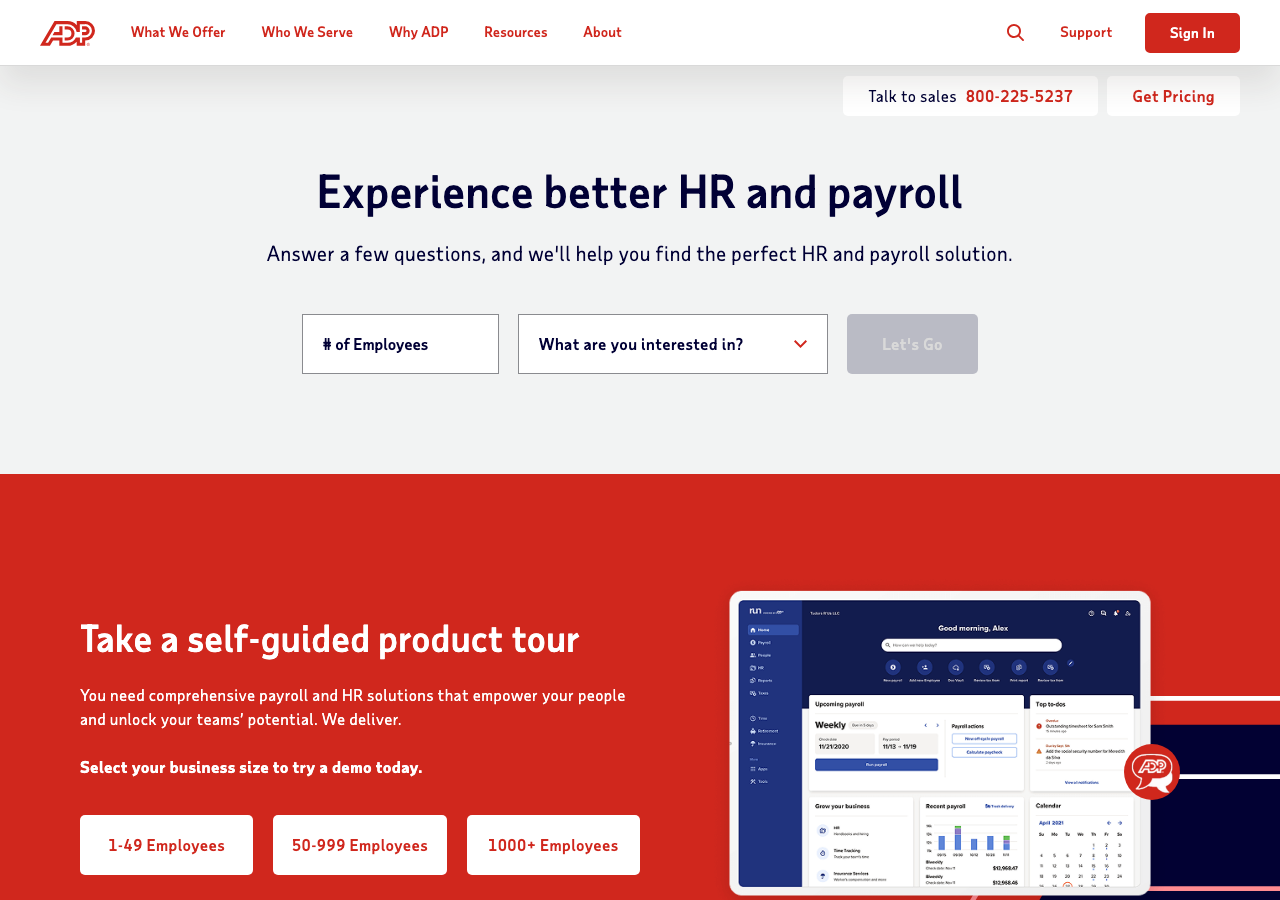
ADP anchors its enterprise line with Workforce Now for large US employers and ADP Global Payroll for multi-country operations, adding automated tax filing, SmartCompliance, and coverage across roughly 140 countries. It is a proven enterprise payroll platform with decades of scale.
Software Pros
- Coverage across about 140 countries
- Automated tax filing and compliance
- Proven at a very large volume
- Deep US and global product line
Software Cons
- Product sprawl can confuse buyers
- Pricing is quote-only
- Some modules feel legacy
ADP Review
During my evaluation, ADP felt like the safe incumbent choice for a large employer that values reliability over novelty. Its tax filing and compliance tooling handled multi-state complexity without drama, and the global option reached markets most rivals cannot. The catch is navigating a broad product family, since Workforce Now, Global Payroll, and Lyric serve different needs, and the right fit is not always obvious up front. A large buyer should map its exact entity and country needs to the specific ADP product before signing.
Our Verdict
Proven Enterprise Payroll Backbone
CloudPay
Quick Overview
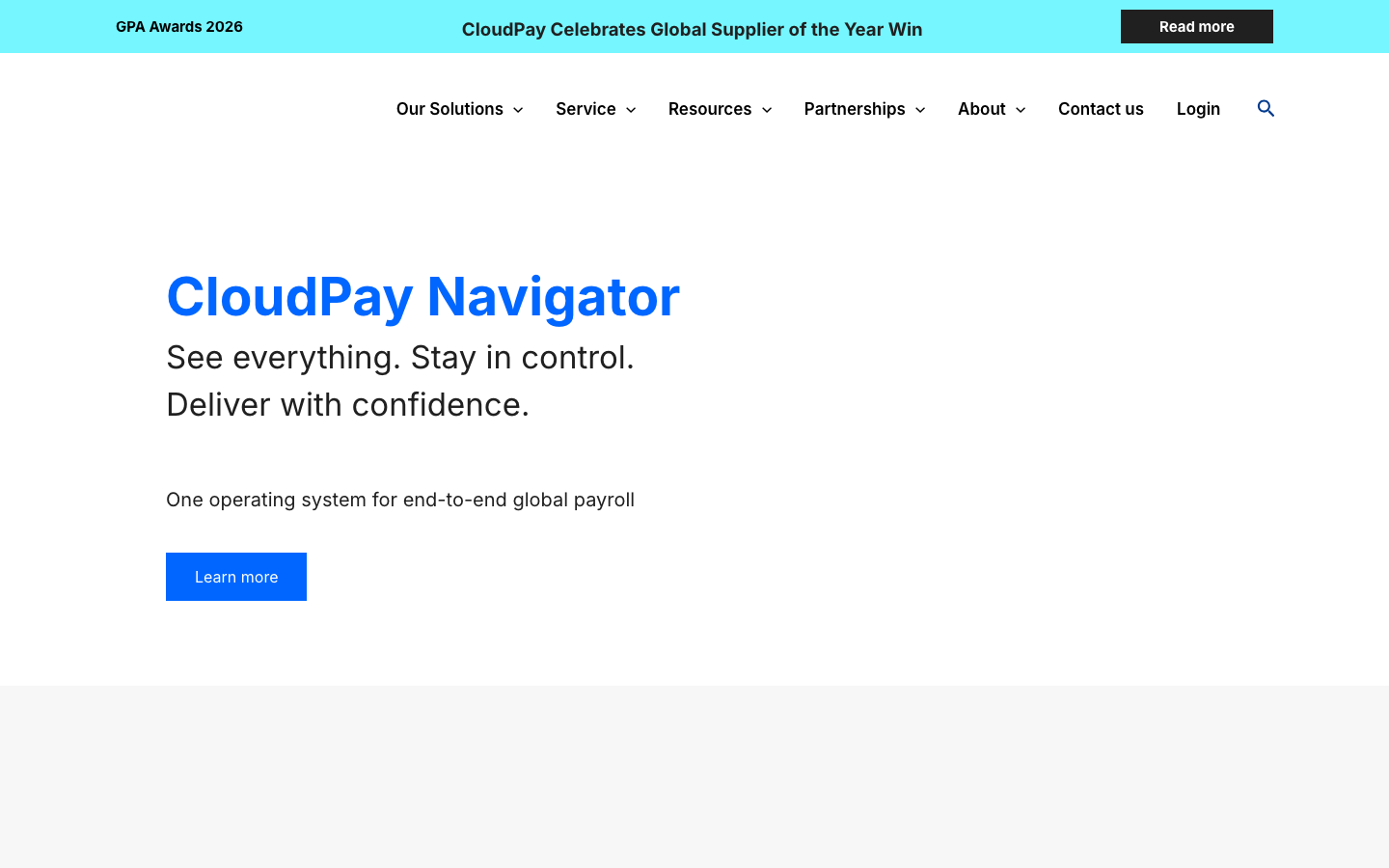
CloudPay delivers fully managed, end-to-end global payroll for large organizations, consolidating multi-country payroll, payments, and compliance into a single managed service. It is one of the clearest answers to the best global payroll software for large companies question when you want the work done for you.
Software Pros
- Fully managed global payroll
- Consolidated multi-country payments
- Compliance handled as a service
- One point of accountability
Software Cons
- Managed service, less hands-on control
- Premium pricing at scale
- Less self-serve than platforms
CloudPay Review
In my assessment of CloudPay, the appeal is the offloading of operational burden: rather than staffing payroll experts in every country, a company routes it all through a single managed service with a single service level. My review of its country coverage and payments flow showed genuine consolidation. The trade is control, since a team that wants to run payroll in-house on its own schedule may find a managed model less flexible than a self-serve platform.
Our Verdict
Managed Global Payroll Service
Dayforce
Quick Overview
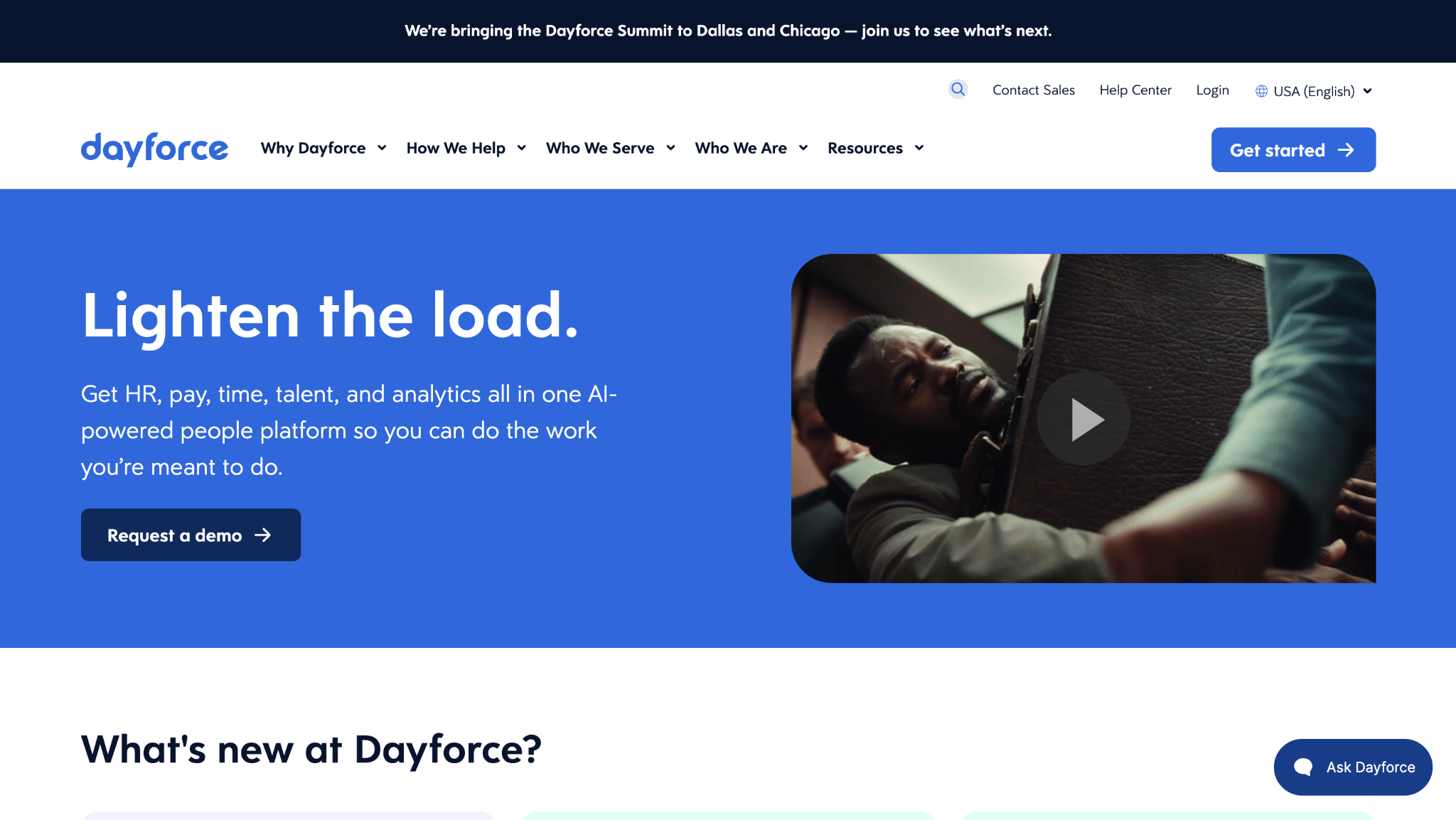
Dayforce runs continuous, real-time payroll within a single HCM platform, recalculating pay as data changes rather than waiting for a batch. That continuous-calculation approach makes it a distinctive enterprise payroll system for complex workforces.
Software Pros
- Continuous real-time calculation
- Payroll unified with HCM
- Strong for complex pay rules
- Fewer end-of-cycle surprises
Software Cons
- Full value needs the whole suite
- Implementation is substantial
- Best for complex, not simple, pay
Dayforce Review
What stood out to me about Dayforce is that pay is always current: a mid-cycle change is recalculated immediately, so there was no scramble at cutoff. For a large employer with intricate shift, overtime, and union rules, that live model is genuinely useful. The commitment is real, though, because the payback depends on adopting the broader HCM, so a company wanting only payroll will not see its full strength.
Our Verdict
Continuous-Calculation Enterprise Payroll
Deel
Quick Overview
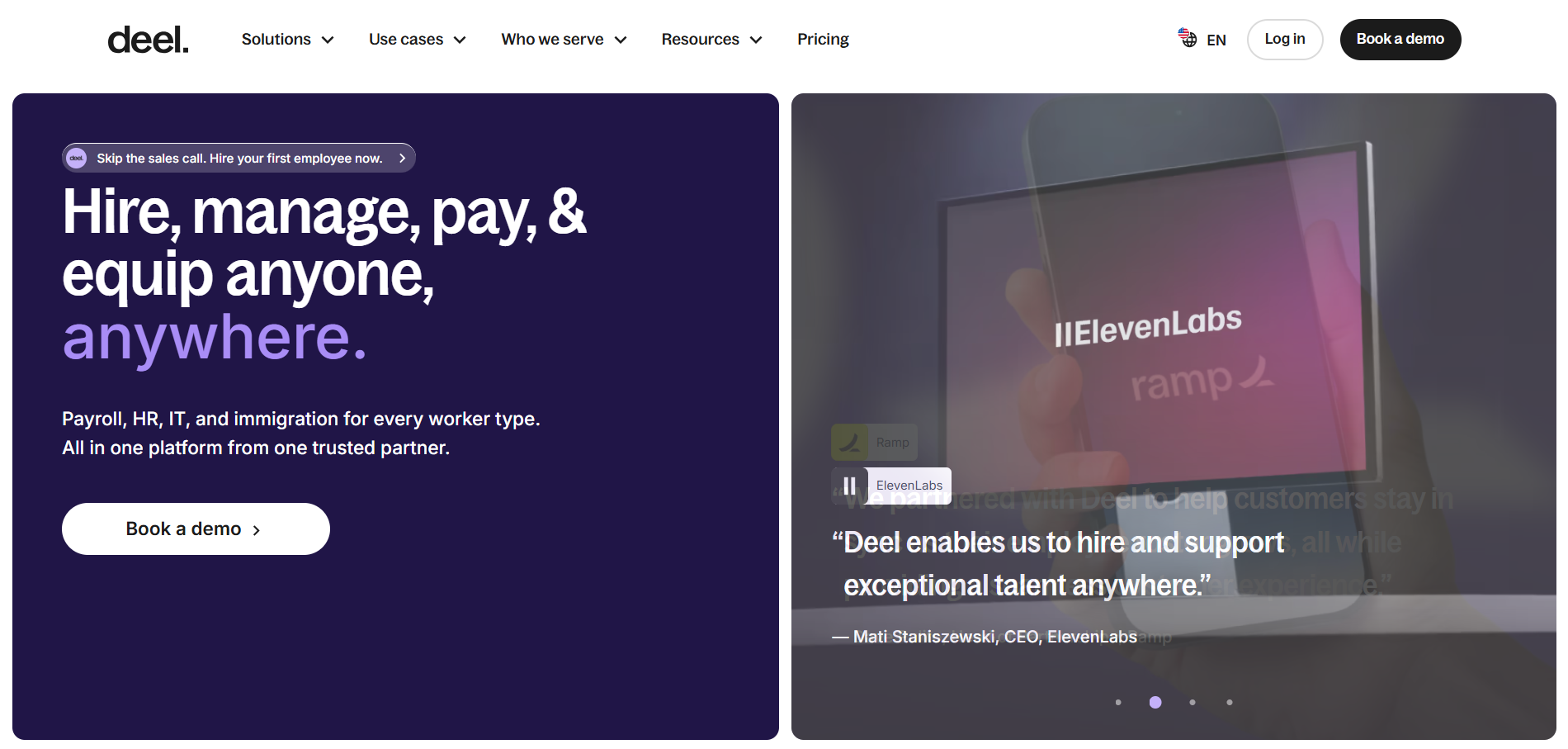
Deel runs compliant payroll in more than 100 countries and adds Payroll Connect, which shows in-house and Deel-managed payroll side by side in one view. For a large company with an international workforce, it is a strong global payroll platform.
Software Pros
- Compliant payroll in 100-plus countries
- Payroll Connect unifies the view
- Fast to add new countries
- Contractor and worker coverage
Software Cons
- Younger in the largest enterprises
- Depth varies by country
- Not a full domestic HCM
Deel Review
While reviewing Deel, the standout was breadth with visibility: I could see managed and in-house payrolls in one place, which large multinationals usually stitch together manually. Adding a new country was far quicker than with a legacy suite. It is newer to the very largest enterprise deployments than ADP or Workday, so a global business should validate depth in its specific priority countries before consolidating.
Our Verdict
Unified Global Payroll Visibility
Homebase
Quick Overview
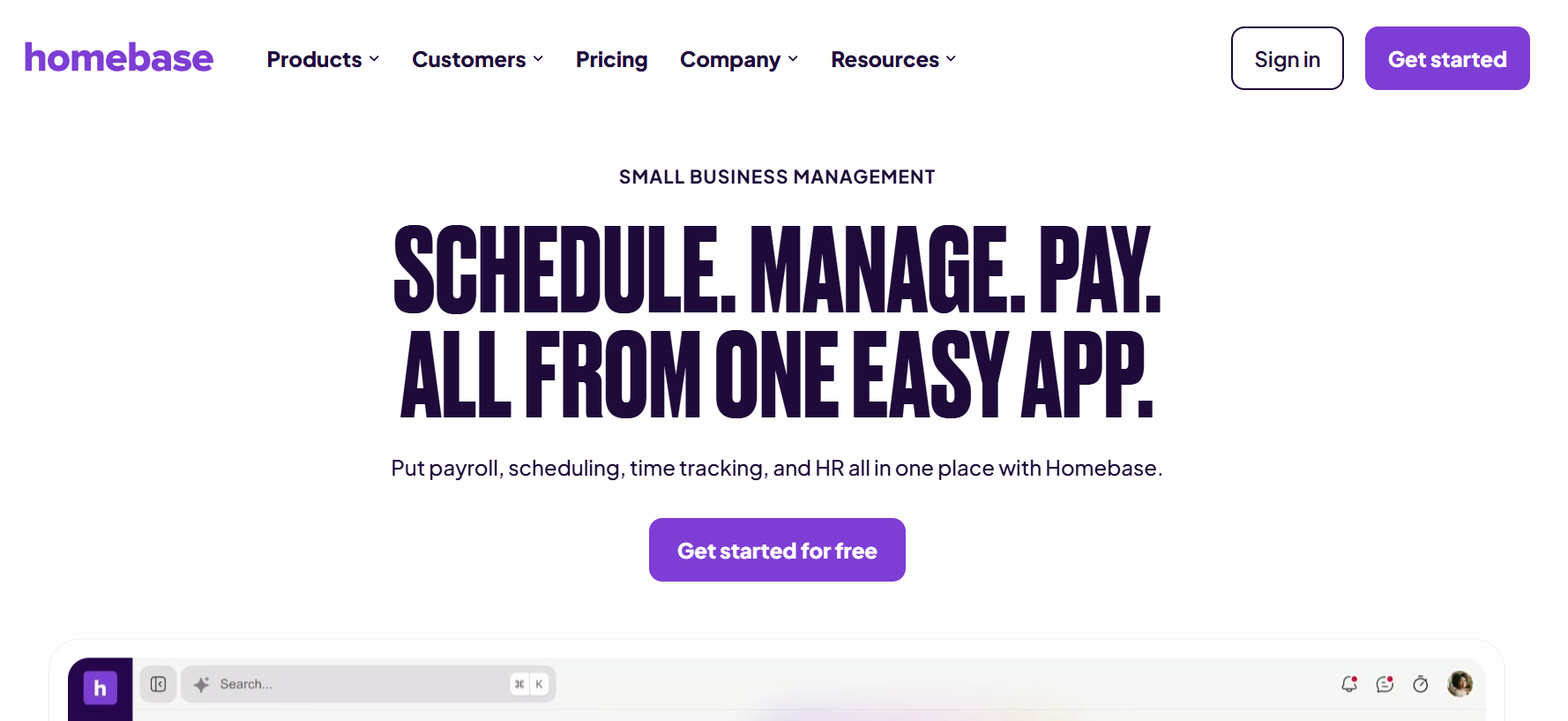
Homebase is a team management platform for hourly workforces that pairs scheduling and time tracking with US payroll running off the same timesheets. It is built for multi-location hourly operations rather than multi-entity or multi-country enterprise payroll, so at this end of the market its fit is large hourly employers running many small sites.
Software Pros
- Timesheets flow straight into payroll
- Built for high-turnover hourly staffing
- Per-location time and break controls
- Mobile-first for managers and staff
Software Cons
- United States payroll only
- No multi-entity or union pay rules
- Not an enterprise system of record
Homebase Review
While reviewing Homebase against the enterprise platforms here, the honest framing is that it solves an adjacent problem: getting hours right at the location level so payroll is not built on guesswork. For a large hourly employer with dozens of small sites, that layer carries real weight because clock-in accuracy and break compliance at each site are where payroll errors usually originate. What it does not do is serve as the payroll engine for a thousand-person, multi-entity organization, since coverage is United States-only, with no union or multi-country pay rules. A large operator would run it as the time-and-scheduling layer feeding an enterprise engine, rather than as a replacement for one.
Our Verdict
Hourly Time-To-Payroll Layer
Oracle
Quick Overview
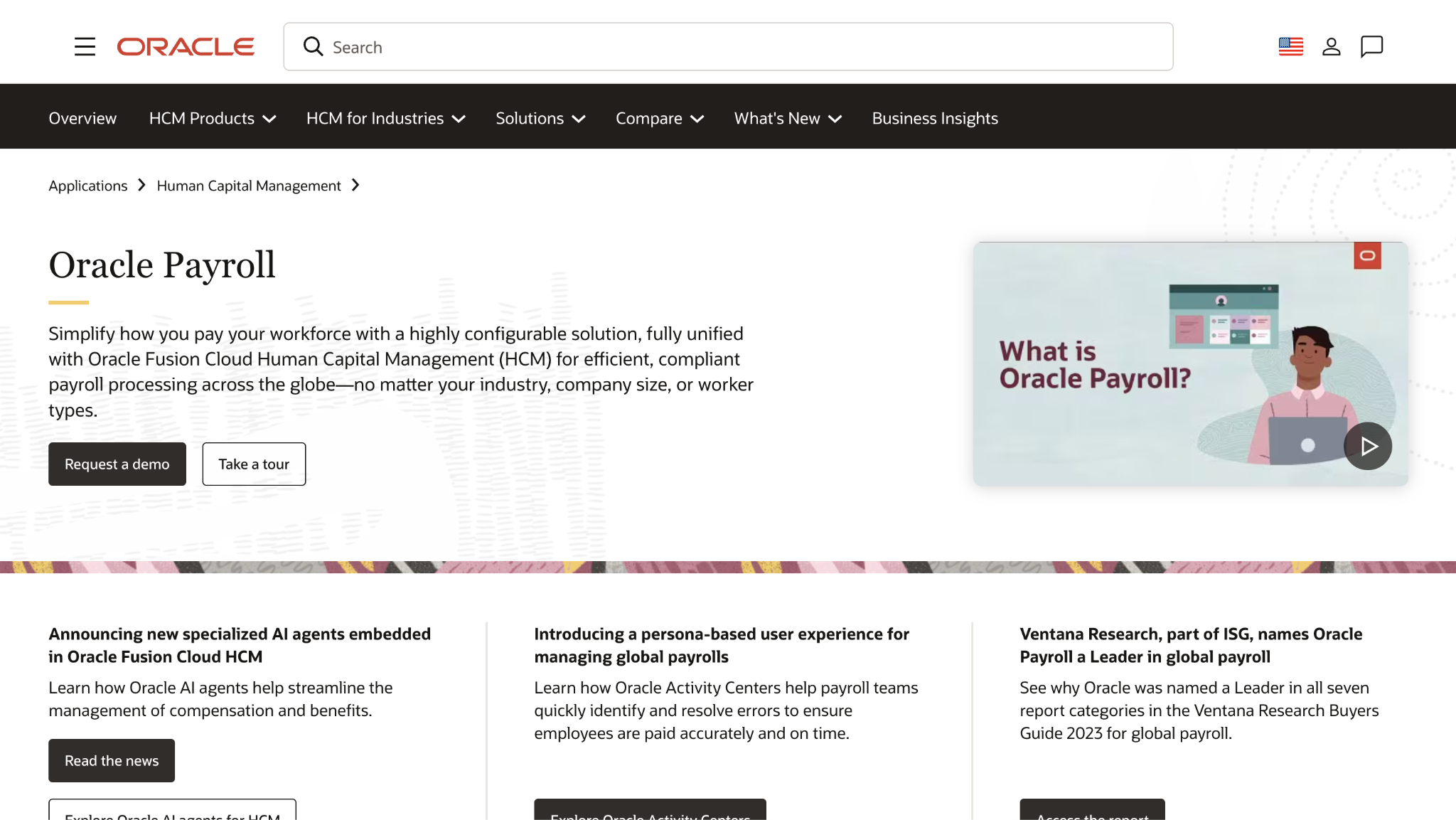
Oracle runs enterprise payroll inside Fusion Cloud HCM on a single data model, built for complex multi-entity organizations already standardized on Oracle Cloud and ERP. It ranks among the best payroll software for enterprise companies rooted in the Oracle stack.
Software Pros
- Single data model with HCM
- Strong multi-entity handling
- Tight Oracle ERP integration
- Enterprise-grade controls
Software Cons
- Best value only inside Oracle
- Long, complex implementation
- Needs specialist administrators
Oracle Review
During my evaluation, Oracle payroll made the most sense as part of a committed Oracle Cloud environment, where HR, payroll, and finance share a single model and reconciliation is largely automated. Its multi-entity handling was robust. Outside that ecosystem, the calculus changes, since the implementation is a major program and the platform expects skilled administrators, so it rewards organizations already all-in on Oracle rather than newcomers.
Our Verdict
Oracle-Native Enterprise Payroll
Papaya Global
Quick Overview
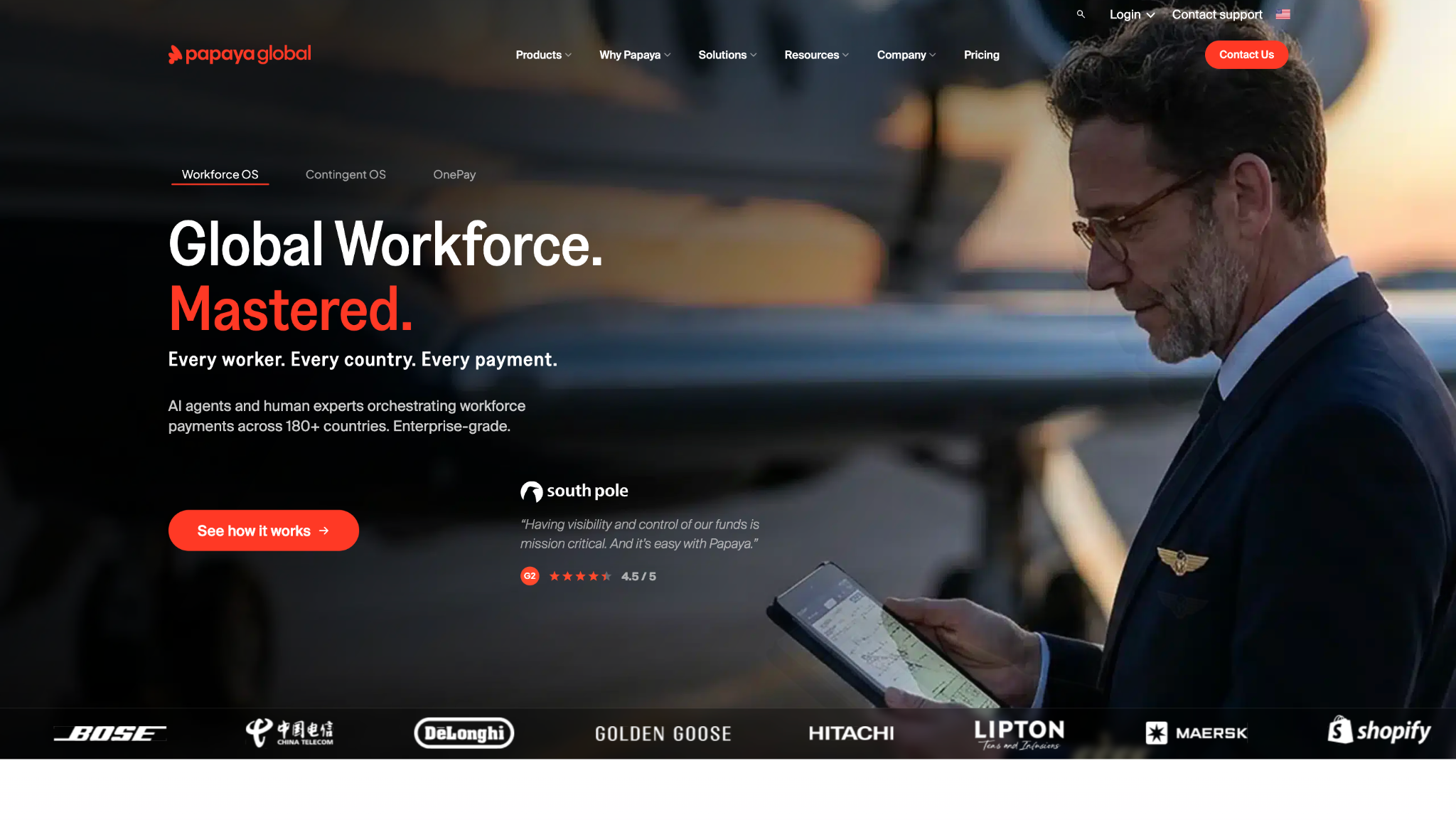
Papaya Global is a global payroll and workforce-payments platform for large enterprises, unifying multi-country payroll, payments, and compliance under tiered global plans. It is built for the best global payroll software for large companies’ use case with payments at the center.
Software Pros
- Payments plus payroll in one
- Broad multi-country coverage
- Compliance and reporting depth
- Real-time payroll visibility
Software Cons
- Premium enterprise pricing
- Depth varies by market
- Heavier than single-country needs
Papaya Global Review
In my assessment of Papaya Global, the payments angle set it apart: moving money to workers across countries sat within the same platform as payroll calculations, which reduces reconciliation between systems. Its dashboards gave a clear cross-country view. The pricing and depth suit genuine enterprise scale, so a company with only a couple of foreign hires may find lighter global tools a better economic fit. For a true multinational, though, having pay and payments reconciled in one platform removes a persistent source of error.
Our Verdict
Global Payroll And Payments
Paycom
Quick Overview
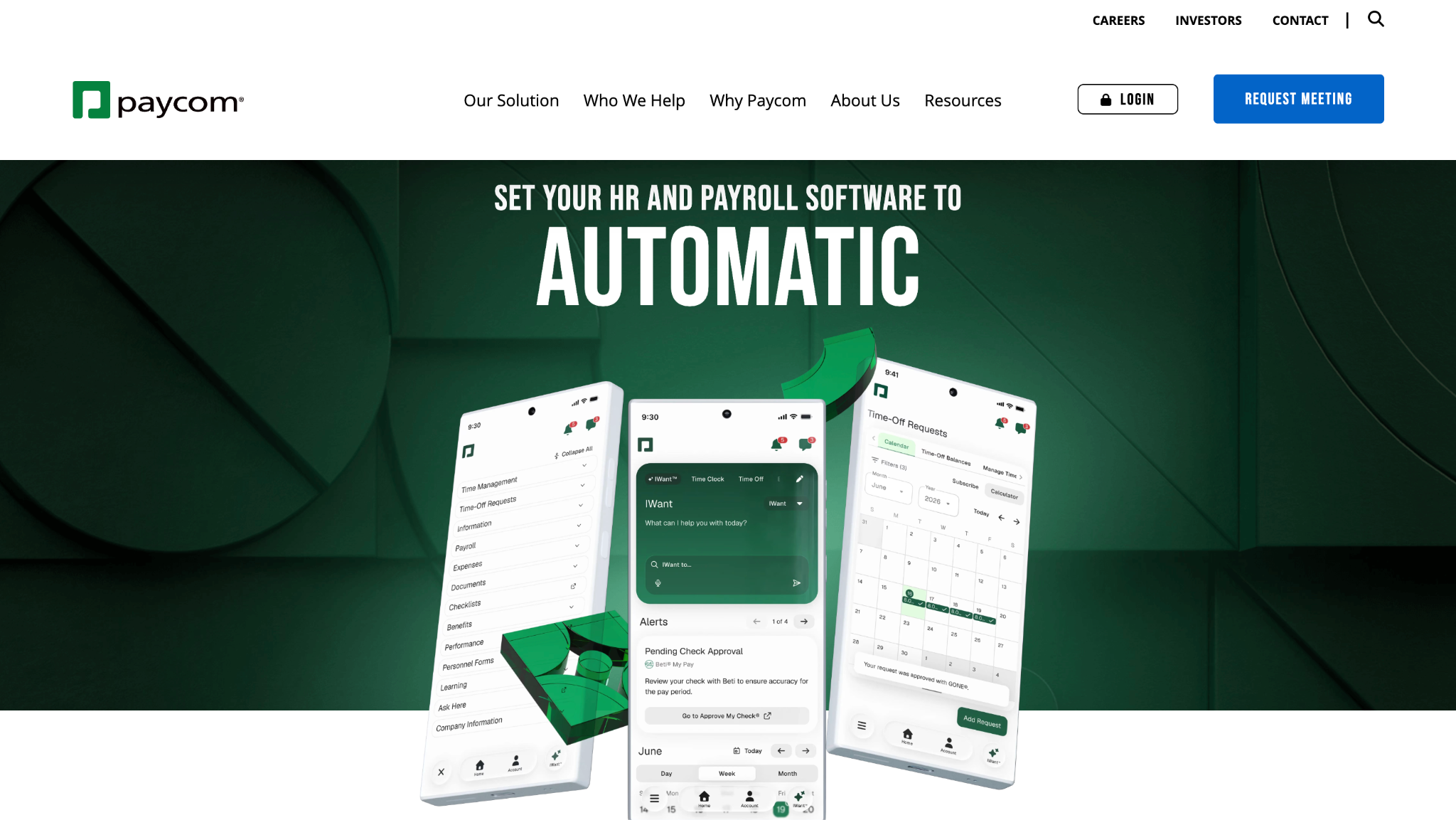
Paycom runs on a single database where employees run and validate their own payroll through Beti, backed by 50-state tax filing and audit-ready reporting. It is a modern enterprise payroll system aimed at large US employers.
Software Pros
- Employee-driven payroll accuracy
- Single-database architecture
- 50-state tax filing
- Audit-ready reporting
Software Cons
- US-centric, limited global reach
- Beti shifts work to employees
- Less fit for a multi-country payroll
Paycom Review
What stood out to me about Paycom is Beti, which puts the final payroll check in employees’ hands so errors are caught before, not after, pay runs. At a large US scale, that can genuinely cut corrections. As payroll software for enterprise businesses, it is strong domestically, but its focus is the United States, so a multinational needing broad country coverage should look to ADP, Deel, or a global specialist instead.
Our Verdict
Employee-Driven US Enterprise Payroll
Paylocity
Quick Overview
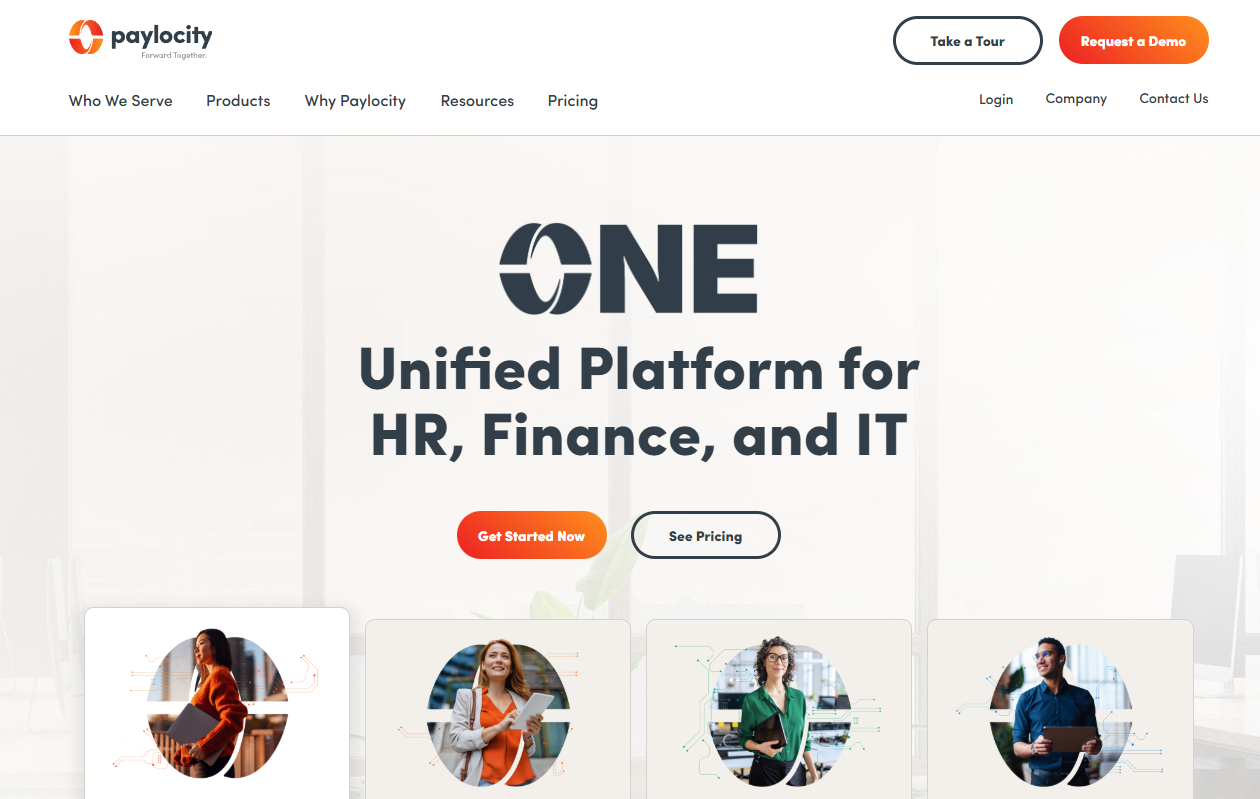
Paylocity is a modern cloud HCM and payroll platform for mid-to-large US organizations, pairing automated multi-state payroll with strong self-service and engagement tools. It suits payroll software for enterprise businesses in the roughly 100 to 1,000-plus band that want a modern interface.
Software Pros
- Modern, well-liked interface
- Automated multi-state payroll
- Strong self-service tools
- Good employee engagement features
Software Cons
- US-focused, not global
- Lighter at mega-enterprise scale
- Fewer deep ERP integrations
Paylocity Review
While reviewing Paylocity, the draw was usability at scale: multi-state payroll ran cleanly, and the self-service experience felt current rather than dated. For a growing US organization moving up-market, it hits a sweet spot. It is strongest in the mid-to-large band, though, so a company pushing into tens of thousands of employees or many countries will weigh it against the heavier Workday and SAP suites.
Our Verdict
Modern Mid-To-Large Payroll
Rippling
Quick Overview
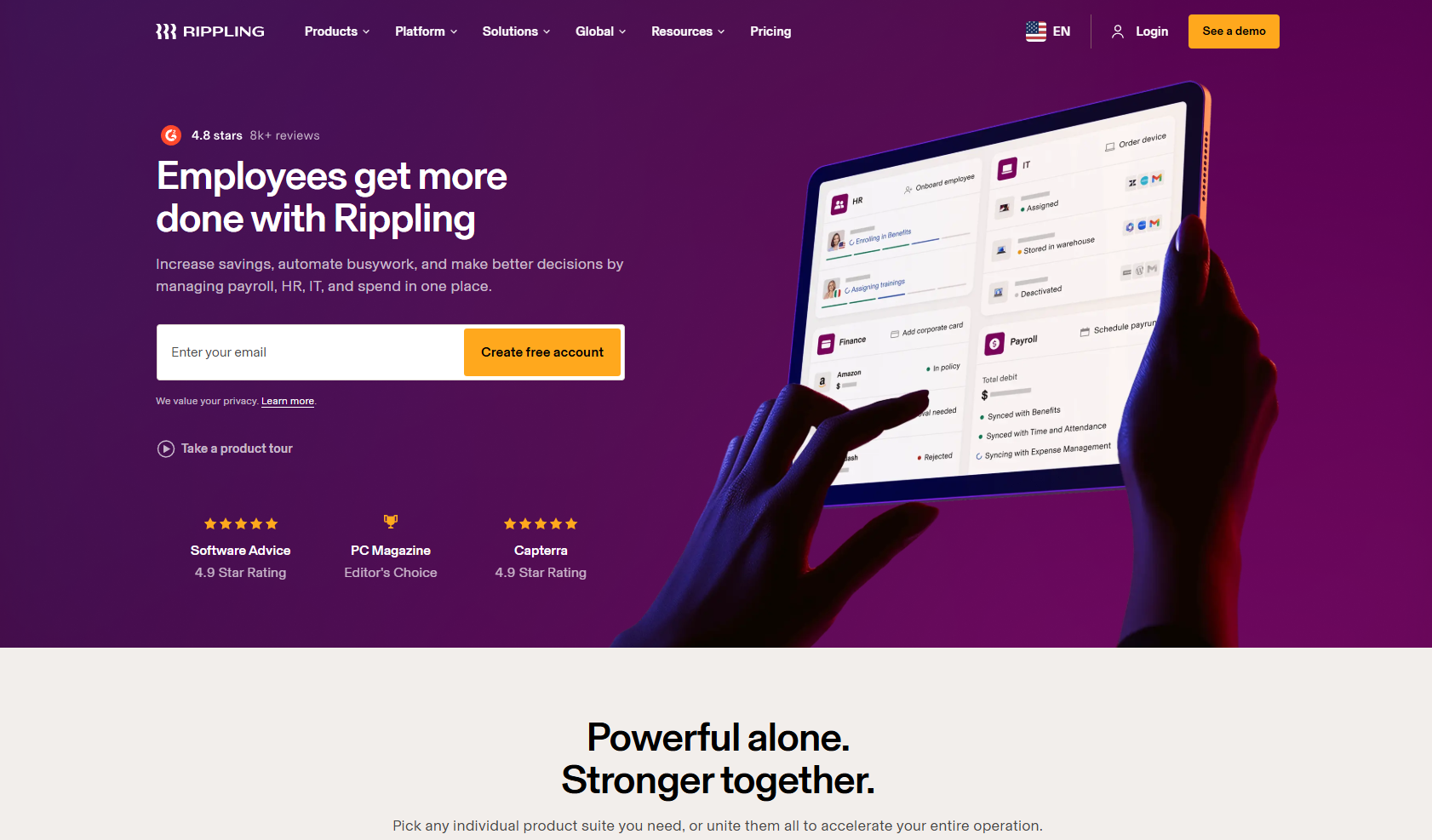
Rippling unifies HR, IT, finance, and payroll into a single employee record, automating multi-state and global payroll with deep workflow capabilities. It is the modern unified option among enterprise payroll platforms rather than the legacy incumbent.
Software Pros
- One record across HR, IT, and payroll
- Strong multi-state automation
- Growing global payroll reach
- Powerful workflow rules
Software Cons
- Younger in large enterprises
- Modular pricing adds up
- Depth varies by module
Rippling Review
During my evaluation, Rippling stood out for its automation: a single change to an employee record cascaded across payroll, benefits, and access without manual steps, which, at scale, saves real administrative time. Its global reach is expanding steadily. It is newer to the largest enterprise deployments than ADP or Workday, so a very big organization should pressure-test its scale and country depth before committing to it as the core. For a fast-growing tech company, automation and a unified record can still outweigh incumbents’ longer track records.
Our Verdict
Modern Unified Enterprise Payroll
SAP SuccessFactors
Quick Overview
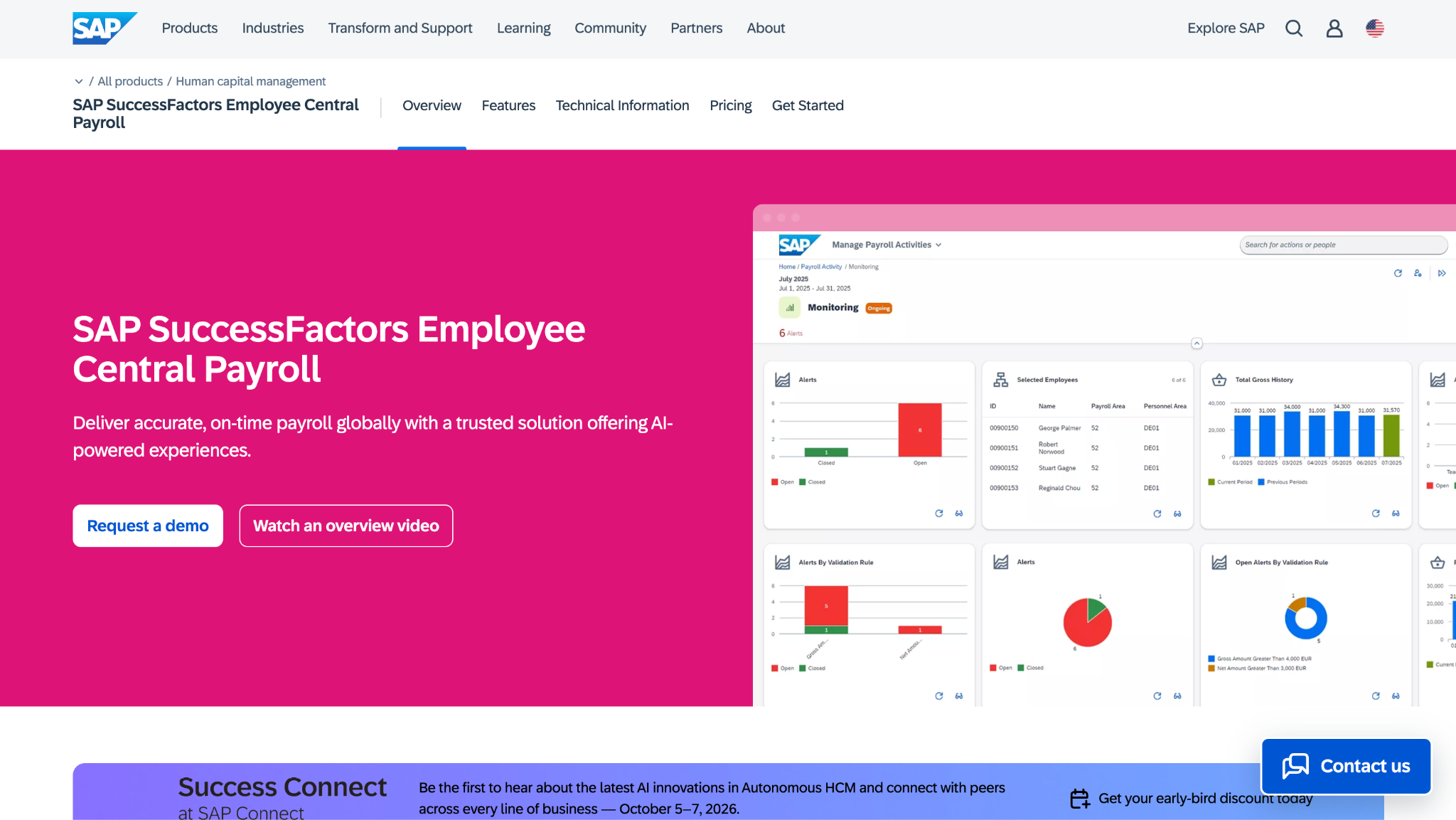
SAP SuccessFactors runs Employee Central Payroll within the SuccessFactors HCM suite, built for global enterprises that need localized payroll across multiple countries alongside SAP ERP. It is a core answer to the question of the best HRIS software for enterprise payroll for SAP shops.
Software Pros
- Localized payroll across many countries
- Tight SAP ERP integration
- Enterprise HCM in one suite
- Strong compliance localization
Software Cons
- Best value only inside SAP
- Lengthy, costly implementation
- Requires specialist expertise
SAP SuccessFactors Review
In my assessment of SAP SuccessFactors, its logic is consolidation for organizations already living in SAP, where payroll, HR, and finance share one backbone and country localisations run deep. My look at its multi-country handling showed real breadth. The commitment is heavy, though, with a long implementation and specialist skills required, so it fits enterprises standardized on SAP far better than those shopping fresh.
Our Verdict
SAP-Native Global HCM Payroll
UKG Pro
Quick Overview
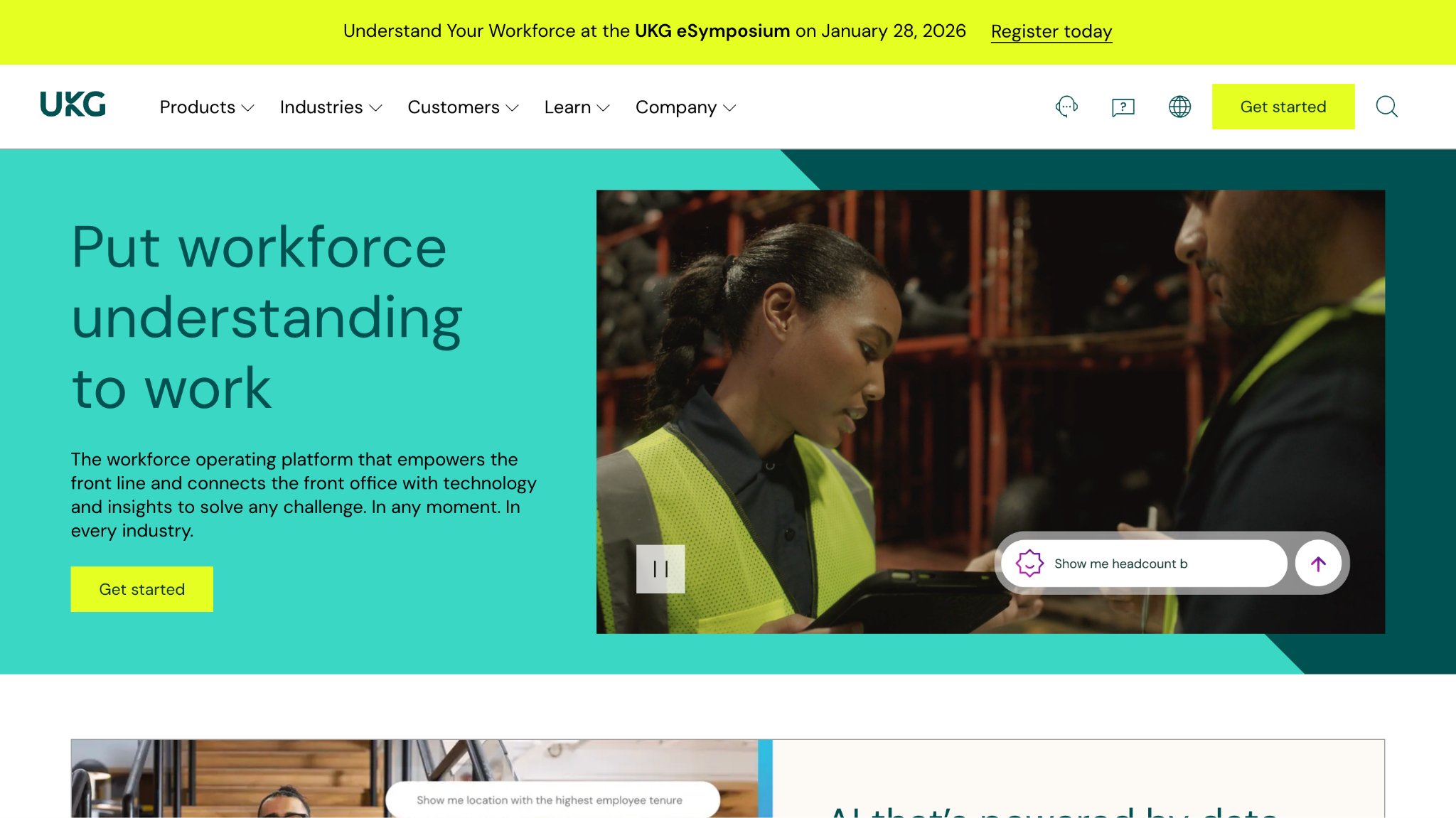
UKG Pro pairs enterprise payroll with deep workforce management, using AI to flag payroll anomalies before pay is processed. For large, shift-heavy organizations, it is a capable enterprise payroll platform integrated with scheduling and time management.
Software Pros
- AI payroll anomaly detection
- Deep workforce-management link
- Strong for shift-based industries
- Compliance depth at scale
Software Cons
- The broad suite has a learning curve
- Implementation is substantial
- More than office-only teams need
UKG Pro Review
What stood out to me about UKG Pro is the tie between payroll and workforce management: because scheduling and time feed the same system, its AI could flag an anomaly before pay is committed rather than after. For a hospital or retailer running complex shifts, that link is valuable. An office-only employer with simple salaried pay, by contrast, would not use much of its shift-oriented depth.
Our Verdict
Payroll Plus Workforce Management
Workday
Quick Overview
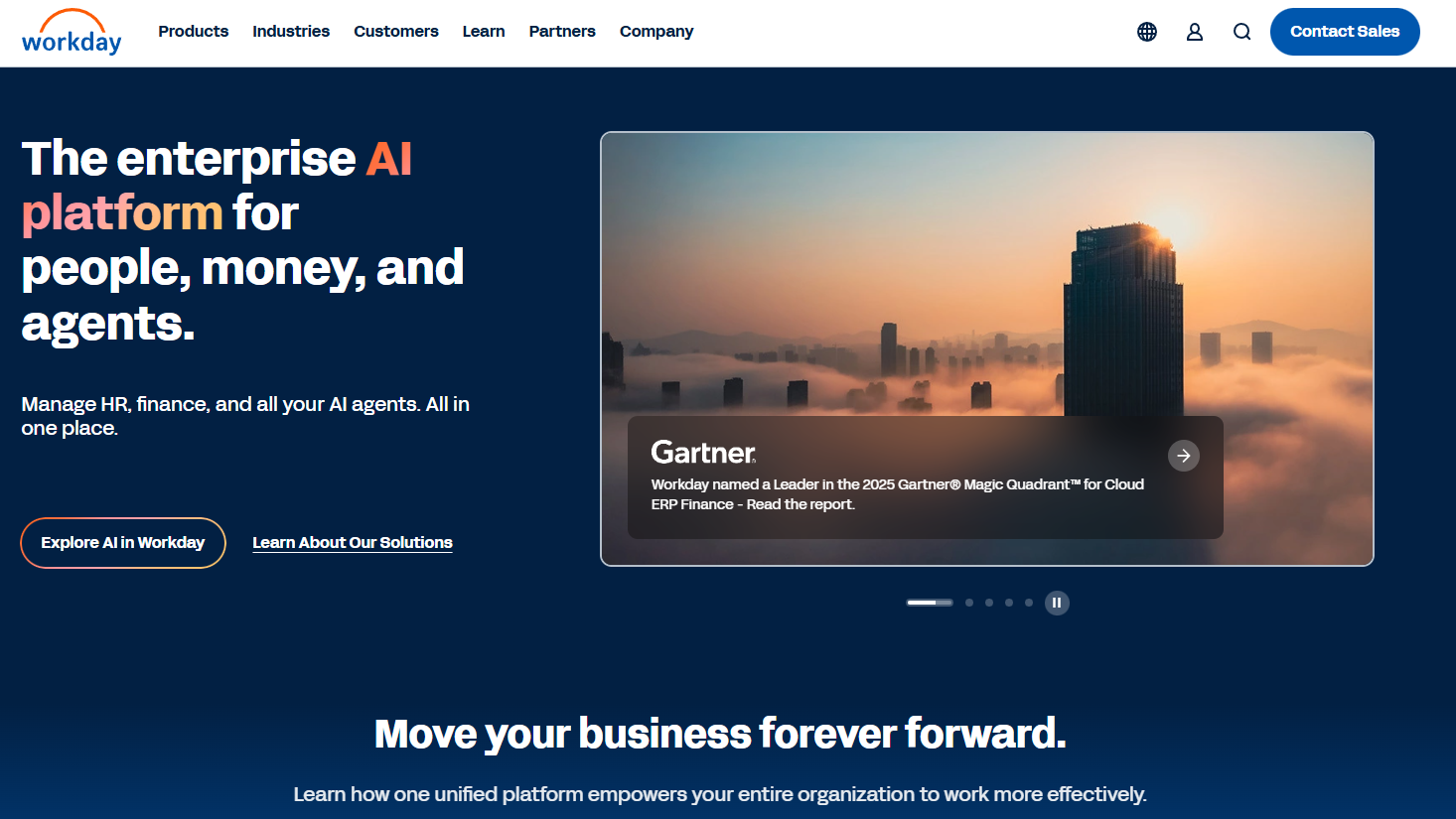
Workday unifies payroll with HCM and finance on a single data model and is strong for complex multi-entity payroll across North America, EMEA, and APAC. It is a leading answer to the question of the best payroll software for enterprise companies at the top of the market.
Software Pros
- Single model for HCM and finance
- Strong multi-entity, multi-region payroll
- Robust analytics and controls
- Widely adopted enterprise standard
Software Cons
- Major implementation timeline
- Premium enterprise pricing
- Best value inside Workday
Workday Review
During my evaluation, Workday impressed me most for its consistency: payroll, HR, and finance drew on a single data model, so reporting reconciled without the usual cross-system patching. Its multi-region handling was assured. The price of that unity is a serious implementation and a real budget, so it rewards large enterprises committing to Workday as their system of record rather than bolting payroll onto an existing patchwork. Once that commitment is made, the single model is what keeps reporting trustworthy across regions.
Our Verdict
Enterprise HCM Payroll Leader
FAQs About Payroll Software for Large Companies
What is the best payroll software for large companies?
It depends on your profile. HCM suites like Workday, SAP SuccessFactors, and Oracle suit enterprises wanting payroll unified with HR and finance. ADP brings proven scale and global reach. Deel, Papaya Global, and CloudPay lead on global coverage, while Paycom, Paylocity, and Rippling offer modern platforms. The best fit follows your entity map, country count, and existing HCM more than any single feature.
What is the best HRIS software for enterprise payroll?
For payroll that shares one record with HR, the leading single-data-model HCM suites are Workday, SAP SuccessFactors, Oracle HCM, UKG Pro, and Dayforce. In each, payroll draws on the same employee data as HR, which cuts reconciliation and errors. Choosing among them usually comes down to which ERP or HCM ecosystem your organization has already standardized on.
What is the best global payroll software for large companies?
The strongest global options are Deel, Papaya Global, CloudPay, and ADP Global Payroll. The real decision is structural: run your own legal entities plus a payroll platform, or use an EOR or a BPO partner for countries where you have no entity. Coverage depth by country, payments handling, and consistency across markets should drive the pick.
What is the difference between enterprise payroll software and a global payroll aggregator?
Native enterprise payroll runs its own in-country calculation engines, giving consistent logic and control but demanding more setup per country. An aggregator consolidates local payroll partners under one dashboard, which speeds coverage but can vary in depth market to market. The trade is control and consistency against reach and speed, so weigh both against your country list.
How long does enterprise payroll implementation take?
Set expectations early. Large HCM suites such as Workday, SAP, and Oracle often take several months to a year or more to implement, driven by data migration, integrations, and change management. Modern platforms and managed global services can move faster. Governance and testing usually shape the timeline more than the software itself, so plan resourcing accordingly.
How much does enterprise payroll software cost?
Most vendors quote custom pricing, typically per employee per month at scale, plus implementation. The license number is only part of it, because the total cost of ownership includes data migration, integrations, support tiers, and ongoing administration. For a fair comparison, ask each vendor for a multi-year total that includes rollout costs, not just the annual subscription, since integration and support tiers can quietly dominate the total cost.
Should a large company run payroll in-house or outsource it?
It comes down to scale, in-house expertise, and the number of countries. Running payroll on your own software gives you the most control but requires staff and processes. Managed or BPO payroll offloads the operation while you keep oversight. Full outsourcing hands both payroll and HR administration to PEO companies under a co-employment model. Base the decision on how many countries you run, how deep your payroll bench is, and how much control you are willing to trade for less operational burden.

Yaryna is our lead writer with over 8 years of experience in crafting clear, compelling, and insightful content. Specializing in global employment and EOR solutions, she simplifies complex concepts to help businesses expand their remote teams with confidence. With a strong background working alongside diverse product and software teams, Yaryna brings a tech-savvy perspective to her writing, delivering both in-depth analysis and valuable insights.