Most organizations collect exit interview data, yet few act on it in a meaningful way. The conversation happens, answers are recorded, and the file is closed. Meanwhile, the same problems, unclear growth paths, inconsistent management, or eroding team trust, continue to push people out. According to Gallup, 52 percent of voluntarily exiting employees say their manager or organization could have done something to prevent them from leaving. That statistic alone suggests exit interviews still carry significant diagnostic value, if the right questions are asked and the answers are actually used.
The real power of exit interview questions lies not in any single response but in patterns that emerge over time. One person’s frustration with communication may be an isolated case. When five people in the same department raise the same concern within a year, it becomes a signal worth investigating. A well-designed exit interview questionnaire helps surface these patterns across roles, teams, and managers, turning individual departures into actionable organizational intelligence.
This article provides 60 employee exit interview questions organized into six thematic categories, along with guidance on how to conduct an exit interview, analyze the feedback, and avoid the most common mistakes. Whether you are building an exit interview questions template from scratch or refining an existing process, these questions are designed to produce honest, useful responses.
Exit Interview Questions by Category
The following 60 questions for exit interview conversations are divided into six categories. Each category includes context on what the questions help uncover and how to use the answers. You do not need to ask all 60 in a single session. Select the questions most relevant to the departing employee’s role, tenure, and circumstances, and aim for a focused conversation of 15 to 25 questions.
Exit Interview Questions About Overall Experience and Satisfaction
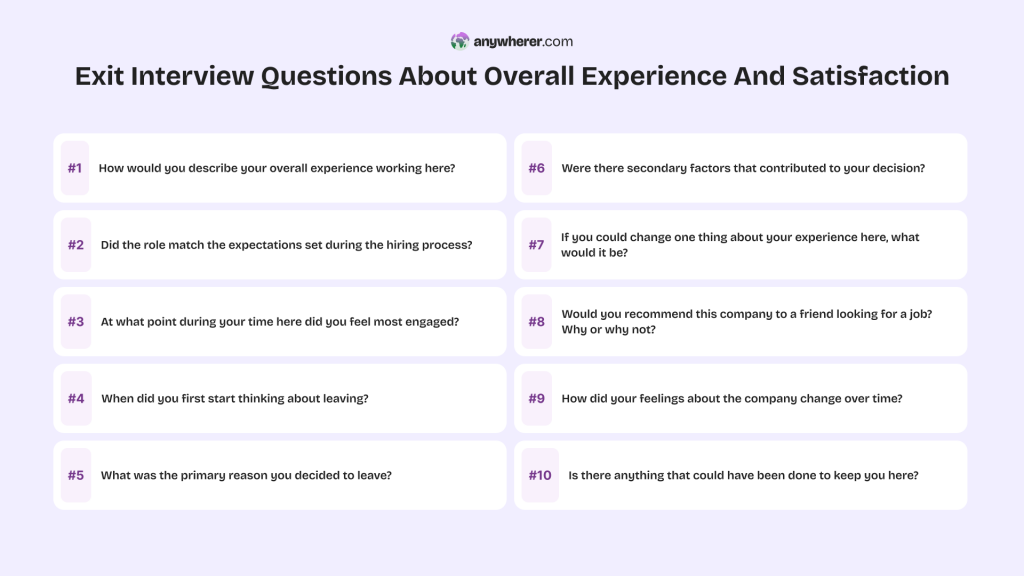
What these questions help uncover: General sentiment about working at the company, the gap between expectations at hire and the day-to-day reality, and the overall emotional arc of the employee’s tenure. These are often good exit interview questions to open with because they set a reflective tone.
How to use the answers: Look for recurring themes in what attracted people versus what drove them away. If multiple employees report that the role did not match the job description, that points to a recruitment messaging problem. If satisfaction declined sharply after a specific period, explore what changed.
Questions:
- How would you describe your overall experience working here?
- Did the role match the expectations set during the hiring process?
- At what point during your time here did you feel most engaged?
- When did you first start thinking about leaving?
- What was the primary reason you decided to leave?
- Were there secondary factors that contributed to your decision?
- If you could change one thing about your experience here, what would it be?
- Would you recommend this company to a friend looking for a job? Why or why not?
- How did your feelings about the company change over time?
- Is there anything that could have been done to keep you here?
Exit Interview Questions About Management and Leadership
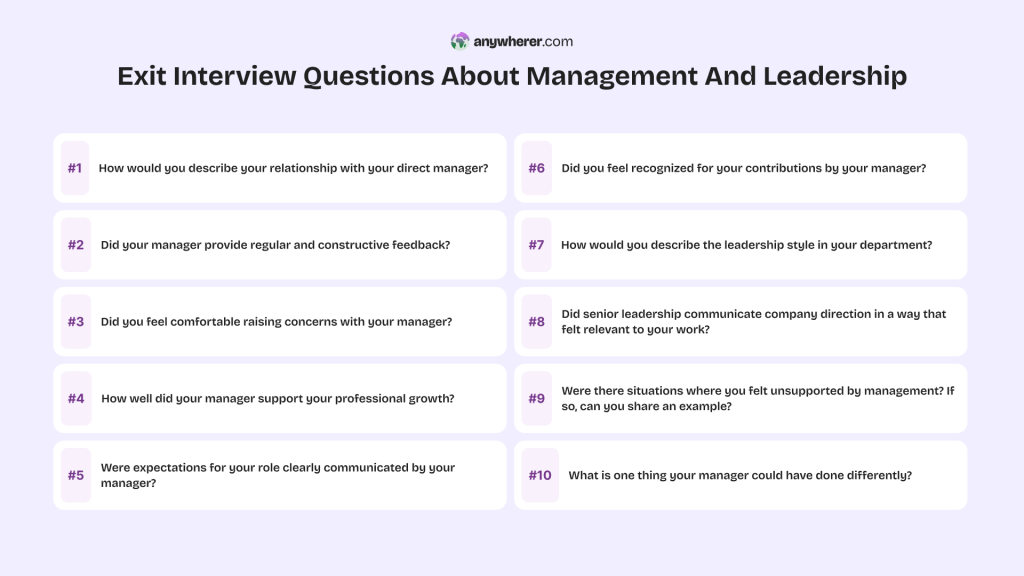
What these questions help uncover: The quality of the direct manager relationship, leadership visibility, and whether employees felt supported, heard, and fairly treated. Research from McKinsey shows that uncaring leaders are among the top reasons employees leave, cited by 35 percent of departing workers.
How to use the answers: Compare responses across employees who reported to the same manager. Patterns of dissatisfaction tied to specific leaders warrant coaching, structural changes, or both. These are among the best exit interview questions for identifying systemic leadership gaps.
Questions:
- How would you describe your relationship with your direct manager?
- Did your manager provide regular and constructive feedback?
- Did you feel comfortable raising concerns with your manager?
- How well did your manager support your professional growth?
- Were expectations for your role clearly communicated by your manager?
- Did you feel recognized for your contributions by your manager?
- How would you describe the leadership style in your department?
- Did senior leadership communicate company direction in a way that felt relevant to your work?
- Were there situations where you felt unsupported by management? If so, can you share an example?
- What is one thing your manager could have done differently?
Exit Interview Questions About Role, Growth, and Development
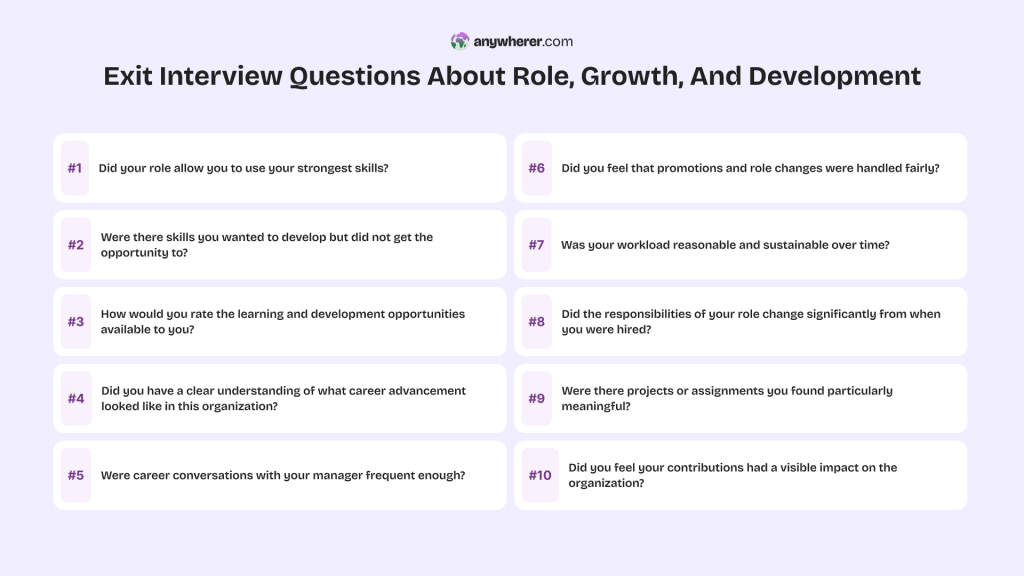
What these questions help uncover: Whether employees felt their skills were utilized, whether growth opportunities existed, and whether career conversations happened frequently enough. These typical exit interview questions reveal whether people left because of the job itself or because of stagnation.
How to use the answers: Track how often lack of development or unclear career paths appear as exit themes. If certain roles consistently show low growth satisfaction, revisit the development plans and promotion criteria for those positions.
Questions:
- Did your role allow you to use your strongest skills?
- Were there skills you wanted to develop but did not get the opportunity to?
- How would you rate the learning and development opportunities available to you?
- Did you have a clear understanding of what career advancement looked like in this organization?
- Were career conversations with your manager frequent enough?
- Did you feel that promotions and role changes were handled fairly?
- Was your workload reasonable and sustainable over time?
- Did the responsibilities of your role change significantly from when you were hired?
- Were there projects or assignments you found particularly meaningful?
- Did you feel your contributions had a visible impact on the organization?
Exit Interview Questions About Team Dynamics and Collaboration
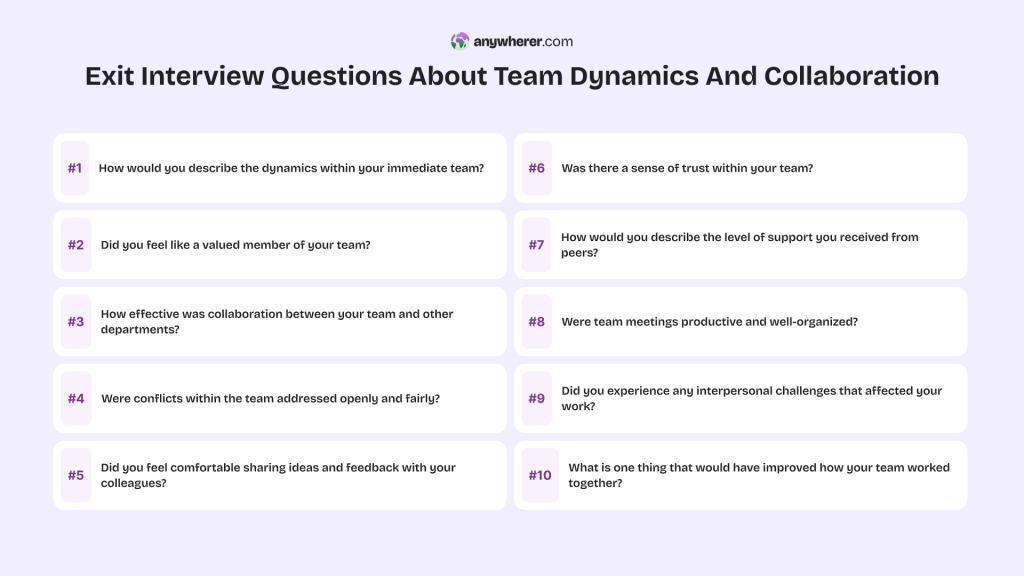
What these questions help uncover: The health of team relationships, the quality of cross-functional collaboration, and whether employees felt a sense of belonging. These sample exit interview questions are particularly revealing in teams with high turnover, where dysfunction may be hidden behind polite silence.
How to use the answers: Map feedback to specific teams and departments. If collaboration issues cluster around certain groups, it may indicate process bottlenecks, conflicting priorities, or interpersonal problems that require mediation. Use this data alongside engagement survey results to validate findings.
Questions:
- How would you describe the dynamics within your immediate team?
- Did you feel like a valued member of your team?
- How effective was collaboration between your team and other departments?
- Were conflicts within the team addressed openly and fairly?
- Did you feel comfortable sharing ideas and feedback with your colleagues?
- Was there a sense of trust within your team?
- How would you describe the level of support you received from peers?
- Were team meetings productive and well-organized?
- Did you experience any interpersonal challenges that affected your work?
- What is one thing that would have improved how your team worked together?
Exit Interview Questions About Compensation, Benefits, and Recognition
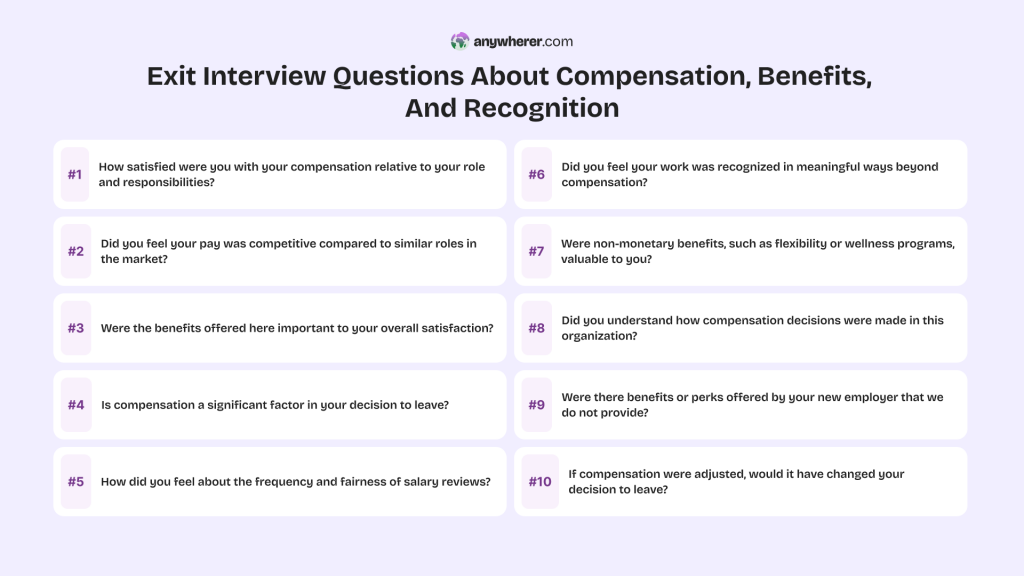
What these questions help uncover: Whether pay, benefits, and recognition practices met employee expectations and how they compared to alternatives in the market. Compensation is often a factor but rarely the only one. These standard exit interview questions help separate genuine pay concerns from broader dissatisfaction being expressed through a compensation lens.
How to use the answers: Cross-reference compensation feedback with market data and internal equity reviews. If departing employees consistently report feeling underpaid, benchmark the role against current market rates. If recognition comes up more than salary, the issue is cultural, not financial.
Questions:
- How satisfied were you with your compensation relative to your role and responsibilities?
- Did you feel your pay was competitive compared to similar roles in the market?
- Were the benefits offered here important to your overall satisfaction?
- Is compensation a significant factor in your decision to leave?
- How did you feel about the frequency and fairness of salary reviews?
- Did you feel your work was recognized in meaningful ways beyond compensation?
- Were non-monetary benefits, such as flexibility or wellness programs, valuable to you?
- Did you understand how compensation decisions were made in this organization?
- Were there benefits or perks offered by your new employer that we do not provide?
- If compensation were adjusted, would it have changed your decision to leave?
Exit Interview Questions About Culture, Communication, and Final Reflections
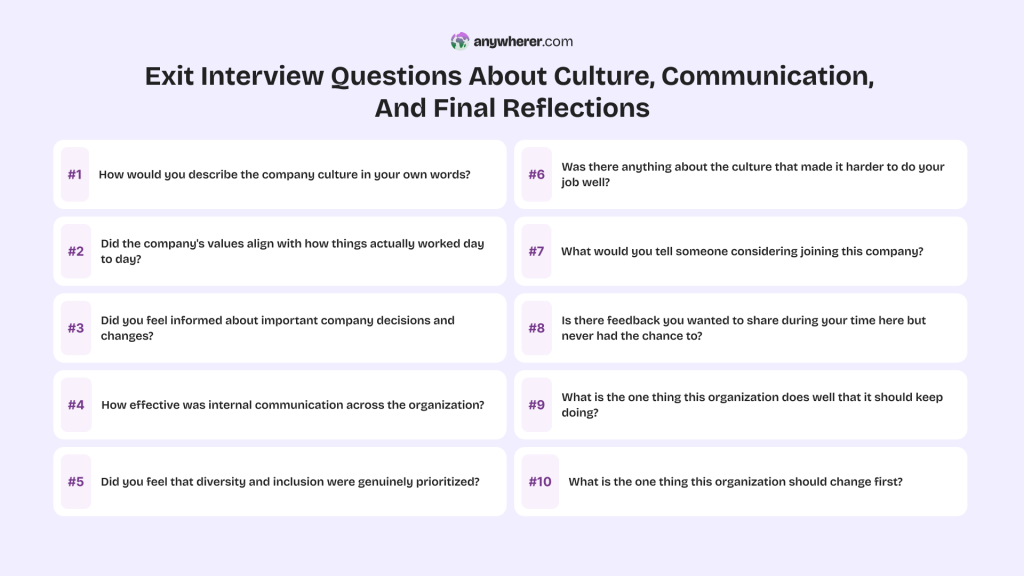
What these questions help uncover: How the employee perceived company culture, internal communication, and the overall direction of the organization. These effective exit interview questions tend to produce the most candid responses when asked toward the end of the conversation, after trust has been established.
How to use the answers: Culture feedback is best analyzed in aggregate. Individual opinions about culture vary widely, but when the same descriptors, positive or negative, appear across multiple exits, they reveal the lived culture as distinct from the stated one. Feed this data into broader organizational health reviews.
Questions:
- How would you describe the company culture in your own words?
- Did the company’s values align with how things actually worked day to day?
- Did you feel informed about important company decisions and changes?
- How effective was internal communication across the organization?
- Did you feel that diversity and inclusion were genuinely prioritized?
- Was there anything about the culture that made it harder to do your job well?
- What would you tell someone considering joining this company?
- Is there feedback you wanted to share during your time here but never had the chance to?
- What is the one thing this organization does well that it should keep doing?
- What is the one thing this organization should change first?
How to Run Exit Interviews Effectively
Knowing what questions to ask in an exit interview is only part of the equation. How the interview is conducted determines whether employees give honest, useful answers or polite, surface-level responses. Three factors shape the quality of exit interview data: timing, the interviewer, and the format.
Timing
Exit interviews can be conducted during the notice period, on the last day, or shortly after departure. Each option has trade-offs. Interviews during the notice period capture information while details are fresh, but employees may still feel cautious about speaking openly. Post-departure interviews, typically conducted one to two weeks after the last day, often yield more candid responses because the professional relationship has ended. According to Gallup, post-departure interviews can produce more transparency due to the lack of fear of retaliation, though they risk lower participation rates. Many organizations find that scheduling the interview during the final week strikes a reasonable balance.
Who Should Run It
The direct manager should not conduct the exit interview. Employees are far less likely to share honest feedback about their manager with that same manager sitting across the table. HR professionals or a neutral third party are better positioned to facilitate the conversation and to know what to ask in an exit interview without injecting bias. In some organizations, a senior HR partner handles all exits to maintain consistency in the process and ensure the data is comparable across departments. If the departing employee is senior, involving an external consultant can add an additional layer of confidentiality and trust.
Interview Format
Live conversations, whether in person or over video, tend to generate richer answers than written exit interview survey questions alone. A conversation allows the interviewer to follow up on vague responses, read non-verbal cues, and explore unexpected topics. However, written formats, such as an exit interview questionnaire, work well as a complement. Sending a short survey before the live conversation gives the employee time to reflect, and it provides a structured baseline that the interviewer can build on. The most effective approach combines both: a concise written exit interview survey questions form followed by a focused live discussion.
Common Mistakes to Avoid in Exit Interviews
Even organizations that consistently conduct exit interviews can undermine their own efforts through a few recurring mistakes. Recognizing these pitfalls is essential for anyone designing or refining an exit interview questions template.
Treating exit interviews as a formality
When exit interviews are reduced to a checkbox exercise, employees notice. If the interviewer rushes through the questions, reads from a script without engaging, or shows no genuine interest in the answers, the departing employee will mirror that energy with vague, non-committal responses. The interview should feel like a genuine conversation, not a compliance task.
Asking questions but not closing the loop
Collecting data without acting on it is worse than not collecting it at all. If employees hear from former colleagues that nothing changed despite honest exit feedback, future departing employees will see the process as performative. A lot of exiting employees say no one spoke with them about their job satisfaction or future in the three months before they left. The problem is not just failing to ask, it is failing to listen and respond when people do speak up.
Overreacting to single responses
A single employee’s exit feedback may reflect a personal situation, a personality clash, or a temporary frustration. Launching an investigation or restructuring a team based on one person’s account creates instability. Exit data becomes actionable when patterns repeat across multiple departures. Track themes over quarters and years, not individual interviews.
Leading or defensive questioning
Questions that steer toward a preferred answer, such as “You found the benefits package competitive, right?” invalidate the data. Similarly, interviewers who become defensive when they hear critical feedback shut down the conversation. The interviewer’s role is to listen, probe gently, and document. Common exit interview questions should be open-ended and neutral in phrasing.
How to Analyze Exit Interview Feedback
Raw exit interview data becomes useful only when it is aggregated, categorized, and reviewed over time. A single exit interview is a data point. A year’s worth of exit interviews is a diagnostic tool. Organizations that treat exit data with the same rigor they apply to customer feedback or financial reporting are the ones most likely to reduce preventable turnover.
Trends over individual answers
Resist the urge to act on every individual response. Instead, code responses into categories, management, compensation, growth, culture, workload, and track frequency over time. Harvard Business Review highlights that the most valuable insight from exit interviews comes from identifying systemic issues rather than reacting to individual complaints. When the same theme appears in 30 percent or more of exits within a department, it signals a structural problem.
Grouping feedback across multiple exits
Segment exit data by department, role level, tenure, and voluntary versus involuntary departure. A pattern visible only among employees with less than one year of tenure suggests an onboarding or expectation-setting issue. A pattern concentrated among mid-level employees may point to a promotion bottleneck. This segmentation transforms a generic exit interview sample into a precise diagnostic instrument.
What to track over time
Build a quarterly or semi-annual report that tracks the top five exit themes, the departments with the highest voluntary turnover, and changes in average tenure. Include a manager-level view where possible. Over time, this data will show whether retention initiatives are working or whether new issues are emerging. The exit interview questions and answers collected across departures become part of the organization’s institutional memory, preventing repeated cycles of the same problems.
Exit Interviews in Remote and Hybrid Teams
Remote and hybrid work environments introduce distinct dynamics that affect both the reasons employees leave and how exit interviews should be conducted. The issues that surface in these conversations often differ from those in fully co-located teams, and the logistics of the interview itself require adaptation.
Different Issues Surface in Remote Exits
Remote employees are more likely to cite isolation, lack of visibility, inconsistent communication, and difficulty disconnecting from work as reasons for leaving. These issues may not appear in standard exit interview questions designed for office-based teams. Adding questions that specifically address remote work experience, such as how supported the employee felt working outside the office and whether they had adequate access to information and decision-makers, will capture issues unique to distributed work. A well-structured employee offboarding checklist template can help ensure these conversations are part of a broader, consistent offboarding process.
Psychological Safety in Remote Conversations
Without the informal rapport that builds in shared physical spaces, remote employees may feel less psychologically safe during exit conversations. Building trust from the outset matters more in a video call than in a familiar meeting room. The interviewer should explain the purpose of the conversation, confirm how the data will be used, and explicitly state whether responses are confidential or attributable. Giving the employee the option to turn off their camera can also reduce pressure and lead to more candid responses.
Written Versus Live Formats for Distributed Teams
For globally distributed teams spanning multiple time zones, a written exit interview questionnaire may be more practical than scheduling a synchronous conversation. Written responses also remove language barriers for non-native speakers who may struggle to articulate nuanced feedback verbally. The trade-off is that written formats lack the depth of a live conversation. A hybrid approach, sending a written set of exit interview questions for employees in advance and then scheduling a brief video call to discuss key points, works well for most remote teams.
FAQs on Exit Interview Questions
When should exit interviews be conducted?
Most organizations conduct exit interviews during the employee’s final week, typically one to three days before their last day. This timing balances accessibility with enough emotional distance for the employee to reflect honestly. Some companies follow up with a post-departure survey two to four weeks later, which can yield additional candid feedback once the professional relationship has fully ended.
Are exit interviews confidential?
They should be, and employees should be told so explicitly at the start of the conversation. Confidentiality encourages honesty. In practice, this means that individual responses should not be shared with the departing employee’s manager in a way that allows attribution. Aggregate data can and should be shared with leadership, but specific quotes or identifying details should be anonymized.
Should managers attend exit interviews?
No. The direct manager’s presence inhibits candid feedback, especially when management issues are part of the reason for leaving. Exit interviews should be conducted by HR, a designated people operations team member, or an external facilitator. If the organization wants the manager to receive feedback, it should be provided in aggregate and anonymized form.
How long should an exit interview last?
Plan for 30 to 45 minutes. Shorter sessions risk staying at a surface level, while longer sessions can become exhausting for both parties. The interviewer should select 15 to 25 questions from the full set of exit interview questions to ask employee, focusing on the areas most relevant to the individual’s experience and role.
Do exit interviews really improve retention?
Exit interviews alone do not improve retention. What improves retention is acting on the patterns they reveal. Organizations that systematically track exit themes, share findings with leadership, and implement targeted changes report measurable reductions in preventable turnover over time. The interview is the data collection mechanism. The impact comes from what happens next.
What if employees refuse to participate?
Participation should be voluntary. Forcing an exit interview undermines the trust needed for honest responses. If an employee declines, offer an alternative: a written questionnaire, an anonymous survey, or a post-departure follow-up. Some employees are more willing to share feedback once they have started their new role. Tracking participation rates over time can also be informative. A low participation rate may itself be a signal of broader trust issues within the organization.

Yaryna is our lead writer with over 8 years of experience in crafting clear, compelling, and insightful content. Specializing in global employment and EOR solutions, she simplifies complex concepts to help businesses expand their remote teams with confidence. With a strong background working alongside diverse product and software teams, Yaryna brings a tech-savvy perspective to her writing, delivering both in-depth analysis and valuable insights.