A 30 60 90 day plan template gives new hires and their managers a shared framework for the first three months on the job. Instead of vague expectations and ad-hoc check-ins, it breaks the transition into three clear phases: learning the role, contributing to the team, and taking full ownership. Whether called a 30-60-90 day plan template or simply a first-quarter roadmap, the structure stays the same: defined goals and activities for each period, reviewed together at regular intervals.
Most new hires form lasting impressions within their first 90 days. According to Gallup, only 12% of employees strongly agree that their organization does a great job of onboarding. That gap between intention and reality is where structured plans make a difference. Concrete 30-60-90 day plan examples help bridge that gap by turning good intentions into specific actions, timelines, and success measures.
Below you will find a 30 60 90 day plan template free to use and adapt for your team. Each 30/60/90 day plan template covers a different role or situation, from general onboarding to executive-level transitions. If you are looking for supporting resources, our remote employee onboarding checklist and onboarding plan template articles provide additional structure for the broader onboarding process.
Every 30 60 90 day plan example below includes two versions: a detailed text template with phase-specific actions, and a condensed visual table you can drop into a presentation or one-pager. Use these 30-60-90 day plan templates as starting points and adjust the details to match your company’s real needs.
When to Use a 30-60-90 Day Plan
A 30-60-90 day plan is most useful when someone is entering a new role and both sides need clarity on what the first three months should look like. This includes new hires joining from outside, internal transfers stepping into different responsibilities, and managers onboarding direct reports for the first time.
- New external hires joining any department or level
- Internal moves, promotions, or lateral transfers
- Leaders stepping into their first management or executive role
- Sales, technical, or specialist hires with role-specific ramp-up needs
- Remote or distributed employees who need extra structure to compensate for distance
- Rehires or employees returning from extended leave
A new employee 30-60-90 day onboarding plan template is especially valuable for distributed teams where the lack of in-person interaction makes structured ramp-up even more important. Similarly, a 30 60 90 day new hire plan template helps hiring managers set expectations without having to reinvent the process each time someone joins.
How a 30-60-90 Day Plan Is Typically Structured
The basic structure divides the first 90 days into three phases, each with a different focus:
30 Days (Learning Phase)
The new hire focuses on understanding the company, their role, the team, and the tools they will use. The goal is to build a solid foundation before taking on real responsibilities.
60 Days (Contributing Phase)
The employee begins taking on tasks, joining projects, and contributing to the team’s work. They move from observation to participation, with support available when needed.
90 Days (Owning Phase)
The hire works independently, owns specific deliverables, and starts thinking about longer-term goals. By this point they should be a reliable, contributing member of the team.
A well-designed 30-60-90 day onboarding plan template connects these phases to specific, measurable activities rather than vague goals. As SHRM notes, employees get about 90 days to prove themselves in a new role, and the faster they feel welcome and prepared, the faster they contribute to the organization’s goals.
30-60-90 Day Plan Templates and Examples
The following 30-60-90 day plan examples cover eight different situations: general new hires, onboarding-focused transitions, leadership, executive, sales, management, technical, and remote roles. Each 30-60-90 day new hire plan template includes a scenario description, a full text version with phase-specific actions, and a condensed visual table. Adapt the goals and actions to match the specific role, team, and company.
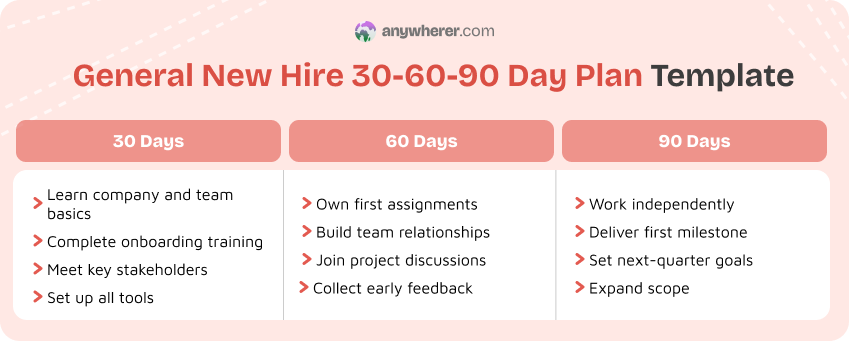
General New Hire 30-60-90 Day Plan
This plan works for any new hire regardless of role or department. It provides a universal framework for the first three months, covering orientation, integration, and independent contribution. Use it as a starting 30 60 90 day new hire plan template and adjust the specifics to match the role.
30 Days (Learning Phase):
- Learn the company’s mission, structure, and how your team fits into the broader organization
- Complete all required onboarding training and compliance sessions
- Meet key stakeholders, your direct manager, and cross-functional partners
- Set up tools, access systems, and get comfortable with communication norms
- Clarify role expectations and agree on initial priorities with your manager
60 Days (Contributing Phase):
- Take ownership of your first real assignments with light guidance
- Build working relationships with team members and adjacent teams
- Participate actively in team meetings, planning sessions, and project discussions
- Request feedback from your manager and peers on your early work
90 Days (Owning Phase):
- Handle core responsibilities independently with minimal support
- Deliver a meaningful piece of work or project milestone
- Set goals for the next quarter in collaboration with your manager
- Identify one area where you can contribute beyond your immediate scope
Success looks like: The new hire can explain their role clearly, has working relationships with key colleagues, delivers consistently on day-to-day tasks, and has agreed goals for the next quarter.
30-60-90 Day Onboarding Plan
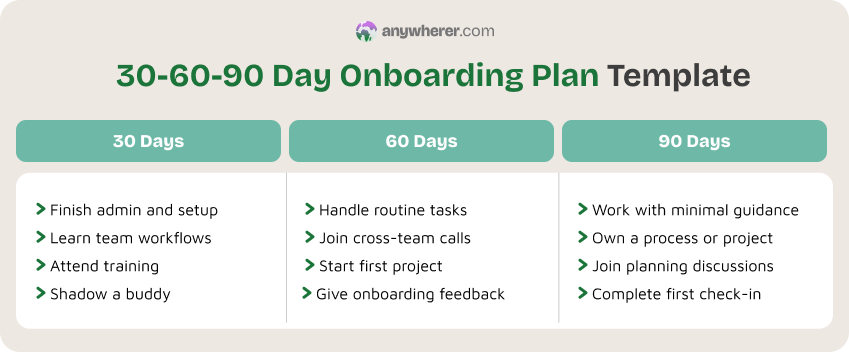
This is a practical 30-60-90 day onboarding plan example designed specifically around the onboarding experience. It ensures new employees complete each stage of their transition before moving to the next, with clear milestones at every checkpoint. It works well alongside a broader onboarding checklist for tracking admin and logistics.
30 Days (Learning Phase):
- Complete all administrative onboarding tasks: contracts, system access, equipment, policies
- Understand team workflows, tools, and how work is planned and reviewed
- Attend all scheduled training sessions and read core documentation
- Shadow a teammate or buddy on typical tasks to see how work flows in practice
60 Days (Contributing Phase):
- Handle routine tasks independently and contribute to ongoing projects
- Join cross-team meetings and build visibility beyond your immediate team
- Start your first independent project or deliverable
- Provide feedback on the onboarding experience to help improve it for future hires
90 Days (Owning Phase):
- Operate with minimal day-to-day guidance from your manager
- Own at least one process, project, or area of responsibility
- Participate in planning and contribute ideas during team discussions
- Complete a first informal performance check-in with your manager
Success looks like: All onboarding tasks are complete, the employee operates independently on routine work, and both the manager and the new hire agree on performance expectations going forward.
30-60-90 Day Plan for Leadership Position
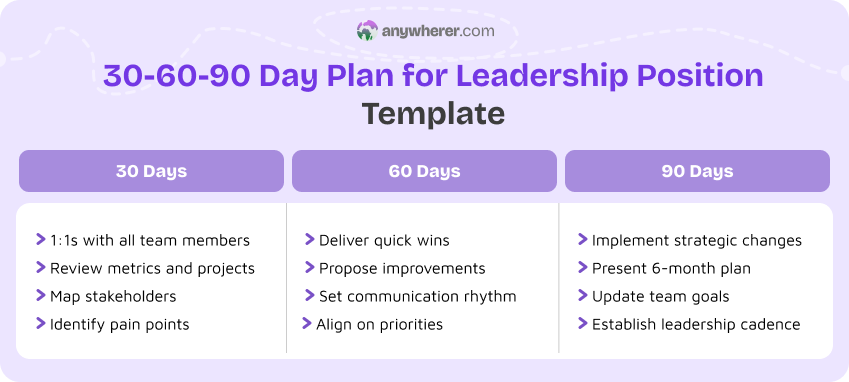
A 30-60-90 day plan for leadership position helps a new leader assess the current state, build trust with their team, and set direction without rushing into changes. The first three months are about understanding context, earning credibility, and laying the groundwork for longer-term impact.
30 Days (Learning Phase):
- Hold individual conversations with every team member to understand their work, concerns, and goals
- Review current team metrics, ongoing projects, and existing commitments
- Map key stakeholders across the organization and schedule introductory meetings
- Understand the team’s biggest pain points and any unresolved issues from the previous leader
60 Days (Contributing Phase):
- Identify two or three quick wins that address visible team pain points
- Propose initial process improvements based on what you learned in Month 1
- Establish a regular communication rhythm with your team and cross-functional partners
- Begin building alignment around priorities for the next quarter
90 Days (Owning Phase):
- Implement first strategic changes with team input and buy-in
- Present a clear 6-month plan to your leadership and stakeholders
- Align the team around updated goals and ways of working
- Establish your leadership cadence: regular 1:1s, team meetings, and cross-functional syncs
Success looks like: The team trusts the new leader, at least one visible improvement has been delivered, and there is an agreed plan for the next two quarters.
30-60-90 Day Plan for Executives
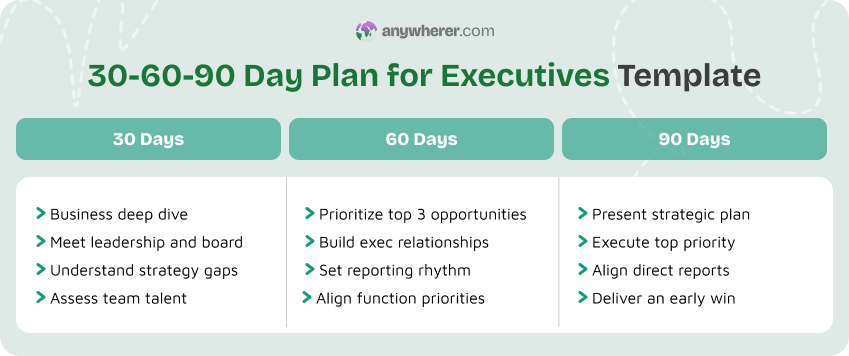
This sample 30 60 90 day plan for executives targets VP-level or C-suite hires who need to understand the business deeply before making significant decisions. The first 90 days focus on learning the landscape, building relationships with senior stakeholders, and identifying the highest-impact opportunities.
30 Days (Learning Phase):
- Conduct a deep dive into the business model, financial performance, and competitive landscape
- Meet every member of the leadership team and key board members or investors
- Understand the current strategy, its assumptions, and where execution gaps exist
- Review organizational structure and talent across your function
60 Days (Contributing Phase):
- Assess strategic gaps and prioritize the top three opportunities for your function
- Build executive relationships that extend beyond your direct team
- Establish a reporting rhythm with your direct reports and the CEO or board
- Start aligning your function around clear, measurable priorities
90 Days (Owning Phase):
- Present a strategic plan for your function to the leadership team
- Begin executing on the top priority with visible, early results
- Align your direct reports around updated goals and accountability
- Deliver at least one early win with measurable business impact
Success looks like: The executive has a clear strategic direction, buy-in from the leadership team, and at least one demonstrable early win that signals momentum.
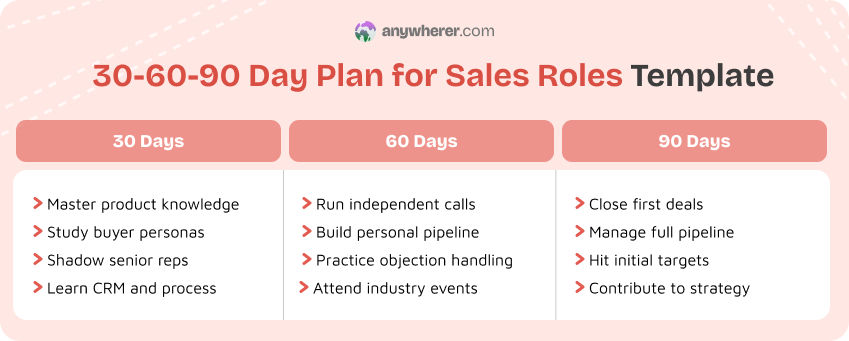
30-60-90 Day Plan for Sales Roles
A 30 60 90 day plan for sales is designed for new sales team members who need to learn the product, understand the buyer, and start building pipeline within their first quarter. The plan moves from product knowledge through practice to independent selling.
30 Days (Learning Phase):
- Learn the product or service inside and out: features, benefits, pricing, positioning
- Study buyer personas, ideal customer profiles, and the competitive landscape
- Shadow senior sales representatives on discovery calls, demos, and negotiations
- Review the CRM, sales process, and pipeline stages
60 Days (Contributing Phase):
- Run first discovery calls and demos independently with coaching support
- Build a personal pipeline from assigned leads or self-sourced prospects
- Practice objection handling through role plays and real conversations
- Attend at least one industry event, webinar, or customer meeting
90 Days (Owning Phase):
- Close first deals or bring opportunities to advanced pipeline stages
- Manage a full pipeline with consistent activity and follow-up
- Hit initial quota targets or demonstrate clear progress toward them
- Contribute to team strategy discussions with insights from your early customer interactions
Success looks like: The sales hire understands the product and market, has an active pipeline, and has closed or is close to closing their first deals.
30-60-90 Day Plan for Managers
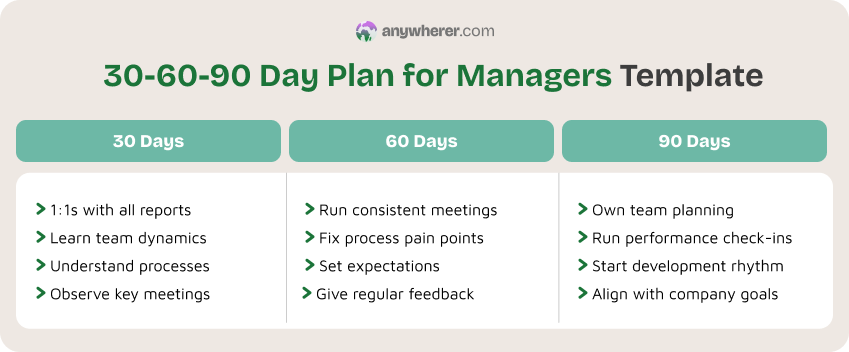
This plan is for newly hired or promoted people managers who need to build relationships with their team, learn how things work, and start leading effectively without disrupting what already works. The focus is on earning trust and establishing good management habits from the start.
30 Days (Learning Phase):
- Meet each direct report in a dedicated 1:1 to understand their role, work, and concerns
- Learn team dynamics, current projects, and how work is prioritized and reviewed
- Understand existing processes, tools, and any recent changes the team has been through
- Attend all key meetings to observe how decisions are made and who the key partners are
60 Days (Contributing Phase):
- Start running effective 1:1s and team meetings with a consistent agenda
- Address one or two process pain points the team has identified
- Set clear expectations for each direct report based on what you learned in Month 1
- Provide regular, specific feedback rather than waiting for formal review cycles
90 Days (Owning Phase):
- Own team planning, prioritization, and workload distribution
- Conduct first informal performance check-ins with each direct report
- Establish a development rhythm: recurring career conversations, skill-building opportunities
- Align team goals with department and company-level objectives
Success looks like: Team members feel supported and know what is expected of them, communication is clear and regular, and at least one process improvement has been implemented.
30-60-90 Day Plan for Technical Roles
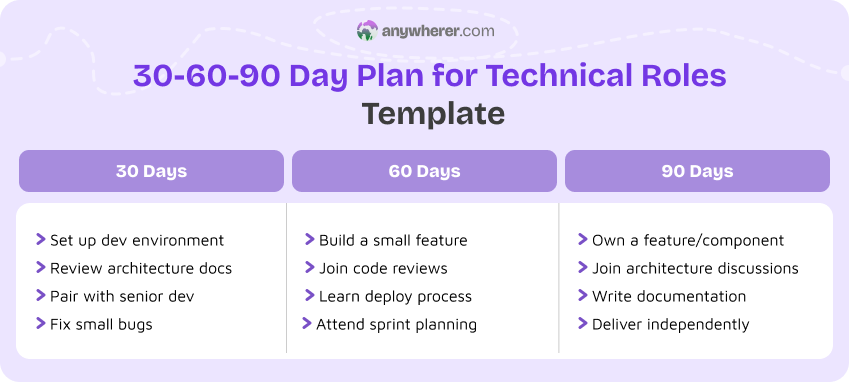
Technical hires, whether engineers, data scientists, or DevOps specialists, need time to understand architecture, codebases, and development practices before they can contribute safely. This plan balances structured ramp-up with early, low-risk contributions.
30 Days (Learning Phase):
- Set up your development environment, access all required repos and tools
- Review architecture documentation, system diagrams, and coding standards
- Pair with a senior teammate on routine tasks to learn the workflow
- Fix a few small bugs or issues to get familiar with the codebase and review process
60 Days (Contributing Phase):
- Take on a small feature or clearly scoped project with support
- Participate in code reviews, both giving and receiving feedback
- Learn the deployment, testing, and release processes end to end
- Attend sprint planning and retros to understand how the team plans and improves
90 Days (Owning Phase):
- Own a meaningful feature, component, or technical area
- Contribute to technical discussions, architecture decisions, and design reviews
- Write or update documentation for the work you have completed
- Deliver independently with quality that meets the team’s standards
Success looks like: The development environment is fully operational, the first feature has shipped, and the hire participates actively in technical discussions and code reviews.
30-60-90 Day Plan for Remote Employees
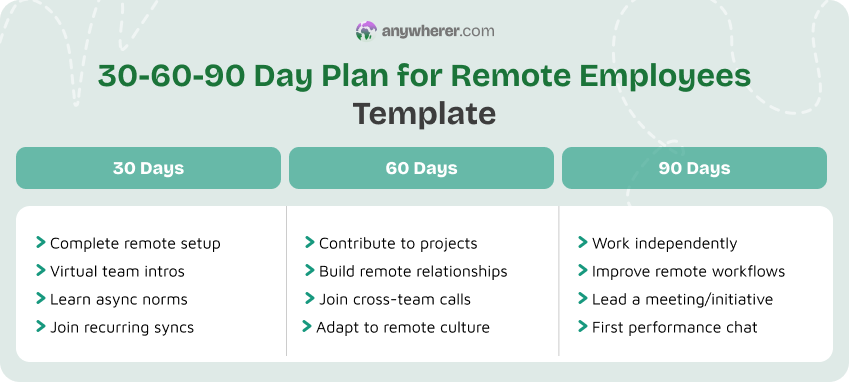
Remote employees face extra challenges around communication, visibility, and social integration. This plan addresses those gaps while following the same phased structure. It pairs well with a structured onboarding checklist that covers remote-specific logistics.
30 Days (Learning Phase):
- Complete all remote setup: hardware, VPN, communication tools, and access permissions
- Attend virtual introductions with your team, manager, and key cross-functional contacts
- Learn async communication norms: when to use chat, email, video, and documentation
- Join all recurring syncs and observe how the team collaborates across time zones
60 Days (Contributing Phase):
- Contribute to team projects and take on independent tasks
- Build async working relationships through regular, proactive communication
- Participate in cross-team discussions and company-wide meetings
- Get comfortable with remote tools, workflows, and cultural expectations
90 Days (Owning Phase):
- Work independently with minimal check-ins from your manager
- Propose improvements to remote workflows or collaboration practices
- Lead a meeting, initiative, or project component to build visibility
- Complete your first remote performance conversation with your manager
Success looks like: The remote employee is fully integrated into the team, communicates proactively, delivers consistent work without constant supervision, and feels connected to the broader organization.
What Makes a 30-60-90 Day Plan Effective
Not every 30-60-90 day plan delivers results. The difference usually comes down to how specific, realistic, and collaborative the plan is. Here are the elements that separate plans that work from plans that get filed and forgotten.
- Each phase has its own clear, measurable goals rather than one long list of tasks spread across 90 days.
- The plan is role-specific, not a generic template applied the same way to a sales hire and an engineer.
- Both the manager and the new hire review and agree on the plan before day one or within the first week.
- Regular check-ins are built in, not left to chance, so the plan stays a living document rather than a forgotten file.
- Expectations are realistic: the first 30 days focus on learning and orientation, not on delivering results under pressure.
Common Mistakes to Avoid
Even well-intentioned plans can fall short if they repeat common pitfalls. Here are four mistakes that undermine 30-60-90 day plans, and what to do differently.
Making the Plan Too Generic
A plan that could apply to anyone in any company does not help a specific person in a specific role. Generic goals like ‘learn the company’ or ‘build relationships’ lack direction. Effective plans name the exact tools, people, and deliverables that matter for that role. The more specific the plan, the more useful it becomes as a shared reference between the manager and the new hire.
Overloading the First 30 Days
It is tempting to front-load the plan with every possible task and meeting, but this creates overwhelm instead of confidence. The first 30 days should focus on learning and orientation, not performance. When new hires feel pressured to deliver results before they understand the basics, the plan works against its own purpose.
Skipping Regular Check-ins
A 30-60-90 day plan without scheduled check-ins is just a document. The plan should include specific dates or intervals for the manager and the employee to sit down, review progress, and adjust goals if needed. Without this feedback loop, small misunderstandings grow into larger problems, and the plan loses its value as a communication tool.
Treating the Plan as a One-Way Assignment
Plans that the manager writes alone and hands to the employee often miss the mark. The most effective 30-60-90 day plans are co-created. When the new hire has input into what they want to focus on and how they will measure progress, they are more likely to follow through and feel ownership of the process. Collaboration turns the plan from a directive into a shared agreement.
Final Thoughts
A 30-60-90 day plan does not need to be complicated. It needs three clear phases, realistic goals, regular check-ins, and a shared understanding between the manager and the new hire about what success looks like at each stage. The templates above give you a concrete starting point for different roles and situations.
The value of the plan is not in the document itself but in the conversation it creates. When both sides know what to expect and when to check in, the first 90 days become productive instead of uncertain. Use these as a free 30-60-90 day plan template library and adjust them to fit your company’s real roles, tools, and culture.
For more detailed onboarding support, including admin checklists and step-by-step templates for different seniority levels, see our onboarding plan template article with 15 ready-to-use examples.
FAQs on 30-60-90 Day Plans
What is a 30-60-90 day plan?
A 30-60-90 day plan is a structured document that outlines what a new hire or employee in a new role should focus on during their first 30, 60, and 90 days. Each phase has specific goals: learning in the first 30 days, contributing during days 31 to 60, and taking ownership from day 61 to 90. It gives both the employee and their manager a shared reference for tracking progress and adjusting priorities.
Who should create a 30-60-90 day plan?
Typically the hiring manager drafts the plan, sometimes with input from HR. In some organizations, the new hire creates a version during the interview process or shortly after starting. The most effective approach is collaborative: the manager outlines expectations and the employee fills in specific actions and goals, then both review and adjust together during regular check-ins.
What is the difference between a 30-60-90 day plan and an onboarding checklist?
An onboarding checklist covers discrete tasks that need to be completed, such as setting up accounts, signing documents, and completing required training. A 30-60-90 day plan focuses on development and outcomes over time: what the employee should understand, contribute, and own at each stage. The two complement each other. The checklist handles logistics, and the plan handles growth and performance.
Can a 30-60-90 day plan be used beyond onboarding?
Yes. While most commonly associated with new hires, 30-60-90 day plans also work well for internal role changes, promotions, new project launches, or any situation where someone needs to ramp up in a structured way. They are especially helpful when an employee moves into a new team, takes on a significantly different scope, or returns from an extended leave.
How detailed should each phase of the plan be?
Each phase should include 4 to 6 clear, actionable items. Avoid over-specifying every task. The plan should set direction without becoming a daily to-do list. The 30-day phase is usually the most detailed because everything is new. The 60- and 90-day phases can be broader, focusing on outcomes rather than exact steps, since priorities may shift as the person learns more.
How do you measure success at the end of 90 days?
Success should be defined at the start, not retroactively. Good measures include whether the employee can perform core tasks independently, feedback from their manager and peers, completion of agreed milestones, and the employee’s own sense of clarity and confidence. Avoid making 90-day evaluations a pass-fail checkpoint. Treat them as a structured conversation about progress and next steps.

Yaryna is our lead writer with over 8 years of experience in crafting clear, compelling, and insightful content. Specializing in global employment and EOR solutions, she simplifies complex concepts to help businesses expand their remote teams with confidence. With a strong background working alongside diverse product and software teams, Yaryna brings a tech-savvy perspective to her writing, delivering both in-depth analysis and valuable insights.