Introduction
Remote onboarding needs a different approach than in-office onboarding. Remote and hybrid work are now normal in many markets: one recent report found that about 32% of employees prefer to work fully remotely and 41% prefer a hybrid setup, while only 27% want to be in the office full-time. When people do not share a workspace, new hires miss casual “over the shoulder” help, quick questions at someone’s desk, and the chance to watch how things are done. If logins are delayed, equipment arrives late, or nobody explains how communication works across time zones and channels, remote employees can feel lost before they even start real work.
This is where a structured onboarding plan template makes a real difference. Research based on Brandon Hall Group’s work shows that organizations with strong onboarding can improve new-hire retention by around 80% and boost productivity by about 70%. At the same time, Gallup has repeatedly found that only about 12% of employees strongly agree their organization does a great job of onboarding, which shows a big gap between best practice and everyday reality.
In this article, you’ll get a step-by-step onboarding plan for new hire roles, broken into clear stages, plus practical onboarding plan templates you can plug into your own process. The content is written for HR teams, managers, founders, and anyone running growing or distributed teams. You can also connect these plans with your onboarding checklist template for admin tasks, and later with an offboarding checklist template, so the full employee journey feels planned instead of improvised.
Onboarding Plan Templates & Examples
Each onboarding plan template below follows the same idea: a clear timeframe, who it is for, what it focuses on, and how success is measured.
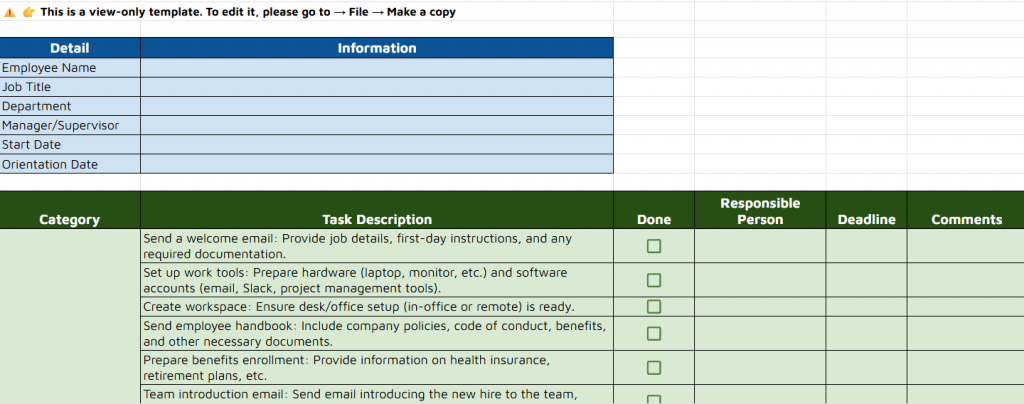
Explore our onboarding plan template in a spreadsheet format and streamline your onboarding process! Easily track and manage every step, from pre-arrival tasks to final check-ins.
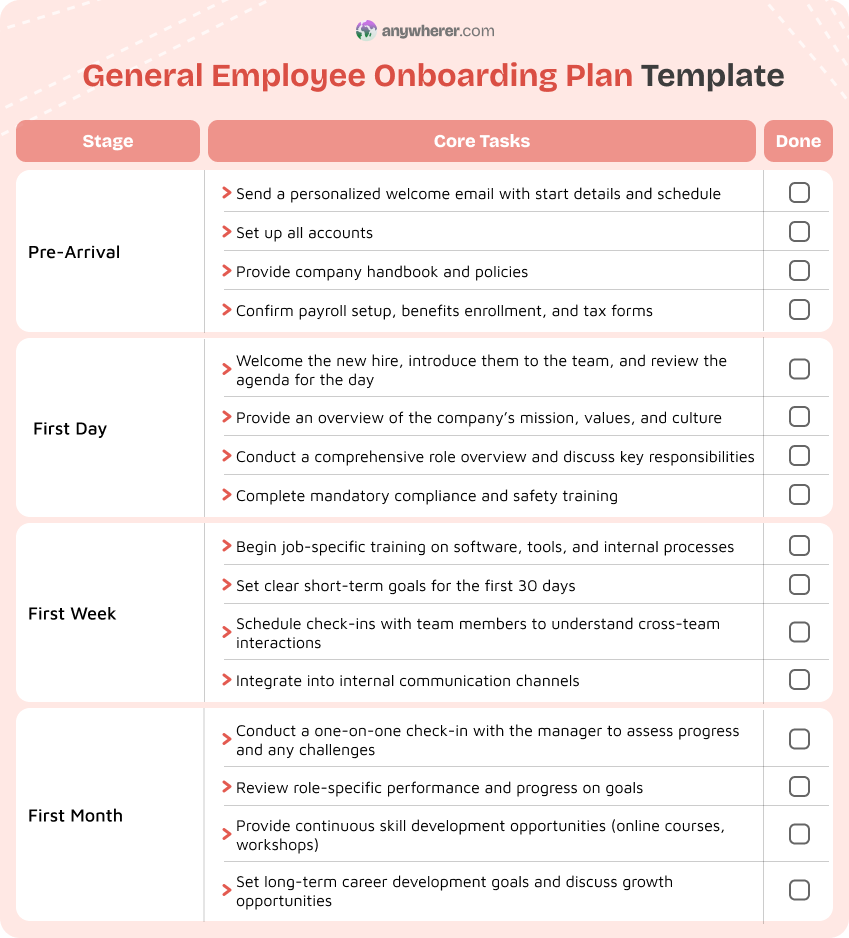
General Employee Onboarding Plan Template
This general example onboarding plan is best when you want one simple structure that works across most roles and departments. It fits companies that do not yet have many role-specific onboarding plans but still want new hires to have a consistent experience. The main focus is on giving every new employee a clear path through their first 30, 60, and 90 days, with enough time for learning, meeting people, and starting real work.
The typical timeframe is 90 days, broken into milestones at 30, 60, and 90 days. Key priorities are understanding the company, learning core tools and processes, and delivering first results without feeling overwhelmed. Success is usually measured by whether new hires can explain their role clearly, complete their first projects by the 90-day mark, and report feeling supported and confident in pulse surveys or manager feedback.
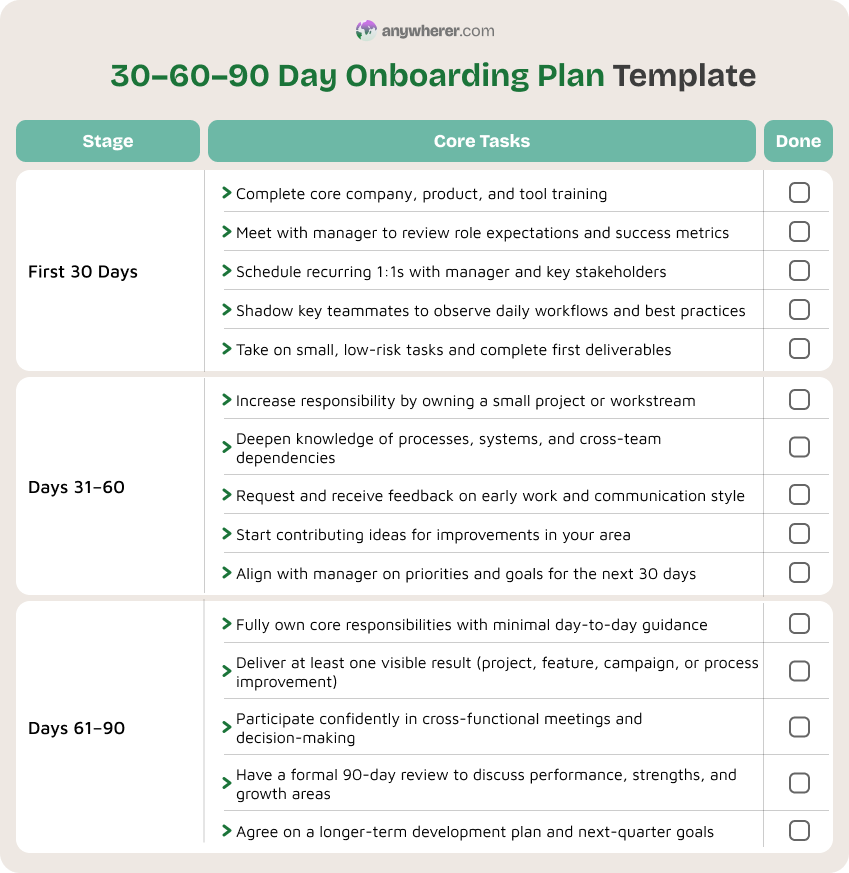
30–60–90 Day Onboarding Plan Template
This 30-60-90 onboarding plan template is best used when you want a very clear structure for the first three months, often for roles with measurable goals. It is designed for most professional roles, from individual contributors to managers, where you can define learning and delivery targets in each phase. The main focus is on moving from “learn” to “do” to “own” in a predictable way.
The plan covers 90 days in three blocks: a 30-day onboarding plan template phase focused on learning and observation, days 30–60 focused on doing work with support, and days 60–90 focused on more independent ownership and improvement. Key priorities include building relationships, learning systems, and delivering meaningful work by the end of the period. Success is usually measured by meeting agreed 30–60–90 day goals, manager feedback, and early performance indicators like quality of work and reliability.
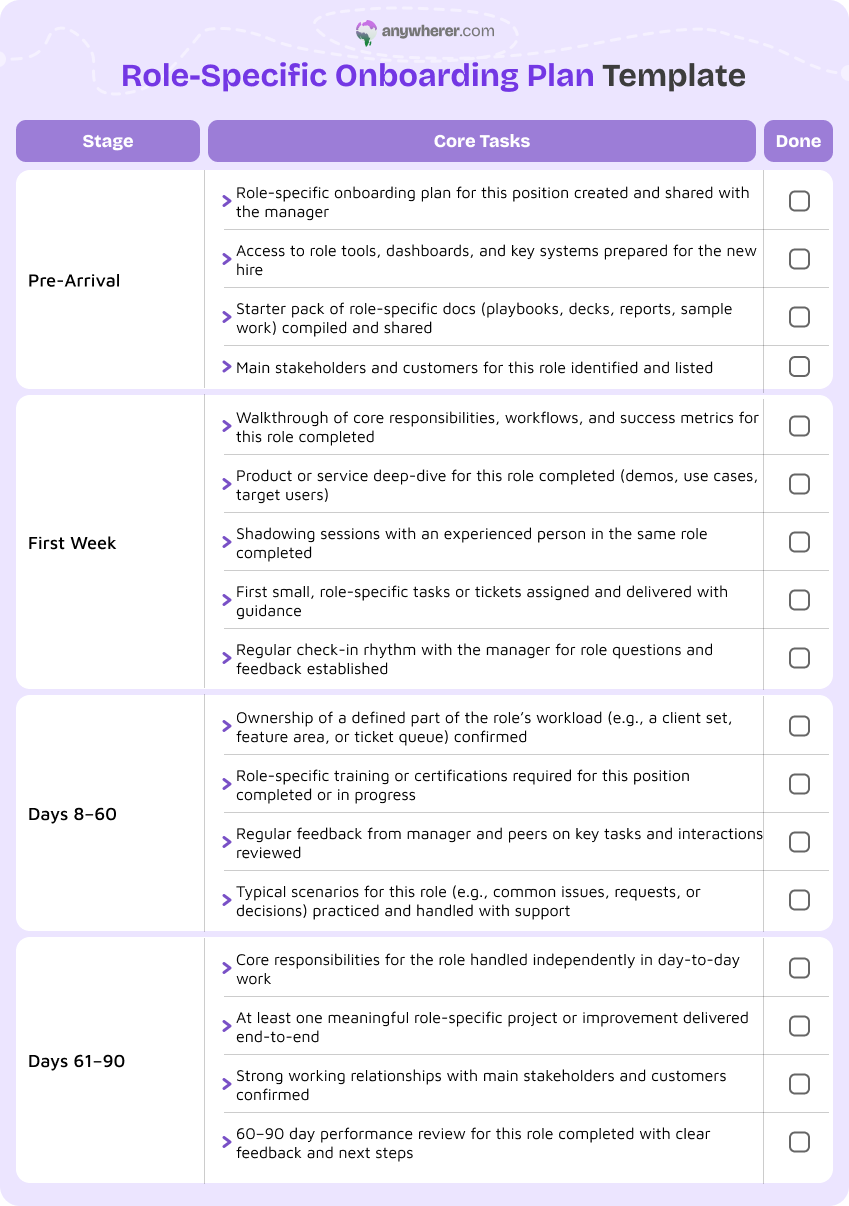
Role-Specific Onboarding Plan Template
A role-specific onboarding plan template is best when you have well-defined roles (such as product manager, customer success manager, or data analyst) and want an onboarding plan new employee version that reflects the actual work. It is designed for repeat roles where you hire for the same job often enough to justify a tailored plan. The main focus is on role mastery rather than generic company knowledge.
The timeframe is usually the first 60–90 days, with clear checkpoints where the new hire should understand the product, tools, workflows, and success measures for that role. Key goals include being able to perform the main tasks of the job with minimal supervision, understanding the customers or stakeholders, and fitting into the team rhythm. Success is measured by role-specific KPIs, manager and peer feedback, and the new hire’s ability to handle typical scenarios in their position.
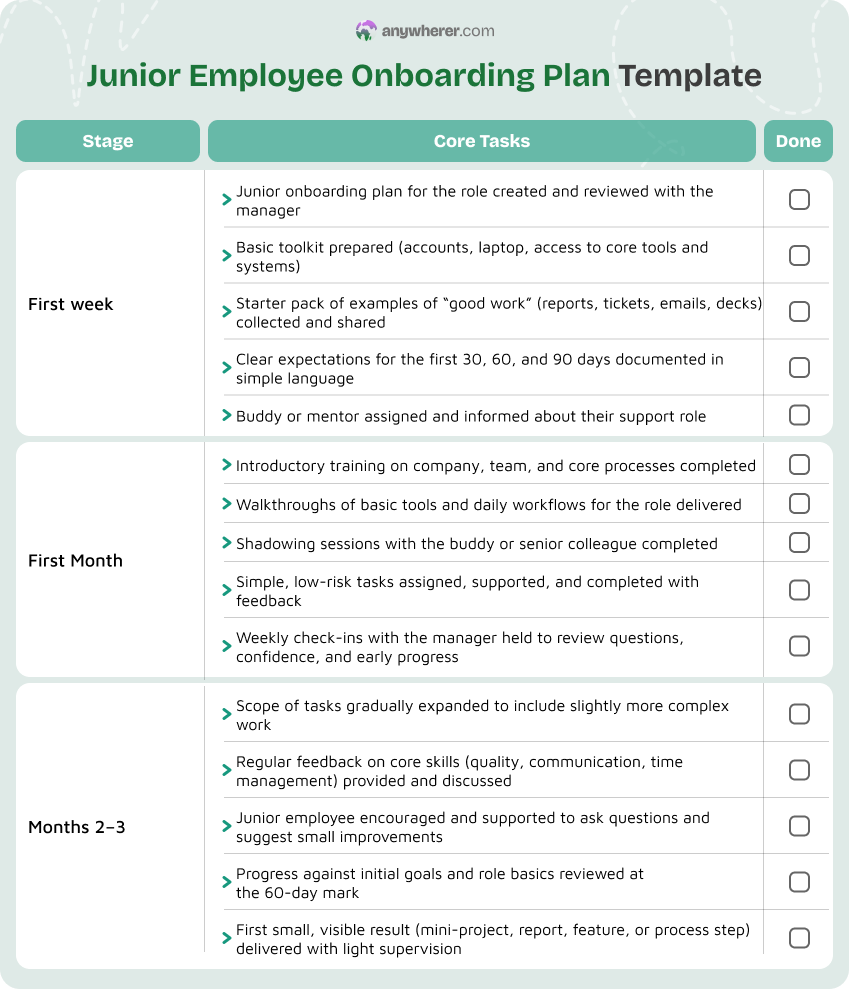
Junior Employee Onboarding Plan Template
This sample onboarding plan for new employees is best for junior or early-career hires, such as first-year analysts, assistants, or interns moving into full-time roles. It is designed for people who may be new to the industry or type of work. The main focus is on building foundational skills, confidence, and good habits rather than expecting high output on day one.
The typical timeframe is 90 days or even 6 months, depending on the complexity of the role. Key priorities include basic tool and process training, clear examples of good work, frequent feedback, and gradual expansion of responsibilities. Success is measured by the junior employee’s ability to complete simple tasks reliably, ask good questions, and show progress in core skills and behaviour over the onboarding period.
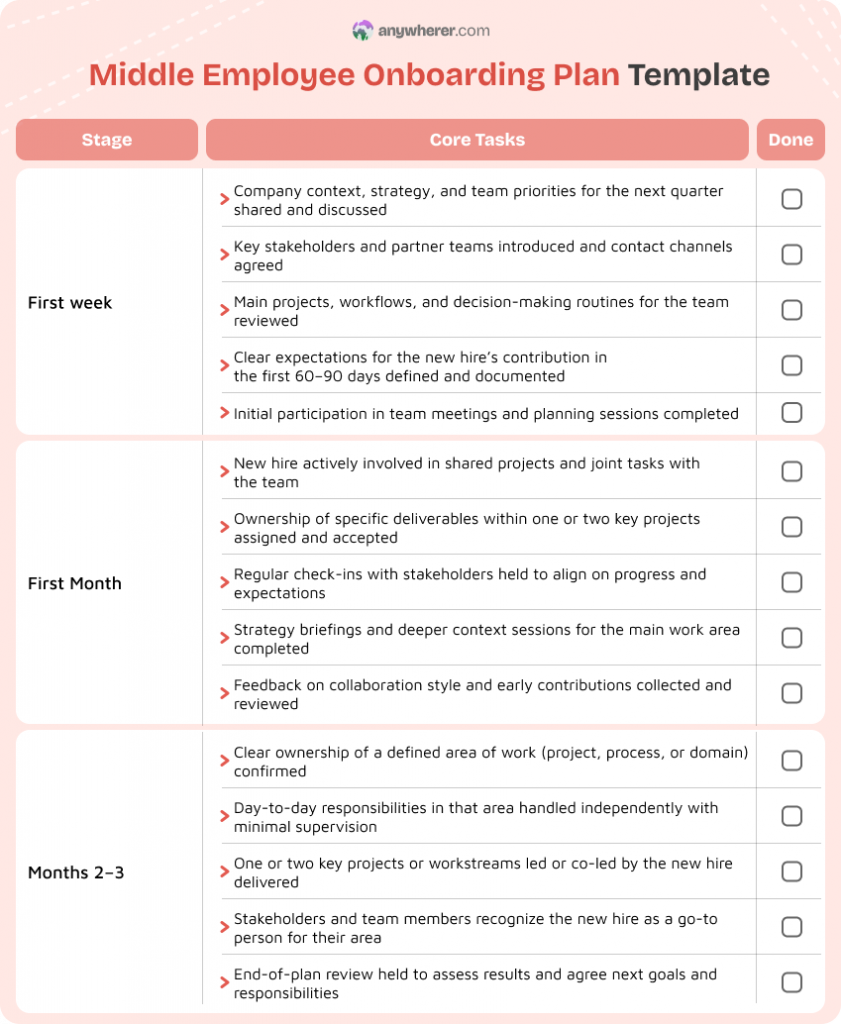
Middle Employee Onboarding Plan Template
This plan is intended for mid-level hires, such as experienced specialists, senior individual contributors, or team-level owners. It is best used when someone joins with solid experience but still needs time to learn your systems and context. The main focus is on combining quick integration with a clear path to independent impact.
The timeframe is usually 60–90 days. Key goals include understanding strategy and priorities, building relationships with key peers, and taking ownership of a meaningful part of the workload by the end of the period. Success is measured by the new hire contributing independently to projects, aligning with team norms, and demonstrating judgment that matches their level of seniority.
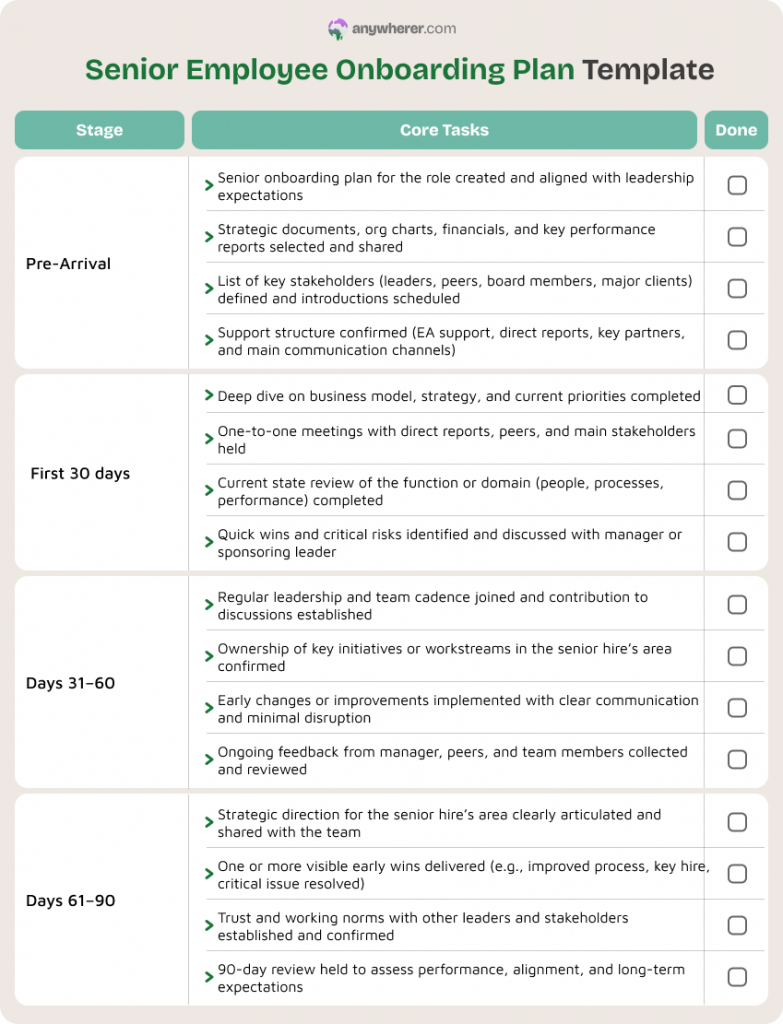
Senior Employee Onboarding Plan Template
This onboarding plan for new employees at senior level is best for roles like senior managers, principal specialists, or directors. It is designed for people who will shape direction, not just follow it. The main focus is on deep context, relationships with senior stakeholders, and early strategic wins.
The plan often runs over 90 days with a clear 30–60–90 structure. Key priorities are understanding the business model and strategy, mapping key stakeholders, and identifying early opportunities to improve or simplify things. Success is measured by the senior hire’s ability to articulate a realistic plan for their area, earn trust from other leaders, and deliver some visible early wins without disrupting what already works.
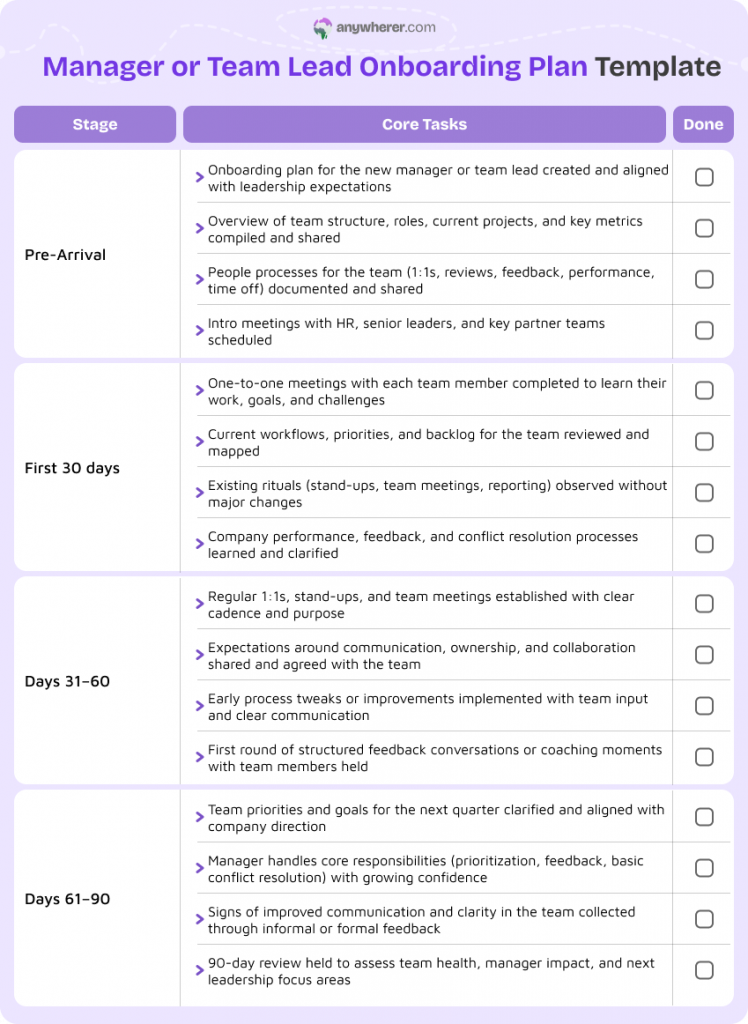
Manager or Team Lead Onboarding Plan Template
This onboarding plan template is best for new managers or team leads who will be responsible for people, not only tasks. It is designed for first-time managers or experienced leaders who are new to your company. The main focus is on understanding the team, learning people processes, and setting up healthy ways of working.
The timeframe is typically 60–90 days. Key goals include getting to know each team member, understanding current workloads and issues, learning your performance and feedback processes, and setting initial expectations and rhythms (such as stand-ups and 1:1s). Success is measured by improved clarity in the team, early feedback that communication feels good, and the manager’s ability to handle core responsibilities like prioritization, feedback, and basic conflict resolution.
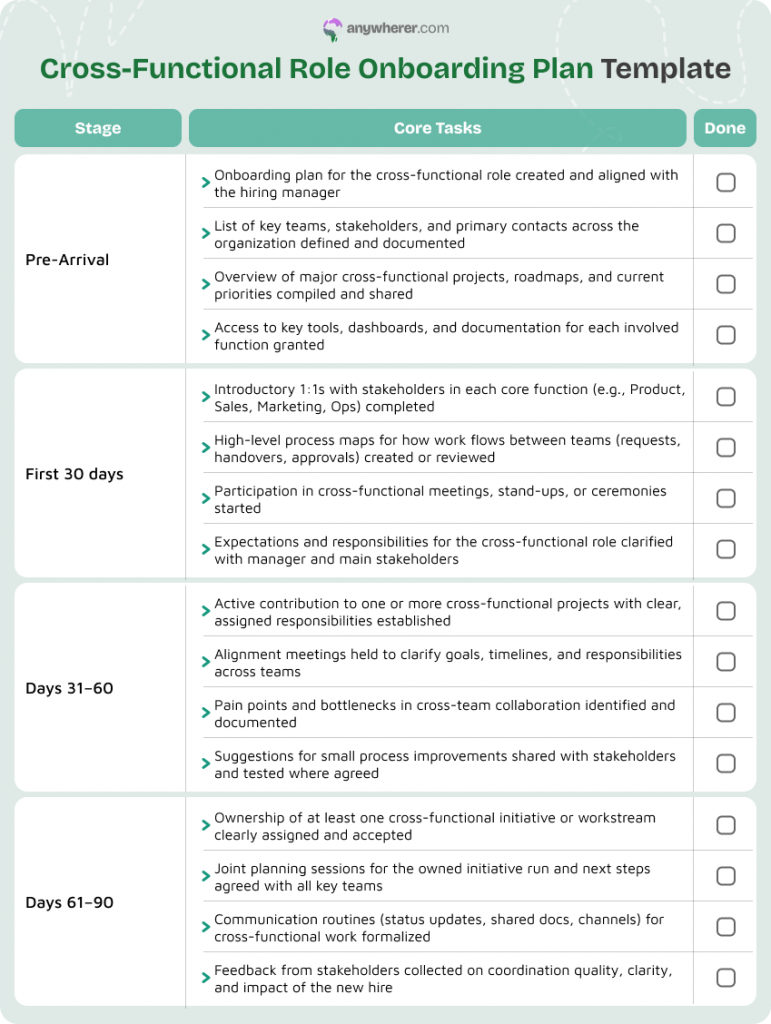
Cross-Functional Role Onboarding Plan Template
This plan is designed for roles that work across multiple teams, such as project managers, product managers, or internal consultants. It is best used when success depends on aligning different departments rather than operating only inside one. The main focus is on mapping stakeholders, aligning expectations, and learning how work flows across the organization.
The typical timeframe is 60–90 days. Key priorities include meeting key stakeholders in each function, understanding cross-team processes, and taking ownership of at least one cross-functional initiative. Success is measured by smooth coordination between teams, fewer misunderstandings, and clear progress on shared projects led or supported by the new hire.
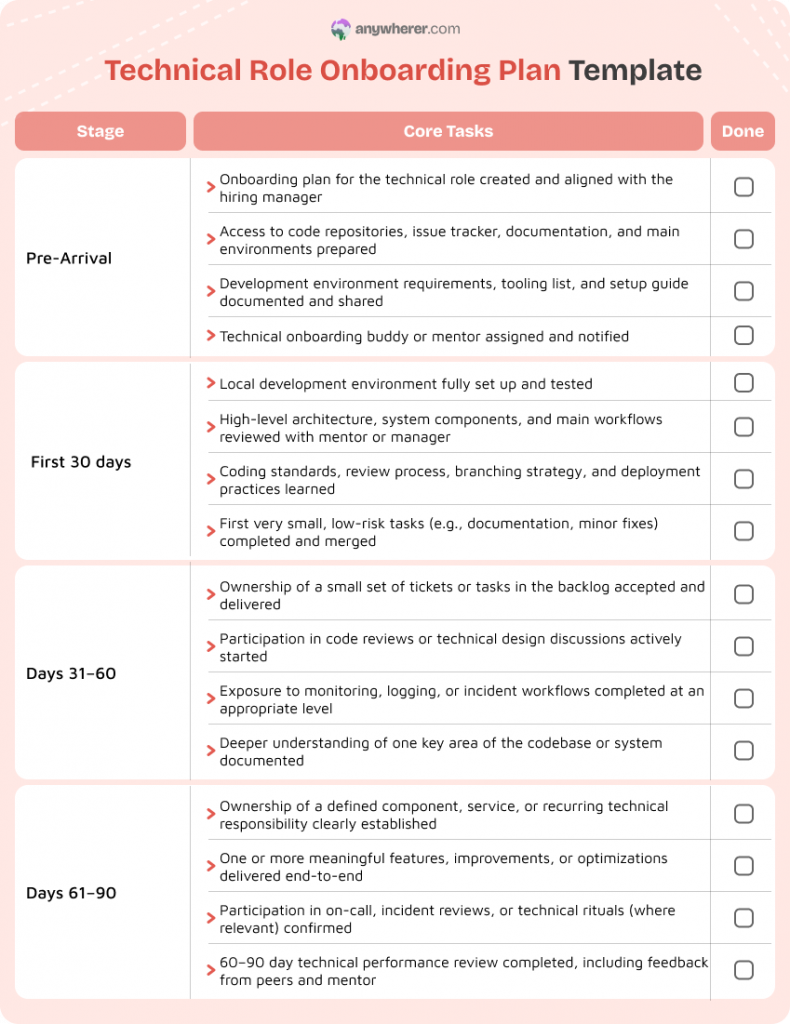
Technical Role Onboarding Plan Template
This employee onboarding training plan is best for technical roles such as engineers, data scientists, or DevOps specialists. It is designed for people who must learn complex systems, codebases, or technical environments. The main focus is on tool access, code or system understanding, and safe, gradual exposure to production work.
The timeframe is usually 60–90 days, depending on system complexity. Key goals include setting up the development environment, understanding architecture and standards, and shipping the first small changes or technical deliverables. Success is measured by the new hire’s ability to contribute code or configuration safely, follow technical guidelines, and participate in reviews or incident handling at the appropriate level.
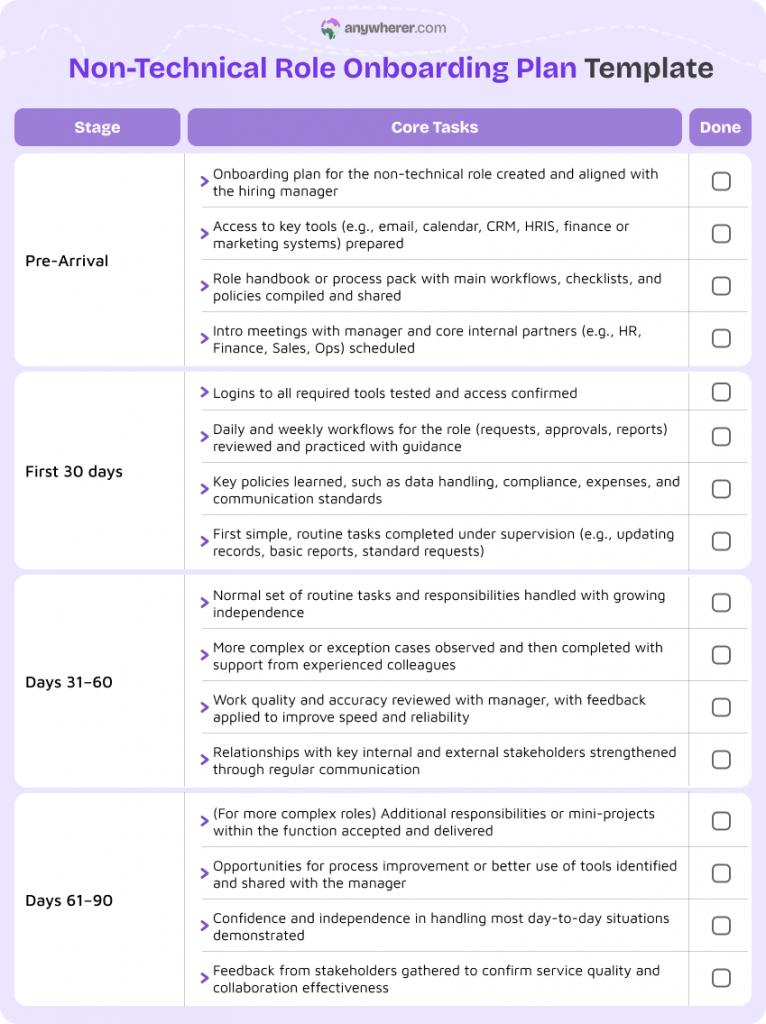
Non-Technical Role Onboarding Plan Template
This plan fits non-technical roles such as HR, finance, marketing, or sales support. It is best used when the role is process-heavy but not focused on code or infrastructure. The main focus is on tools, policies, workflows, and communication with internal and external stakeholders.
The timeframe is often 60 days, sometimes extended to 90 for more complex roles. Key priorities include understanding daily workflows, learning the main tools (for example CRM, HRIS, finance systems), and handling routine tasks with confidence. Success is measured by accuracy in core tasks, timely completion of work, and positive feedback from the people they support.
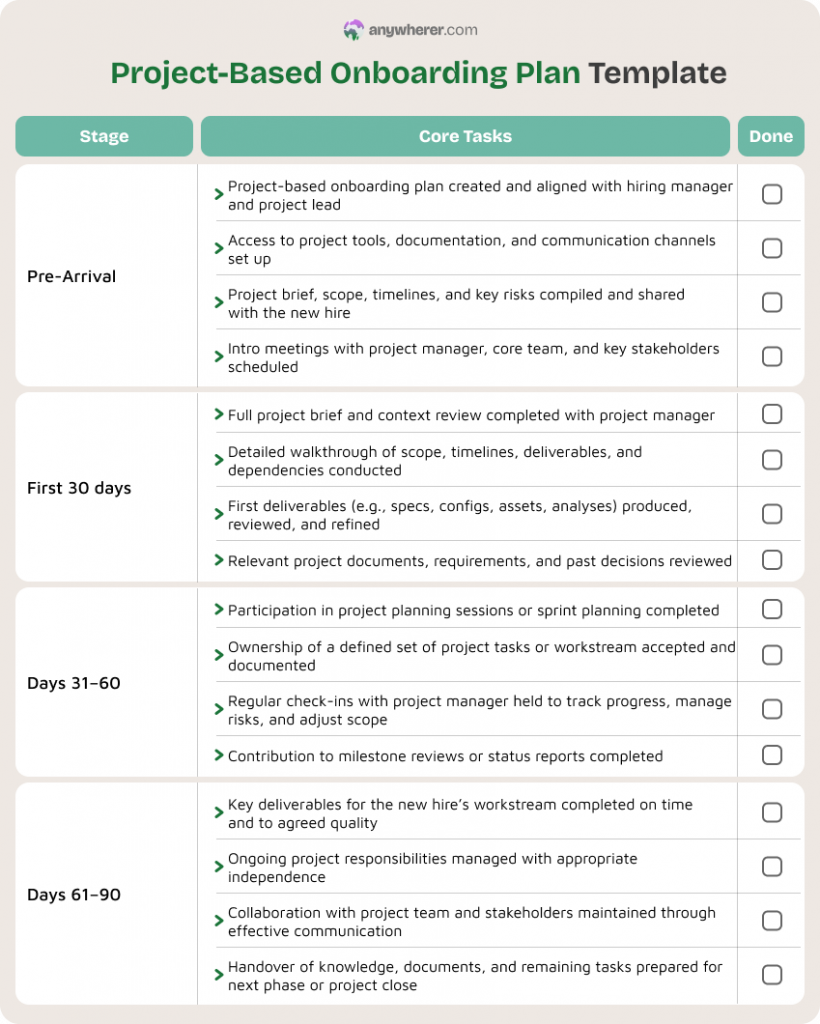
Project-Based Onboarding Plan Template
This sample onboarding plan is for new hires brought in mainly to work on a specific project or client, such as a large implementation or a time-bound initiative. It is best used when success is tied to one clear delivery rather than ongoing BAU work. The main focus is on project context, scope, and timelines.
The timeframe usually matches the project phases, with the first 30–60 days focused on getting the new hire fully ready to deliver their part. Key goals include understanding project goals, stakeholders, and risks, and being able to contribute effectively in planning and execution. Success is measured by the new hire’s impact on project milestones, quality of their deliverables, and feedback from the project team or client.
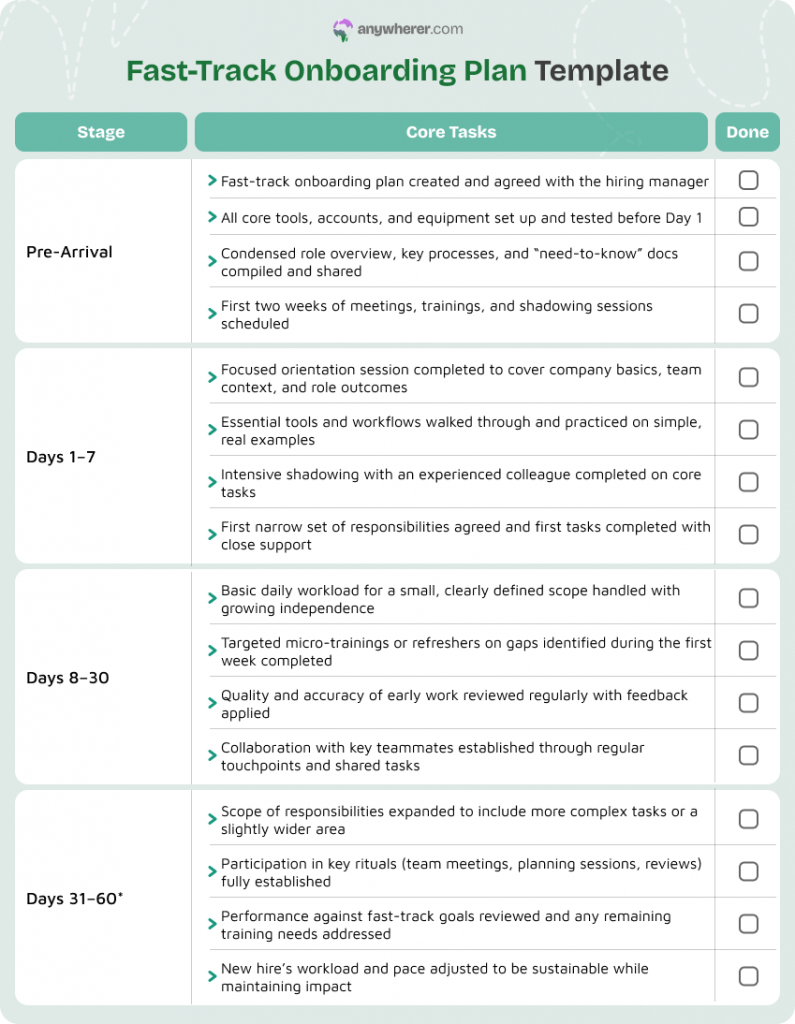
Fast-Track Onboarding Plan Template
A fast-track onboarding plan for new hires is best when you must ramp someone up quickly, for example during peak season, after a sudden departure, or in a fast-moving startup. It is designed for cases where you cannot wait a full 90 days before seeing impact. The main focus is on delivering value early while still covering essentials.
The timeframe is usually 30–60 days. Key priorities include compressing training into focused blocks, using more shadowing and pairing, and giving the new hire clear, narrow responsibilities at first. Success is measured by the speed at which the person can handle a basic workload safely, early output quality, and their own sense of clarity and support despite the faster pace.
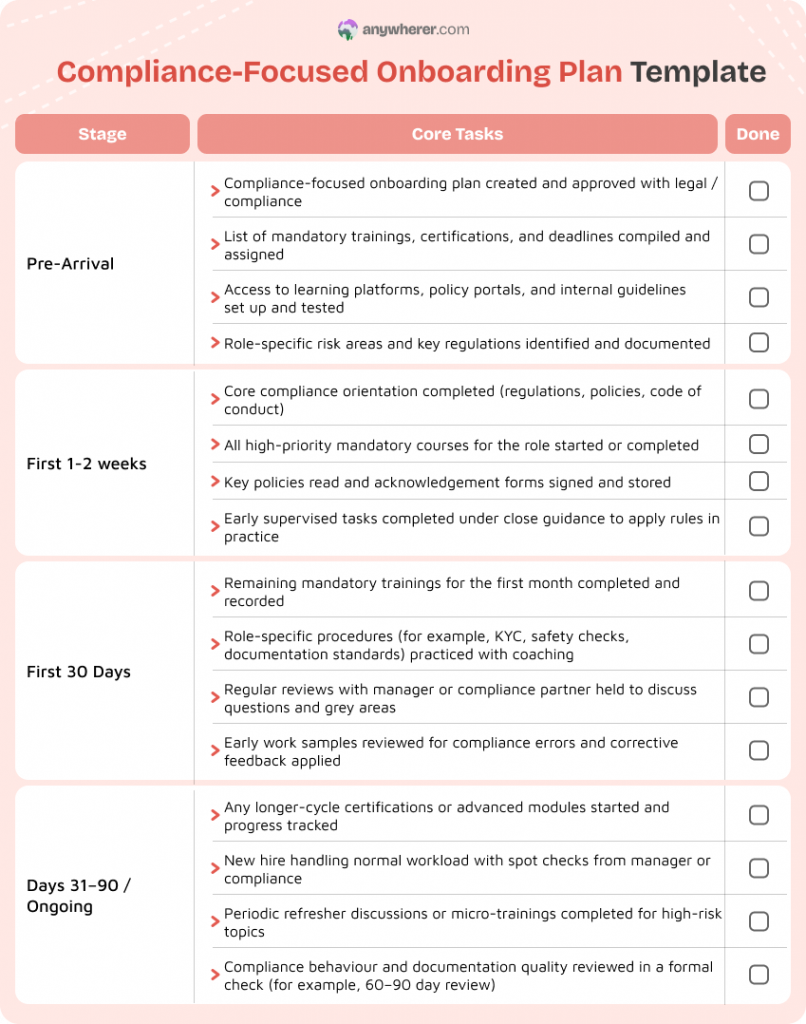
Compliance-Focused Onboarding Plan Template
This plan is designed for roles in regulated environments (such as finance, healthcare, legal, or safety-sensitive operations) where compliance is critical. It is best used when there are many mandatory trainings, certifications, or policy requirements. The main focus is on risk management and correct behaviour from day one.
The timeframe is typically the first 30–90 days, with some training recurring later. Key goals include completion of required training, understanding of key policies, and demonstration of compliant behaviour in daily work. Success is measured by training completion rates, quiz or assessment scores, manager observations, and the absence of early compliance issues.
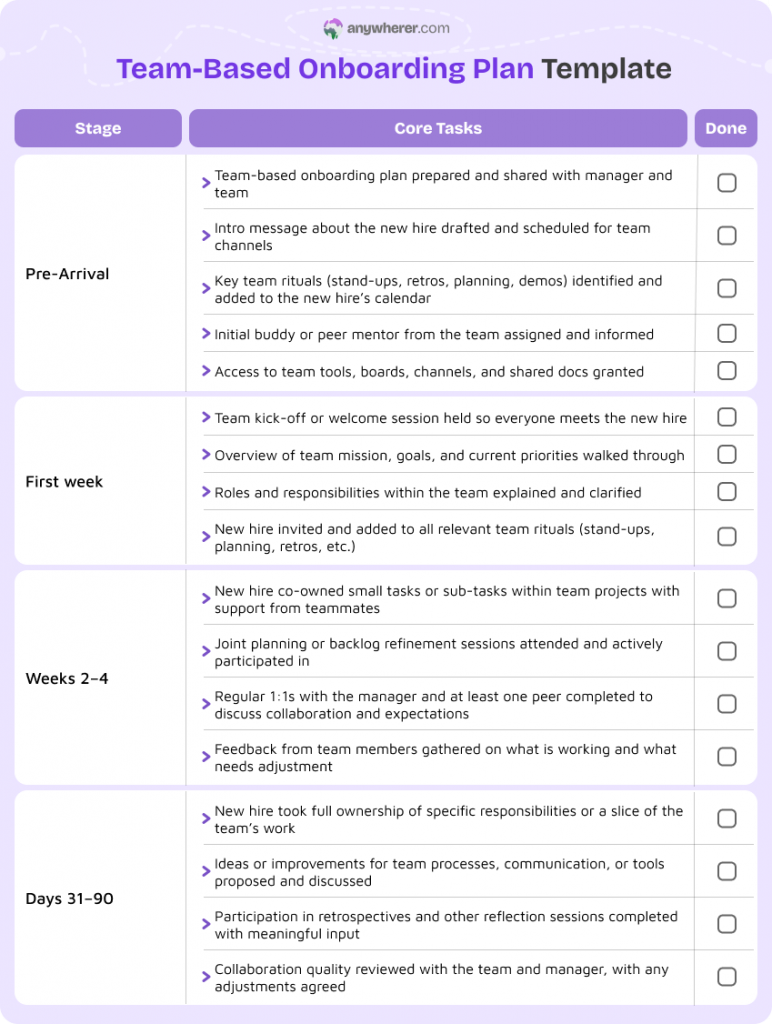
Team-Based Onboarding Plan Template
This onboarding communication plan style template is best when a new hire joins a team where collaboration is critical, such as product squads, service teams, or cross-functional pods. It is designed for situations where relationships and ways of working matter as much as individual skills. The main focus is on integrating into the team, not only learning tasks.
The timeframe is usually 60–90 days. Key priorities include team introductions, shared planning sessions, clarity on roles within the team, and a few joint wins early on. Success is measured by how well the new hire is included in team rituals, feedback from teammates on collaboration, and visible contribution to shared outcomes.
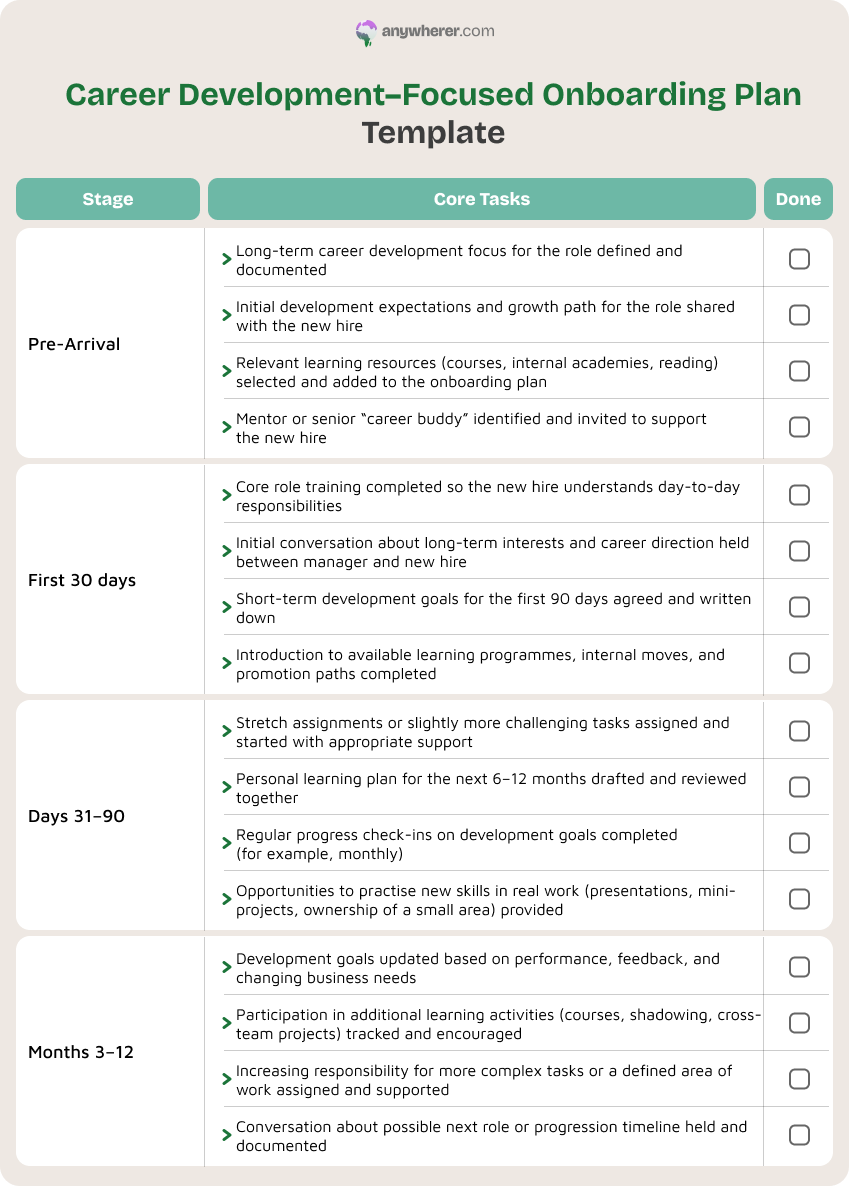
Career Development–Focused Onboarding Plan Template
This employee onboarding plan template is best when you want onboarding to connect directly to long-term career growth, for example in graduate programs or roles with clear progression paths. It is designed for people you hope to keep and grow over several years. The main focus is on development goals, not just initial performance.
The timeframe can extend beyond 90 days, often covering the first 6–12 months with more detail in the first 90 days. Key goals include setting early development objectives, mapping possible next steps, and exposing the new hire to learning opportunities beyond their current role. Success is measured by progress on development goals, engagement with training and mentoring, and signs that the person sees a future in the company.
Conclusion
These plans are not just paperwork. A clear structure gives new joiners a sense of direction from the first day and helps them understand what to learn, who to talk to, and how their work will matter over time. Instead of guessing, they can see how their first weeks and months are supposed to unfold.
If you are wondering how to build an onboarding plan for a new hire, the core idea is simple: decide what they should understand, who they should meet, and what they should deliver at each stage, then write it down in a way both sides can see. Use the ideas in this article as a base, then adjust them to match your roles, levels, and ways of working. The more closely they reflect real life in your company, the more useful they become. Over time, you can apply the same kind of structure to the whole employee journey, so joining, growing, and eventually leaving your organization all feel organized, fair, and respectful.
FAQs on Onboarding Plan Templates
What is an onboarding plan template?
An onboarding plan template is a reusable outline that describes what a new hire should learn and deliver over a set period, usually the first 30–90 days. It includes goals, activities, and check-ins and can be adapted into a new employee onboarding plan example for each role.
How is an onboarding plan different from an onboarding checklist?
An onboarding plan focuses on outcomes and development over time: what the person should understand, who they should know, and what they should be able to do. A checklist focuses on discrete tasks like setting up accounts or signing documents. Both are useful, but the plan guides ramp-up, while the checklist ensures nothing basic is missed.
How long should an onboarding plan last?
Most onboarding plans last at least 30–90 days. Some roles, especially junior or complex ones, benefit from a longer structure such as a 90 day onboarding plan or even a 6–12 month development view. Shorter plans can still work when combined with a clear 30 day onboarding plan template and ongoing support.
Who is responsible for creating onboarding plans?
Usually the hiring manager owns the onboarding plan for new hire and works with HR or People teams to align it with company standards. In some organizations, HR provides a central employee onboarding plan template and managers adapt it for their roles and teams.
Are onboarding plans necessary for every new hire?
They are strongly recommended for most professional roles. Even a lightweight onboarding plan sample makes it easier for new people to understand what success looks like. For very short-term or casual roles, a smaller plan and a simple checklist might be enough, but a clear onboarding plan for new employees still reduces confusion.
How can onboarding plans be adapted for different roles?
You can start from a general new hire onboarding plan template and then adjust the timeframe, goals, and activities based on role type and seniority. For example, a sales onboarding plan template might include more product and pitch practice, while a technical plan focuses on code and systems. Over time you will build a library of onboarding plan examples that match your main job families.

Yaryna is our lead writer with over 8 years of experience in crafting clear, compelling, and insightful content. Specializing in global employment and EOR solutions, she simplifies complex concepts to help businesses expand their remote teams with confidence. With a strong background working alongside diverse product and software teams, Yaryna brings a tech-savvy perspective to her writing, delivering both in-depth analysis and valuable insights.