A Professional Employer Organization (PEO) becomes a co-employer of your staff. It pays them under its own tax accounts and covers them on its insurance and benefit plans. It also takes on HR paperwork, while you keep running the work. The model fits a state of small firms: Wisconsin has 497,370 small businesses employing about 1.2 million people. Few of them can buy benefits at large-group prices on their own.
3 state rules shape the decision. Workers’ comp becomes mandatory the day you employ a third person, or once anyone earns $500 in a calendar quarter. A 2025 law reshaped the income tax brackets, and health coverage costs more for a small group. Wisconsin also registers co-employers, which gives anyone comparing PEO Wisconsin options a first check before signing.
Wisconsin PEO: Why Small Businesses Use One
Wisconsin taxes wages at 4 progressive rates from 3.5% to 7.65%. 2025 Wisconsin Act 15 widened the 4.4% bracket, so more income now falls in the lower band, and the thresholds move with inflation. Employers withhold with the state formula and Form WT-4, the employee’s state withholding certificate; a federal W-4 cannot replace it. There is no city income tax. Pay rules are simple too: the minimum wage matches the federal $7.25, and no statewide paid sick leave law applies. Wisconsin payroll services still earn their fee by applying indexed brackets, formula withholding and state deadlines correctly every cycle.

INSIGHT: What does Wisconsin payroll include?

There is one state income tax layer and no city taxes, so the state pieces are withholding, unemployment insurance and workers’ comp.
- State income tax: 4 rates from 3.5% to 7.65% (2025 rate schedule).
- 2025 Wisconsin Act 15: the 4.4% bracket now ends at $50,480 for single filers.
- Unemployment insurance (UI): charged on the first $14,000 of each worker’s wages (2026).
- Minimum wage: $7.25 an hour, unchanged since July 24, 2009.
Sources:
as of October 2026
The employer funds state UI alone, administered by DWD. The tax applies to the first $14,000 of each employee’s wages. New employers pay 3.05% on payroll under $500,000 and 3.25% above it, and 2026 experience rates run from 0% to 12%. Wage reports go to DWD every quarter, and the state deposits withholding on a set schedule and reconciles it each year. New hires are reported within 20 days. On top of that sit the federal payroll taxes for Social Security, Medicare, and unemployment (FICA and FUTA). Firms that sell payroll services, including Wisconsin ones, keep that calendar for you.
2 needs push owners from a payroll vendor to a co-employer. The first is injury coverage. Under DWD’s rules, a policy is due once a third person joins, or once 1 employee earns $500 in a quarter. A PEO can cover your team under its own program. The second is benefits. Below 50 full-time equivalents, no law requires health, dental, vision, or 401(k) plans, but candidates ask about them first. PEO services in Wisconsin pool small employers so those plans become affordable.
INSIGHT: Which insurance and benefits does a Wisconsin employer have to provide?
Injury coverage is the only state mandate, and it applies even at very small headcounts. Health and retirement plans are optional for small firms but shape hiring, which is where pooling helps.
- Workers’ comp: required at 3 employees, or $500 in quarterly wages to anyone (2026).
- State paid sick leave or family leave insurance: none in Wisconsin (2026).
- Wisconsin Family and Medical Leave Act (FMLA): employers with 50 or more employees.
- Affordable Care Act (ACA) employer mandate: 50 or more full-time equivalents.
Owners usually weigh 3 setups. A PEO in Wisconsin shares employer status with you, packaging payroll, benefits, workers’ comp and HR, yet you still run each day. Payroll vendors stop at wages and tax returns, and HR outsourcing adds advice without any shared employer status. For the mechanics of co-employment, see my explainer on what a PEO is. Before signing, confirm the firm is registered with the Department of Financial Institutions (DFI). A registrant renews by July 31 each year and must hold $100,000 in net working capital or post a bond.
Federal certification is a separate check. Certified PEOs (CPEOs) appear on a public IRS roster, and each one assumes federal employment tax liability for the wages it pays. My shortlist covers 15 providers for owners who already employ people here: 5 Wisconsin firms and 10 national PEOs active in the state. For a wider national comparison, my ranking of the best PEO companies is a useful second stop.
Top 15 PEO Companies in Wisconsin
Start with the kind of help you need. Some owners need benefits and workers’ comp wrapped into payroll, others only want pay runs and filings, and some just want HR advice. Then count heads, because workers’ comp starts at 3 employees, and the state FMLA and the federal health mandate start at 50.
Local or national is the last fork. A Madison or Wauwatosa firm may answer the phone in your time zone with state rules in mind. A national PEO brings a larger benefits program. Neither is right for every team, so the choice rests on trade, headcount and how much admin you want gone.
I checked every provider against the same points. They include DFI registration, accurate WT-4 withholding and DWD filings, and the workers’ comp model. I also compared the cost and quality of health and 401(k) plans. HR support and handbook help counted too, along with CPEO status or accreditation where claimed, and how clearly pricing is explained.
All 15 providers appear in A-to-Z order. The sequence says nothing about quality, preference, or ranking.
ADP TotalSource
Provider Type:
National US PEO serving Wisconsin
Company Description:
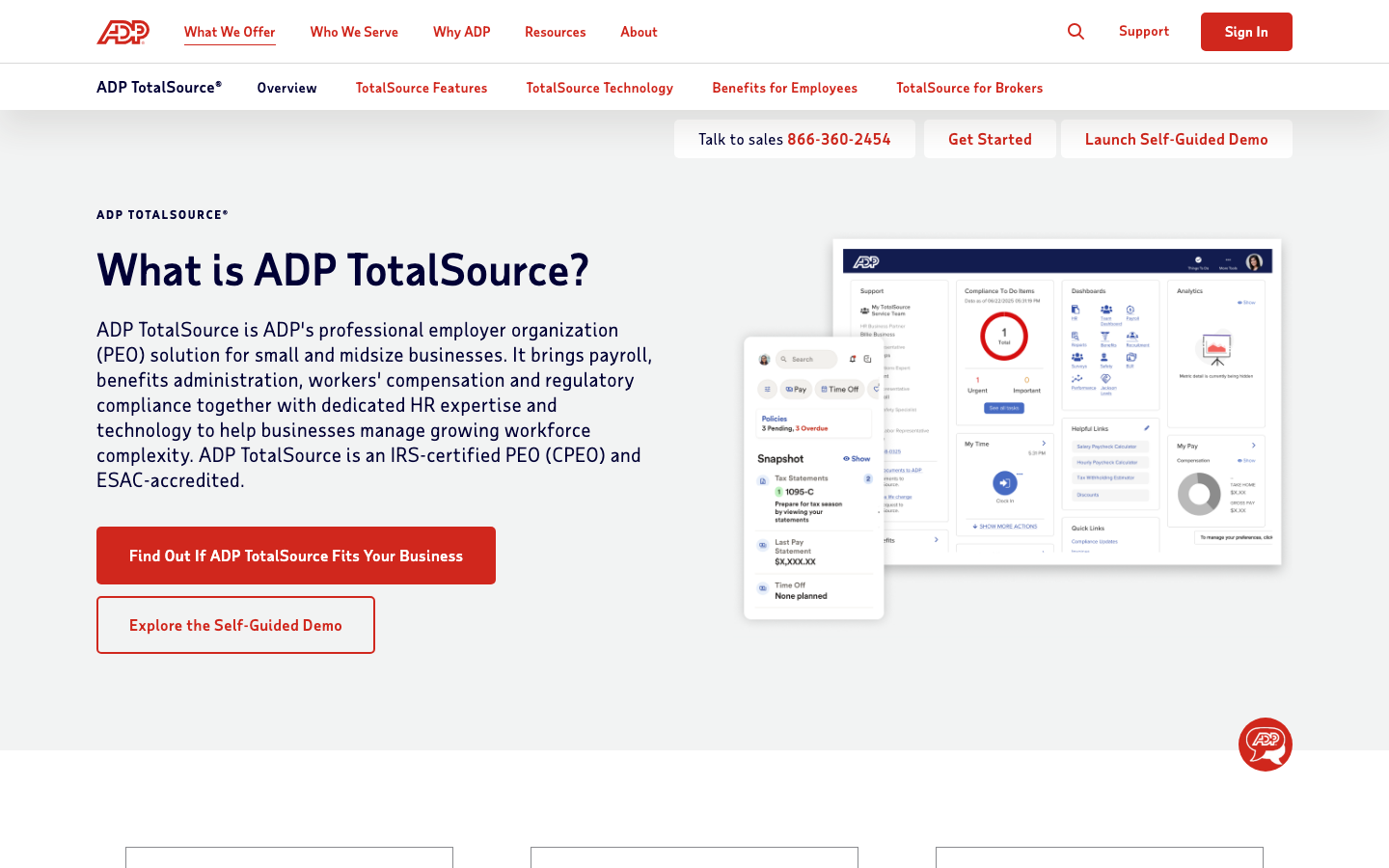
ADP TotalSource is ADP’s co-employment service for small and midsize businesses. Each client is paired with a named HR business partner, alongside payroll, benefits administration, injury coverage and compliance support. ADP calls it ESAC-accredited, and its entities have been on the IRS CPEO list since 2017.
Key Specialty Area:
Large-employer benefits for growing Wisconsin teams
Service Cost:
Quote-based, set by headcount and the plans you choose
Top Advantages:
- Named HR business partner for policy and people questions
- Benefit plans negotiated and administered by ADP
- IRS-certified since 2017, per the public list
Scope of Services:
- Payroll and employment tax filing
- Benefits administration and workers’ comp
- HR guidance and regulatory compliance
Our Verdict
A sensible pick for a 60-person Waukesha firm that wants a large provider and familiar payroll tools.
EmPower HR
Provider Type:
Wisconsin-based PEO
Company Description:
EmPower HR works from North Jefferson Street in downtown Milwaukee and has supported employers since 1995. It describes itself as a PEO for HR outsourcing and says it serves 400+ businesses, from nonprofits and clinics to restaurants and accounting firms.
Key Specialty Area:
Hands-on HR outsourcing for Milwaukee small businesses
Service Cost:
Custom proposal after a needs conversation
Top Advantages:
- Local team based in downtown Milwaukee
- Payroll checked so staff are paid correctly and on time
- Recruiting help available alongside core HR
Scope of Services:
- HR administration and payroll
- Employee benefits administration and enrollment
- HR consulting, risk management and compliance
Our Verdict
My pick for a Milwaukee nonprofit or restaurant group that wants a local co-employer it can meet in person.
Engage PEO
Provider Type:
National US PEO serving Wisconsin
Company Description:
Engage PEO provides co-employment for small and mid-sized businesses across the US. Founded by CEO Jay Starkman, it says it has been ESAC-accredited since 2012, and Engage PEO, LLC appears on the IRS CPEO list.
Key Specialty Area:
Benefits and risk programs for multi-state small firms
Service Cost:
Quoted per client after a review of staff and plans
Top Advantages:
- ACA-compliant benefits from large national insurers
- Workers’ comp and risk management in one contract
- Guidance for teams spread across several states
Scope of Services:
- Payroll on an integrated HR platform
- HR consulting and compliance
- Employee benefits, risk and workers’ comp
Our Verdict
Worth a quote for a Green Bay distributor with staff in Wisconsin and a few neighboring states.
ExtensisHR
Provider Type:
National US PEO serving Wisconsin
Company Description:
ExtensisHR says it helps thousands of small and mid-sized businesses across the country, with 30+ years in HR and PEO work. Its standard PEO covers payroll, benefits and compliance. The PEO Premier tier adds a Premier Account Manager with a limited client load.
Key Specialty Area:
2 service tiers for growing, complex employers
Service Cost:
Quote-based for both the standard and Premier tiers
Top Advantages:
- Premier Account Manager overseeing HR, payroll and benefits
- Mobile-first platform for payroll and HR tasks
- Extensis entities listed on the IRS CPEO list
Scope of Services:
- Payroll administration and tax filing
- Employee benefits and enrollment
- HR support, recruiting tools and compliance
Our Verdict
Fits a fast-growing Madison tech company that wants one named manager for every HR question.
FrankCrum
Provider Type:
National US PEO serving Wisconsin
Company Description:
FrankCrum is a family-owned firm founded in 1981 by Frank W. Crum Jr. and his father. Its PEO handles payroll, HR, benefits and workers’ comp for growing businesses, and the company says over 4,700 businesses use it. Construction, trades and medical offices feature among its clients.
Key Specialty Area:
Workers’ comp depth for trades and construction
Service Cost:
Quote after an intro call; no rates published
Top Advantages:
- Workers’ comp backed by its own insurance group
- Retirement plans with possible tax advantages
- MyFrankCrum portal for onboarding and enrollment
Scope of Services:
- Payroll processing and tax filing
- Workers’ compensation and claims management
- HR support, benefits and retirement plans
Our Verdict
A practical option for a Fox Valley contractor whose biggest worry is injury cover and claims.
G&A Partners

Provider Type:
National US PEO serving Wisconsin
Company Description:
G&A Partners is a Houston-founded PEO that has operated since 1995 and says it supports businesses in all 50 states. The firm describes itself as a certified PEO, and its G&A Outsourcing VII entity is on the IRS roster. Service packages are matched to company size.
Key Specialty Area:
HR packages scaled to small and midsize firms
Service Cost:
Package-based quote by company size
Top Advantages:
- Choice of HR packages instead of one fixed bundle
- Certified PEO entity on the IRS list
- Roots in an accounting practice founded in 1991
Scope of Services:
- HR management and payroll
- Employee benefits administration and enrollment
- HR technology and compliance support
Our Verdict
A good fit for a Kenosha company that wants to pick a service level rather than buy everything.
Group Management Services
Provider Type:
National US PEO serving Wisconsin
Company Description:
Group Management Services (GMS) began in 1996 and is now based in Richfield, Ohio, serving small to midsize employers. It works with companies across the US from 25 offices. It is a certified PEO and appears on the IRS list, though none of its offices is in Wisconsin.
Key Specialty Area:
Safety-focused PEO for workers’ comp heavy trades
Service Cost:
Priced per client once headcount and services are set
Top Advantages:
- Risk plans aimed at keeping workers’ comp rates down
- Listed by the IRS as a certified PEO
- Self-insured in Ohio, showing deep comp experience
Scope of Services:
- Payroll and tax compliance
- Benefits administration and HR compliance
- Workers’ compensation and workplace safety
Our Verdict
Suits a Sheboygan manufacturer that wants safety programs bundled with payroll and benefits.
HRDelivered
Provider Type:
Wisconsin-based PEO serving all 50 states
Company Description:
HRDelivered is a full-service PEO with offices in West Bend, Jacksonville and Fort Myers. It offers payroll, benefits, workers’ comp, and compliance, plus HR packages from HR Core to HR Full Suite. It says its controls are SOC 1 Type II audited.
Key Specialty Area:
PEO and tiered HR packages from West Bend
Service Cost:
Proposal after a free review of current HR and benefits
Top Advantages:
- Pay-as-you-go workers’ comp billed with each payroll
- Named HR specialist with SHRM or HRCI credentials
- 4 HR packages, from basic support to full suite
Scope of Services:
- Payroll, tax and workers’ comp
- Health and benefit plans
- HR consulting, hiring and compliance
Our Verdict
My pick for a Washington County employer that wants a nearby office and flexible HR packages.
Insperity
Provider Type:
National US PEO with a Wauwatosa office
Company Description:
Insperity is headquartered in Kingwood, Texas, and runs its Milwaukee-area sales office from West Innovation Drive in Wauwatosa. Its PEO pairs payroll, benefits and HR support with in-house technology, and Insperity PEO Services appears on the IRS CPEO list.
Key Specialty Area:
Broad HR bench for midsize Milwaukee-area firms
Service Cost:
Priced after a workforce review
Top Advantages:
- Local sales office in Wauwatosa
- Payroll, benefits and HR on its own platform
- Certified status shown on the IRS public roster
Scope of Services:
- Payroll and employment tax administration
- Benefits and retirement plans
- HR support, training and technology
Our Verdict
Fits an 80-person Milwaukee-area company ready to pay for a deep HR team and polished tools.
Nextep
Provider Type:
National US PEO serving Wisconsin
Company Description:
Nextep is based in Norman, Oklahoma, and has served growing businesses nationwide for nearly 30 years. Through co-employment, it handles payroll, tax filings, health benefits and HR. It says it is ESAC-accredited and SOC 1 Type II audited, and its entities appear on the IRS CPEO list.
Key Specialty Area:
Co-employment with a dedicated local success manager
Service Cost:
Per employee per month, quoted after a call
Top Advantages:
- Dedicated Client Success Manager for each account
- Payroll, benefits and HR on one platform
- Credentials checked by the IRS and an accreditor
Scope of Services:
- Payroll and tax filings
- Health benefits and benefit claim support
- HR policies, compliance and reporting
Our Verdict
Worth comparing for an Eau Claire services firm that wants per-employee pricing and a named contact.
PrestigePEO

Provider Type:
National US PEO serving Wisconsin
Company Description:
PrestigePEO has worked with small and mid-sized businesses since 1998 from its base in Melville, New York. Its service spans payroll, benefits and retirement plans, plus workers’ comp, HR and compliance. It says it is ESAC-accredited, and Prestige PEO III appears on the IRS CPEO list.
Key Specialty Area:
Benefits-led PEO for small professional firms
Service Cost:
Quote after a benefits and payroll review
Top Advantages:
- Benefits and retirement plans in one package
- Workers’ comp handled with payroll
- Named on the IRS roster of certified PEOs
Scope of Services:
- Payroll administration and tax filing
- Employee benefits and retirement plans
- HR, compliance and risk management
Our Verdict
Suits a Madison professional practice that wants richer benefits without building an HR department.
Professional Staff Resources
Provider Type:
Wisconsin-based PEO
Company Description:
Professional Staff Resources (PSR) is a Wauwatosa PEO on West State Street that has worked in co-employment for over 30 years. It focuses on small businesses and offers its benefits suite to clients with as few as 1 employee.
Key Specialty Area:
Benefits access for very small Milwaukee-area employers
Service Cost:
Based on headcount and taxes, with a fee breakdown
Top Advantages:
- Health and 401(k) access from the first employee
- Payroll every week or every 2 weeks, paid by direct deposit
- ACA reporting handled for staff on its health plan
Scope of Services:
- Payroll with FICA, SUTA and FUTA payments
- Health, disability and workers’ comp insurance
- Onboarding, handbooks and HR compliance
Our Verdict
For a 5-person Wauwatosa or Milwaukee shop, this is the most direct route to real benefits on a small budget.
Questco
Provider Type:
National US PEO serving Wisconsin
Company Description:
Questco is a PEO for small to mid-sized businesses, headquartered in metro Houston and founded in 1989. It offers HR outsourcing across the US, and Questco HR LLC appears on the IRS CPEO list.
Key Specialty Area:
Full HR outsourcing for small to midsize firms
Service Cost:
Quote-based after an HR review
Top Advantages:
- More than 35 years of PEO experience
- Payroll, benefits and HR from one team
- IRS-certified entity on the public CPEO list
Scope of Services:
- Payroll and employee benefits
- HR services and compliance
- Risk management and workers’ comp
Our Verdict
A sound choice for a Janesville or Beloit firm that wants an experienced national PEO without a large enterprise feel.
SustainableHR PEO
Provider Type:
Wisconsin-based PEO
Company Description:
SustainableHR PEO is headquartered in Madison and serves small and mid-sized employers across Wisconsin. Its founders started an HR and payroll firm in 2019 and later expanded it into a PEO. Clients range from teams of 3 or 4 people to more than 100.
Key Specialty Area:
Local PEO for Madison nonprofits and small firms
Service Cost:
Proposal after a booked call; no public rates
Top Advantages:
- Dedicated local specialist instead of a call center
- Group benefits that avoid age-banded small-group plans
- HR outsourcing available without full co-employment
Scope of Services:
- Paychecks, direct deposit and payroll tax returns
- Medical, dental and retirement benefits
- HR support, recruiting and DiSC training
Our Verdict
Madison nonprofits wanting a local co-employer plus culture and training help should start here.
The Employer Group
Provider Type:
Wisconsin-based PEO and payroll provider
Company Description:
The Employer Group (TEG) works from Solar Court in Verona and has offered payroll and HR services since 1995. It offers full co-employment as a PEO, and clients can also buy payroll or HR services alone. TEG says it is certified in 28 states.
Key Specialty Area:
PEO or stand-alone payroll for Dane County
Service Cost:
Flat fee per payroll run plus a per-check fee
Top Advantages:
- Itemized bills with no extra charge for W-2s
- Choice of PEO, payroll-only or HR projects
- Benefits from health and 401(k) to disability coverage
Scope of Services:
- Payroll with tax filing and new hire reports
- Benefits and workers’ comp administration
- HR projects billed hourly or on retainer
Our Verdict
Suited to a Dane County owner who wants payroll first and co-employment later.
How Much PEO and Payroll Services Cost in Wisconsin
Co-employers usually price their service as a flat monthly charge per worker or as a slice of gross wages. Almost all of them quote, and none of the 15 here posts a PEO price online. A payroll-only service costs much less, priced per run or per check, but it leaves out benefits and workers’ comp. The Employer Group, for instance, charges a flat fee per payroll run plus a per-check fee.
In return, the fee generally covers payroll runs and returns, benefits and injury coverage administration, and an HR contact. Insurance premiums, 401(k) plan charges, and any onboarding fee usually arrive as separate items. Required taxes sit outside the fee too: UI on the first $14,000 of wages and the federal FICA and FUTA payments. The fair comparison is what each employee costs you over a full year.
INSIGHT: What should a Wisconsin payroll provider handle for you?
Payroll here looks simple on paper, so the risk sits in withholding updates, filings and workers’ comp timing. Get a clear answer from each provider on all 3 points.
- Withholding: indexed brackets across rates from 3.5% to 7.65% (2025).
- UI: first $14,000 of wages; new employers pay 3.05% or 3.25% (2026).
- Workers’ comp: from the third employee or $500 in quarterly wages (2026).
- Tipped cash wage: $2.33 an hour, if tips lift pay to $7.25 (2026).
Sources:
as of October 2026
Snowbird owners from Wisconsin often run a second location in Florida, with staff on the ground there. With no state income tax, that payroll is lighter, though benefits still matter. My roundup of PEO companies in Florida covers the options before you hire in Naples or Fort Myers.
As they scale, Milwaukee manufacturers and Madison software firms often add engineers on the West Coast. California adds disability insurance deductions and daily overtime rules. My list of PEO companies in California covers the providers worth calling before a first hire there.
FAQs on PEO and Payroll Services in Wisconsin
What does a PEO do for a small business in Wisconsin?
Under co-employment, the provider becomes a second employer for tax and insurance purposes, yet decisions on hiring, firing and daily work remain yours. The provider processes pay, files state and federal employment taxes, and can place your team on its own injury coverage program. It also offers group health, dental and retirement plans and takes on HR paperwork such as onboarding forms and handbooks. Your contract spells out each split of responsibility, so go through it line by line before signing.
Do PEOs have to register in Wisconsin?
Yes, co-employment firms must register with the Department of Financial Institutions and renew each year by July 31, with a late window to September 30. A registrant must keep at least $100,000 in net working capital at all times or file a surety bond with the department instead. Out-of-state firms with no local office and no more than 50 employees serving clients here can use a lighter small operations registration. IRS certification is a separate federal status and does not replace state registration.
When does a Wisconsin business need workers’ compensation?
Coverage is required on the day a business employs its third person, counting both full-time and part-time staff. It is also required once any one employee earns $500 or more in a calendar quarter, by the 10th day of the next quarter. Farms follow a separate rule that starts at 6 workers employed on the same day for 20 days in a year. Coverage must come from a licensed insurer or approved self-insurance, and many small employers get it through a co-employment provider’s program.
What are the Wisconsin income tax rates?
Wisconsin taxes income at 4 rates: 3.5%, 4.4%, 5.3%, and 7.65%, and adjusts the bracket thresholds for inflation each year. A 2025 law widened the 4.4% bracket, which for single filers now runs from $14,680 to $50,480 of taxable income. Employees give their employer Form W-4 for state withholding, because the federal W-4 cannot be used for this purpose. No city or county levies an income tax, so employers withhold only state and federal amounts from each paycheck.
How much does a PEO cost in Wisconsin?
Fees are usually set per employee each month or as a share of gross payroll, and almost every provider prices by quote. Headcount, industry, claims history, and the benefit plans you choose can move the final price by a wide margin. Insurance premiums for health and injury coverage, plus retirement plan costs, normally appear as separate lines on the invoice. Ask for a sample invoice and compare the full yearly cost per employee, including unemployment tax, rather than the headline fee.
What is the minimum wage in Wisconsin?
Wisconsin’s wage floor sits at $7.25 an hour, matching the federal figure, and it has stayed there since July 24, 2009. Servers and other tipped staff may receive $2.33 an hour in cash wages, provided tips lift them to $7.25. An opportunity wage of $5.90 applies to workers under 20 during their first 90 days, and cities cannot set higher rates. Hours beyond 40 in a workweek earn time and a half, which mirrors the federal overtime rule for most workers.

Helen is Anywherer’s Market Analyst & Content Researcher, with extensive experience in analyzing global employment markets and HR technology trends. She is skilled at turning complex market data into clear, well-researched insights that inform every piece of content. With a strong grasp of the EOR, PEO, and international hiring space, Helen plays a key role in keeping Anywherer’s research accurate, up to date, and genuinely useful for readers.