At 3 employees, an employer of record is a convenience. At 300 across 25 countries, it is a liability structure. Choosing the best EOR for enterprise means answering 1 question first: which legal entity signs the employment contract. The second question follows from it: who stands behind that contract when a labor inspector arrives, or a termination goes wrong. Country coverage is the number every vendor leads with, and it is close to irrelevant at this scale. The entity map matters; the coverage map does not.
2 pressures make 2026 different. Enforcement has tightened around who is genuinely self-employed, and the Netherlands is the clearest example. The Dutch government’s business portal states that since 1 January 2025, the Netherlands Tax Administration has been checking whether contractors are genuinely self-employed. Additional assessments are possible back to that date. The second pressure is internal. Procurement functions now treat an employer of record for enterprise buyers as a processor of employee data. That means a security review before a commercial one.
So there is no single winner. The 11 providers here split into owned-entity, hybrid, and program-led models, and the right one depends on your country list. The category keeps expanding underneath that choice. Custom Market Insights values 2026 spending on the employer of record market at $7.45 billion, with a 2035 projection of $15.89 billion. Only 3 of the 11 publish an owned-entity count separately from a coverage count. Treat this page as information, not legal, tax, or employment-law advice. Below, I’ve reviewed 11 of the leading providers in A-Z order.

INSIGHT: How many countries does your EOR actually own an entity in?

Coverage numbers and entity numbers are different numbers. The gap between them is exactly where enterprise employment liability sits.
- Atlas HXM publishes fully owned and operated legal entities in 160+ countries against coverage of 160+, so its entity map and its coverage map are the same map (Atlas HXM, read 31 August 2026).
- Deel publishes a split: it owns entities and a payroll engine in 130+ countries while covering 150+, which means roughly 20 markets are delivered another way (Deel, read 31 August 2026).
- Remote takes the narrowest position, offering employment without a local entity in 90+ countries, because it only employs where it owns the entity itself (Remote, read 31 August 2026).
- Custom Market Insights puts the employer of record market at $7.45 billion for 2026 and projects $15.89 billion by 2035 (report published 29 July 2026).
Top EOR Platforms for Multinational Companies Compared
Among the top EOR platforms for multinational companies, the second and third columns are the ones a procurement committee will actually argue about. Read them together, because an entity count with no certification behind it clears nothing.
| Provider | Employment structure | Owned-entity footprint | Certifications published | Enterprise HRIS integrations | G2 rating |
|---|---|---|---|---|---|
| Atlas HXM | Owned entity | Vendor states owned entities in 160+ countries, coverage 160+ | ISO 27001, ISO 27017, ISO 27018 | Not published | 4.2 (94) |
| CXC Global | Program-led | Not published; vendor states 100+ countries | Not published | Not published | 5.0 (2) |
| Deel | Hybrid | Vendor states owned entities in 130+ countries, coverage 150+ | SOC 1, SOC 2, ISO 27001 | SAP SuccessFactors and a wider catalog | 4.7 (6,958) |
| G-P | Owned entity | Not published; vendor states 180+ countries | ISO/IEC 42001 for AI governance | Workday | 4.4 (1,059) |
| GoGlobal | Owned entities plus in-country teams | Not published; vendor states 145+ countries | ISO 27001 | Not published | 5.0 (2) |
| Mercans | In-country specialist delivery | Not published; vendor states 160 countries and payroll in 100+ | SOC 1, SOC 2, ISO 27017, ISO 27018, ISO 27701 | Direct HCM integrations per vendor | 4.8 (27) |
| Multiplier | Owned entity | Vendor states owned entities 150+, coverage 160+ | SOC 2 (Type I & II), SOC 3, ISO 27001:2022 | Not published | 4.7 (1,488) |
| Papaya Global | Hybrid | Not published | Not published | Not published | 4.5 (55) |
| Pebl | Hybrid | Not published; vendor states 185+ countries | Not published | Not published | 4.6 (598) |
| Remote | Owned entity only | Vendor states employment without a local entity in 90+ countries | ISO 27001, SOC 2, CSA STAR Level 1 | Workday, HiBob, BambooHR, Personio | 4.5 (4,903) |
| Safeguard Global | In-country specialist delivery | Not published; vendor states 187 countries | Not published | Not published | 4.3 (131) |
I read every entity, coverage, and certification figure above on the provider’s own site in September 2026. Ratings pulled from G2 the same day.
Who Actually Employs Your People
In an owned-entity model, the provider’s own local subsidiary signs the employment contract. That makes the provider the counterparty on every claim, every termination, and every labor inspection, with no third party in between. Atlas HXM, G-P, and Remote all present themselves this way, and Remote takes the position furthest, employing only where it holds the entity. The buyer gains a single legal chain and gives up coverage in markets the provider has not incorporated in.
A partner network works differently. The provider contracts a local firm, and that firm becomes the actual employer of your people. Ask what that changes, and the answers are uncomfortable. The partner holds the employee data and answers the labor inspector. If the partner fails, you are exposed to a company you never selected. The service level agreement you negotiated binds your provider, not the firm behind it, unless it has been flowed down in writing.
Most of the market runs a hybrid of the 2. The honest point is that a coverage map and an entity map are different documents. A provider marketing 185 countries may own entities in a fraction of them. Deel is the clearest case here because it publishes both numbers, 130+ owned against 150+ covered. The useful question is never how many entities exist in total. It is whether 1 exists in each country on your list.
This compounds with headcount. Among top EOR companies for large enterprises, the model drives termination cost, audit exposure, and what happens on exit. It also drives permanent establishment risk, meaning the point at which your activity in a country creates a taxable presence. At 300 employees across 25 countries, it decides whether a restructuring takes 3 months or 12. Buyers below this scale weigh these models very differently, which is why our roundup of the best EOR companies reaches different conclusions.
What an Enterprise Vendor Review Asks an EOR
- Security and data. The first ask is a scoped SOC 2 Type II report. That means an audited report covering a defined period, not a badge on a website. Then ISO 27001 scope, penetration test summaries, a published sub-processor list, data residency, and whether employee data crosses borders. 6 of the 11 here publish readable certification detail on their own sites: Atlas HXM, Deel, G-P, GoGlobal, Mercans, and Remote. The other 4 do not, which means the report arrives only after a mutual NDA.
- Contractual. Enterprise legal wants a master services agreement rather than click-through terms, and click-through terms are usually the first thing it rejects. Beyond that: a data processing agreement, indemnity for misclassification and permanent establishment, and a liability cap that is not a multiple of 1 month’s fees. Notice periods and a termination-for-convenience right sit alongside them. None of this appears in a demo, and all of it decides whether the deal closes.
- Operational. Ask whether you get a named account team or a ticket queue, and get the answer in the contract rather than from the salesperson. Then the implementation timeline for a multi-country rollout and the escalation path when a payroll run breaks. Ask too whether the provider will sign a service level agreement with credits attached. A commitment without a credit is a statement of intent.
- Financial and reporting. Consolidated multi-country invoicing, purchase-order-based billing, cost-center allocation, currency handling with the FX margin disclosed as a percentage, and any deposit or prefunding requirement. The last test is whether the platform produces what group finance needs without a monthly reconciliation project. Our guide to EOR companies for payroll works through the same question in more depth.
Best EOR Platform for Enterprise Companies by Scenario
Enterprise selections cluster into 4 situations, and each one produces a different shortlist. Picking the best EOR platform for enterprise companies depends on whether you are entering markets, absorbing a workforce, reclassifying contractors, or replacing vendors. Every provider sits in exactly 1 group, chosen by the structure it actually runs.
For Multi-Country Expansion at Scale
Entering 10 or more markets on a fixed timeline requires the entity map to match the target list rather than the marketing map. Atlas HXM, G-P, and Safeguard Global all operate at this scale. Atlas HXM states owned entities across its full 160+ coverage, and G-P covers 180+ countries with legal entities behind its platform. Safeguard Global supports 187 countries through in-country specialist teams. Buyers without an existing entity strategy will find the general comparison in our guide to EOR services for international hiring more useful.
The test to run is unglamorous. Take your 10 target countries and send the list. Ask for written confirmation of which are served by an owned entity and which by a partner. The answer usually arrives shorter than the coverage map implies, and that shortfall is your negotiating position.
For Mergers, Acquisitions, and Carve-Outs
GoGlobal, Papaya Global, and Pebl all fit the transitional services agreement window, where an acquired population needs employing before entities transfer. GoGlobal sells entity establishment alongside EOR, which matters when the plan is to migrate people into your own entities later. Papaya Global runs a licensed payments layer under its employment product. Pebl operates a high-touch managed model across 185+ countries per its own site.
Service continuity is the detail that decides these deals. Moving somebody between legal employers can reset seniority, notice entitlement, and benefit accrual, depending on the country. Plan the sequencing before signing rather than discovering it at cutover.
For Converting a Large Contractor Population
CXC Global and Deel are the 2 here built for an enterprise deciding which of 300 or more long-tenure contractors to reclassify. CXC Global has run contingent workforce programs since the early 1990s, delivering EOR and agent of record alongside managed program services. Classification assessment and employment infrastructure then come from 1 partner. Deel pairs its own classification tooling with owned entities in 130+ countries.
The Dutch enforcement change is the live example of why this queue has grown. When a tax authority starts checking whether contractors are genuinely self-employed, a population that looked settled for 5 years becomes a project with a deadline. The assessment has to happen before the employment does.
For Consolidating a Fragmented Vendor Set
Replacing 5 regional EOR vendors and 3 payroll bureaus with 1 counterparty is where Mercans and Remote fit, from opposite directions. Mercans delivers on its own proprietary stack: HR Blizz for global payroll and HRM, plus its G2N gross-to-net engine. The vendor states it uses no third-party software. Remote consolidates by owning every entity it employs through, which removes third parties by construction.
What you gain is 1 contract, 1 data model, and self-reconciling reporting. The cost is local optionality. When a single provider is weak in 1 of your markets, no regional specialist is left to fall back on. Adding one back reopens the problem you consolidated to solve.
Enterprise EOR Pricing
At enterprise volume, a published per-employee rate is an opening position, not a price. 5 of the 11 publish one: Multiplier starts at $459 per employee per month for its Core plan, billed annually; Atlas HXM, Deel, and G-P list $599; and Remote lists $699. Atlas HXM’s own page shows that rate against 1 to 5 employees and invites a conversation about volume discounts above that. That invitation is the whole point. Published flat rates describe the buyer our guide to EOR providers for small businesses is written for, not this one.
What actually moves the number is committed headcount, country mix, contract term, who funds payroll, FX handling, and deposit requirements. Bundling matters too: immigration, benefits uplift, and equipment. Administering a hire in Brazil or China costs a provider far more than 1 in Poland. And the platform fee sits on top of gross salary, statutory employer contributions, mandatory benefits, and any deposit, which together dwarf it.
| Provider | Pricing model | Published starting price | Deposit or prefunding requirement |
|---|---|---|---|
| Atlas HXM | Published per employee monthly, volume-tiered above 5 employees | $599 per employee per month | Not published |
| CXC Global | Program-based, quote only | Custom pricing | Not published |
| Deel | Published per employee monthly | $599 per employee per month | Not published |
| G-P | Published per employee monthly | $599 per employee per month | Not published |
| GoGlobal | Quote-based | Custom pricing | Not published |
| Mercans | Quote-based | Custom pricing | Not published |
| Multiplier | Published per employee monthly, tiered | $459 per employee per month (Core), billed annually | Not published |
| Papaya Global | Quote-based | Custom pricing | Not published |
| Pebl | Quote-based | Custom pricing | Not published |
| Remote | Published per employee monthly | $699 per employee per month | Not published |
| Safeguard Global | Quote-based | Custom pricing | Not published |
As pricing is subject to change, prices are listed as of September 2026.
How to Choose an Enterprise EOR
My first step is writing down the markets, well before any vendor names. Write down the markets you will employ in, send them over, and ask which are served by an owned entity. Then count the population you expect to employ this way in year 2, not year 1, because that number sets your commercial terms. The discount you negotiate on 20 people has to hold at 100.
Next, work out whether the purchase is employment or a program. A contingent workforce program and an EOR contract are different purchases with different internal owners, and conflating them wastes a quarter. Then run the security review before the commercial one. A vendor that cannot produce a scoped SOC 2 Type II report will not clear procurement, no matter how well the demo went. Finding that out in month 3 is expensive.
Ask what happens on exit, because employee transfer terms, notice periods, and data return are the clauses nobody negotiates and everybody eventually needs. Check the integration path into the HRIS you already run. Manual reconciliation across 20 countries is a headcount cost that never appears in the quote. Ask who the named account team is and what they are contractually obliged to do.
A best enterprise-grade employer of record provider is the one that answers those questions in writing before you sign. Scores on a comparison page settle nothing. Price the second year while you are at it. By then, headcount has grown, and the terms you agreed at 20 employees have to stretch to 100.
Top 11 EOR Providers for Enterprise Companies in 2026
To assemble this list of best EOR providers for enterprise companies, I read each vendor’s own entity, security, integration, and pricing pages. Then I recorded what they publish and what they leave out. Country counts and entity counts in this category are marketing numbers that move quarterly. Each is credited to the vendor that published it, never restated as a finding of mine.
I’m listing all providers in alphabetical order to keep this comparison neutral.
The mix runs across 3 delivery models, from direct owned-entity providers like Atlas HXM and Remote to hybrid platforms like Deel and Papaya Global. Program-led firms like CXC Global and Safeguard Global make up the third group. Anyone assembling a shortlist of best EOR vendors for enterprise companies 2026 should note that the 3 models fail procurement for entirely different reasons.
Atlas HXM
Quick Overview
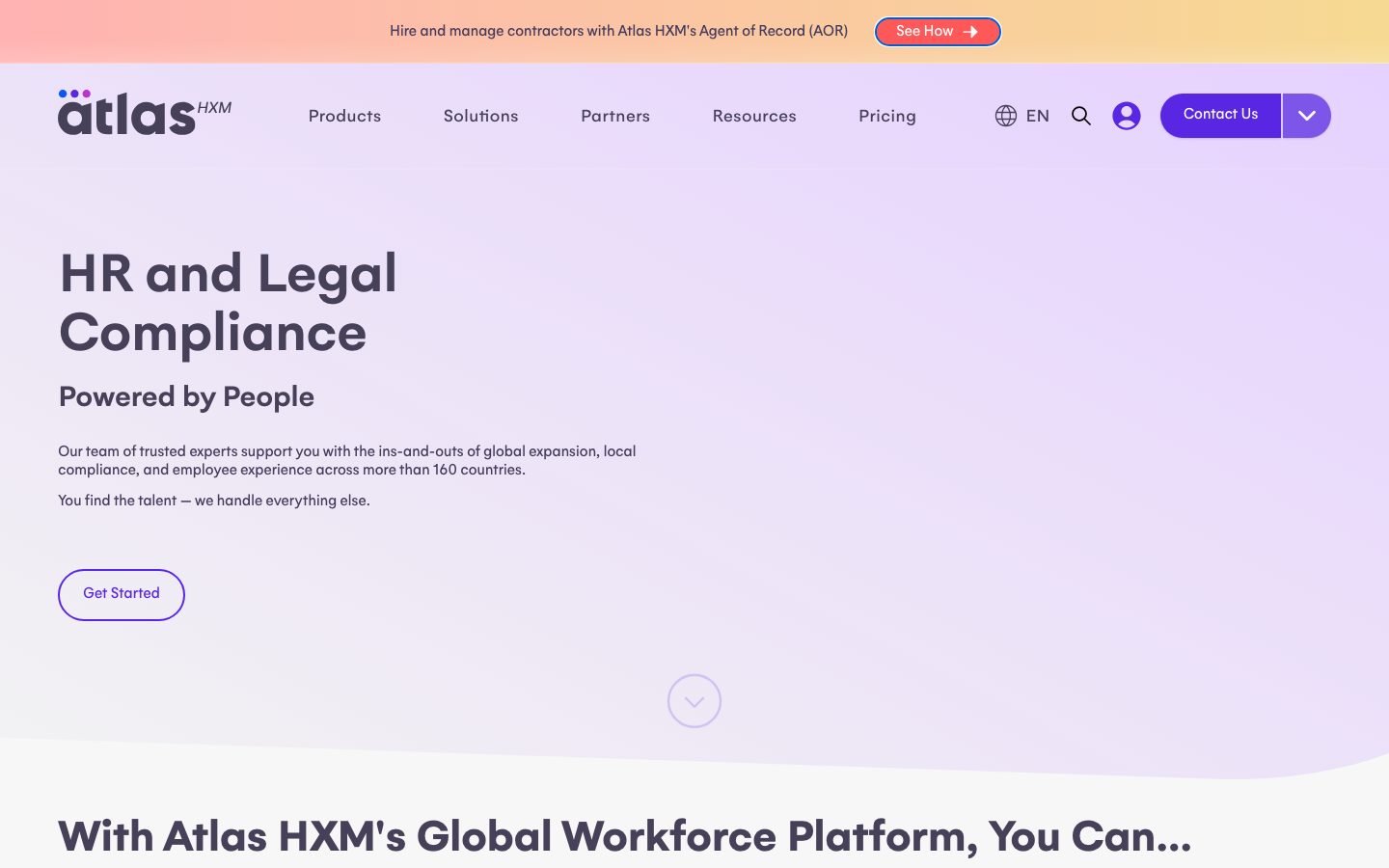
Atlas HXM is a distributed company that operates a direct employer-of-record model. Its own subsidiaries employ your people, with no third-party processors in the chain. The vendor states it has fully owned and operated legal entities in 160+ countries, matching its published coverage rather than sitting beneath it. It publishes ISO 27001, ISO 27017, and ISO 27018 certification on its own site.
Enterprise Strengths
- Entity map and coverage map are the same map, per the vendor’s own claim
- 3 ISO certifications published as readable text, not badges behind a form
- Immigration and mobility handled in-house across 100+ countries per the vendor
- A published per-employee rate that gives procurement an opening number
Trade-offs
- No enterprise HRIS integrations documented on its own integrations pages
- A G2 rating resting on 94 reviews, modest against the largest names here
- The published $599 rate covers 1 to 5 employees, so enterprise terms are negotiated
Atlas HXM Review
Judged on the entity question, Atlas HXM gives the cleanest answer on this page. One counterparty everywhere, and a legal chain a general counsel can draw on a single slide. It suits a buyer whose legal team treats third-party processors as unacceptable. It is a weaker fit where the requirement is deep integration into an existing HR stack, because that documentation is not there. Ask what the rate looks like at your headcount before comparing it with anyone else.
Our Verdict
Entity Map Equals Coverage
*As pricing is subject to change, we are listing prices as they stand in September 2026
CXC Global
Quick Overview
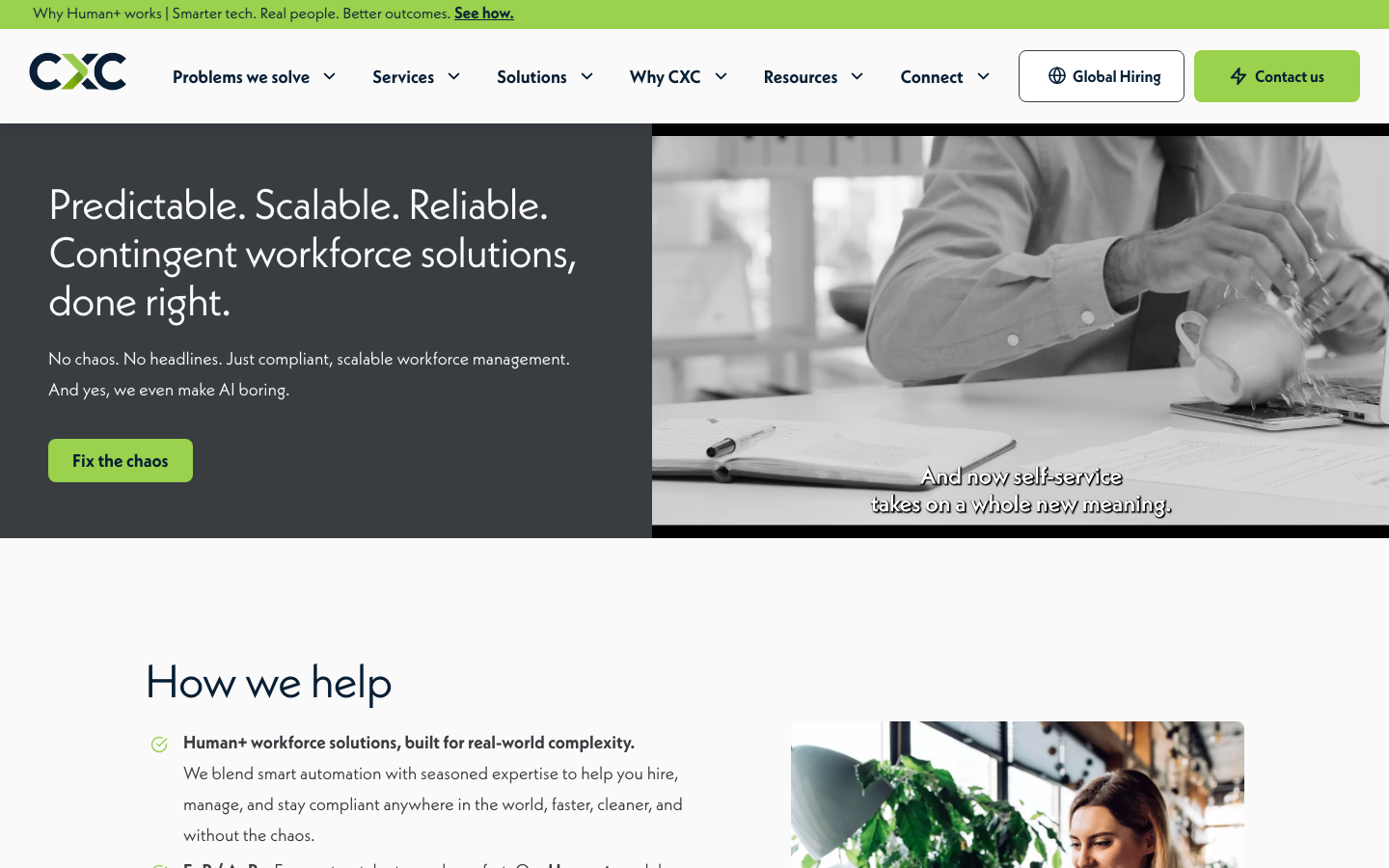
CXC Global has operated since the early 1990s and delivers employer of record and agent of record alongside vendor-neutral managed program services through in-country teams. The vendor states a footprint spanning 5 continents, more than 30 offices, and services across 100+ countries. It publishes no owned-entity count and no security certifications as readable text on its own site.
Enterprise Strengths
- Employment and contractor engagement delivered under one program relationship
- Vendor-neutral managed services, so it does not compete for the placements it administers
- More than 3 decades of continuity running mixed employee and contractor populations
Trade-offs
- No owned-entity count published, so the liability chain cannot be sized from outside
- No security certifications published, which slows an enterprise security review
- A 5.0 on G2 resting on 2 reviews, which is no sample at all
CXC Global Review
I would shortlist CXC Global when the problem is a mixed workforce rather than a hiring project. Running employees and contractors through 1 program with a vendor-neutral operator is a genuine structural answer. The difficulty is evidence. A procurement team that starts with the security questionnaire will find less published here than at almost any other name on this list. The program model is worth that extra diligence if your contractor population is large.
Our Verdict
Program Led Mixed Workforce
Deel
Quick Overview
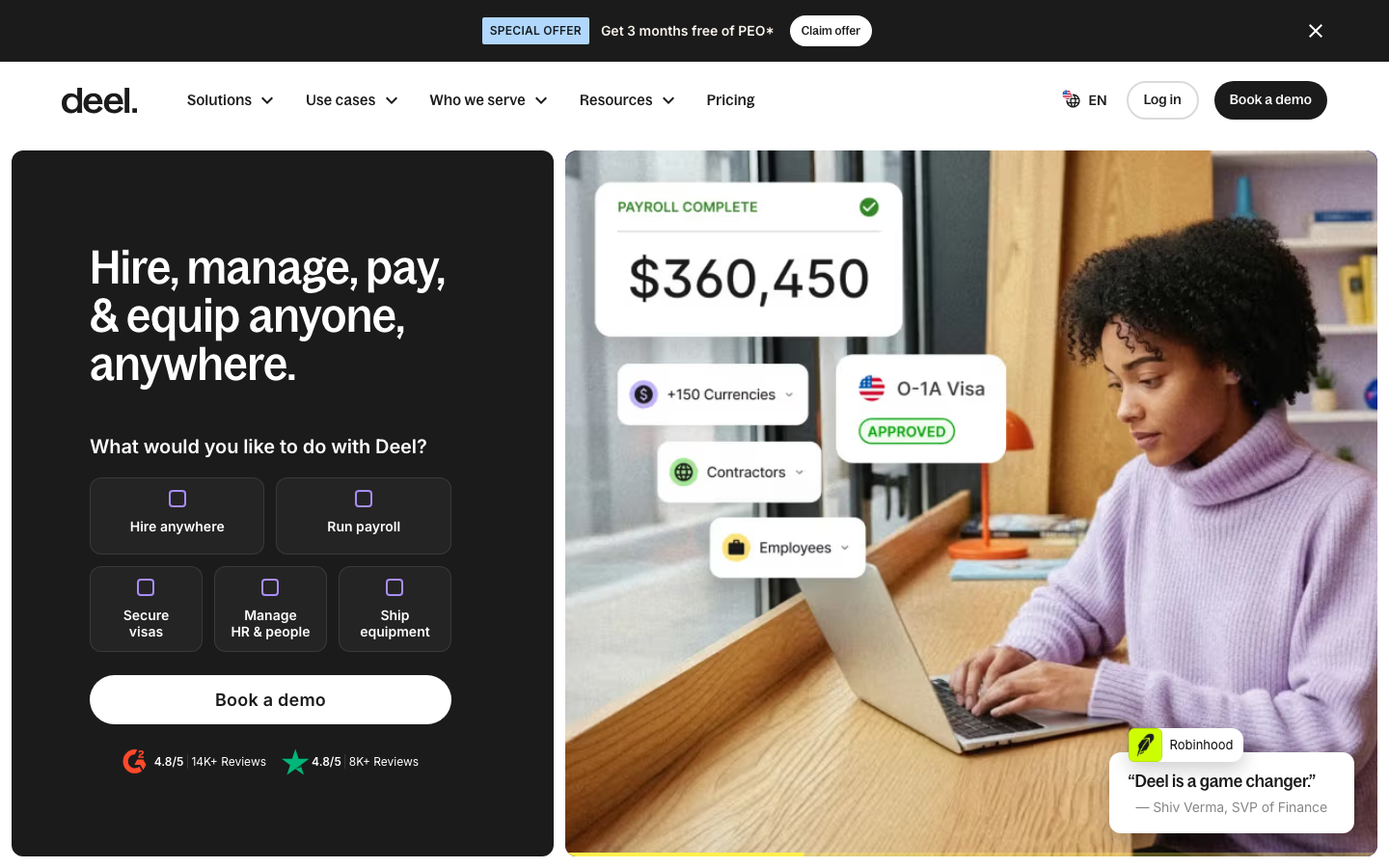
Deel runs a hybrid model and is 1 of only 3 providers here that publishes the split. The vendor states it owns entities and a payroll engine in 130+ countries while covering 150+. That puts roughly 20 markets outside its own entity footprint. Its security page publishes SOC 1, SOC 2, and ISO 27001, and it documents SAP SuccessFactors among a wider integration catalog.
Enterprise Strengths
- The owned-versus-covered split is published openly, which almost nobody else does
- SOC 1, SOC 2, and ISO 27001 all named on its own security page
- The deepest integration catalog on this list, including SAP SuccessFactors
- An in-house immigration function brought in by acquisition rather than referred out
Trade-offs
- Roughly 20 covered markets sit outside its owned entities and are delivered another way
- G2 lists it under Deel Payroll, a profile covering far more than employment
- Its review base is overwhelmingly non-enterprise, so the score says little about this buyer
Deel Review
I read this as the most complete platform here and the one whose disclosure I trust most, precisely because it admits the gap. Publishing 130+ owned against 150+ covered invites the follow-up question rather than avoiding it. It fits an enterprise consolidating onto 1 system of record. Ask which 20 markets fall outside the entity map before signing. The breadth also means paying for parts of a platform you may never switch on.
Our Verdict
Published Split, Widest Integrations
G-P
Quick Overview
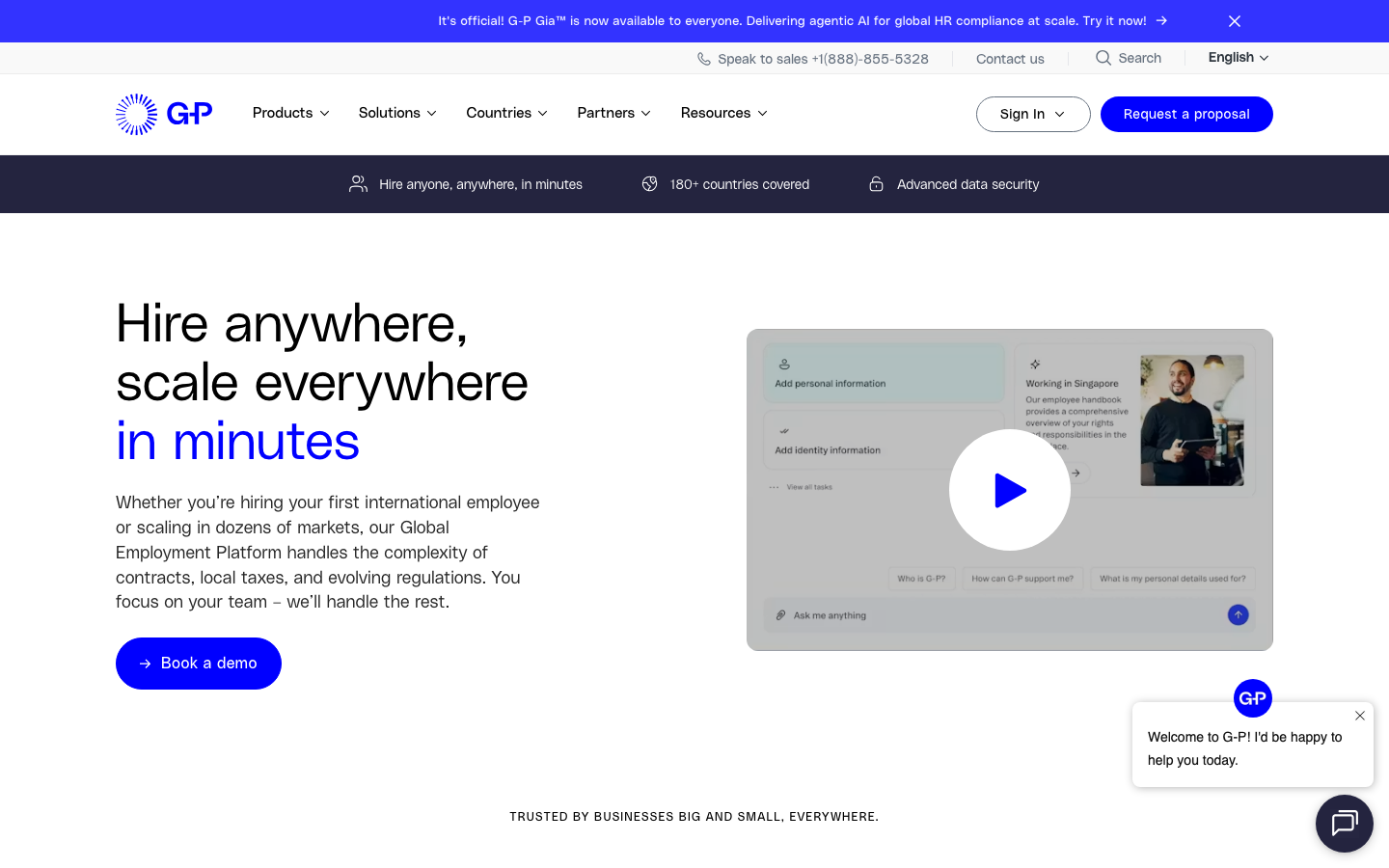
G-P has run an owned-entity employer of record model since 2012 and states coverage across 180+ countries with its own legal entities behind the platform. It does not publish a separate owned-entity count. Its security page names ISO/IEC 42001 certification for AI governance and routes the wider accreditation set to a request; it also publishes a Workday integration.
Enterprise Strengths
- An owned-entity model across a very large published footprint
- ISO/IEC 42001 certification for AI governance, which is rare in this category
- A documented Workday integration, evidenced by its own published customer work
- A published per-employee starting rate of $599 per month
Trade-offs
- No separate owned-entity count published, so the entity map cannot be checked
- Certification detail sits behind a request rather than on the page
- The published rate is an opening position that enterprise volume renegotiates
G-P Review
I keep landing on G-P for buyers with formal vendor governance and long country lists. The owned-entity claim across 180+ markets is the broadest here. The AI governance certification anticipates a question most procurement teams have only just started asking. What it does not give you is a number for how many entities that footprint contains. Ask for the entity list market by market, in writing, before the shortlist closes.
Our Verdict
Owned Entity At Scale
*As pricing is subject to change, we are listing prices as they stand in September 2026
GoGlobal

Quick Overview
GoGlobal sells employer of record alongside entity establishment, company secretarial, and accounting work, delivered through owned entities and on-ground teams. The vendor states end-to-end services and on-ground experts in 145+ countries. It publishes ISO 27001 certification for its information security management system through its own newsroom, and no separate owned-entity count.
Enterprise Strengths
- ISO 27001 certification published on its own site
- Entity establishment sold next to EOR, so people can migrate into your entities later
- Company secretarial and accounting available under the same relationship
Trade-offs
- No owned-entity count published against the 145+ coverage figure
- Buying here means entering a broader services relationship, not a platform subscription
- Just 2 public reviews behind that 5.0, which reads as no evidence either way
GoGlobal Review
My concern with GoGlobal is scope creep, and it is also the reason to choose it. If the plan is to employ through an EOR now and stand up your own entities in 3 years, both halves come from 1 firm. That removes a migration project later. If you want a platform and nothing else, the services relationship will feel heavier than the problem requires. Weigh the migration you avoid against the overhead you take on.
Our Verdict
Entity Services Alongside EOR
Mercans
Quick Overview
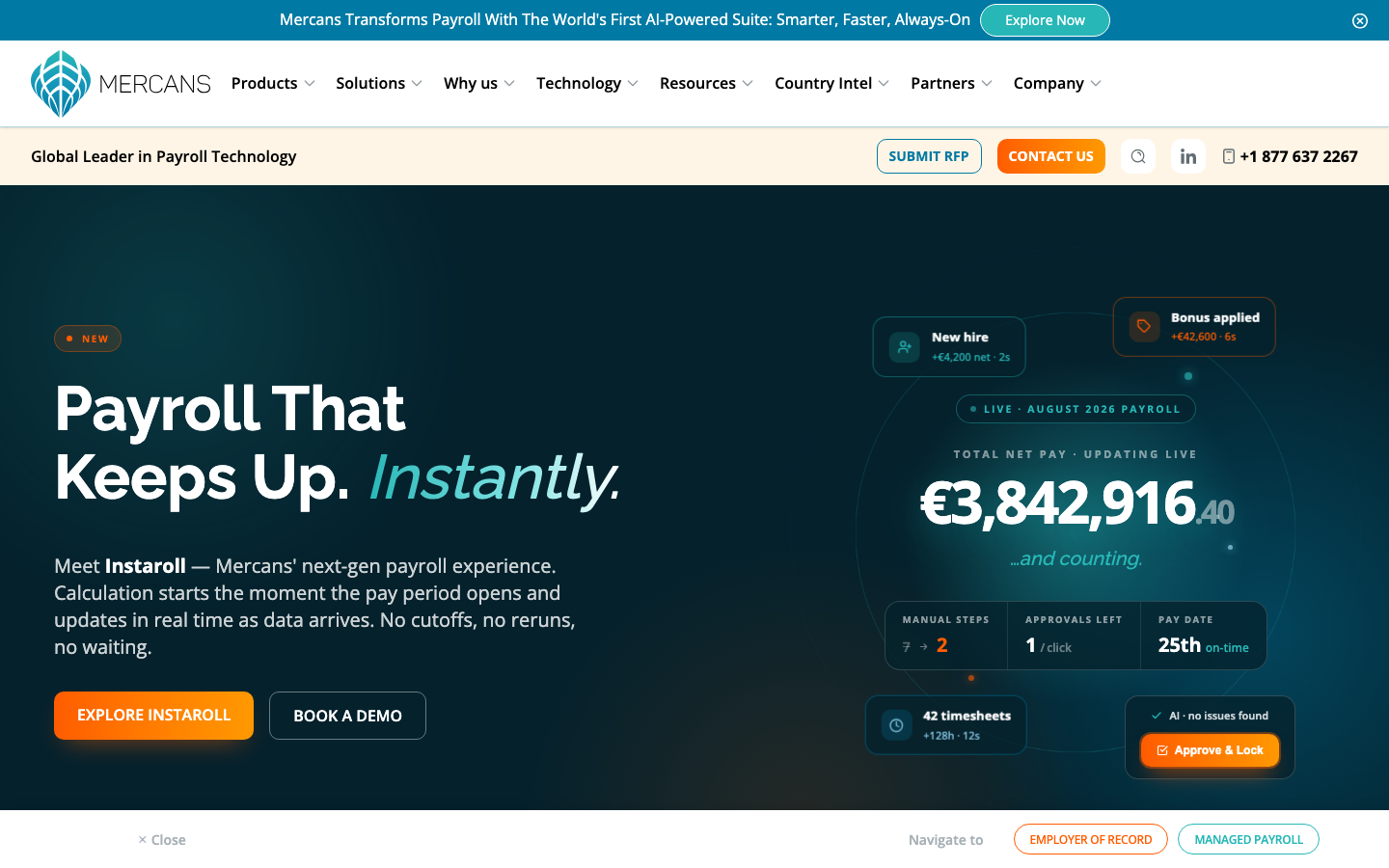
Mercans delivers employer of record on payroll technology it built itself, running HR Blizz for global payroll and HRM alongside its G2N gross-to-net engine. The vendor states it uses no third-party software. The vendor states it delivers across 160 countries, with payroll in 100+. It publishes SOC 1, SOC 2, ISO 27017, ISO 27018, and ISO 27701 certification on its own site.
Enterprise Strengths
- The longest published certification list here, including ISO 27701 for privacy
- A proprietary gross-to-net engine, so payroll data is not passed to a third party
- Direct integrations into the major HCM suites per the vendor
- GDPR posture backed by Binding Corporate Rules, per its own site
Trade-offs
- No owned-entity count published against its 160-country delivery claim
- The G2 listing is Mercans HR Blizz, its payroll platform rather than the EOR line
- 27 public reviews, the thinnest usable sample among the rated providers here
Mercans Review
I would shortlist Mercans where the deciding constraint is what happens to payroll data after it leaves your HR system. Owning the engine end to end is a real answer to a question most providers deflect. The gap is the entity map: a single counterparty claim is only as strong as the entities behind it, and that number is not published. Ask which markets it serves directly before treating the claim as settled.
Our Verdict
Single Counterparty Payroll Stack
Multiplier
Quick Overview
Multiplier runs a direct, owned-entity employer-of-record model. The vendor states it operates its own network of 150+ legal entities across 160+ countries, backed by in-house legal and tax experts rather than local partner firms. It publishes SOC 2 Type I & II, SOC 3, and ISO 27001:2022 certifications, alongside GDPR-compliant, AWS-hosted infrastructure.
Enterprise Strengths
- Owned-entity network (150+ entities) rather than a partner-delivered footprint
- Published, tiered pricing with no hidden FX, onboarding, termination, or compliance surcharges
- 24×7 human support with no bot-first tier
- Named Global EOR Leader by the IEC Group for the third consecutive year (2026) and Employer of Record of the Year by the Global Payroll Alliance
Trade-offs
- No enterprise HRIS integrations (Workday, SAP SuccessFactors) documented on its own site
- Owned-entity count (150+) sits below its 160+ country coverage claim, so a handful of markets are likely delivered another way
- Enterprise-tier pricing requires a custom quote
Multiplier Review
Judged on the entity question this page keeps returning to, Multiplier lands close to Atlas HXM and G-P: an owned network large enough that most buyers won’t need to ask who the counterparty is. The gap between its 150+ entities and 160+ country claim is worth a written confirmation for any market on the edge of that range, the same test this page recommends for every vendor here. Its published, tiered pricing is a genuine differentiator against the quote-only majority of this list. Ask for the entity list against your specific country set before treating the coverage number as settled.
Our Verdict
Owned Network, Published Pricing
Papaya Global
Quick Overview
Papaya Global runs a hybrid employment model with a licensed payments layer underneath it. It targets enterprises where treasury flows and payment auditability weigh as heavily as employment compliance. It publishes neither an owned-entity count nor security certification details as readable text on its own site. Only 55 reviews sit behind its G2 score, the smallest rated sample here.
Enterprise Strengths
- A licensed payments layer sitting under the employment product
- Regional legal teams kept in-house instead of 1 central office
- An audit trail built for enterprises where finance owns the vendor relationship
Trade-offs
- No owned-entity count published, so the hybrid split cannot be sized
- No security certifications published as readable text on its own site
- A G2 score built on 55 reviews, well short of a dependable base
Papaya Global Review
I read this as a strong fit for a finance-led buyer and a harder sell to a security-led one. When treasury controls and payment traceability are the requirement, the payments layer is a real differentiator that platform-only rivals cannot match. The published evidence is the weak point, so ask for the entity split and the certification set in writing early. A payments layer will not carry a security review on its own.
Our Verdict
Treasury Controls, Quiet Documentation
Pebl
Quick Overview
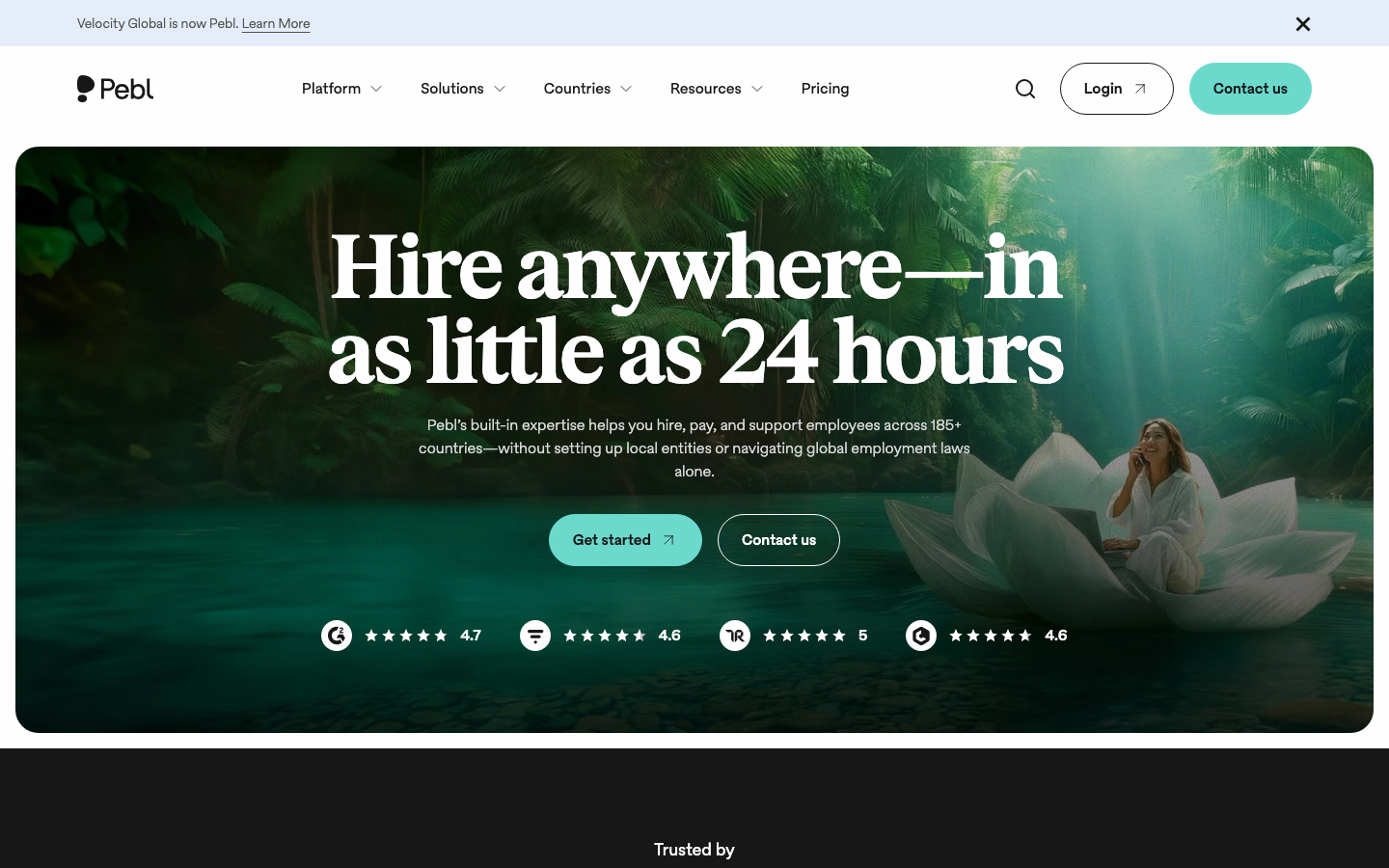
Pebl, which traded as Velocity Global until its 2025 rebrand, runs a hybrid model. Its delivery style is service-led and built for complex cases and hard-to-reach markets. The vendor states it helps companies hire, pay, and support employees across 185+ countries without local entities. It publishes no owned-entity count and no security certification detail as readable text.
Enterprise Strengths
- The broadest published country reach on this list at 185+
- A managed engagement model rather than self-serve, which suits complex cases
- Benefits administration published across the same 185+ country footprint
- 598 G2 reviews, a solid public sample for a service-led firm
Trade-offs
- No owned-entity count published against a very large coverage claim
- No security certifications published as readable text on its own site
- A high-touch model costs more than a platform subscription at equivalent headcount
Pebl Review
My concern with Pebl is the distance between 185+ countries and an entity map nobody can see. The service quality is not in question, and the reach is genuine. For a long tail of 1 or 2 employees in difficult markets, it is a sensible choice. For a core market where you will employ 50 people, ask who signs the contract. The answer decides whether that reach is an asset or a risk.
Our Verdict
Managed Service, Long Tail
Remote
Quick Overview
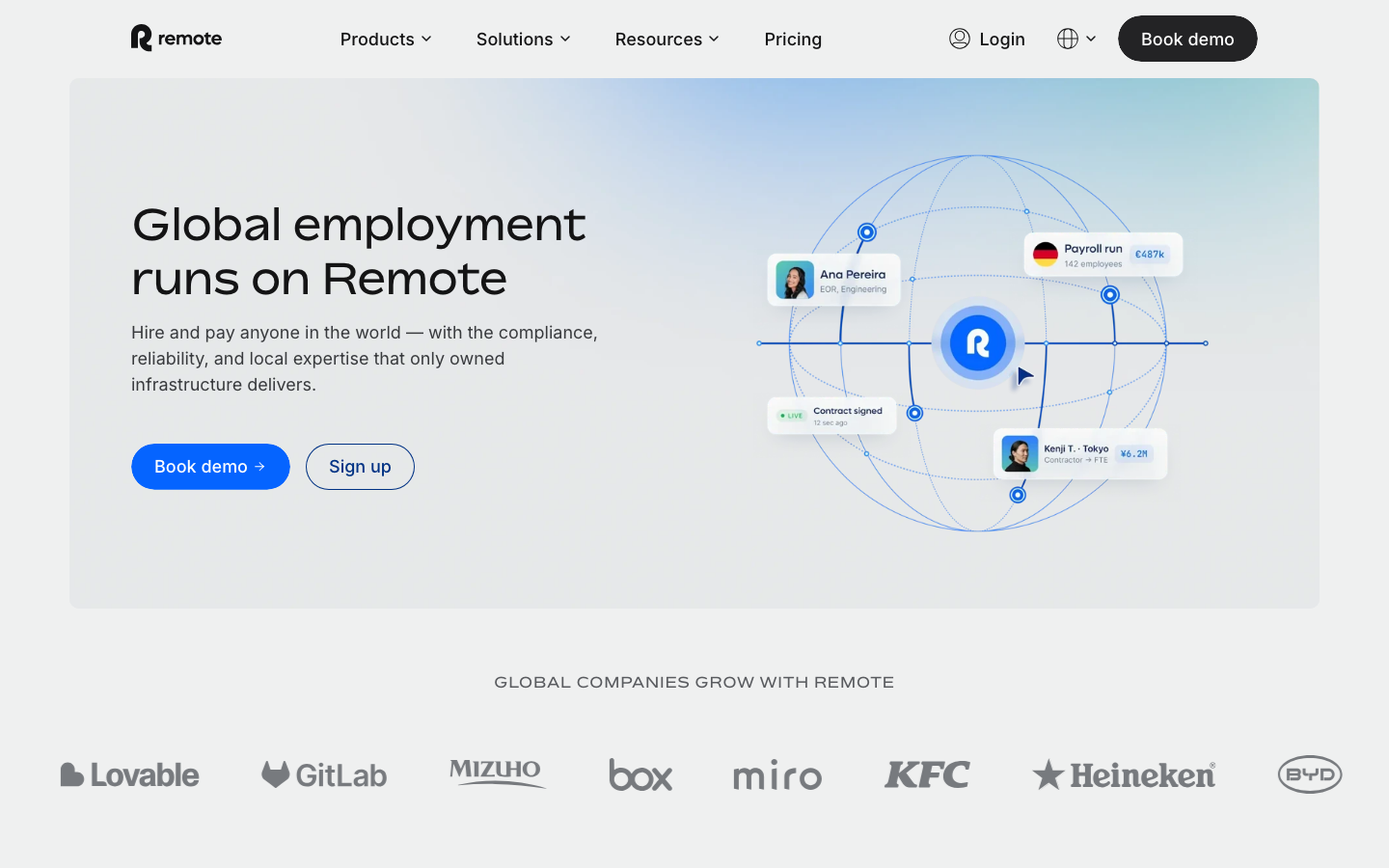
Remote employs only in countries where it owns the entity itself, which is the strictest position on this page. The vendor states it employs people without a local entity in 90+ countries. Because it owns every one, that figure is both its entity map and its coverage map. It publishes ISO 27001, SOC 2, and CSA STAR Level 1, plus native integrations with Workday, HiBob, BambooHR, and Personio.
Enterprise Strengths
- No third-party processors anywhere in its EOR footprint, by construction
- ISO 27001, SOC 2, and CSA STAR Level 1 all published on its own site
- The most documented HRIS integration set here, Workday included
- Intellectual property and invention-rights protection as a contractual feature
Trade-offs
- 90+ countries is the narrowest reach on this list, and it cannot employ elsewhere
- $699 per employee per month, the highest published figure on this page
- Owned-entity purity means no fallback in markets it has chosen not to enter
Remote Review
Judged on the entity question, Remote is the purist and pays for it in coverage. If your legal team treats a partner network as unacceptable risk, this is the shortest conversation on the page. If your country list includes markets it has not incorporated in, the answer is simply no, and no amount of commercial flexibility changes that. Check your list against its 90+ before anything else, because that test is binary.
Our Verdict
Owned Only, Narrower Reach
*As pricing is subject to change, we are listing prices as they stand in September 2026
Safeguard Global
Quick Overview
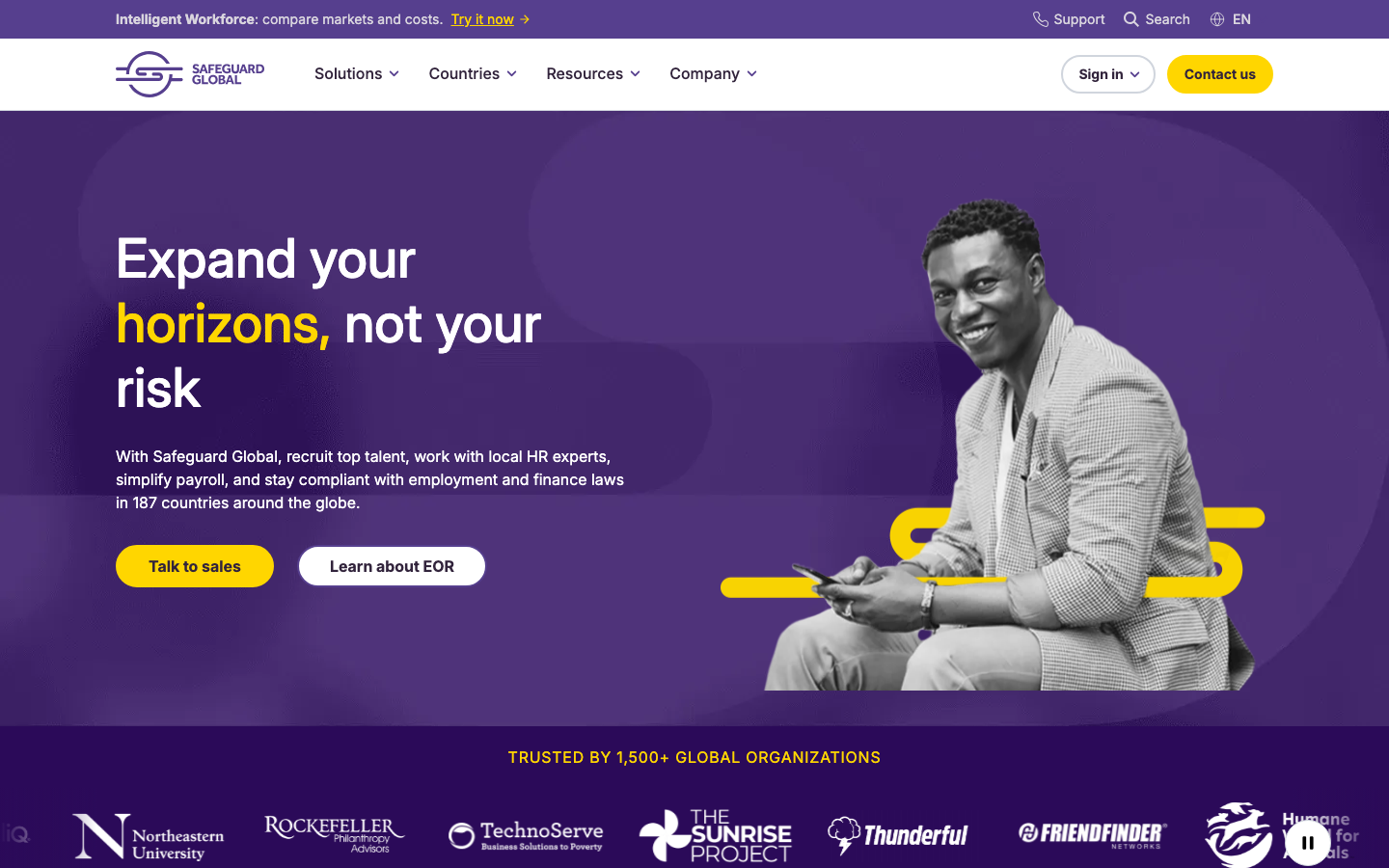
Safeguard Global delivers employment through in-country specialist teams and offers EOR alongside entity setup, finance, and tax work. Buyers can move between models as markets mature. The vendor states support across 187 countries, the largest published figure on this page. It publishes no owned-entity count and no security certification detail as readable text on its own site.
Enterprise Strengths
- The broadest published country support here at 187
- In-country specialist teams rather than a centralized service desk
- EOR, entity setup, finance, and tax available under one relationship
- 131 G2 reviews, a usable public sample
Trade-offs
- No owned-entity count published, and the model is unlikely to be uniform by market
- No security certifications published as readable text on its own site
- Model flexibility means a broader services relationship than a platform purchase
Safeguard Global Review
I keep landing on Safeguard Global for buyers who expect their operating model to change. Starting on EOR in a market and moving to an owned entity 2 years later is a real path. Few providers sell both halves credibly. Procurement will push back on the documentation. 187 countries with no published entity split invites exactly the question this page is about. Ask for the split market by market rather than a single figure.
Our Verdict
In Country Specialist Depth
INSIGHT: What stops an EOR deal at the procurement stage?
The demo is rarely the problem. The security report, the contract terms, and the exit clause are.
- 7 of the 11 providers here publish security certification details as readable text on their own sites: Atlas HXM, Deel, G-P, GoGlobal, Mercans, Multiplier, and Remote. The other 4 do not publish these details publicly, so supporting reports may need to be requested separately.
- ISO 27001 is the most common certification across the 11 providers, published by Atlas HXM, Deel, GoGlobal, Multiplier, and Remote. SOC 2 appears at Deel, Mercans, Multiplier, and Remote.
- 4 of the 11 publish an owned-entity count separately from their overall coverage count. Multiplier states 150+ owned entities and coverage across 160+ countries.
- The least negotiated and most consequential clause is the exit: employee transfer terms and data return get attention only when the relationship is already ending.
Sources:
as of September 2026. This is information for buyers, not legal or tax guidance
FAQs About Enterprise EOR Providers
What Is the Best Global EOR for Enterprise Companies?
No provider wins this category outright, regardless of what vendor-published comparison pages claim. The 11 providers here fall into 3 models: owned entity, hybrid, and program-led. Which model fits depends on your country list and risk posture, not a score. Ask each vendor to mark your actual markets as owned entity or partner, then check that answer against the comparison table above.
What Is the Difference Between an Owned-Entity and a Partner-Network EOR?
In an owned-entity model, the vendor’s own local subsidiary signs the employment contract, so the vendor is your counterparty on every claim and every inspection. In a partner network, the vendor contracts a local firm, and that firm becomes the actual employer. The difference decides who holds employee data and who answers a labor authority. It also decides whether the agreement you negotiated reaches the firm doing the work, and what happens if that firm fails.
How Many Employees Can an EOR Realistically Support?
There is no technical ceiling, and providers on this list administer populations in the thousands. The real limit is economic, and it is worth modeling market by market before committing. Above a certain headcount in a single country, incorporating and running your own entity usually costs less than per-employee platform fees. Where that crossover sits depends on incorporation cost, payroll complexity, and statutory obligations, so no universal number applies.
Does Using an EOR Create Permanent Establishment Risk?
Permanent establishment is a tax concept: a taxable presence created when a company’s activity in a country passes a threshold. An EOR reduces that exposure because it employs through a local entity, but it does not remove it. What the employees actually do usually matters more than who signs the contract, and sales staff concluding contracts carry more exposure than a support engineer. None of this is tax advice.
What Certifications Should an Enterprise EOR Have?
SOC 2 Type II and ISO 27001 are the baseline most procurement teams expect, along with a GDPR posture and a published sub-processor list. A logo on a website is not the same artifact as a scoped report you can read. Ask for the scope section rather than the certificate. A document covering a head office, and not the payroll platform holding your employee data, is weaker assurance than it looks.
Can We Move Employees From One EOR to Another?
Yes, with planning, and large employers do it regularly. The usual shape is a parallel run: the new provider onboards employees while the old one completes and closes its final payroll cycle. Employment continuity treatment varies by country, and a change of legal employer can reset or preserve service length. That affects notice and severance, so confirm each market individually rather than assuming 1 timeline will apply everywhere.
How Does EOR Pricing Work at Enterprise Volume?
A published per-employee monthly rate is an opening position at this scale, not a price. What moves the number is committed headcount, country mix, contract term, who funds payroll, FX handling, and whether immigration or benefits uplift is bundled. The platform fee also sits on top of gross salary, statutory employer contributions, and mandatory benefits, which are usually the larger share of total cost. Ask for the rate card by country rather than a single headline number.
Should a Large Company Use an EOR or Set Up Its Own Entity?
Treat it as a portfolio decision rather than a choice between 2 options. Entities make sense in core markets with sustained headcount, a local management presence, and a reason to hold assets there. Employment through a provider suits the long tail, markets still under evaluation, and populations you may not keep. Most large employers run both, and the useful question is where the line sits per market.

Helen is Anywherer’s Market Analyst & Content Researcher, with extensive experience in analyzing global employment markets and HR technology trends. She is skilled at turning complex market data into clear, well-researched insights that inform every piece of content. With a strong grasp of the EOR, PEO, and international hiring space, Helen plays a key role in keeping Anywherer’s research accurate, up to date, and genuinely useful for readers.