In an employer of record arrangement, someone else signs the employment contract, and you still run the work. Searching for an EOR for healthcare hides a split that decides everything, because the word covers two completely different purchases. Employing a digital health company’s engineers in Portugal is ordinary global employment. Employing a travel nurse two states away means becoming the legal employer of someone whose professional judgment can injure a patient. Most providers will do the first and decline the second, and no amount of country coverage changes that answer.
The demand behind the question is steady rather than dramatic. Staffing Industry Analysts reported in August 2026 that its July 2026 Pulse Survey found positive year-over-year median revenue growth. All four healthcare staffing segments it measures were up. Allied healthcare led at 4% and per diem nursing at 3%, with locum tenens at 2% and travel nursing at 1%. The same survey put average recruiting difficulty for travel nursing firms at 3.63 on a five-point scale, versus sales difficulty at 3.38. Placement volume, in other words, is limited by supply and by the administration behind each placement rather than by orders.
That administration is why this list is short. A provider earned a place here only by publishing a healthcare capability on its own site. A service for staffing firms naming healthcare among its sectors also counted. That filter removed most familiar global platforms, which publish no healthcare positions at all. For scale, SIA forecast US healthcare staffing revenue at $39.4 billion for 2025, with 2% growth in 2026. Travel nursing accounted for $14.2 billion of that and locum tenens for $9.6 billion. Nothing on this page is legal, regulatory, clinical, or insurance advice. Below, I’ve reviewed 10 providers in A-Z order.

INSIGHT: Will an EOR actually employ a nurse?

Most global platforms will employ a health-tech company’s engineers anywhere in the world and decline a travel nurse in the next state. The reason is medical liability.
- Of the 10 reviewed here, five publish that they employ clinical roles, one publishes non-clinical work only, and four publish no position on clinical employment at all (provider sites, read 27 August 2026).
- SIA forecast the US travel nursing segment at $14.2 billion for 2025 and locum tenens at $9.6 billion, inside a healthcare staffing market of roughly $40 billion (Staffing Industry Analysts, September 2025).
- What clinical employment actually requires is visible at FoxHire, which states it verifies nursing and allied health licenses daily through direct board access and tracks suspensions, restrictions, and expirations.
- Silence is not a soft yes. An agency cannot place a clinician against a provider that has never written down whether it will employ one.
Sources:
as of September 2026. Nothing here is legal, clinical, or insurance advice.
EOR for Healthcare Compared
Read the second column first. Everything else here depends on whether a provider will employ a licensed clinician. 4 of the 10 have never published an answer.
| Provider | Clinical roles employed | Family | Credentialing performed | Coverage | Professional liability |
|---|---|---|---|---|---|
| Ascen | Yes | US clinical and staffing back office | Healthcare credentialing named, scope not itemized | All US states, Canada, 140+ countries via expansion support | Not published |
| Atlas HXM | Not published | International for healthcare companies | Not published | Owned entities in 160+ countries | Not published |
| BOSS | Yes | US clinical and staffing back office | Employment screening only; clinical credentialing stays with the agency | 50 states | Not published |
| CXC Global | Not published | International for healthcare companies | Not published | 100+ countries | Not published |
| FoxHire | Yes | US clinical and staffing back office | Daily license verification via state boards, exclusions, immunizations, background and drug screening | All 50 states | Not published |
| Innovative Employee Solutions | Not published | US clinical and staffing back office | Not published | All 50 states and 150+ countries | Not published |
| Magnit | Not published | Talent supplier and program platform | Not published | 130+ countries | Not published |
| People2.0 | Yes | Talent supplier and program platform | Not published | 130+ countries | Not published |
| Remunance | Non-clinical only | International for healthcare companies | Not published | India | Not published |
| TCWGlobal | Yes | US clinical and staffing back office | Primary source verification of licenses, immunizations, background, and drug screening | US, plus international programs | Not published |
Checked in September 2026 against each provider’s own pages.
Which EOR Providers Will Actually Employ a Clinician
Employment law does not change when the employee holds a license, but the risk around it does. A registered nurse carries a scope of practice, meaning the range of tasks the license permits. They also carry a professional liability exposure that follows their judgment rather than your instructions. The employer of record sits inside that exposure. It also inherits licensure as an employment condition. A lapsed or restricted license makes the worker unable to perform the job they were hired for.
That is why most providers stop at the line. Malpractice exposure does not sit comfortably on a platform priced like software. Licensure is state-by-state in a way country coverage never solves. Industry commentary indicates that general global providers restrict themselves to non-clinical roles to avoid international medical liability. The pattern is visible in what the 10 publish. Ascen, BOSS, FoxHire, People2.0, and TCWGlobal cross the line. Remunance is explicitly non-clinical. Atlas HXM, CXC Global, Innovative Employee Solutions, and Magnit publish nothing either way.
The other half of healthcare is large and completely ordinary. Digital health, medtech, and life sciences companies hire engineers, clinical research associates, regulatory affairs staff, and commercial teams. Any competent global provider can employ them. A remote healthcare EOR arrangement for a telehealth company’s product team is not clinical employment, whatever the industry label says. Shop it against the best EOR companies rather than against this list. Bedside work is where the shortlist collapses.
So ask one question first, in writing: which job titles will you employ, and which will you not? Send it before you discuss price, before the demo, and before anyone builds a spreadsheet. A provider that employs clinicians will answer with a list. A provider that does not will answer with a paragraph about compliance. That single email disqualifies most of the market in a day, and it is the cheapest work in the whole selection process.
How an EOR Manages Compliance With Healthcare Licenses
Understanding how an EOR manages compliance with healthcare licenses means breaking credentialing into its parts, because providers carry some parts and leave others behind. Credentialing is the process of collecting and verifying the qualifications that allow a clinician to work. Six pieces matter, and the split between them is what an agency gets wrong.
- License verification and primary source verification. Primary source verification means confirming a credential with the issuing board rather than accepting a copy from the worker. That distinction is exactly what a surveyor asks about. FoxHire states it verifies nursing and allied health licenses through direct board access. TCWGlobal states it verifies all licenses and certifications directly from the issuing source. Ascen names healthcare credentialing as a service but doesn’t itemize it. The rest publish nothing.
- Ongoing monitoring. A license valid on Monday can be suspended by Friday, so the real question is frequency and source. FoxHire publishes the tightest answer on this list, stating that it monitors daily and automatically tracks suspensions, restrictions, and expirations against state boards. No other provider here publishes a monitoring cadence, which is a gap worth raising in a first call rather than assuming.
- Multi-state practice. A compact license lets a nurse practice across participating states under one multistate credential, reducing the licensing burden without touching the employer’s credentialing obligations. Those still run per assignment and per facility. Placing across state lines also multiplies employment registration, workers’ compensation, and tax positions. This is where a domestic provider holding active state coverage earns its fee.
- Exclusion and sanctions screening. Federal and state exclusion lists identify individuals barred from participating in federally funded health programs. The check is repeated rather than performed once, because a clinician can be excluded mid-assignment. FoxHire states it performs federal exclusion list checks. Nobody else on this list publishes an exclusion-screening position, which, for an agency billing reimbursed care, is a question to settle in writing.
- Health and background records. Immunizations and titers, TB screening, drug screening, and criminal background checks make up the bulk of a credentialing packet. FoxHire publishes tracking for TB, Hep B, MMR, Varicella, and flu. TCWGlobal publishes immunization records, TB testing, and respirator fit tests alongside background checks and drug screenings. Retention matters as much as collection, since a survey asks for documents rather than assurances.
- Where responsibility actually sits. BOSS publishes the clearest statement of the split on this list. It handles the employment screening layer during W-2 onboarding, while clinical credentialing remains the agency’s process. Using an employer of record does not transfer the facility’s own obligations either, and facilities routinely repeat verification regardless of who did it first. Three adjacent categories will surface while you shop, and none of them is an employer of record: credentialing platforms, vendor management systems, and clinician marketplaces.
Choosing an EOR by Healthcare Staffing Model
Four buying situations account for almost everyone who reaches this page, and they do not share a shortlist. A travel nursing agency and a health system running a contingent program are on opposite sides of the same placement. A medtech company hiring regulatory staff in three countries has a different problem again. Each provider appears once below, in the group where it genuinely belongs.
For Travel Nursing and Allied Health
The best EOR for healthcare staffing agencies placing travelers usually comes down to three things. Multi-state employment coverage, weekly pay against facility terms running to net-45 or net-60, and a credentialing packet turned around in days rather than weeks. Ascen, BOSS, and FoxHire all serve this desk. FoxHire is the deepest on credentialing and holds nurse staffing agency licenses in states that require them. Ascen and BOSS both pair W-2 employment with payroll funding, which is what limits placement volume when facilities pay slowly. Our Ascen review goes further into that back office.
Healthcare workers’ compensation class codes are the other reason this group is distinct. They are among the most expensive in the market and are quoted as a rate against payroll rather than a flat fee. A blended average tells you nothing about your own clinical mix. Agencies that want a general back-office comparison rather than a clinical one will find our dedicated guide to employer of record services for staffing agencies.
For Locum Tenens and Physician Placement
Locum tenens work stretches every timeline. Physician credentialing runs longer than nursing, and facility privileging proceeds alongside employment rather than after it. Professional liability arrangements are more complicated because the exposure is larger. Innovative Employee Solutions and TCWGlobal both serve this end of the market from a payrolling heritage. TCWGlobal publishes the more detailed screening position, and IES publishes none.
Higher bill rates make the economics easier and the diligence harder. Ask both providers what happens to liability cover after an assignment ends, since claims in physician work surface long after the contract closes. Confirm who is named on which policy before the first placement.
For Hospitals and Health Systems Running Contingent Programs
Here the buyer is the facility rather than the agency, and the problem is consistency across many supplier agencies at once. Magnit and People2.0 both operate at this layer. Magnit’s healthcare business, RightSourcing, has run vendor-neutral managed services for health systems since 2001 and states it serves more than 350 facilities. People2.0 sits on the supply side of the same programs, employing workers on behalf of the agencies feeding into them.
Documentation retrieval is the operational test. When a survey lands, someone has to produce credential files for clinicians employed by four different suppliers. A program that cannot do that quickly creates work for the facility rather than removing it.
For Healthcare and Life Sciences Companies Hiring Internationally
Choosing an EOR for a healthcare company hiring abroad is usually not a clinical decision. Roles include clinical research associates, regulatory affairs specialists, biostatisticians, field service engineers, and commercial teams, and standard global employment rules apply. Atlas HXM, CXC Global, and Remunance cover this ground. Atlas HXM owns its entities across 160+ countries. CXC Global runs vendor-neutral services across 100+ countries with published healthcare and life sciences verticals, and Remunance is India-only. Where the hiring is entirely non-clinical, compare them against EOR services for international hiring instead.
The healthcare framing mostly disappears at this level, and that is the useful insight. What remains is entity ownership, payroll accuracy, and benefits quality. The last question is whether a provider can support a trial site or a plant in the country you actually need.
What Healthcare EOR Actually Costs
Healthcare employment isn’t priced like corporate employment, and three costs sit behind every clinical bill rate without showing up as a platform fee. Healthcare workers’ compensation class codes are among the most expensive in the market. They are quoted as a payroll rate rather than a flat charge. Medical professional liability may sit with the provider, the agency, the facility, or the clinician, and which one it is can materially move the number. State registration for staffing agencies placing clinicians carries fees and sometimes surety bonds in the states that require it.
Then there is the cash cycle. Clinicians are paid weekly while facilities pay on net-45 to net-60 terms, so somebody finances the gap between them. Whether a provider funds payroll changes the effective cost of growth far more than a percentage point on the fee. The table below compares published starting fees and custom pricing, alongside professional liability coverage and payroll funding.
| Provider | Pricing model | Published price | Professional liability included | Payroll funding |
|---|---|---|---|---|
| Ascen | Quote only | Custom pricing | Not published | Embedded funding, no personal guarantees |
| Atlas HXM | Monthly EOR platform fee per employee | From $599 per employee per month | Not published | Not applicable |
| BOSS | Quote only, plan-based | Custom pricing | Not published | Funded and self-funded plans offered |
| CXC Global | Quote only | Custom pricing | Not published | Not published |
| FoxHire | Quote only | Custom pricing | Not published | Not published |
| Innovative Employee Solutions | Quote only | Custom pricing | Not published | Payroll funding offered |
| Magnit | Quote only, program based | Custom pricing | Not published | Not published |
| People2.0 | Quote only | Custom pricing | Not published | Not published |
| Remunance | Quote only | Custom pricing | Not published | Not applicable |
| TCWGlobal | Quote only | Custom pricing | Not published | Not published |
As pricing is subject to change, prices are listed as of September 2026.
How to Choose an EOR for Healthcare Staffing
I would start with the job titles question and refuse to move past it. Ask in writing which titles the provider will employ and which it will not, and treat a non-answer as a no. Then build a one-page credentialing matrix with three columns. What the provider performs, what stays with you, and what the facility will repeat anyway. That third column surprises people, and it is why credentialing costs more than the contract implies.
Next, liability. Ask who carries professional liability for clinical placements, on what policy type, and what happens to coverage after an assignment ends. Policy type matters as much as existence. Then ask for the workers’ compensation classes and rates that apply to your own clinical mix rather than a blended average. A respiratory therapist and a medical coder are not priced alike.
Confirm coverage for the states you actually place into, including any state staffing agency registration the provider holds or expects you to hold. Confirm the pay cadence and whether payroll is funded, since weekly clinician pay against long facility terms is the real constraint on placement volume. Ask how fast a credentialing packet completes and insist on the measured average rather than the best case.
Finally, ask for two references from agencies your size placing your clinical specialties, and call them. Ask those references what broke in the first quarter. Everything above can be answered in a sales call, and only that last question tells you what the answers were worth.
Top 10 Rated EOR Providers for Healthcare Staffing in 2026
I checked each provider’s own healthcare and service pages, the clinical position it publishes, and the credentialing scope it documents item by item. I also checked for a professional liability statement and pulled its public rating on the day of writing. Where a provider publishes nothing, I record it as nothing rather than filling it in from a review site.
I’m listing all providers in alphabetical order to keep this comparison neutral.
Search top-rated EOR for healthcare staffing, and you get the same global platforms that appear on every other list. Those are absent here on purpose, because they publish no healthcare positions at all. What is left splits three ways. US clinical and staffing back office, talent supplier and program platforms, and international providers for healthcare and life sciences companies.
Ascen
Quick Overview
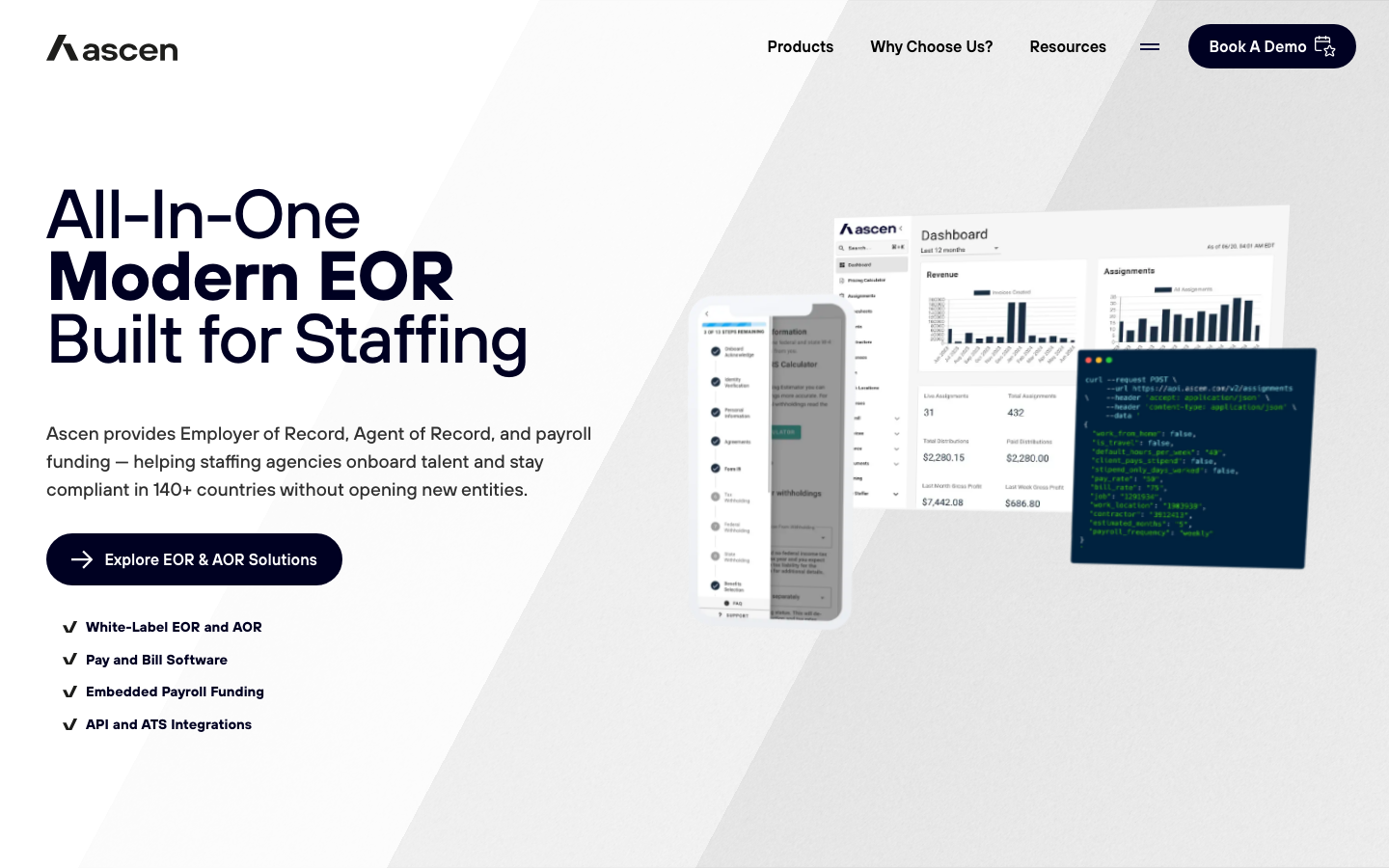
Ascen employs clinical roles, names healthcare staffing as a vertical it serves, and lists healthcare credentialing among its onboarding services. It belongs to the US clinical and staffing back office family, pairing white-label employer of record and agent of record work with embedded payroll funding. The vendor states it covers all US states, Canada, and 140+ countries through global expansion support. It also states its funding carries no personal guarantees or liens.
Healthcare Strengths
- Healthcare workers’ compensation class codes carried alongside professional and light industrial
- Payroll funding embedded in the platform, with no personal guarantee attached
- White-label employer of record and agent of record so the agency keeps the client relationship
- Pay and bill software and ATS integrations rather than a separate back office stack
Trade-offs
- Credentialing is named as a service, but the scope is not itemized publicly
- No professional liability position published anywhere on the site
- No public rating, since its listing carries no aggregate score
Ascen Review
I would trust Ascen for an agency that needs funding and employment in one place and already runs its own credentialing. The funding position is the differentiator here, and it’s often the binding constraint for a growing travel desk. This is the wrong call for an agency expecting the provider to own primary source verification, because that scope isn’t written down.
Our Verdict
Healthcare Vertical With Funding
Atlas HXM
Quick Overview
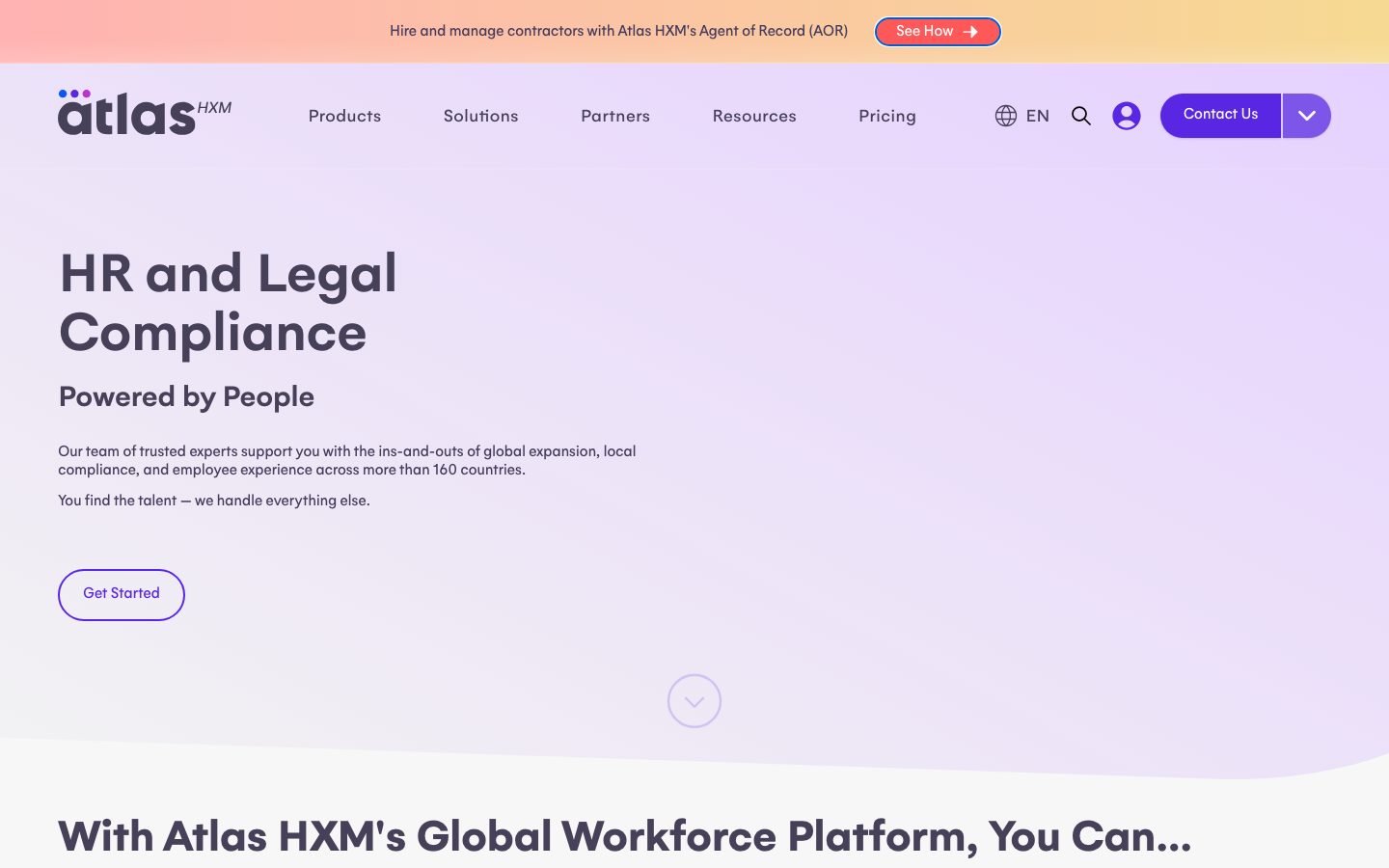
Atlas HXM does not publish any position on employing clinical roles. That places it in the international family serving healthcare and life sciences companies rather than staffing agencies. It is a direct employer of record, meaning it employs through entities it owns instead of local partners. The vendor states it holds fully owned and operated legal entities in 160+ countries. It also states it can onboard employees in as little as two weeks.
Healthcare Strengths
- Owned entities in 160+ countries, so employment is not sublet to a partner network
- Agent of Record (AOR) service for independent contractors, including worker classification assessment and recurring classification checks
- Visa sponsorship across 75+ countries for relocating research and technical staff
Trade-offs
- No published clinical position, so a staffing agency cannot act on it either way
- Nothing published on credentialing, licensure monitoring, or medical liability
- A 4.2 rating from 94 reviews, the only entry here clearing 50, but built for the hiring company rather than the agency
Atlas HXM Review
The clearest read on Atlas HXM is that it solves a different healthcare problem well. A medtech firm putting regulatory affairs staff into four countries gets owned entities and clean classification work. A nursing agency gets nothing it can use, and the silence on clinical employment should be read as a limit rather than an oversight.
Our Verdict
Owned Entity Global Employment
BOSS
Quick Overview
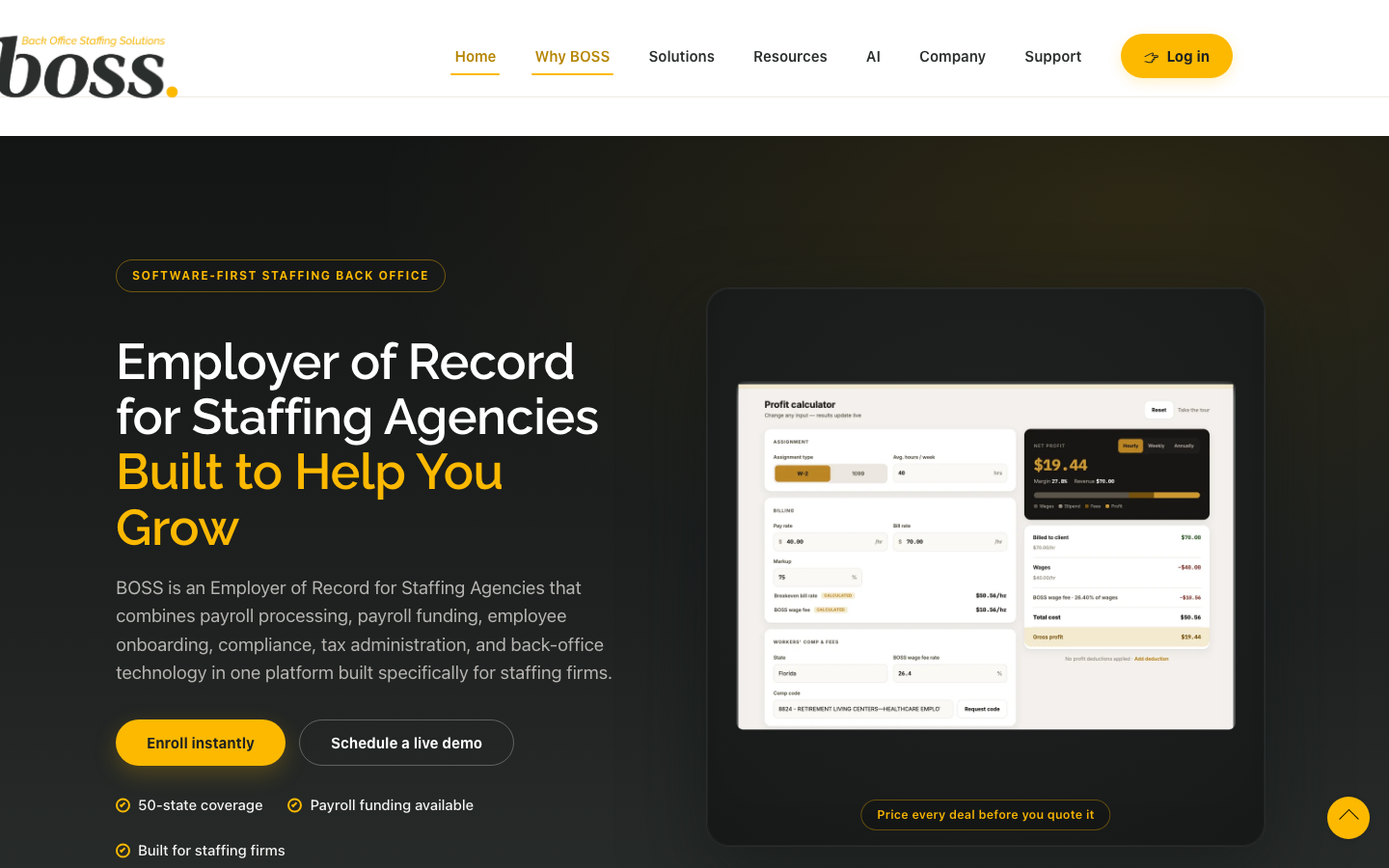
BOSS employs clinical workers as W-2 employees through its employer-of-record model, and it is unusually explicit about where the line sits. It sits in the US clinical and staffing back office family, combining payroll processing, payroll funding, onboarding, tax administration, and back-office technology for staffing firms. The vendor states it offers 50-state coverage, and its healthcare guidance states that workers’ compensation runs under the employer of record’s policy.
Healthcare Strengths
- The credentialing split is published plainly rather than left to a sales call
- Employment screening during W-2 onboarding covering client-required checks, drug tests, and background reviews
- Healthcare workers’ compensation class codes carried under the provider’s own policy
- Funded and self-funded plans, so an agency can choose who finances the payroll gap
Trade-offs
- Clinical credentialing stays with the agency by design, not with the provider
- Domestic only, with no route to placement outside the United States
- No public rating, and no published professional liability position
BOSS Review
What I could verify about BOSS is more useful than what most of this list publishes. Stating that clinical credentialing remains the agency’s process is an honest answer that saves an implementation from failing later. It suits an agency with its own credentialing function and a cash-flow problem. It is wrong for one hoping to outsource the packet itself.
Our Verdict
Domestic Back Office Engine
CXC Global
Quick Overview
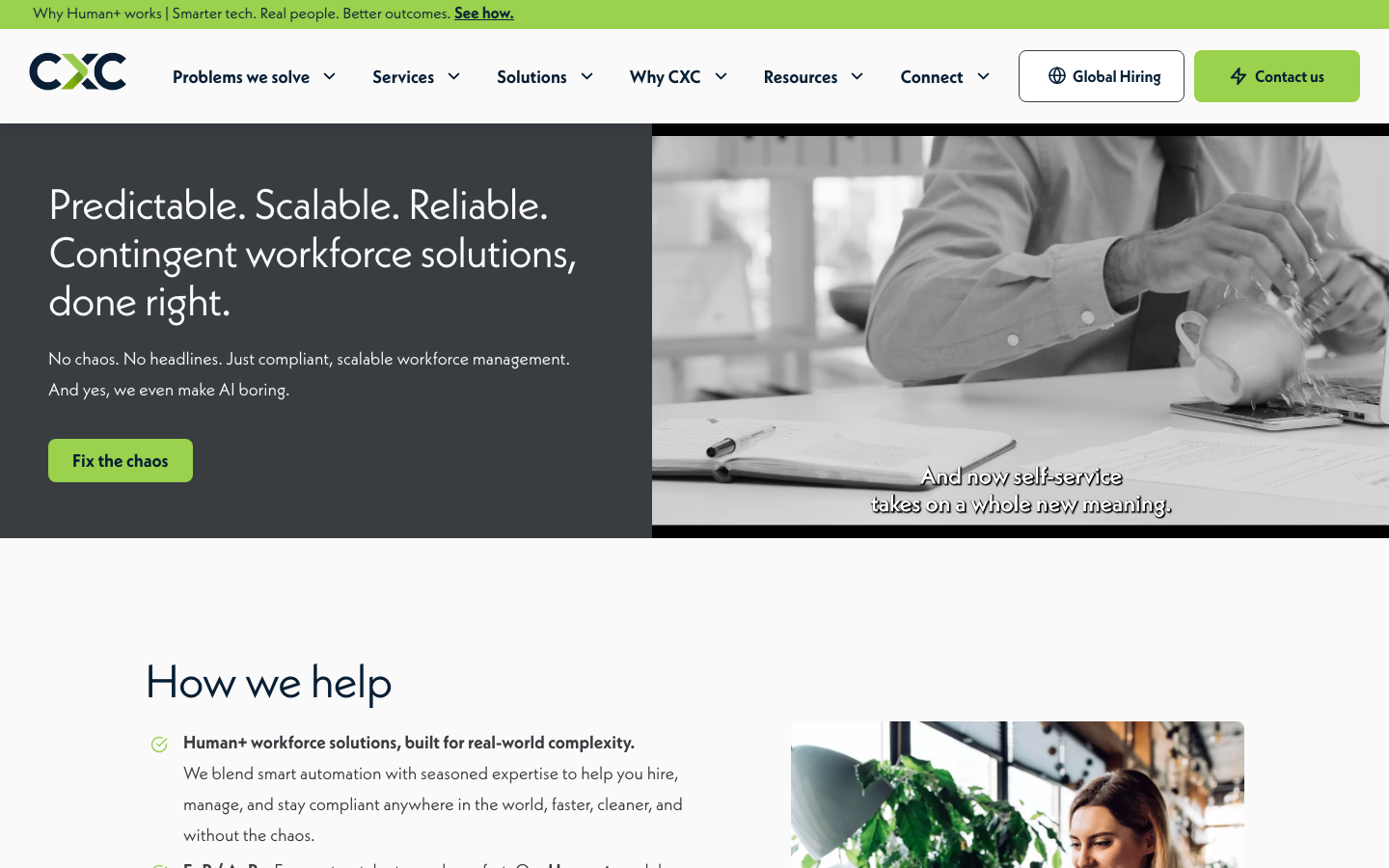
CXC Global publishes no position on employing clinical roles. It does name healthcare and life sciences as industry verticals and runs a dedicated CXC Health page for North America and ANZ. It belongs to the international family of healthcare companies, offering employer of record and agent of record work alongside vendor-neutral managed services. The vendor states it operates across 100+ countries and has 34 years of operation.
Healthcare Strengths
- Published healthcare and life sciences verticals rather than a generic industry list
- Vendor-neutral managed services alongside employment, useful where a program already exists
- Long operating history across 100+ countries for companies hiring research and commercial staff
Trade-offs
- A published healthcare vertical page is not the same as clinical employment capability
- Nothing published on credentialing, license monitoring, or medical liability
- A 5.0 rating drawn from 2 public reviews, too thin to read anything into
CXC Global Review
My shortlist keeps CXC Global for the healthcare company hiring across borders rather than for the agency placing clinicians. The vertical pages describe serving healthcare organizations, which is a different claim from employing licensed clinicians. I would confirm that difference in writing before shortlisting it for anything patient-facing.
Our Verdict
Vendor Neutral Global Coverage
FoxHire
Quick Overview
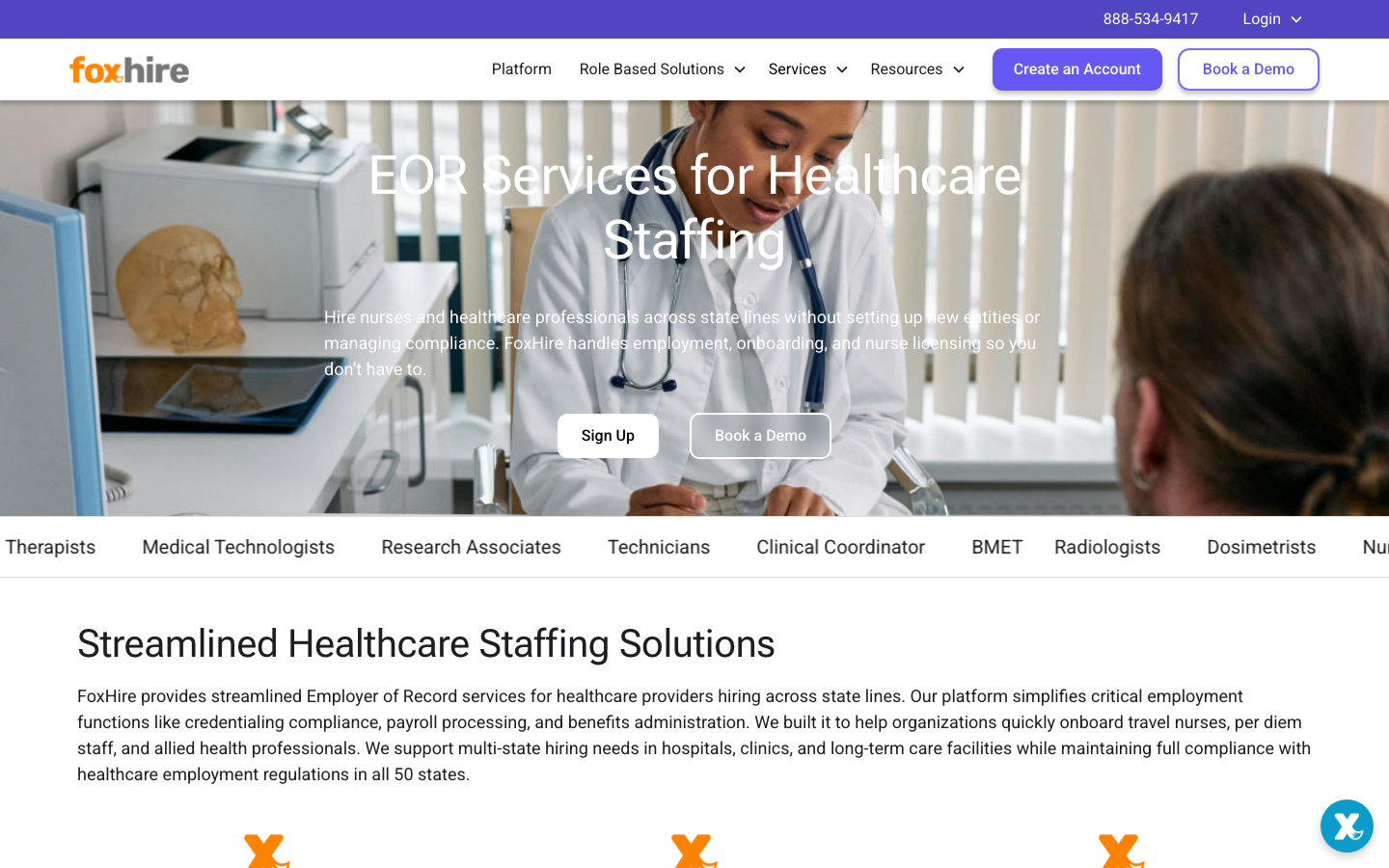
FoxHire employs clinical roles and publishes the deepest credentialing detail on this list, which makes it the benchmark every other entry is measured against. It is a US clinical and staffing back office provider operating since 1992 across all 50 states. The vendor states it can legally employ RNs, LPNs, radiologists, dosimetrists, respiratory therapists, medical technologists, and other allied health roles.
Healthcare Strengths
- Daily license verification through direct state board access, with suspensions, restrictions, and expirations tracked automatically
- Federal exclusion list checks, drug screens, and criminal background reviews
- Immunization tracking covering TB, Hep B, MMR, Varicella, and flu
- Active nurse staffing agency licenses in the states that require them, including New York, Massachusetts, Illinois, and Washington
Trade-offs
- United States only, so international placement is not an option
- No professional liability position published, which is the one gap in an otherwise detailed picture
- A 4.9 rating from only 26 public reviews, thin for a provider operating since 1992
FoxHire Review
I came to see FoxHire as the reference point for what clinical employment actually requires. Daily board monitoring and state staffing licenses are operational commitments rather than marketing lines, and they are what a travel nursing agency is buying. It is the wrong answer only when placement crosses a border, at which point the list changes entirely.
Our Verdict
Deepest Published Clinical Credentialing
Innovative Employee Solutions
Quick Overview
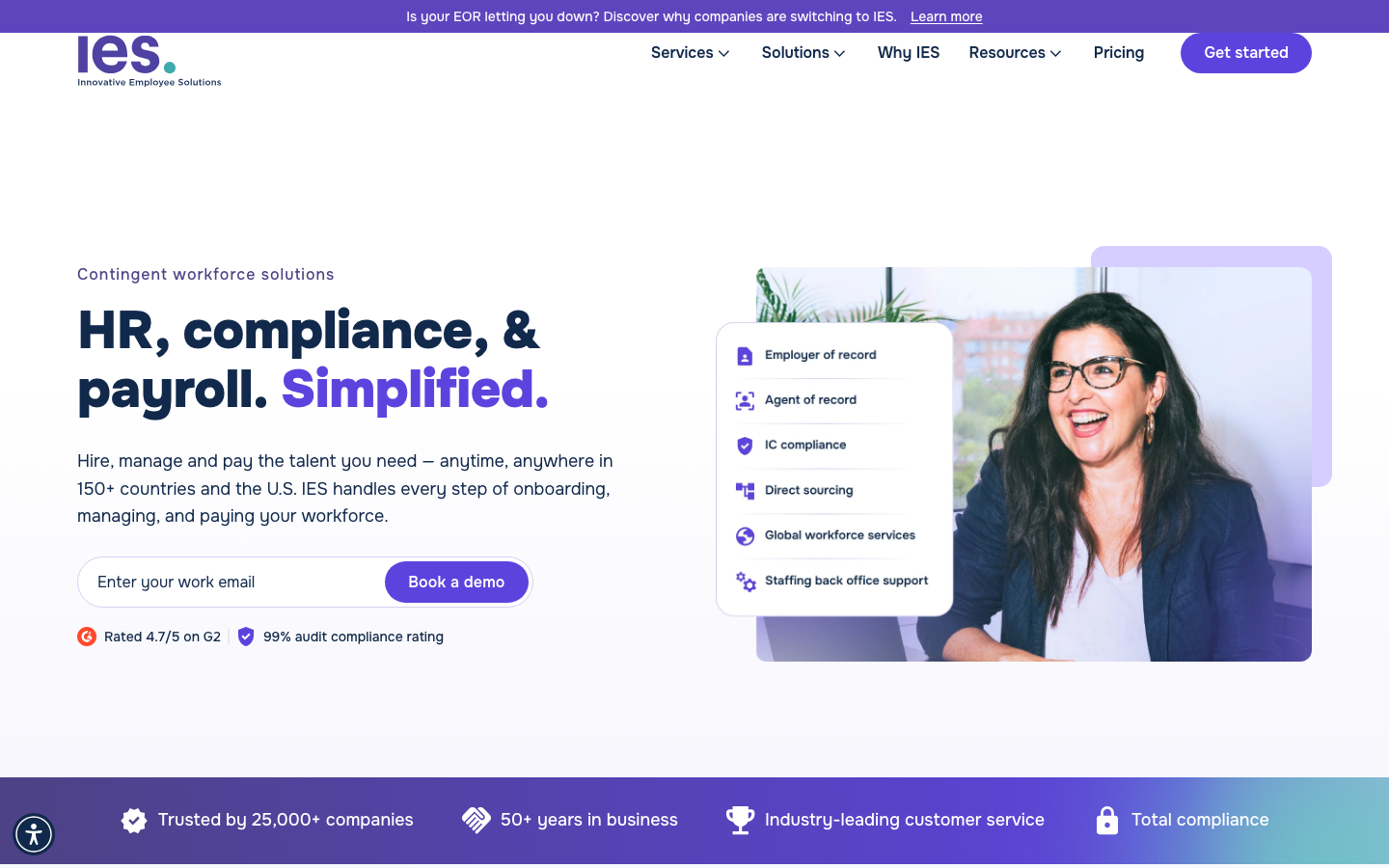
Innovative Employee Solutions publishes no position on employing clinical roles, despite serving staffing organizations adding contract placement. It sits in the US clinical and staffing back office family. The offering covers employer of record, agent of record, and back office support, including invoicing and payroll funding. The vendor states it operates across all 50 US states and 150+ countries, with 50+ years in business and 25,000+ companies served.
Healthcare Strengths
- Employment, contractor engagement, and back office invoicing under one provider
- Domestic and international coverage from a single relationship rather than two
- Payroll funding and profit payments built into the back office offering
Trade-offs
- No published clinical position, which a healthcare agency cannot work around
- Nothing published on credentialing scope or professional liability
- A 4.7 rating from 23 public reviews, and no split of direct versus partner markets
Innovative Employee Solutions Review
I would trust Innovative Employee Solutions on the mechanics of contract employment, where a fifty-year history counts for something real. The problem for this page is silence. Sector-agnostic marketing leaves a healthcare agency guessing at the answer that matters most, and surveys punish guessing. Ask before shortlisting.
Our Verdict
Long-Running Payrolling Specialist
Magnit
Quick Overview
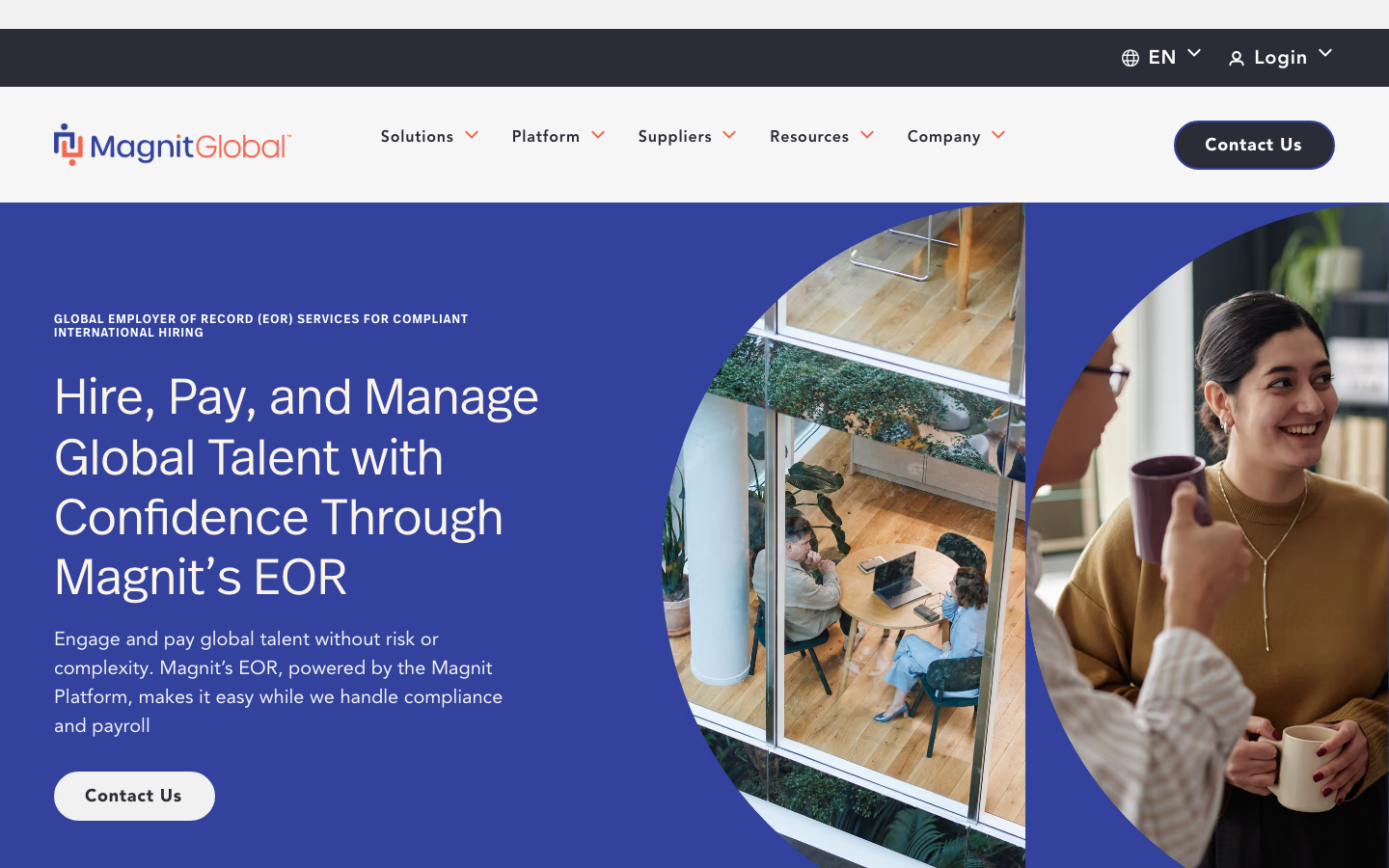
Magnit publishes no clinical positions on its employer-of-record line, which runs across 130+ countries and is sold to enterprises rather than agencies. It belongs to the talent supplier and program platform family. Its healthcare business, RightSourcing, has run vendor-neutral managed services for health systems since 2001 and states it serves more than 350 facilities nationwide. It manages contingent workforces rather than directly employing clinicians.
Healthcare Strengths
- A healthcare business with 25 years of vendor-neutral managed services behind it
- Program-level visibility across many supplier agencies at once, including per diem
- Employer of record capability across 130+ countries for the non-clinical half of a health system’s contingent workforce
Trade-offs
- The buyer is the health system or enterprise, not the agency supplying into it
- Clinical workers typically run through supplier agencies in the program rather than through the employer of record line
- A 4.5 rating drawn from 1 public review, and no published credentialing or liability position
Magnit Review
The clearest read on Magnit is that you have to know which side of the placement you sit on. For a health system consolidating a contingent program, it is a serious option with a long healthcare track record. For an agency wanting an employer of record for its own nurses, it is a program to register with rather than a provider to buy.
Our Verdict
Health System Program Platform
People2.0
Quick Overview
People2.0 employs clinical roles, as shown in its own case study describing a healthcare staffing division that placed nurses into health systems across the country. It is the largest dedicated provider in the talent supplier and program platform family. Employment, contractor engagement, and back office run from onboarding through invoicing across 130+ countries. The vendor states that the division assigned more than 100 nurses.
Healthcare Strengths
- Documented clinical employment for a staffing client rather than a generic healthcare page
- Employer of record and agent of record together, so worker classification decisions stay in one place
- Scale across 130+ countries for suppliers running both domestic and cross-border desks
Trade-offs
- Credentialing scope is not published item by item, only described in general terms
- No professional liability position published for clinical placements
- A 4.0 rating drawn from 1 public review, which tells you nothing about service quality
People2.0 Review
What I could verify about People2.0 is that clinical work happens, which already puts it ahead of four providers here. The scale suits a supplier growing past what a domestic-only back office can carry. I would still get the credentialing split in writing, since the case study proves capability without describing who does which part.
Our Verdict
Talent Supplier Scale Employment
Remunance
Quick Overview
Remunance serves non-clinical healthcare roles only, and it is India-focused by design rather than by limitation. It belongs to the international family for healthcare and life sciences companies. The offering covers employer of record, PEO, and subsidiary formation in a major life sciences delivery market. Its healthcare writing names clinical research associates, telemedicine specialists, medical coders, and regulatory professionals as the roles it addresses.
Healthcare Strengths
- Deep single-market knowledge of Indian payroll, statutory contributions, and labor law
- Relevant to pharmaceutical, medical device, and clinical research organizations building delivery teams
- Subsidiary formation alongside employment, so a company can graduate from one to the other
Trade-offs
- India only, so it cannot be compared with the global providers on this list
- Non-clinical work only, with no patient-facing employment capability
- No public rating, and no published credentialing or liability position
Remunance Review
My shortlist keeps Remunance in a narrow slot, and I would not stretch it. A life sciences company building a clinical data or pharmacovigilance team in India gets genuine local depth. Any reader who arrived here looking for someone to employ nurses should move on immediately, because this is a different product answering a different question.
Our Verdict
India Life Sciences Hiring
TCWGlobal
Quick Overview
TCWGlobal employs clinical roles through its healthcare brand, TCWGlobal Remedy. It covers RNs, LPNs, and LVNs; travel nurses; charge nurses; physicians; advanced practice providers; and allied health staff. It sits in the US clinical and staffing back-office family, with international program coverage. The vendor states it has worked with 750+ clients and 15,000+ workers globally over 15 years.
Healthcare Strengths
- Primary source credentialing, verifying licenses and certifications directly from the issuing source
- Immunization records, TB testing, and respirator fit tests alongside background and drug screening
- Reference and employment verifications built into the same onboarding process
- Payrolling and employer of record work available alongside the healthcare staffing brand
Trade-offs
- No published monitoring cadence, so how often licenses are rechecked is unclear
- No professional liability position published for clinical placements
- A 4.5 rating drawn from 1 public review, and no split of the international footprint
TCWGlobal Review
I came to see TCWGlobal as the closest thing this list has to a second benchmark. Primary source verification stated plainly is the claim that matters, and Remedy reads as a real clinical operation rather than an industry page. The open question is monitoring frequency, where FoxHire is still the only provider with a published answer.
Our Verdict
Primary Source Clinical Screening
INSIGHT: What is in a clinical bill rate that nobody quotes?
Healthcare workers’ compensation classes, professional liability, and state staffing agency registration sit behind every clinical placement. None of them appears in an employer of record platform fee.
- New York requires temporary health care services agencies to register with its Department of Health under Public Health Law Article 29-K, on a registration year running 1 August to 31 July, with a $1,000 annual fee on the department’s own application form (version dated 15 April 2026). Requirements vary by state, and several states require nothing at all.
- Not one of the 10 publishes a professional liability position for clinical placements. Five publish that they employ clinical roles; none of the five states carry the malpractice cover.
- BOSS publishes that workers’ compensation for clinicians runs under the employer of record’s policy, and that healthcare class codes are among the most expensive in the market.
- Clinicians are paid weekly, and facilities pay on net-45 to net-60 terms, so somebody funds the gap between them.
Sources:
as of September 2026. Nothing here is legal or insurance advice.
FAQs About EOR for Healthcare Staffing
What Is EOR in Healthcare?
One company signs the employment contract for your workers and carries payroll, taxes, benefits, and workers’ compensation. You continue to direct the work itself. The answer then splits in two, and for a software engineer at a digital health firm it is ordinary global employment. For a nurse, it means employing someone whose professional judgment carries patient risk, which most providers decline.
Which Is the Leading Global EOR for Healthcare Companies?
For corporate, research, and commercial roles, the choice is an ordinary global hiring decision. Judge entity ownership, payroll accuracy, and benefits in the countries you need. No provider is a global clinical employer, because licensure and medical liability are jurisdiction-specific and nobody has solved that at scale. The second column of the table above separates those two cases, which is the fastest way to see it.
Can an EOR Employ Licensed Clinicians?
Some will and most will not. The answer depends on whether the provider accepts malpractice exposure and holds employment coverage in the states where the clinician practices. Payroll processing is not the constraint. Get the answer in writing before anything else, as a list of job titles it will and will not employ, because silence is not agreement.
Who Verifies a Clinician’s License, the EOR or the Facility?
Usually both, and often the agency as well. Responsibility is split rather than transferred, and facilities routinely repeat verification on their own terms regardless of who performed it first. Using a provider does not remove the facility’s own obligations, which stay where they are. Map the split in writing before the first placement, and treat this as a description of practice rather than legal advice.
Does an EOR Provide Malpractice Cover for Clinical Staff?
Arrangements vary by provider, policy type, and state. Some carry cover, some require the agency to hold it, and some rely on the clinician’s individual policy. Policy type matters as much as existence, since claims-made and occurrence policies behave very differently once an assignment ends. None of the 10 providers reviewed here publishes its position, so ask.
Do I Still Need a State Staffing Agency License If I Use an EOR?
Possibly. Several states register or license agencies supplying temporary health care personnel, with fees, bonds, and administrator requirements that differ considerably, while some require nothing. Using a provider does not automatically remove an obligation that attaches to your business rather than to the employment relationship. Check with the health department in each state you place into.
Can an EOR Run Weekly Payroll for Travel Nurses?
Many corporate platforms cannot, because they were built around salaried monthly employment and treat weekly cycles as an exception. Verify the pay cadence, timesheet capture, per diem and stipend handling, and whether the provider funds payroll while facilities pay on long terms. Ask this before price, because a provider that cannot pay weekly is disqualified regardless of what it charges.
Can an EOR Employ Healthcare Workers Outside the United States?
For non-clinical roles, routinely. Ordinary global providers employ research, regulatory, engineering, and commercial staff abroad every day. For clinical roles, rarely, because licensure sits with a national or state authority and medical liability is written jurisdiction by jurisdiction. Treat any provider claiming global clinical employment as a claim to verify rather than a capability to assume.

Helen is Anywherer’s Market Analyst & Content Researcher, with extensive experience in analyzing global employment markets and HR technology trends. She is skilled at turning complex market data into clear, well-researched insights that inform every piece of content. With a strong grasp of the EOR, PEO, and international hiring space, Helen plays a key role in keeping Anywherer’s research accurate, up to date, and genuinely useful for readers.