Writing performance appraisals is one of the most time-consuming tasks managers face, and one of the most impactful when done well. The challenge is not whether feedback matters but how to phrase it clearly enough that the employee knows exactly where they stand. Research from McKinsey shows that companies focusing on their people’s performance are 4.2 times more likely to outperform their peers. Yet most managers struggle with the actual writing, falling back on vague phrases that leave employees confused about what to keep doing and what to change.
That is where a ready-made collection of performance appraisal examples helps. Instead of starting from a blank page, managers can reference specific, professionally written comments and adapt them to each employee’s situation. Whether you need a how to write performance appraisals sample or a complete sample performance evaluation for a specific role, having a reference library makes the process faster, more consistent across the team, and more useful for the person receiving it.
This article contains over 200 review comments organized into 12 categories that cover the most common areas of employee performance. Each category includes employee evaluation examples and examples of performance evaluations for two rating levels: Below Expectations and Meets or Exceeds Expectations. You can use them as a starting point for your own performance appraisal comments, adjusting the language to fit each employee’s specific role and context.
200+ Performance Appraisal Examples by Category
The examples of performance appraisal below are grouped into 12 categories that come up most frequently in employee reviews: quality of work, productivity, communication, collaboration, problem-solving, accountability, adaptability, reliability, leadership, goal achievement, remote work effectiveness, and professionalism. As SHRM notes, effective performance reviews should be a continuous process rather than a one-time event, with clear expectations, regular feedback, and documented outcomes.
Each category includes a brief description of what the area covers, followed by numbered examples for each rating level and a summary table with condensed versions for quick reference. You can treat each sample of performance appraisal as a starting point and adjust the performance review phrases to fit the individual. The more you tailor each comment, the more impact it will have.
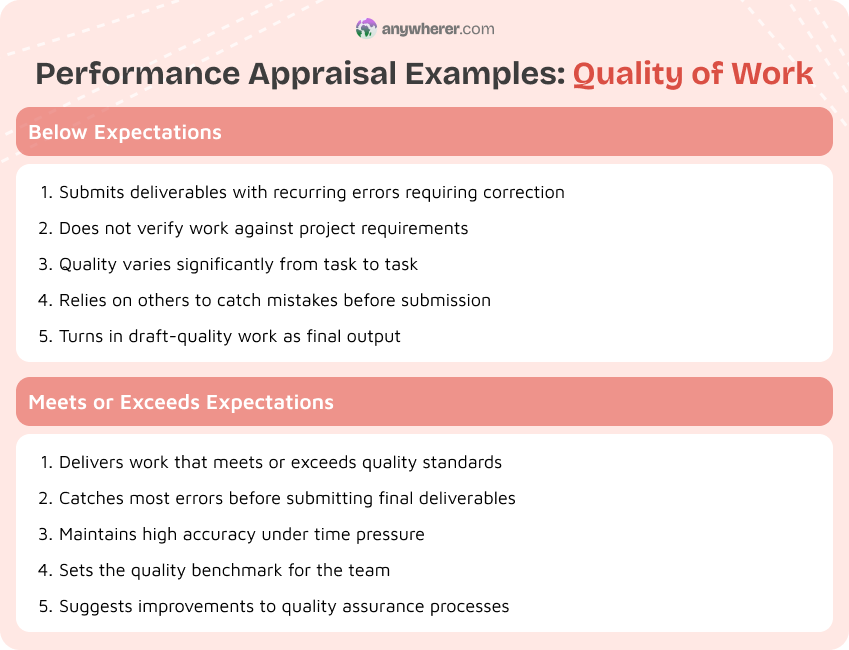
Quality of Work
Quality of work comments address accuracy, thoroughness, and the overall standard of output an employee delivers. These performance appraisal examples help managers describe patterns in work quality rather than reacting to isolated incidents.
Below expectations:
- Submits deliverables with recurring errors that require review and correction before they can be shared externally.
- Does not consistently verify work against project requirements, resulting in avoidable gaps in the final output.
- The level of detail in completed assignments frequently falls short of what is expected for this role.
- Produces work that varies in quality from task to task, making it difficult to maintain a predictable standard.
- Has been asked to revise the same type of deliverable multiple times due to repeated accuracy issues.
- Misses key details in client-facing materials, which creates additional review cycles for the team.
- Relies on others to catch errors rather than building a personal review habit before submission.
- Turns in draft-quality work as final output, which shifts the editing burden to teammates.
- Does not apply corrections from previous feedback to new assignments, resulting in the same types of mistakes.
- Completes tasks quickly but at the expense of precision, which undermines the reliability of the output.
Meets or exceeds expectations:
- Consistently delivers work that meets or exceeds the team’s quality standards with minimal need for revision.
- Pays close attention to detail and catches most errors before submitting final deliverables for review.
- Follows established quality guidelines and applies them uniformly across different types of assignments.
- Produces output that other team members can confidently build on without needing to re-verify the underlying work.
- Maintains a high standard of accuracy even when working under time pressure or shifting priorities.
- Reviews their own work carefully and applies lessons from past feedback to improve quality over time.
- Handles both routine and complex assignments with a consistent level of care and thoroughness.
- Asks for clarification when instructions are ambiguous to avoid producing work that misses the mark.
- Delivers clean, well-organized output that meets professional standards and is ready for stakeholder review.
- Regularly exceeds expectations by identifying potential issues in deliverables before they reach the next stage.
- Sets the quality benchmark for the team by treating every assignment, whether high-profile or routine, with the same attention to detail.
- Proactively suggests improvements to quality assurance processes that benefit the broader team.
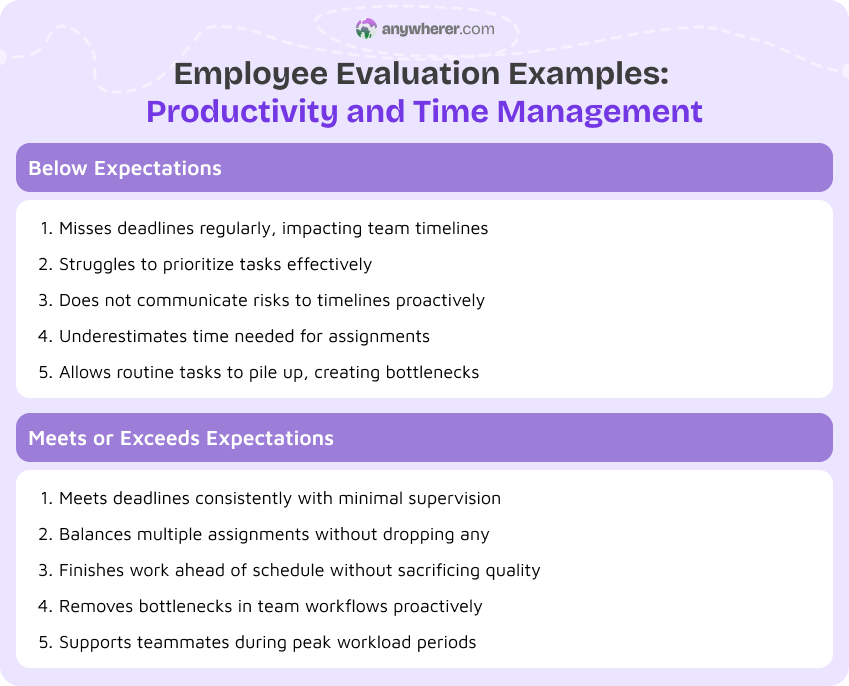
Productivity and Time Management
Productivity comments focus on how efficiently an employee uses their time, manages priorities, and meets deadlines. These performance feedback examples help managers describe output patterns without resorting to vague statements.
Below expectations:
- Misses deadlines regularly, and the delays have a visible impact on team timelines and dependent work.
- Struggles to prioritize tasks effectively, often spending too much time on lower-impact activities.
- Takes significantly longer than expected to complete standard assignments without communicating the reason.
- Does not flag risks to timelines proactively, leaving the team to discover delays after the fact.
- Needs frequent check-ins to stay on track with work that should be manageable independently at this level.
- Spends time on non-essential tasks while higher-priority items remain incomplete or overdue.
- Consistently underestimates the time needed for assignments, which causes last-minute rushes and lower quality.
- Fails to break large projects into smaller milestones, which makes progress difficult to track.
- Allows routine administrative tasks to pile up, creating bottlenecks that affect team workflows.
- Does not adjust priorities when circumstances change, continuing to work on outdated tasks.
Meets or exceeds expectations:
- Completes work on time and manages daily responsibilities without needing close supervision or reminders.
- Prioritizes tasks appropriately and adjusts quickly when new requests come in during the workday.
- Meets deadlines consistently and communicates early when there is a genuine risk of delay.
- Balances multiple assignments at once and keeps each one moving forward without dropping any.
- Plans workdays effectively and uses available tools and systems to stay organized.
- Delivers a steady volume of output that matches expectations for the role and workload level.
- Breaks larger projects into manageable steps and stays on schedule through each phase.
- Responds promptly to time-sensitive requests and adjusts priorities accordingly without losing momentum.
- Consistently finishes work ahead of schedule without sacrificing quality, which gives the team more flexibility.
- Manages a heavier-than-average workload and still delivers high-quality results on time across all assignments.
- Proactively identifies and removes bottlenecks in team workflows, improving overall efficiency.
- Helps teammates manage their own workload by offering support during peak periods.
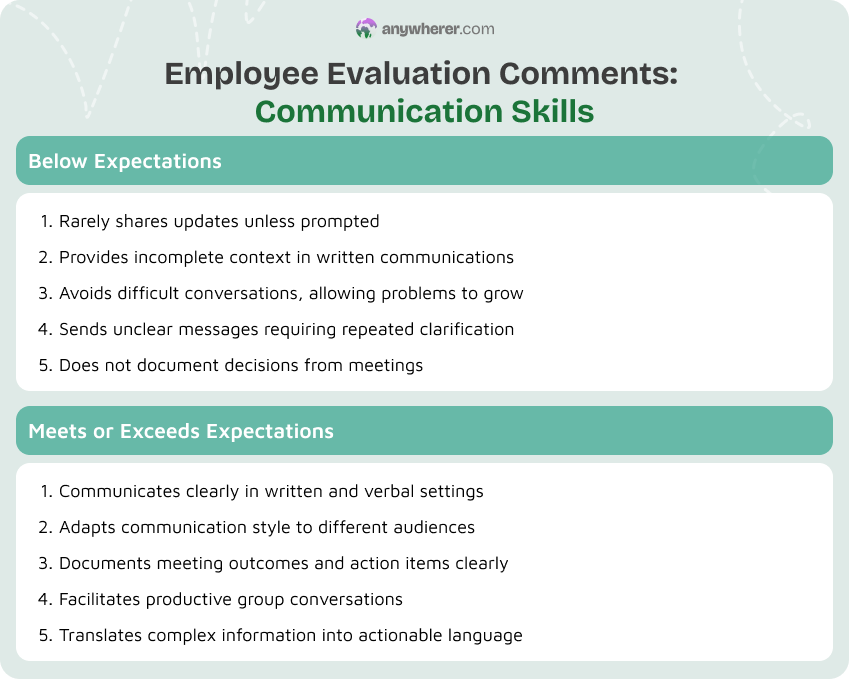
Communication Skills
Communication comments evaluate how clearly and effectively an employee shares information, responds to colleagues, and contributes to team discussions. Strong performance evaluation comments in this area highlight specific patterns rather than general impressions.
Below expectations:
- Rarely shares updates with the team unless prompted, which creates information gaps that slow collaborative work.
- Responds to messages and emails inconsistently, sometimes leaving colleagues waiting for critical information.
- Tends to provide incomplete context in written communications, which leads to follow-up questions and delays.
- Struggles to express ideas clearly in meetings, resulting in misunderstandings or incomplete hand-offs.
- Avoids difficult conversations rather than addressing issues directly, which allows small problems to grow.
- Does not tailor communication style to different audiences, using the same approach regardless of context.
- Sends unclear or disorganized messages that require colleagues to ask for clarification repeatedly.
- Fails to document decisions and action items from meetings, which causes confusion about next steps.
- Interrupts others frequently during discussions, which limits the team’s ability to share perspectives.
- Does not acknowledge receipt of important communications, leaving senders uncertain about the status.
Meets or exceeds expectations:
- Communicates clearly in both written and verbal settings and keeps the team informed about task progress.
- Responds to messages and requests from colleagues in a timely and professional manner.
- Participates actively in team meetings and contributes ideas that move discussions forward constructively.
- Adapts communication style to suit different audiences, from technical peers to senior leadership.
- Documents meeting outcomes and action items clearly so everyone knows what was agreed upon.
- Gives and receives feedback with professionalism, keeping conversations focused on outcomes rather than personalities.
- Actively listens during discussions and asks clarifying questions when something is unclear.
- Writes clearly and concisely in emails and project documentation, reducing the need for back-and-forth.
- Builds strong working relationships across departments through consistent and transparent communication.
- Facilitates productive group conversations and helps the team reach decisions more efficiently.
- Proactively identifies communication gaps and establishes processes that improve team alignment.
- Translates complex information into clear, actionable language for a range of audiences, including non-technical stakeholders.
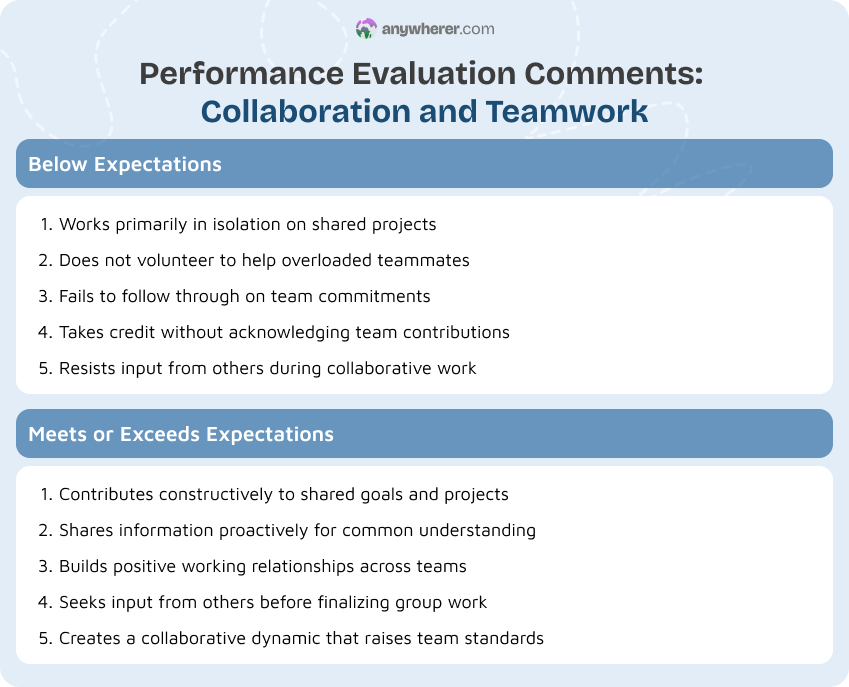
Collaboration and Teamwork
Collaboration comments assess how well an employee works with others, contributes to shared goals, and supports the team environment. These examples of performance appraisal focus on observable teamwork behaviors that managers can document with confidence.
Below expectations:
- Works primarily in isolation and does not actively engage with the team on shared projects or priorities.
- Does not volunteer to help when teammates are overloaded, even when they have available capacity.
- Creates friction in group settings by dismissing others’ ideas without offering constructive alternatives.
- Fails to follow through on commitments made to the team, which disrupts shared timelines and deliverables.
- Does not share relevant information with colleagues, resulting in duplicated effort or missed opportunities.
- Avoids participating in group discussions, which limits the team’s ability to make well-rounded decisions.
- Takes credit for collaborative work without acknowledging the contributions of other team members.
- Resists input from others and insists on their own approach, even when team consensus points elsewhere.
- Does not adapt when working with new team members or cross-functional partners, causing unnecessary tension.
- Ignores agreed-upon processes and workflows, which creates confusion for colleagues who depend on them.
Meets or exceeds expectations:
- Works well with colleagues across the team and contributes constructively to shared goals and projects.
- Offers to help teammates when they are under pressure and redistributes effort willingly during busy periods.
- Shares relevant information and context proactively so the team can work from a common understanding.
- Follows through on commitments to the team and communicates early if any adjustments are needed.
- Participates actively in group discussions and respects differing viewpoints during collaborative work.
- Adapts working style when collaborating with new teams or cross-functional partners without creating friction.
- Builds positive working relationships that make collaborative projects more efficient and enjoyable.
- Supports a team environment where colleagues feel comfortable sharing ideas and raising concerns.
- Actively seeks input from others before finalizing work that affects the broader group.
- Regularly contributes to team success in ways that go beyond individual responsibilities.
- Facilitates alignment between different groups and helps resolve disagreements constructively.
- Creates a collaborative dynamic that raises the overall standard of teamwork across the department.
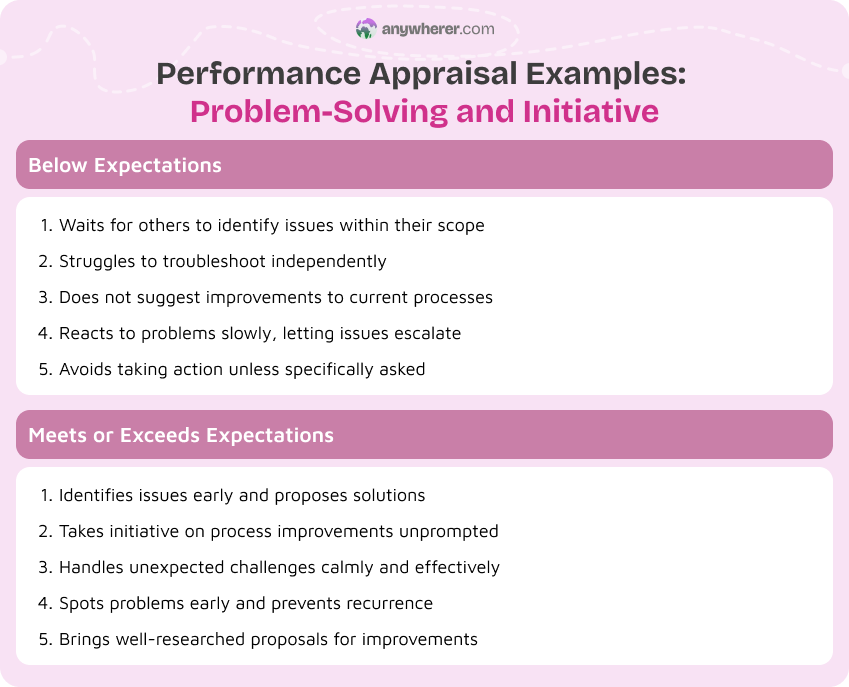
Problem-Solving and Initiative
Problem-solving comments describe how an employee approaches challenges, proposes solutions, and acts without waiting for direction. These sample performance appraisals highlight initiative and critical thinking in day-to-day work.
Below expectations:
- Waits for others to identify issues or propose solutions, even when the problem falls within their own scope.
- Struggles to troubleshoot independently and escalates problems that could be resolved at their level.
- Does not suggest improvements or alternatives when a current process is clearly not producing results.
- Reacts to problems slowly, which sometimes allows minor issues to become larger obstacles for the team.
- Relies heavily on management for direction whenever unexpected challenges arise, rather than attempting a first solution.
- Avoids taking action on issues they notice unless specifically asked, which slows the team’s response time.
- Tends to focus on describing the problem rather than proposing practical steps to address it.
- Does not apply lessons from past problem-solving experiences to similar situations that arise later.
- Misses opportunities to improve existing workflows because they do not question current practices.
- Hesitates to make decisions within their authority, preferring to defer even on straightforward matters.
Meets or exceeds expectations:
- Approaches problems methodically and works through issues before deciding whether escalation is needed.
- Identifies potential issues early and brings them to the team’s attention along with possible solutions.
- Takes initiative on routine improvements to processes or workflows without needing to be prompted.
- Handles unexpected challenges calmly and finds practical solutions that keep projects on track.
- Shows willingness to try new approaches when a standard method is not producing expected results.
- Recognizes when something falls outside normal parameters and takes appropriate action to resolve it.
- Proactively flags risks and suggests ways to mitigate them before they affect the timeline or outcome.
- Works through ambiguous situations with reasonable judgment and asks for guidance when stakes are high.
- Regularly spots problems before anyone else does and implements solutions that prevent recurrence.
- Drives meaningful process improvements that save time, reduce errors, or improve outcomes for the team.
- Tackles complex, cross-functional problems with creativity and delivers solutions that benefit multiple groups.
- Consistently brings well-researched proposals for improvements rather than just pointing out what is not working.
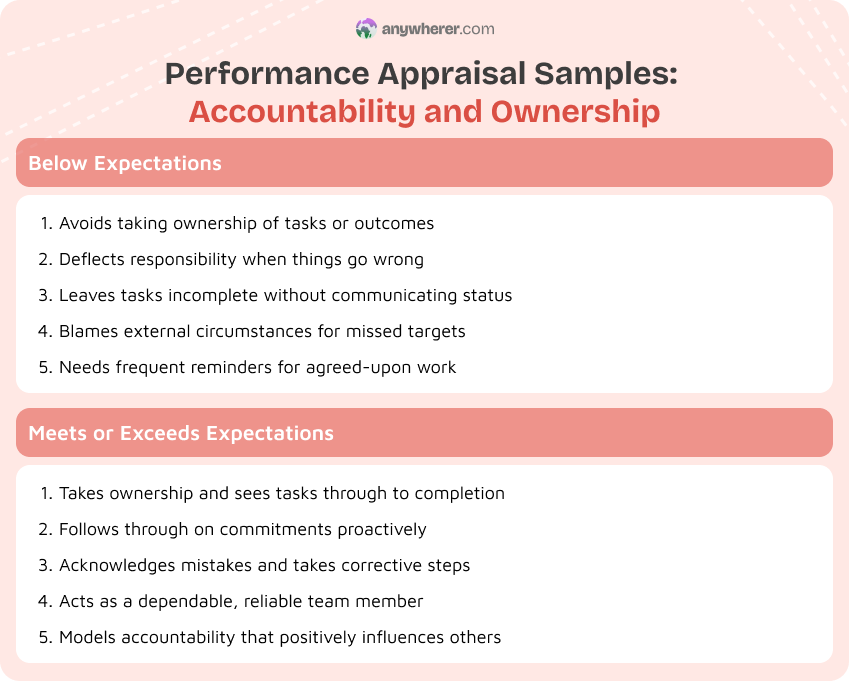
Accountability and Ownership
Accountability comments evaluate whether an employee takes responsibility for their work, follows through on commitments, and accepts outcomes honestly. These performance appraisal sample comments help managers document patterns in ownership behavior.
Below expectations:
- Avoids taking ownership of tasks or outcomes, which shifts the burden to others on the team.
- Tends to deflect responsibility when things go wrong instead of contributing to a solution.
- Does not follow through on commitments made during meetings or planning sessions.
- Blames external circumstances for missed targets without examining what was within their control.
- Leaves tasks incomplete and does not communicate about the status, which forces others to follow up.
- Rarely acknowledges mistakes and misses the chance to learn from them or prevent repetition.
- Does not take personal responsibility for the impact of their work on downstream processes or teams.
- Agrees to deadlines but does not take the steps necessary to meet them, creating last-minute scrambles.
- Needs frequent reminders to complete work that was already agreed upon and assigned.
- When confronted about a gap in delivery, redirects the conversation rather than addressing the issue directly.
Meets or exceeds expectations:
- Takes ownership of assigned work and sees tasks through to completion without needing constant follow-up.
- Accepts responsibility for outcomes, including when things do not go as planned, and works to correct course.
- Follows through on every commitment and communicates proactively when adjustments are needed.
- Holds themselves to a consistent standard regardless of whether the work is visible to leadership.
- Takes personal responsibility for both successes and setbacks, using both as learning opportunities.
- Completes work on time and to standard, demonstrating that others can rely on their follow-through.
- Proactively flags when a commitment is at risk and proposes an alternative plan before the deadline passes.
- Acknowledges mistakes openly and takes immediate steps to correct them and prevent recurrence.
- Acts as a dependable team member whose follow-through raises the overall reliability of the group.
- Demonstrates full ownership of their role and seeks ways to expand their accountability as they grow.
- Takes on additional responsibility willingly and delivers on it with the same standard as core tasks.
- Models accountability in a way that positively influences how others on the team approach their own work.
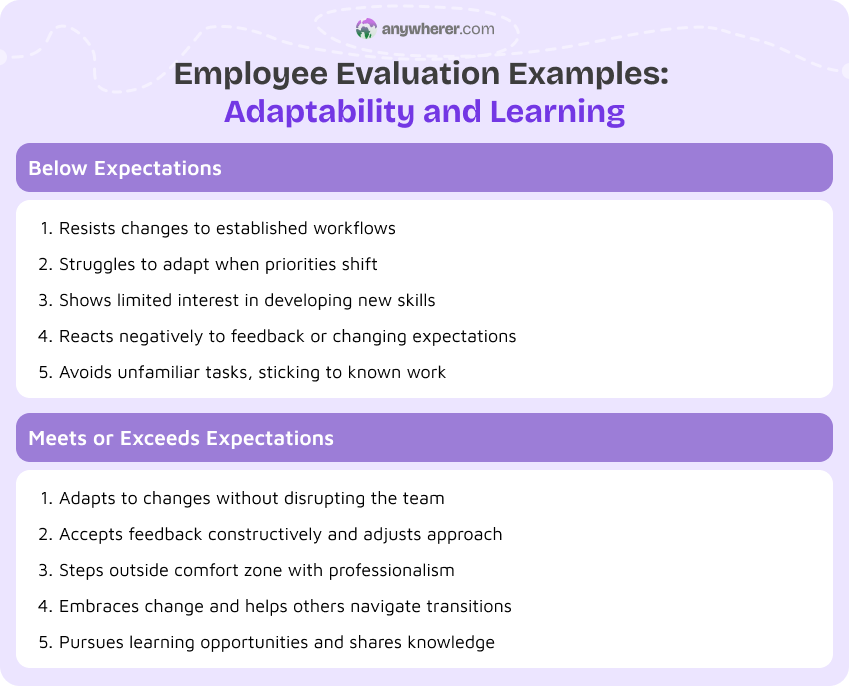
Adaptability and Learning
Adaptability comments assess how an employee responds to change, acquires new skills, and adjusts when priorities shift. These performance appraisal examples help capture how well someone handles uncertainty and growth.
Below expectations:
- Resists changes to established workflows, even when the team has agreed on a new direction.
- Struggles to adapt when priorities shift, which causes delays and disruption for others.
- Shows limited interest in developing new skills or learning tools relevant to the role.
- Takes significantly longer than peers to get comfortable with new processes or technologies.
- Reacts negatively to feedback or changing expectations, which affects team morale and progress.
- Avoids unfamiliar tasks and gravitates toward work they already know how to do.
- Does not seek out learning opportunities, even when resources are readily available.
- Becomes visibly frustrated when asked to change direction mid-project, which affects team dynamics.
- Fails to apply new information or training to their work, continuing to rely on outdated methods.
- Has not shown meaningful progress in any development areas identified during the previous review cycle.
Meets or exceeds expectations:
- Adapts to changes in priorities or processes without significant disruption to their work or the team.
- Learns new tools and methods at an appropriate pace and applies them effectively once comfortable.
- Accepts feedback constructively and makes visible adjustments to their approach based on input.
- Stays flexible when project scope or direction changes and reorients quickly without losing productivity.
- Shows willingness to step outside their comfort zone and handles unfamiliar tasks with a professional attitude.
- Keeps up with relevant developments in their field and applies new knowledge to day-to-day work.
- Recovers from setbacks without extended disruption and refocuses on moving forward.
- Takes on new responsibilities with a positive approach, even when they require learning on the job.
- Embraces change as an opportunity and helps others navigate transitions with steady support.
- Actively pursues learning opportunities outside of formal requirements and brings insights back to the team.
- Adapts to unexpected situations faster than most peers and remains productive during periods of uncertainty.
- Shares new knowledge with colleagues regularly, contributing to a culture of continuous improvement.
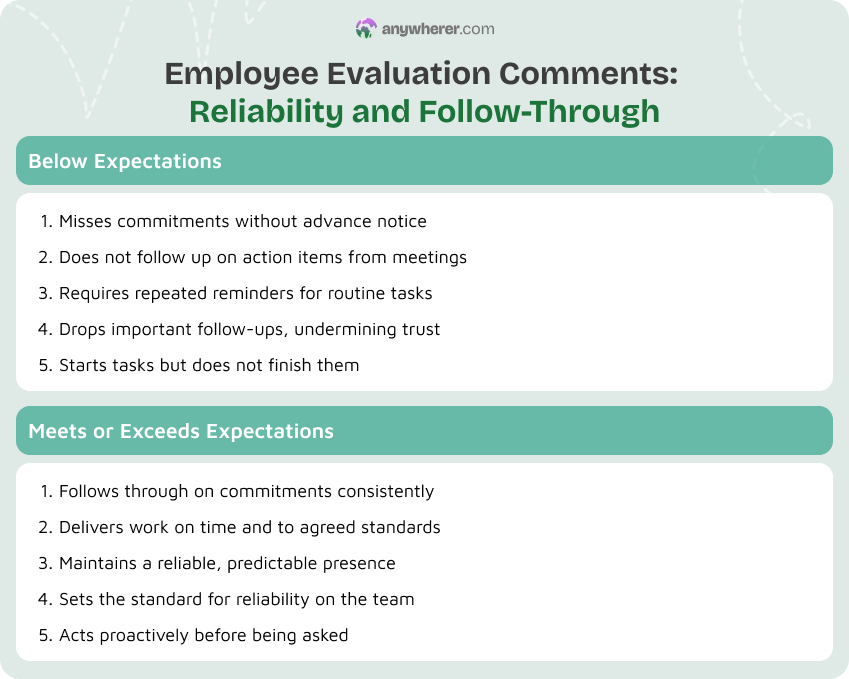
Reliability and Follow-Through
Reliability comments describe how consistently an employee delivers on promises, meets expectations, and shows up for the team. These employee performance appraisal examples capture dependability as a measurable pattern, not a personality trait.
Below expectations:
- Frequently misses commitments without advance notice, which forces the team to adjust plans at the last minute.
- Does not follow up on action items from meetings, and tasks assigned to them often stall without explanation.
- Shows an inconsistent pattern of attendance and availability that makes it difficult to plan collaborative work.
- Agrees to take on tasks but does not complete them within the expected timeframe or to the expected standard.
- Requires repeated reminders to complete routine tasks that should be managed independently.
- Fails to communicate when they will be unavailable, which creates gaps in team coverage.
- Delivers inconsistent results from week to week, making it hard for the team to depend on their output.
- Does not maintain visibility into their work progress, which leaves teammates unsure about deadlines.
- Drops the ball on small but important follow-ups, which undermines trust with both the team and stakeholders.
- Has a pattern of starting tasks but not finishing them, requiring others to pick up the remaining work.
Meets or exceeds expectations:
- Follows through on commitments consistently and communicates proactively when any adjustments are needed.
- Can be counted on to deliver work on time and to the standard that was agreed upon at the outset.
- Maintains a predictable, reliable presence that the team can plan around with confidence.
- Completes routine and non-routine tasks alike with the same level of dependability and thoroughness.
- Tracks action items carefully and ensures nothing falls through the cracks between meetings.
- Communicates availability clearly and plans work so that coverage gaps do not affect the team.
- Delivers consistent results week after week, which builds trust with both peers and managers.
- Keeps teammates informed about progress without being asked, which helps the group stay aligned.
- Sets the standard for reliability on the team by following through on every commitment without exception.
- Anticipates what needs to happen next and acts on it before being asked, which keeps projects moving forward.
- Has earned a reputation as the person others turn to when something absolutely needs to get done.
- Consistently goes beyond what is expected in follow-through, closing loops that others might leave open.
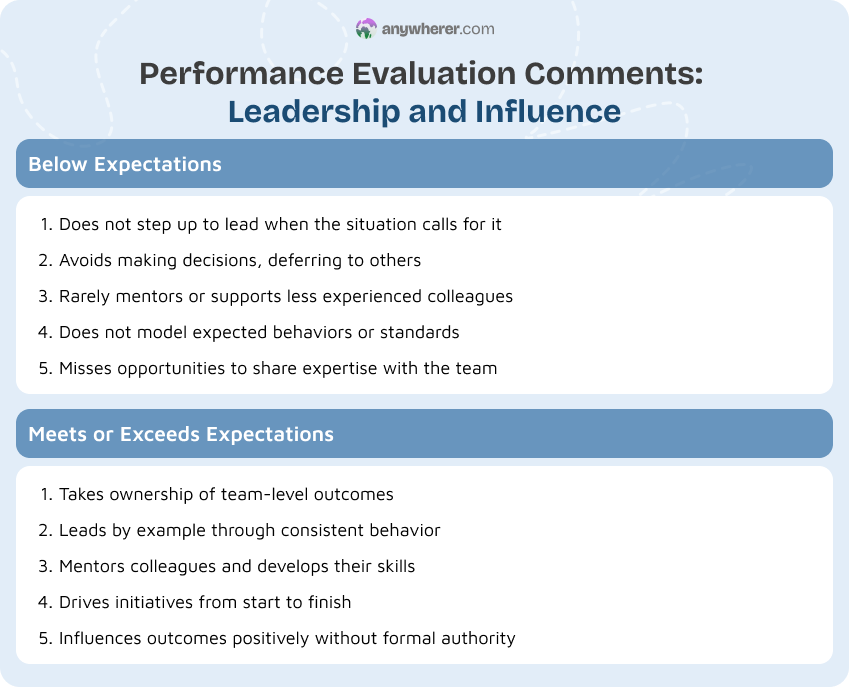
Leadership and Influence
Leadership comments apply to both formal managers and individual contributors who take responsibility, guide others, and drive outcomes forward. These performance evaluation comments help recognize leadership behaviors at every level.
Below expectations:
- Does not step up to lead or coordinate when the situation calls for it, even in areas of personal expertise.
- Avoids making decisions when needed, preferring to defer to others rather than taking a position.
- Rarely mentors or supports less experienced colleagues, even when they have the knowledge to help.
- Does not model the behaviors or standards expected of someone in their position.
- Tends to focus only on their own tasks and does not look for ways to contribute to the broader team.
- Avoids giving direct feedback to peers, even when it would benefit the team’s overall performance.
- Does not take initiative in group settings and waits for others to set direction before acting.
- Fails to inspire confidence in others during challenging situations or periods of uncertainty.
- Has not demonstrated growth in leadership skills since the previous review period.
- Misses opportunities to influence outcomes by not sharing expertise or perspective when it would add value.
Meets or exceeds expectations:
- Takes ownership of team-level outcomes and holds themselves to a standard that reflects positively on the group.
- Steps into coordination roles when needed and helps keep the team aligned on shared priorities.
- Leads by example through consistent behavior, meeting commitments, and maintaining a professional standard.
- Makes decisions within their scope confidently and escalates appropriately when the situation requires it.
- Supports teammates by sharing knowledge and offering guidance when it benefits the collective effort.
- Communicates expectations clearly when coordinating group efforts and ensures follow-through on action items.
- Acts as an informal leader on the team, guiding others through complex situations with clarity and composure.
- Mentors colleagues proactively and helps develop the skills of those around them in a meaningful way.
- Drives initiatives forward from start to finish with minimal direction, earning the trust of leadership.
- Creates an environment where others feel empowered to take ownership and make decisions within their scope.
- Frequently volunteers to lead cross-functional projects and delivers results that benefit the wider organization.
- Influences outcomes positively even without formal authority, through expertise, credibility, and consistent action.
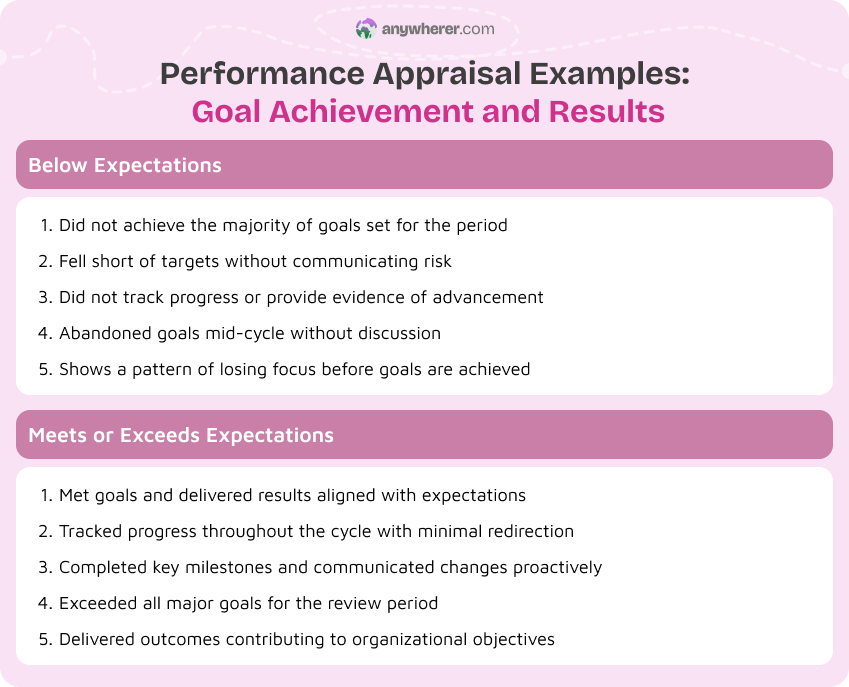
Goal Achievement and Results
Goal achievement comments evaluate how well an employee meets targets, milestones, and objectives set during the review period. These example of performance appraisal comments focus on measurable outcomes and progress toward agreed-upon goals.
Below expectations:
- Did not achieve the majority of goals set for this review period and has not provided a clear explanation.
- Fell short of agreed-upon targets in several key areas without communicating the risk in time for course correction.
- Set goals at the beginning of the cycle but did not take consistent action to work toward them over time.
- Results are significantly below expectations, even accounting for external factors that affected the team.
- Has not followed through on performance goals examples discussed during the previous review cycle.
- Abandoned or deprioritized goals mid-cycle without discussion, leaving milestones unmet.
- Did not track progress against goals and could not provide evidence of advancement during the review.
- Consistently set goals that were either too vague to measure or too easy to represent meaningful progress.
- Missed key milestones and did not propose alternatives or adjusted timelines when obstacles arose.
- Shows a pattern of starting strong but losing focus before goals are fully achieved.
Meets or exceeds expectations:
- Met the goals set for this review period and delivered results that align with what was expected.
- Achieved most targets on time, with minor adjustments needed only when external factors required flexibility.
- Tracked progress against goals throughout the cycle and stayed on course with minimal redirection.
- Delivered consistent results that contributed meaningfully to the team’s overall objectives.
- Completed key milestones as planned and communicated any changes to scope or timeline proactively.
- Balanced goal achievement with day-to-day responsibilities without letting either area fall behind.
- Achieved results that reflect steady effort and good alignment with team and organizational priorities.
- Exceeded all major goals for the review period and delivered results that moved the team beyond its initial targets.
- Achieved stretch objectives in addition to core goals, demonstrating a commitment to going beyond the expected.
- Results this period are among the strongest on the team, with measurable impact across multiple areas.
- Set ambitious goals and met every one, showing the ability to plan realistically and execute at a high level.
- Delivered outcomes that contributed directly to organizational-level objectives, not just team targets.
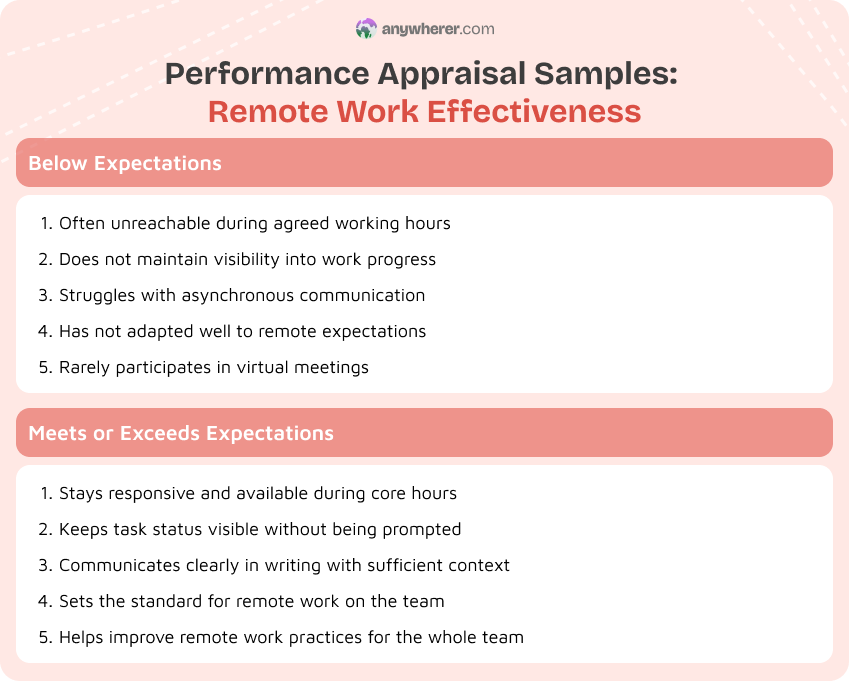
Remote Work Effectiveness
Remote work comments evaluate how well an employee maintains productivity, visibility, and communication in a distributed or hybrid setting. These performance appraisal samples help managers assess remote performance based on output and collaboration, not just presence.
Below expectations:
- Often unreachable during agreed working hours, which creates delays for team members who depend on timely responses.
- Does not maintain adequate visibility into their work progress, making it difficult to plan around their output.
- Struggles with asynchronous communication and frequently misses updates shared in written channels.
- Has not adapted well to remote expectations, resulting in missed deadlines and unclear deliverables.
- Rarely participates in virtual meetings or contributes to discussions that take place outside of in-person settings.
- Does not use shared tools effectively, which makes it harder for the team to stay informed about their work.
- Fails to maintain a professional environment during video calls, which can affect the team’s image externally.
- Does not respect time zone differences when scheduling meetings or setting response expectations.
- Frequently has technical issues that disrupt meetings and are not resolved between occurrences.
- Works in a way that is disconnected from the rest of the team, as if operating as a solo contributor rather than part of a group.
Meets or exceeds expectations:
- Stays responsive and available during core working hours and communicates reliably through primary channels.
- Keeps task status and project updates visible to the team, even without being prompted.
- Communicates clearly in writing and provides enough context in messages to minimize back-and-forth.
- Participates actively in virtual meetings and contributes the same way they would in an in-person setting.
- Manages their own schedule effectively in a remote or hybrid setup, meeting all regular deadlines.
- Uses shared tools and documentation practices that make it easy for others to follow their work.
- Maintains a professional and engaged presence regardless of whether they are working from the office or remotely.
- Adapts to time zone differences and finds ways to collaborate without causing delays for colleagues.
- Sets the standard for remote work on the team by combining clear communication, consistent output, and proactive check-ins.
- Actively builds team connection in a distributed environment through regular informal touchpoints and updates.
- Delivers results that are indistinguishable from or better than in-office output, regardless of location.
- Helps improve remote work practices for the whole team by suggesting tools, processes, or habits that increase clarity.
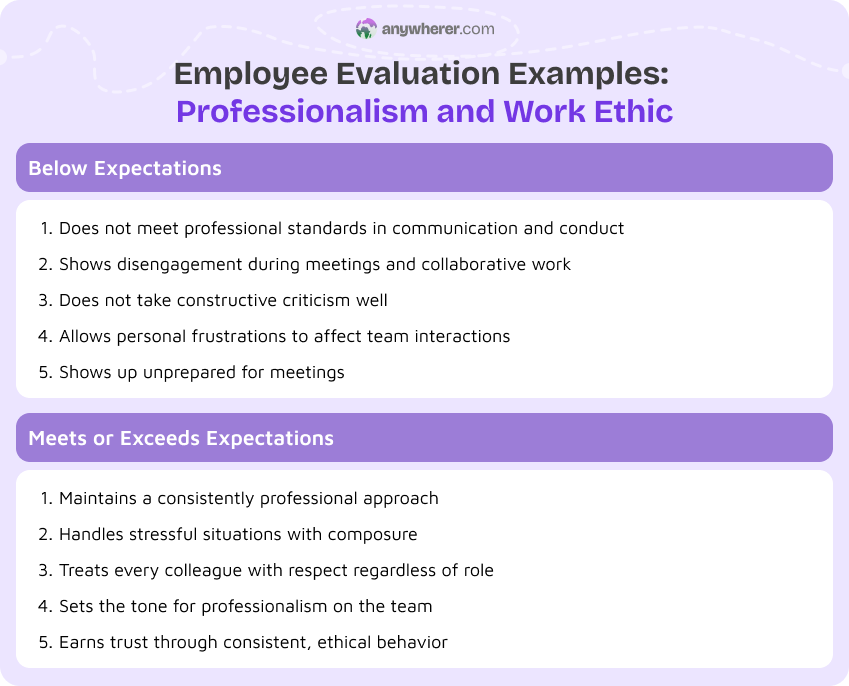
Professionalism and Work Ethic
Professionalism comments describe how an employee conducts themselves in the workplace, including their attitude, integrity, and commitment to standards. These samples of performance appraisal help managers document observable professional conduct.
Below expectations:
- Does not consistently meet the professional standards expected for this role in communication and conduct.
- Shows a pattern of disengagement during meetings and collaborative work, which affects team morale.
- Has received feedback about professional behavior but has not made visible adjustments since the last review.
- Does not take constructive criticism well and becomes defensive when improvement areas are discussed.
- Allows personal frustrations to affect interactions with colleagues, creating an uncomfortable team dynamic.
- Demonstrates inconsistent effort, putting in strong work on some tasks while neglecting others without explanation.
- Does not follow established workplace norms around scheduling, communication, or documentation.
- Shows up unprepared for meetings and does not review materials shared in advance.
- Treats some tasks or stakeholders as less important than others, which affects the consistency of output.
- Has had repeated issues with meeting basic role expectations that were outlined during onboarding.
Meets or exceeds expectations:
- Maintains a consistently professional approach to all interactions, whether with teammates or external stakeholders.
- Demonstrates strong work ethic by delivering quality output and holding themselves to a high personal standard.
- Handles stressful situations with composure and does not let pressure affect the quality of their work or relationships.
- Takes constructive feedback seriously and uses it as a genuine input for professional development.
- Treats every colleague and stakeholder with respect, regardless of their role or seniority.
- Follows through on commitments and demonstrates integrity in how they manage their responsibilities.
- Comes prepared to meetings, reviews shared materials in advance, and contributes meaningfully to discussions.
- Represents the team and organization well in external-facing interactions and client communications.
- Sets the tone for professionalism on the team by consistently modeling the behavior expected at this level.
- Goes beyond minimum expectations in effort and conduct, raising the standard for those around them.
- Demonstrates genuine commitment to the organization’s values through their daily actions and decisions.
- Earns the trust of colleagues and leadership through consistent, ethical, and transparent behavior.
Common Mistakes in Performance Appraisals
Even with a strong bank of performance appraisal keywords and phrases, the way you apply them matters. Gallup’s global research consistently shows that employee engagement drops when feedback is infrequent, vague, or disconnected from day-to-day work. A few common patterns can weaken an appraisal and make it less useful for the employee.
Being too vague
Comments like “does a good job” or “needs improvement” do not give the employee anything to work with. Every comment should point to a specific behavior, outcome, or pattern. Instead of “great communicator,” a stronger performance evaluation comment would be: “Keeps the team informed about project status through regular written updates and raises potential blockers before they cause delays.” Specificity makes the review credible and actionable.
Writing for the file instead of the person
When reviews are written primarily to create a paper trail rather than to help the employee grow, the language tends to become stiff, legalistic, and unhelpful. The best performance appraisal comments sound like something you would say in a direct conversation. If the employee would not understand the feedback from reading the review alone, it needs to be rewritten.
Recency bias
Managers often weigh recent events more heavily than earlier ones, which skews the review. If an employee had a strong first three quarters but a rough final month, the review should reflect the full picture. Keeping notes throughout the cycle and referencing them during the appraisal process helps managers write more balanced and accurate performance evaluation comments.
Avoiding constructive feedback
Skipping improvement areas because the conversation feels uncomfortable does the employee a disservice. Constructive feedback is a specific observation paired with a practical path forward. When delivered professionally, it builds trust. Managers who invest in clear, ongoing feedback see stronger engagement and fewer surprises during formal reviews.
Mixing personality with performance
A performance appraisal should evaluate what someone does, not who they are. Comments about attitude, temperament, or personality traits often feel personal and create unnecessary tension. Focus on observable actions and measurable outcomes. Instead of “has a negative attitude,” try: “Responds to shifting priorities in ways that slow the team’s ability to adjust, particularly during urgent timeline changes.”
Final Words
Performance appraisals work best when they are honest, specific, and grounded in what actually happened during the review period. The 200+ examples of employee evaluations in this article are meant to be a starting point, not a script. Think of each one as a performance appraisal example you can reshape to fit the person, the role, and the situation. The more specific you make each comment, the more useful it becomes for everyone involved.
If writing reviews still feels like a heavy lift, that is usually a sign that feedback is not happening often enough between cycles. Regular check-ins, clear performance goals examples, and honest conversations throughout the year make formal appraisals shorter and more productive. As CIPD highlights, effective performance management is a continuous responsibility for both line managers and people professionals, not something confined to an annual form.
Pairing structured appraisals with tools like a clear performance improvement plan example for employees who need additional support ensures that feedback leads to action, not just documentation. These examples of evaluations for employees and employee evaluation comments are meant to help each person understand where they stand, what they are doing well, and what to focus on next. Managers who combine strong staff appraisal examples with regular coaching create teams that improve continuously, not just at review time.
FAQs on Performance Appraisals
What are some examples of performance appraisal comments?
Performance appraisal comments are short, specific statements that describe how an employee performs relative to expectations. They focus on observable behavior and outcomes rather than personality. For example, a meets-expectations comment might be: “Consistently meets deadlines and communicates proactively when adjustments are needed.” A below-expectations comment might be: “Frequently misses deadlines without advance notice, which impacts dependent work.” The goal is to give the employee clear, actionable information about where they stand.
How do you write a good performance appraisal?
A good performance appraisal is specific, balanced, and tied to observable results. Start with the employee’s key responsibilities and evaluate each one based on what actually happened during the review period. Avoid vague language like “does a great job” or “needs to improve.” Instead, reference concrete examples, specific projects, or measurable outcomes. Include both strengths and areas for development, and end with clear next steps the employee can act on.
What are the best performance appraisal keywords to use?
Effective performance appraisal keywords are descriptive and behavior-focused. Words like “consistently,” “proactively,” “independently,” and “accurately” describe how work is done. “Exceeds,” “meets,” and “falls short of” describe performance levels relative to expectations. Avoid subjective words like “amazing,” “terrible,” or “lazy.” The most useful keywords help both the employee and anyone reading the review understand exactly what the comment refers to.
How should employee final comments be handled in a performance appraisal?
Performance appraisal employee final comments give the employee a chance to respond to the review in their own words. They might agree with the assessment, add context the manager may not have seen, or note areas where they feel the evaluation could be more accurate. These comments are an important part of a fair review process because they ensure the employee’s perspective is documented alongside the manager’s. Managers should encourage employees to use this section honestly and should not penalize them for respectful disagreement.
How many performance appraisal examples should I include per category?
The right number depends on the depth of the category and the detail of each comment. For most categories, 10 to 15 examples per rating level give managers enough variety to find one that fits their specific situation. Having fewer than 5 per level limits usefulness. Having more than 20 can feel overwhelming. The key is that each example should be distinct and cover a different aspect of the category so managers are not choosing between near-identical options.
Can these performance appraisal examples be used for self-evaluations?
Yes. Many of these examples can be adapted for self-evaluations by changing the perspective from third person to first person. For instance, “Communicates clearly in both written and verbal settings” becomes “I communicate clearly in both written and verbal settings.” The key adjustment is to ground each statement in specific examples from your own work during the review period so the self-evaluation reads as genuine rather than generic.

Yaryna is our lead writer with over 8 years of experience in crafting clear, compelling, and insightful content. Specializing in global employment and EOR solutions, she simplifies complex concepts to help businesses expand their remote teams with confidence. With a strong background working alongside diverse product and software teams, Yaryna brings a tech-savvy perspective to her writing, delivering both in-depth analysis and valuable insights.