Writing performance reviews is one of those tasks that almost every manager puts off. The reasons are predictable: limited time, uncertainty about what to say in a performance review, and a real concern about sounding either too harsh or too vague. Without clear performance review comments to guide the process, reviews create confusion rather than clarity. When they are skipped altogether, employees are left guessing where they stand.
Research from Gallup shows that only about half of employees strongly agree they know what is expected of them at work. Well-crafted employee evaluation comments can close that gap. When feedback is specific, balanced, and connected to observable behavior, it helps employees understand what they are doing well and what needs to change. Good performance feedback examples also protect managers from the trap of relying on memory or gut feeling at the end of a review cycle.
That is where ready-made examples come in. Having a reference bank of employee performance review examples removes the blank-page problem and gives managers a starting point they can adapt to their specific team member. Whether you need performance appraisal examples, employee evaluation examples, or sample employee evaluations for different rating levels, having a library of options saves time and improves consistency.
This article contains 200 performance review examples organized into 12 categories. Each category includes employee review comments for three rating levels: Below Expectations, Meets Expectations, and Exceeds Expectations. The examples are written to be practical, neutral, and easy to customize for any role or industry. You can use them as a starting point for your own performance appraisal comments, adjusting the language to fit each employee’s specific situation.
200 Employee Performance Review Examples
The employee review examples below are grouped by the areas that come up most often in performance evaluations: overall results, communication, work quality, productivity, problem-solving, leadership, adaptability, strengths, improvement areas, remote work, goal achievement, and professional development. Each category includes performance evaluation comments for the same three rating levels, so the format stays consistent. You can treat each one as a performance review example to adapt rather than copy word for word.
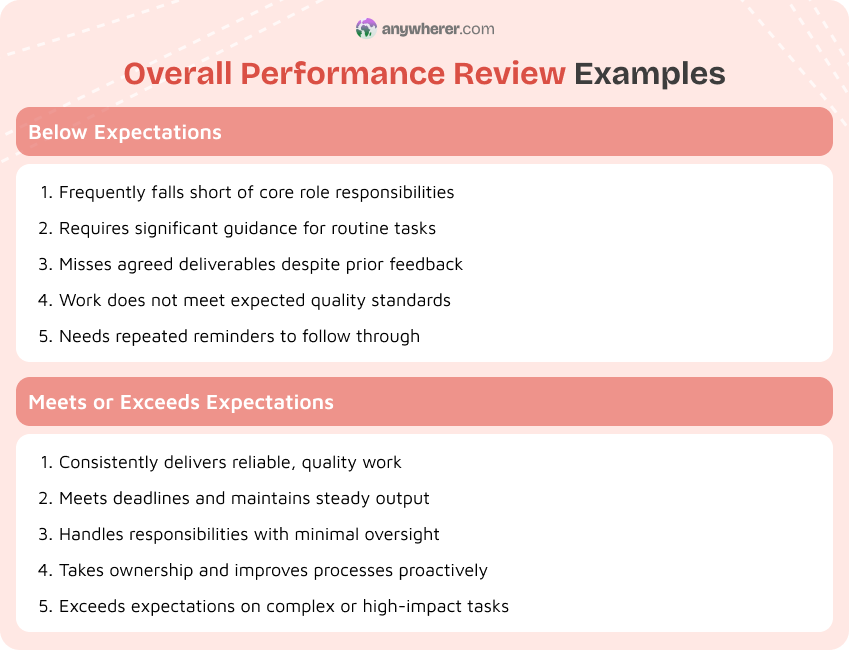
Overall Performance Review Examples
Overall performance comments capture how well an employee delivers on their core responsibilities and meets general expectations for the role. These are often the opening or closing statements in a review, and getting the right positive overall performance comments or constructive ones sets the tone for everything that follows.
Below expectations:
- Frequently falls short of the core responsibilities outlined for this role and has not shown consistent progress toward meeting them.
- Struggles to complete routine tasks without significant guidance, which places additional pressure on the rest of the team.
- Has missed several agreed-upon deliverables this review period, and the pattern has not improved despite earlier feedback.
- Regularly produces work that does not meet the baseline standards for quality or completeness expected at this level.
- Needs repeated reminders to follow through on assignments, and overall output remains below what the role requires.
- Performance has declined compared to the previous review cycle, with fewer goals met and more tasks left unfinished.
Meets expectations:
- Consistently meets the expectations set for this role, delivering reliable work across day-to-day responsibilities.
- Maintains a steady level of output and handles assigned tasks with minimal oversight from management.
- Demonstrates a solid understanding of role requirements and meets deadlines with acceptable quality.
- Keeps up with workload expectations and adjusts when priorities shift during the review period.
- Performs well in most areas and contributes to team outcomes in a dependable way throughout the cycle.
- Shows a good grasp of what the role demands and fulfills those duties without major gaps or delays.
- Regularly meets project milestones and produces work that aligns with team standards.
- Handles routine and moderately complex work with consistency, rarely requiring course corrections.
- Delivers on commitments and contributes to the team’s ability to meet shared goals reliably.
Exceeds expectations:
- Consistently goes beyond what is expected, delivering higher-quality results and taking ownership of outcomes across the board.
- Sets a strong example for the rest of the team through a combination of reliable output, proactive thinking, and consistent follow-through.
- Regularly identifies opportunities to improve processes or results without being asked, and acts on them effectively.
- Takes on complex challenges willingly and delivers results that exceed the scope of the original assignment.
- Has been a driving force behind several key team achievements this cycle, raising the overall standard of performance.
- Produces exceptional work across multiple areas and is frequently sought out by peers for input and collaboration.
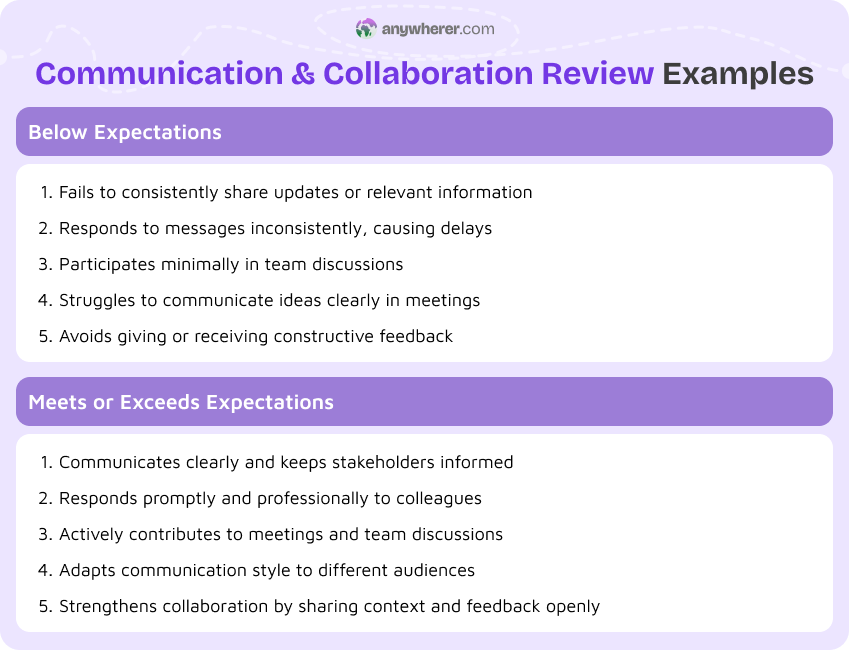
Communication & Collaboration Review Samples
These comments address how effectively an employee shares information, works with others, and contributes to a productive team environment.
Below expectations:
- Rarely shares updates or relevant information with the team, which creates confusion and slows down collaborative work.
- Responds to messages and emails inconsistently, sometimes leaving colleagues waiting for critical information.
- Tends to work in isolation and does not actively participate in team discussions, even when input is needed.
- Has difficulty expressing ideas clearly in meetings, leading to misunderstandings or incomplete hand-offs.
- Avoids giving or receiving feedback, which limits both personal growth and the team’s ability to improve collectively.
Meets expectations:
- Communicates clearly and keeps the team informed about task progress and any blockers without being prompted.
- Participates actively in team meetings and shares ideas that contribute to group discussions.
- Responds to messages and requests from colleagues in a timely and professional manner.
- Works well with cross-functional partners and adapts communication style to suit different audiences.
- Keeps documentation and updates organized so others can follow the status of shared projects easily.
- Collaborates openly and is willing to adjust plans when team priorities change.
- Gives and receives feedback with professionalism, keeping conversations focused on outcomes rather than personalities.
- Actively listens during discussions and asks clarifying questions when something is unclear.
- Shares relevant context and background with new team members to help them contribute faster.
Exceeds expectations:
- Builds strong working relationships across departments and is regularly sought out as a reliable communication partner.
- Goes out of the way to ensure everyone involved in a project has the information they need to succeed.
- Facilitates productive conversations in group settings, helping the team reach decisions more efficiently.
- Proactively identifies communication gaps and establishes processes that improve team alignment.
- Creates a welcoming environment where colleagues feel comfortable sharing concerns, questions, or new ideas.
- Consistently translates complex information into clear, actionable language for a range of audiences.
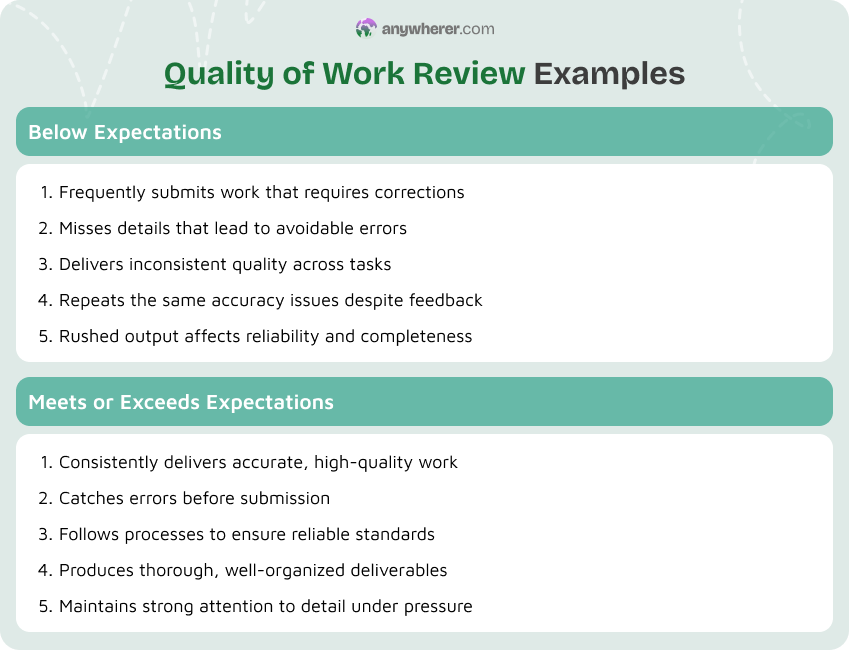
Quality of Work Review Comments
Quality of work comments evaluate how thoroughly and accurately an employee completes their assignments. This includes attention to detail, consistency, and the overall standard of output. Using specific work quality performance review phrases makes it easier to document patterns and give the employee something concrete to act on.
Below expectations:
- Frequently submits work with errors that require review and correction by others before it can be used.
- Does not consistently double-check work before submission, leading to avoidable mistakes in final deliverables.
- The quality of output varies significantly from task to task, making it difficult to rely on consistent results.
- Has been asked multiple times to revise the same type of work due to recurring accuracy issues.
- Rushes through assignments in a way that noticeably affects the final product’s reliability and completeness.
Meets expectations:
- Produces work that consistently meets the team’s quality standards and rarely requires major revisions.
- Pays attention to detail and catches most errors before submitting final deliverables.
- Follows established processes and guidelines to ensure consistent quality across different types of tasks.
- Delivers clean, well-organized output that other team members can build on or reference without confusion.
- Maintains a reliable standard of accuracy even when working under time pressure or shifting priorities.
- Reviews own work carefully and applies lessons from past feedback to improve quality over time.
- Produces output that is thorough enough to move forward without requiring additional rounds of editing.
- Asks for clarification when instructions are unclear to avoid producing work that misses the mark.
- Handles both routine and more complex assignments with a consistent level of care and precision.
- Follows through on quality-related feedback from prior reviews and shows improvement in those areas.
Exceeds expectations:
- Consistently delivers work of exceptional quality that sets the benchmark for the rest of the team.
- Catches issues early in the process and resolves them before they become larger problems downstream.
- Takes extra steps to verify accuracy and completeness, even when not explicitly required to do so.
- Other team members frequently reference this person’s work as an example of what good output looks like.
- Treats every assignment, whether high-profile or routine, with the same high standard of attention to detail.
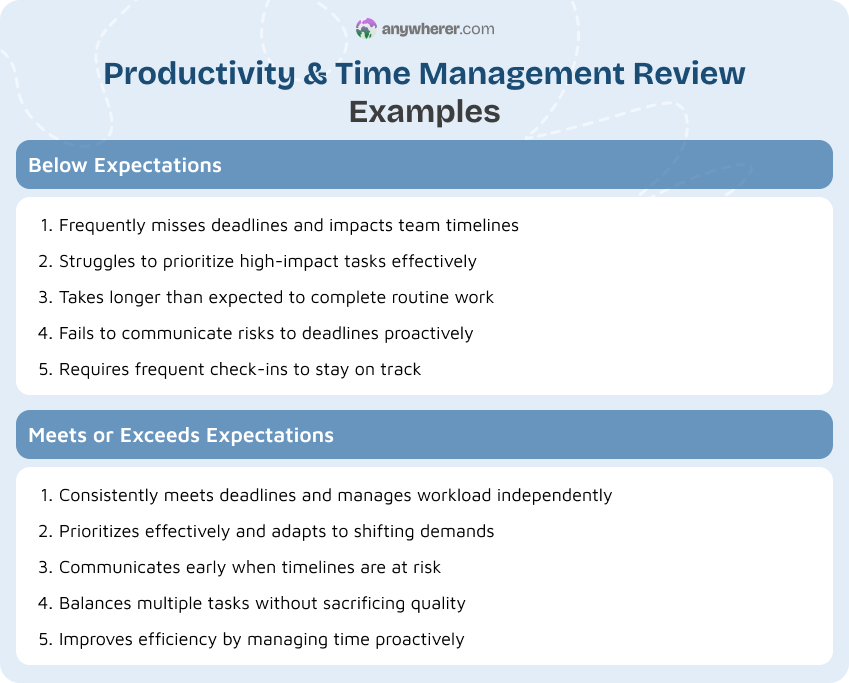
Productivity & Time Management Review Examples
These comments focus on how efficiently an employee uses their time, manages workload, and meets deadlines. Strong time management directly impacts the team’s overall capacity to deliver results.
Below expectations:
- Misses deadlines regularly, and the delays have a noticeable impact on team timelines and dependent work.
- Struggles to prioritize tasks effectively, often spending too much time on lower-impact activities.
- Takes significantly longer than expected to complete standard assignments without a clear reason for the delay.
- Does not communicate proactively when a deadline is at risk, leaving the team to discover delays after the fact.
- Needs frequent check-ins to stay on track with assignments that should be manageable independently at this level.
Meets expectations:
- Completes work on time and manages daily responsibilities without needing close supervision.
- Prioritizes tasks appropriately and adjusts when new requests come in without losing track of existing commitments.
- Meets deadlines consistently and communicates early when there is a risk of delay.
- Balances multiple assignments at once and keeps each one moving forward without dropping any.
- Plans workdays effectively and uses available tools and systems to stay organized.
- Delivers a steady volume of output that matches expectations for the role and workload level.
- Breaks larger projects into manageable steps and stays on schedule through each phase.
- Responds promptly to time-sensitive requests and adjusts priorities accordingly.
- Makes good use of available time and avoids bottlenecks caused by delayed hand-offs or decisions.
Exceeds expectations:
- Consistently finishes work ahead of schedule without sacrificing quality, which gives the team more flexibility.
- Manages a heavier-than-average workload and still delivers high-quality results on time across all assignments.
- Proactively identifies and removes bottlenecks in team workflows, which improves efficiency for everyone involved.
- Plans and executes complex projects with tight timelines and keeps all stakeholders aligned throughout.
- Helps teammates manage their own workload by offering support or redistributing tasks during busy periods.
- Uses time so effectively that there is consistently capacity to take on additional responsibilities or stretch projects.
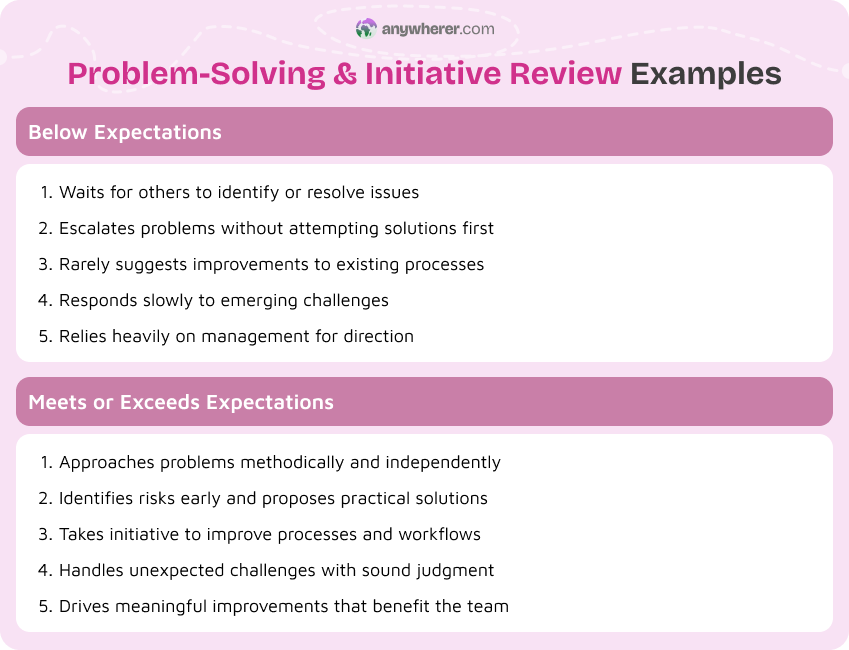
Problem-Solving & Initiative Review Comments
These comments address how an employee approaches challenges, proposes solutions, and takes proactive steps without waiting to be told what to do.
Below expectations:
- Tends to wait for others to identify issues or propose solutions, even when the problem is within their scope of work.
- Struggles to troubleshoot issues independently and often escalates problems that could be resolved at their level.
- Does not suggest improvements or alternative approaches when a current process is clearly not working.
- Reacts to problems slowly, which sometimes causes minor issues to grow into larger ones before they are addressed.
- Relies heavily on management for direction when unexpected challenges arise, rather than attempting to resolve them first.
Meets expectations:
- Approaches problems methodically and works through issues before escalating them when appropriate.
- Identifies potential issues early and brings them to the team’s attention along with possible solutions.
- Takes initiative on routine improvements to processes or workflows without needing to be asked.
- Handles unexpected challenges calmly and finds practical solutions that keep projects on track.
- Shows willingness to try new approaches when a standard method is not producing the expected results.
- Contributes useful ideas in brainstorming sessions and follows through on the ones that get selected.
- Recognizes when something falls outside normal parameters and takes appropriate action to resolve it.
- Proactively flags risks and suggests ways to mitigate them before they affect the timeline or outcome.
- Works through ambiguous situations with reasonable judgment and asks for guidance when the stakes are high.
Exceeds expectations:
- Regularly spots problems before anyone else does and implements solutions that prevent issues from recurring.
- Drives meaningful process improvements that save time, reduce errors, or improve outcomes for the broader team.
- Tackles complex, cross-functional problems with creativity and delivers solutions that benefit multiple groups.
- Takes ownership of difficult situations and leads resolution efforts, even when the responsibility is shared.
- Consistently brings well-researched proposals for improvements rather than just pointing out what is not working.
- Inspires teammates to think critically and take initiative by setting a strong example through their own actions.
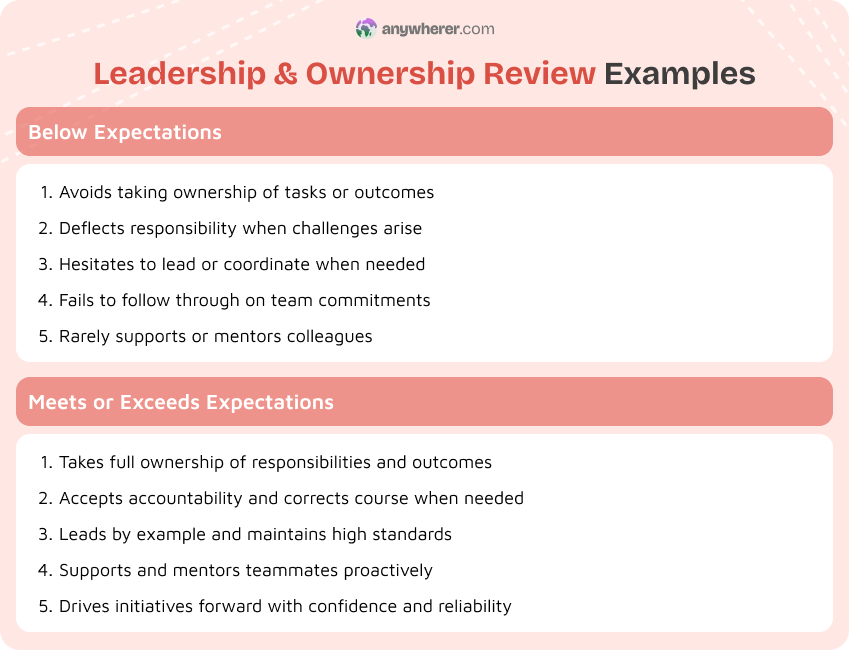
Leadership & Ownership Review Samples
Leadership comments apply not only to people managers but also to individual contributors who take responsibility, influence others positively, and drive outcomes forward.
Below expectations:
- Avoids taking ownership of tasks or outcomes, which shifts the burden to others on the team.
- Does not step up to lead or coordinate when the situation calls for it, even in areas of personal expertise.
- Tends to deflect responsibility when things go wrong instead of contributing to solutions.
- Rarely mentors or supports less experienced colleagues, even when they have the knowledge to do so.
- Does not follow through on commitments to the team, which undermines trust and accountability.
- Avoids making decisions when needed, preferring to defer to others rather than take a position.
Meets expectations:
- Takes ownership of assigned work and sees tasks through to completion without needing constant follow-up.
- Accepts responsibility for outcomes, including when things do not go as planned, and works to correct course.
- Supports teammates by sharing knowledge and offering guidance when it is helpful to the group.
- Steps into coordination roles when needed and helps keep the team aligned on shared priorities.
- Leads by example through consistent behavior, meeting commitments, and maintaining a professional standard.
- Makes decisions within their scope confidently and escalates appropriately when the situation requires it.
- Takes responsibility for both successes and setbacks, and uses both as learning opportunities.
- Communicates expectations clearly when coordinating group efforts and ensures follow-through.
Exceeds expectations:
- Acts as an informal leader on the team, guiding others through complex situations with clarity and confidence.
- Takes full ownership of team-level outcomes and holds themselves to a higher standard than the role requires.
- Mentors colleagues proactively and helps develop the skills of those around them in a meaningful way.
- Drives initiatives forward from start to finish with minimal direction, earning the trust of leadership.
- Creates an environment where others feel empowered to take ownership and make decisions within their scope.
- Frequently volunteers to lead cross-functional projects and delivers results that benefit the wider organization.
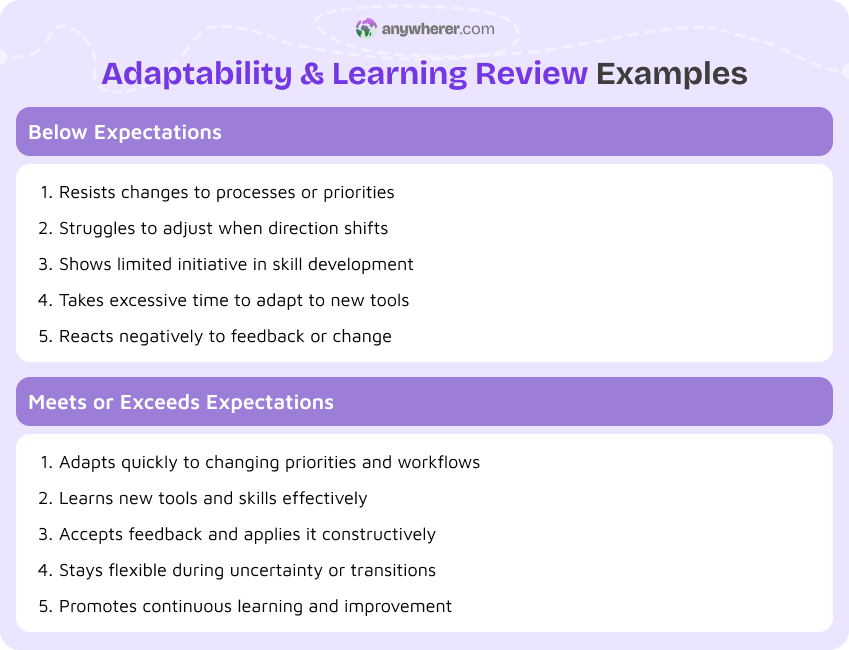
Adaptability & Learning Review Comments
These comments evaluate how an employee responds to change, acquires new skills, and adjusts their approach when circumstances shift.
Below expectations:
- Resists changes to established workflows, even when the team has agreed on a new direction.
- Struggles to adapt when priorities shift, which causes delays and disruption for others.
- Shows limited interest in developing new skills or learning tools that are relevant to the role.
- Takes significantly longer than peers to get comfortable with new processes or technologies.
- Reacts negatively to feedback or changing expectations, which affects team morale and progress.
Meets expectations:
- Adapts to changes in priorities or processes without significant disruption to their work or the team.
- Learns new tools and methods at an appropriate pace and applies them effectively once comfortable.
- Accepts feedback constructively and makes adjustments to their approach based on what they hear.
- Stays flexible when project scope or direction changes and reorients quickly.
- Shows willingness to step outside their comfort zone when asked and handles it with a professional attitude.
- Keeps up with relevant developments in their field and applies new knowledge to day-to-day tasks.
- Recovers from setbacks without extended disruption and refocuses on moving forward.
- Adjusts communication and work style when collaborating with new teams or stakeholders.
- Takes on new responsibilities with a positive approach, even when they require learning on the job.
Exceeds expectations:
- Embraces change as an opportunity and helps others navigate transitions with a steady, supportive attitude.
- Actively pursues learning opportunities outside of formal requirements and applies them to benefit the team.
- Adapts to unexpected situations faster than most peers and remains productive even during periods of uncertainty.
- Shares new insights and knowledge with the team regularly, contributing to a culture of continuous improvement.
- Handles rapidly shifting priorities with minimal stress and keeps quality high throughout the transition.
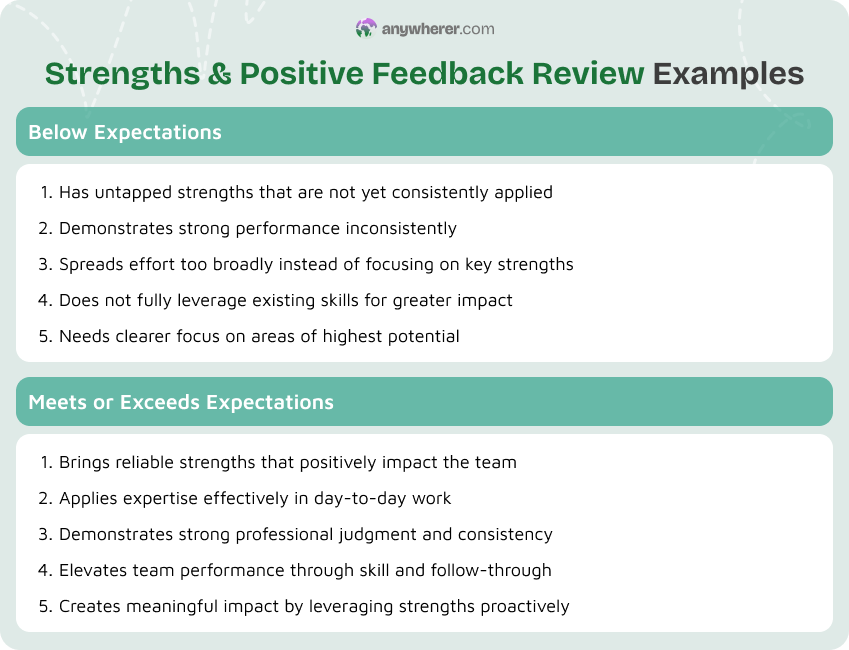
Strengths & Positive Feedback Review Samples
Recognizing an employee’s strengths reinforces the behaviors and contributions that matter most. These comments highlight what the person does well and should continue doing. Knowing the right employee review keywords and phrases for positive feedback helps managers be specific rather than relying on generic praise.
Below expectations:
- Has potential in certain areas but has not yet developed those strengths into consistent, reliable contributions.
- Shows flashes of strong work on occasion but has not been able to sustain that level over the review period.
- Needs to identify and build on existing strengths rather than spreading effort too thin across too many areas.
- Does not fully leverage skills that could add more value to the team’s work if applied more deliberately.
- Would benefit from a clearer focus on the areas where they have the most natural ability and impact.
Meets expectations:
- Brings a steady, reliable presence to the team and contributes positively to the overall work environment.
- Demonstrates strong subject-matter knowledge and applies it well in everyday situations.
- Communicates effectively and keeps relationships with colleagues constructive and professional.
- Shows good judgment in prioritizing tasks and managing competing demands throughout the workday.
- Produces dependable results that the team can count on, even during busier periods.
- Maintains a professional attitude in stressful situations and helps stabilize the mood of the group.
- Brings useful perspective to discussions and is willing to share opinions in a constructive manner.
- Balances attention to detail with broader awareness of project goals, contributing effectively at both levels.
Exceeds expectations:
- Stands out as one of the most impactful contributors on the team through a combination of skill, effort, and reliability.
- Has a rare ability to see the big picture while also executing on the details, which strengthens every project they touch.
- Teammates consistently name this person as someone they enjoy working with and learning from.
- Brings energy, ideas, and follow-through to everything they do, raising the standard for the entire group.
- Uses their strengths to fill gaps on the team without being asked, and does so with genuine enthusiasm.
- Creates visible, measurable impact in their work that extends well beyond the boundaries of their individual role.
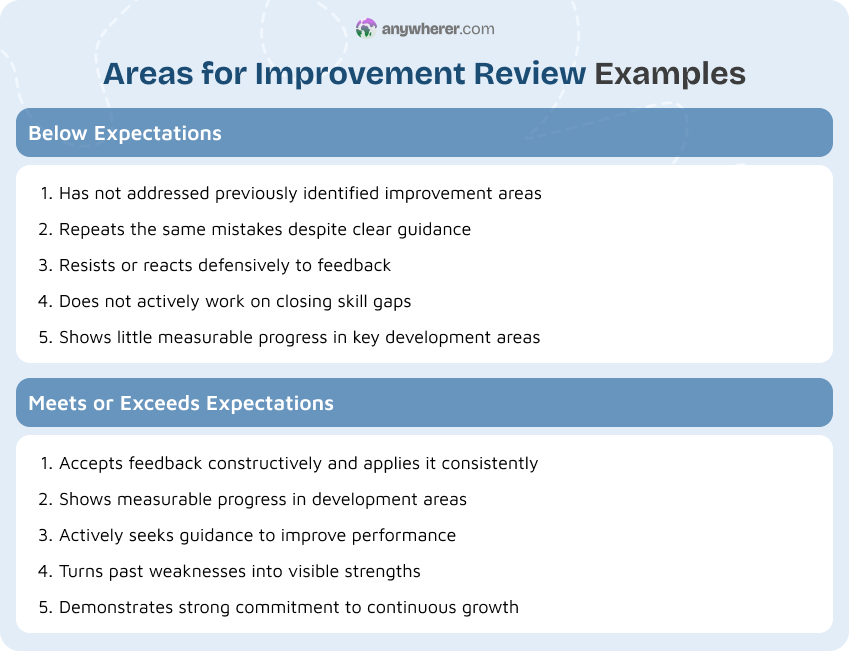
Areas for Improvement Review Comments
Constructive feedback helps employees grow by identifying specific behaviors or patterns that need attention. The goal is development, not criticism. Well-written performance evaluation comments in this area give employees a clear direction rather than a vague sense that something needs to change.
Below expectations:
- Has not acted on the improvement areas outlined in the previous review, and the same issues persist.
- Frequently repeats the same mistakes despite receiving clear guidance on how to correct them.
- Resists feedback and becomes defensive when improvement areas are discussed, which limits progress.
- Does not seek help or resources for known skill gaps, even when they affect the quality of work.
- Performance in key areas has declined since the last review period, and no improvement plan has been initiated.
Meets expectations:
- Shows awareness of personal development areas and has made some measurable progress on them during this cycle.
- Accepts constructive feedback professionally and makes visible efforts to apply it in subsequent work.
- Has improved in at least one area identified in the previous review, showing a willingness to grow.
- Asks for specific guidance when they are unsure how to improve, which helps accelerate development.
- Works consistently on identified areas for improvement without needing constant reminders.
- Actively seeks feedback from peers and managers to better understand where adjustments are needed.
- Remains open to coaching and applies suggestions to their daily workflow in a practical way.
- Has shown incremental but steady improvement in areas where feedback was given previously.
- Recognizes when a task requires skills they are still developing and asks for support appropriately.
- Takes responsibility for areas where performance could be stronger and builds those into personal goals.
Exceeds expectations:
- Actively seeks feedback even in areas where performance is already strong, with a genuine desire to keep improving.
- Turns past development areas into current strengths through sustained effort and disciplined follow-through.
- Uses constructive criticism as a catalyst for meaningful change, and the results are visible in their output.
- Sets self-directed development goals that go beyond what management has suggested, and follows through consistently.
- Serves as an example to others of how to approach improvement areas with maturity and professionalism.
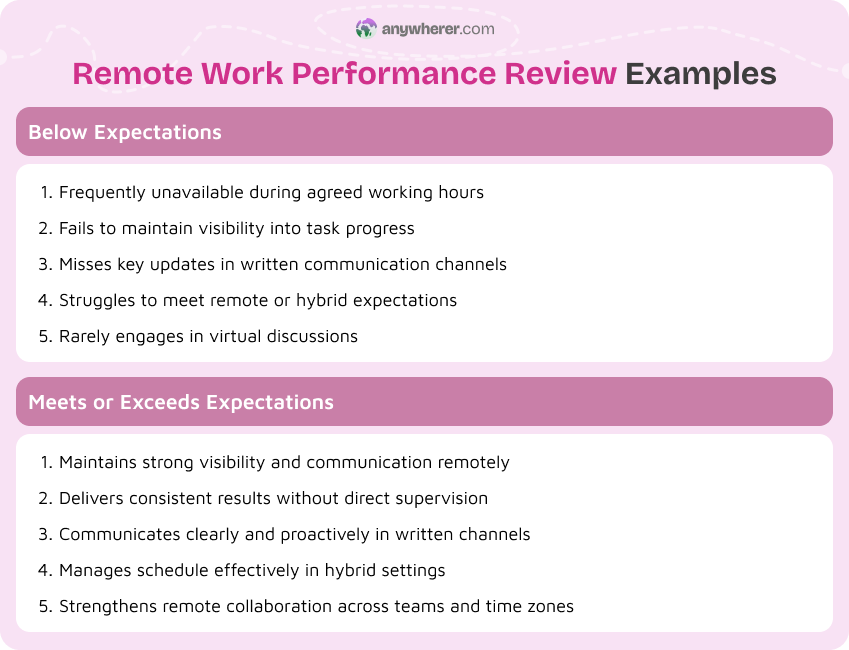
Remote / Hybrid Work Performance Review Examples
For employees working remotely or in hybrid settings, these comments evaluate how well they maintain visibility, communicate asynchronously, and deliver results without in-person supervision.
Below expectations:
- Often unreachable during agreed working hours, which creates delays for team members who depend on timely responses.
- Does not maintain adequate visibility into their work progress, making it difficult for the team to plan around their output.
- Struggles with asynchronous communication and frequently misses updates shared in written channels.
- Has not adapted well to remote or hybrid expectations, resulting in missed deadlines and unclear deliverables.
- Rarely participates in virtual meetings or contributes to discussions that take place outside of in-person settings.
Meets expectations:
- Stays responsive and available during core working hours and communicates reliably through the team’s primary channels.
- Keeps task status and project updates visible to the team, even without being prompted to do so.
- Communicates clearly in writing and provides enough context in messages to minimize back-and-forth.
- Participates actively in virtual meetings and contributes to team discussions the same way they would in person.
- Manages their own schedule effectively in a remote or hybrid setup, meeting all regular deadlines.
- Uses shared tools and documentation practices that make it easy for others to stay informed on their work.
- Maintains a professional and engaged presence regardless of whether they are working from the office or remotely.
- Adapts to time zone differences and finds ways to collaborate with teammates in other locations without causing delays.
Exceeds expectations:
- Sets the standard for remote work on the team by combining clear communication, consistent output, and proactive check-ins.
- Actively builds team connection in a distributed environment through regular informal touchpoints and thoughtful updates.
- Delivers results that are indistinguishable from or better than in-office output, regardless of location.
- Helps improve remote work practices for the whole team by suggesting tools, processes, or habits that increase clarity.
- Maintains strong working relationships across locations and time zones, making remote collaboration feel seamless.
- Demonstrates that physical presence is not required for high performance by consistently exceeding expectations from any location.
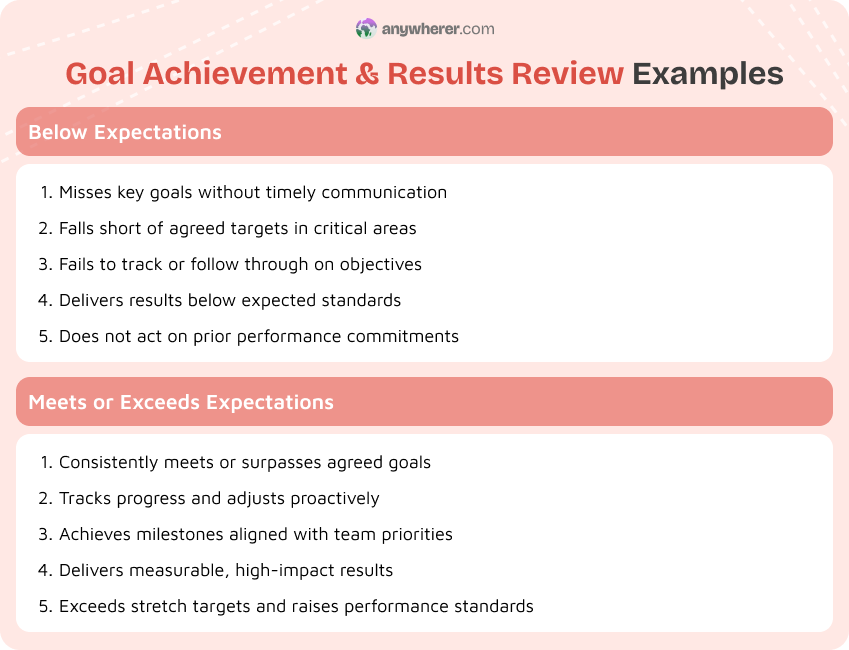
Goal Achievement & Results Review Comments
These comments evaluate how well an employee meets the specific targets, objectives, and milestones set during the review period. The focus is on measurable outcomes.
Below expectations:
- Did not achieve the majority of goals set for this review period and has not provided a clear explanation for the gaps.
- Fell short of agreed-upon targets in several key areas, and the shortfall was not communicated in time for course correction.
- Set goals at the beginning of the cycle but did not take consistent action to work toward them over time.
- Results for this period are significantly below expectations, even accounting for external factors that affected the team.
- Has not followed through on performance improvement steps agreed upon during the previous review cycle.
Meets expectations:
- Met the goals set for this review period and delivered results that align with what was expected.
- Achieved most targets on time, with minor adjustments needed only when external factors required a change in approach.
- Tracked progress against goals throughout the cycle and stayed on course with minimal redirection.
- Delivered consistent results that contributed meaningfully to the team’s overall objectives.
- Completed key milestones as planned and communicated any changes to scope or timeline proactively.
- Balanced goal achievement with day-to-day responsibilities without letting either area fall behind.
- Achieved results that reflect steady effort and good alignment with team and organizational priorities.
- Set realistic goals at the start of the cycle and followed through with consistent execution.
- Contributed directly to team-level outcomes through their individual results this period.
Exceeds expectations:
- Exceeded all major goals for the review period and delivered results that moved the team beyond its initial targets.
- Achieved stretch objectives in addition to core goals, demonstrating a commitment to going beyond the expected.
- Results this period are among the strongest on the team, with measurable impact across multiple areas.
- Set ambitious goals and met every one, showing the ability to plan realistically and execute at a high level.
- Delivered outcomes that contributed directly to organizational-level objectives, not just team targets.
- Consistently turns planned goals into tangible results and raises the standard for what is achievable in this role.
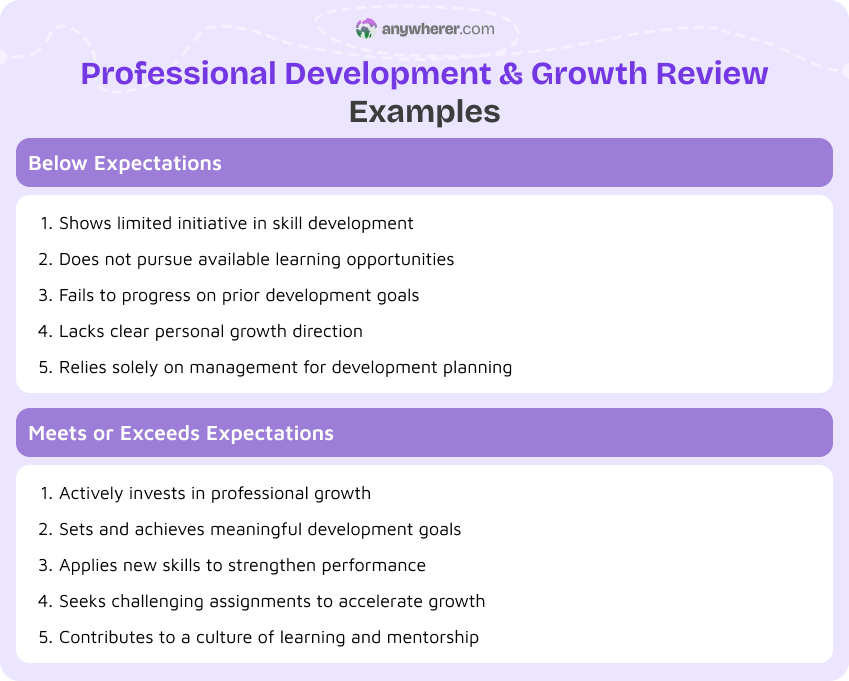
Professional Development & Growth Review Samples
These comments assess how actively an employee invests in their own growth, seeks new skills, and prepares for the next step in their career.
Below expectations:
- Has not taken advantage of available development opportunities such as training, mentoring, or stretch assignments.
- Shows limited interest in expanding skills beyond what is strictly required for current daily tasks.
- Has not progressed in any of the professional development areas discussed during the previous review.
- Does not set personal growth goals or take initiative to learn new skills that would benefit the role.
- Relies entirely on management to identify learning opportunities rather than seeking them independently.
Meets expectations:
- Takes advantage of available learning opportunities and applies new knowledge to their current role.
- Sets professional development goals and makes steady progress toward them throughout the review period.
- Seeks feedback on growth areas and uses it to guide decisions about what to learn or practice next.
- Attends relevant training sessions and incorporates key takeaways into day-to-day work.
- Shows genuine interest in growing within the role and takes steps to prepare for future responsibilities.
- Stays informed about industry trends and brings relevant insights back to the team.
- Balances skill development with current job responsibilities without letting either suffer.
- Asks thoughtful questions about career progression and takes ownership of their development plan.
- Shares useful resources and learning with colleagues, contributing to the team’s overall knowledge base.
Exceeds expectations:
- Actively pursues growth opportunities well beyond what is required and applies learning in ways that benefit the entire team.
- Has developed new skills during this review period that have already had a visible, positive impact on their work.
- Mentors others and helps create a learning culture by sharing expertise and encouraging continuous development.
- Regularly seeks challenging assignments that stretch their abilities and accelerate professional growth.
- Takes ownership of their career trajectory and comes to reviews with clear, well-thought-out goals for the next phase.
- Demonstrates consistent and deliberate investment in their own development, which sets them apart from peers at the same level.
Common Performance Review Mistakes (and How to Avoid Them)
Even with a strong set of performance review phrases and performance appraisal keywords at hand, the way you apply them matters. A few common patterns can weaken a review and make it less useful for the employee. Here is what to watch for.
Being Too Vague
Comments like “does a good job” or “needs to improve” do not give the employee anything to work with. Every piece of feedback should point to a specific behavior, outcome, or pattern. Instead of “great communicator,” say something like: “Keeps the team informed about project status through regular written updates and raises potential blockers before they cause delays.” Specificity makes the review credible and actionable.
Overusing “Meets Expectations” Without Explanation
When every section of a review says “meets expectations” with nothing else, the employee learns almost nothing. Meets expectations performance review examples should still include specific observations about what the person is doing well. Even when performance is genuinely on track, the review should explain what meeting expectations looks like in practice. A sentence or two of context transforms a generic label into meaningful employee review feedback.
Avoiding Constructive Feedback
Skipping improvement areas because the conversation feels uncomfortable does the employee a disservice. Constructive feedback is not criticism. It is a specific observation paired with a practical path forward. When delivered professionally, it builds trust rather than breaking it. Managers who invest in clear, ongoing feedback see stronger engagement and fewer surprises during formal reviews. Using best employee performance management software can help structure these conversations so nothing important gets lost between review cycles.
Mixing Personality with Performance
A performance review should evaluate what someone does, not who they are. Comments about attitude, temperament, or personality traits often feel personal and can create unnecessary tension. Focus on observable actions and measurable outcomes. Instead of “has a negative attitude,” try: “Reacts to shifting priorities in ways that slow down the team’s ability to adjust, particularly during urgent timeline changes.” This keeps the conversation professional and productive.
Final Words
Performance reviews work best when they are honest, specific, and grounded in what actually happened during the review period. The 200 performance evaluation examples in this article are meant to be a starting point, not a script. Think of each one as an employee performance review sample you can reshape to fit the person, the role, and the situation. The more specific you make each comment, the more useful it becomes.
If reviews still feel like a heavy lift, that is usually a sign that feedback is not happening often enough between cycles. Regular check-ins, clear goal-setting, and honest conversations throughout the year make formal reviews shorter and more productive. Managers who track progress consistently, whether through notes, 1:1s, or a structured tool, find that employee evaluation comments examples almost write themselves when there is a clear record to draw from.
Pairing structured reviews with regular employee satisfaction survey questions can give you a broader picture of how your team experiences their work. Surveys surface what one-on-one conversations sometimes miss, especially in remote or hybrid setups where visibility into day-to-day experience is naturally lower.
FAQs on Performance Review Examples
How detailed should employee performance review comments be?
Each comment should be specific enough that the employee knows exactly what behavior or outcome you are referring to. A good test: if the same comment could apply to anyone on the team without changes, it is too vague. Include references to actual tasks, projects, or timeframes when possible. Two or three well-written sentences per section are usually more effective than a long paragraph.
How often should employee performance reviews be conducted?
Most organizations run formal reviews annually or semi-annually, but the trend is moving toward more frequent touchpoints. Quarterly check-ins or monthly 1:1s allow managers to address issues in real time and make the formal review more of a summary than a surprise. The key is consistency. Whatever cadence you choose, stick to it.
How do I give constructive feedback without sounding negative?
Focus on the behavior, not the person. Describe what happened, why it matters, and what a better approach would look like. Avoid words like “always” or “never,” which feel absolute and often inaccurate. Frame the feedback as a path forward rather than a verdict on past performance. If the employee can walk away knowing exactly what to do differently, you have delivered it well.
What should I avoid writing in performance review comments?
Avoid vague generalities, personality-based judgments, and emotional language. Stay away from comparisons to other employees. Do not reference protected characteristics or personal circumstances unrelated to work. Keep every comment tied to observable behavior and job-related outcomes.
How do I document poor performance fairly and objectively?
Start with facts: what was expected, what was delivered, and the gap between the two. Include dates, examples, and any prior conversations or feedback that was given. Avoid editorializing or speculating about intent. The documentation should be neutral enough that a third party could read it and understand the situation without additional context.
Is it okay to include informal language in performance reviews?
A conversational tone is fine as long as the content stays professional and clear. Overly formal language can feel stiff and impersonal, but slang or humor can undermine the seriousness of the review. Write the way you would speak in a professional meeting: direct, respectful, and focused on the substance.

Yaryna is our lead writer with over 8 years of experience in crafting clear, compelling, and insightful content. Specializing in global employment and EOR solutions, she simplifies complex concepts to help businesses expand their remote teams with confidence. With a strong background working alongside diverse product and software teams, Yaryna brings a tech-savvy perspective to her writing, delivering both in-depth analysis and valuable insights.